Best Social Media Data APIs for AI Agents (2026)
A 2026 market map of public social media data APIs for AI agents — Western, Chinese, video, and messaging platforms — all reachable through one SandBase key.
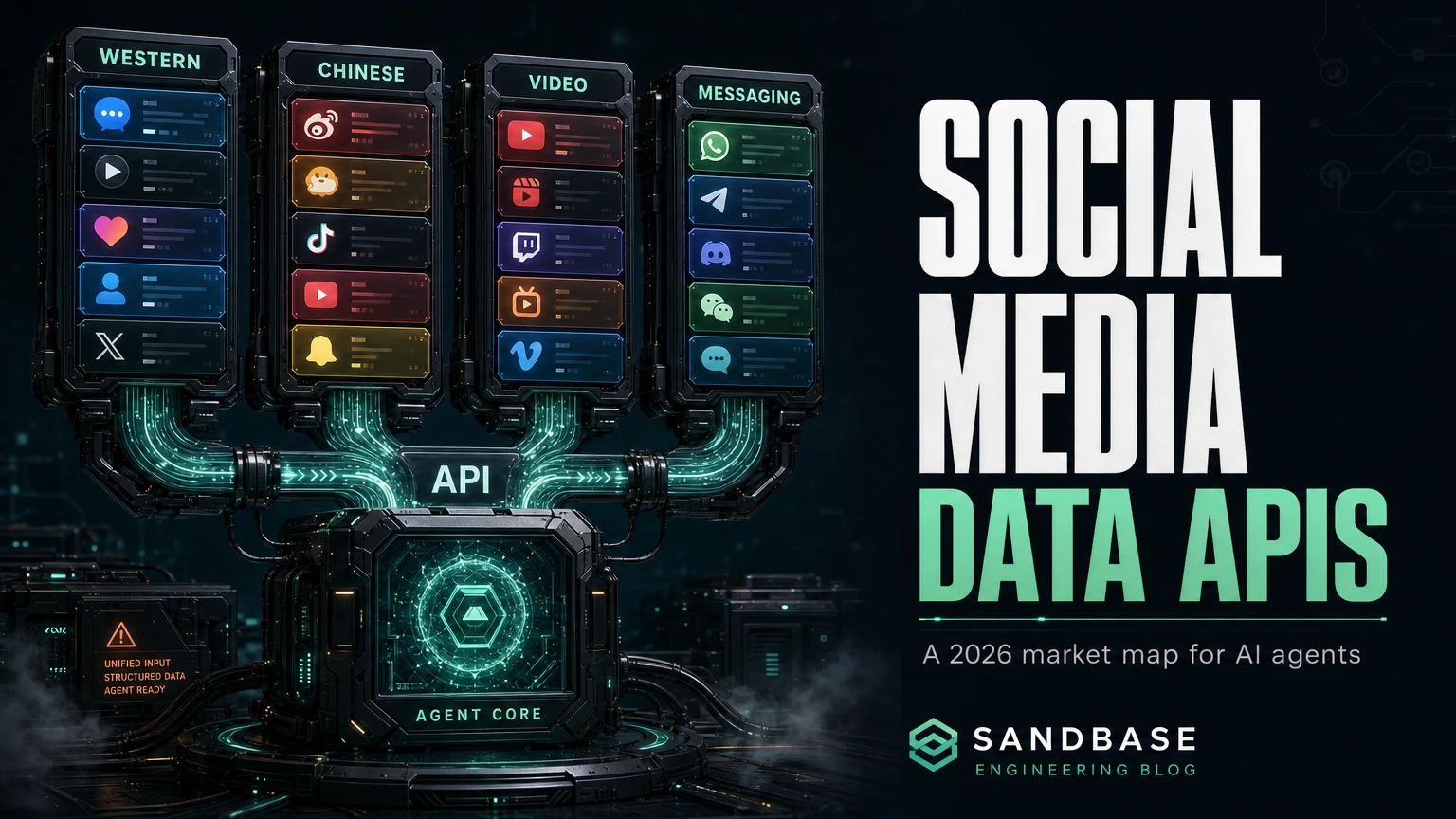
If you build agents that research audiences, track trends, or profile creators, you quickly run into the same wall: every social platform has its own API, its own auth, and its own quirks — assuming it exposes public data at all. This 2026 market map lays out the public social media data APIs that matter for AI agents, grouped so you can find the right one fast. Every platform below is reachable through one SandBase API key with the same request convention, so you integrate once and switch platforms with a path change.
These are public, read-only data APIs. They are not the platforms’ official account-management APIs; use official channels for authenticated member actions or licensed data. The endpoint references are the source of truth for parameters and response shapes — confirm against them before you build.
Key takeaway
- One SandBase key covers Western, Chinese, video, messaging, and visual platforms — integrate once, switch by path.
- Every call is
POST /v1/api/<vendor>/<path>with the same response envelope, so your reading code is shared.- Public, read-only data only — no posting, no private/account-only data, no platform login on your side.
- Pick by audience and region, not by hype: match the platform to where your users and creators actually are.
The market at a glance
| Category | Platforms (SandBase hubs) |
|---|---|
| Western social | Twitter/X, Instagram, Reddit, LinkedIn, Threads |
| Short video | TikTok, Douyin, Kuaishou |
| Long / mid video | YouTube, Bilibili, Xigua |
| Chinese social & content | Weibo, Xiaohongshu, Zhihu, Toutiao, Pipixia |
| Messaging & lifestyle | Telegram, Lemon8, WeChat Search, Pinterest |
Each hub covers that platform’s endpoints, real tested responses, and the read-only boundaries in depth. This page is the map; the hubs are the territory.
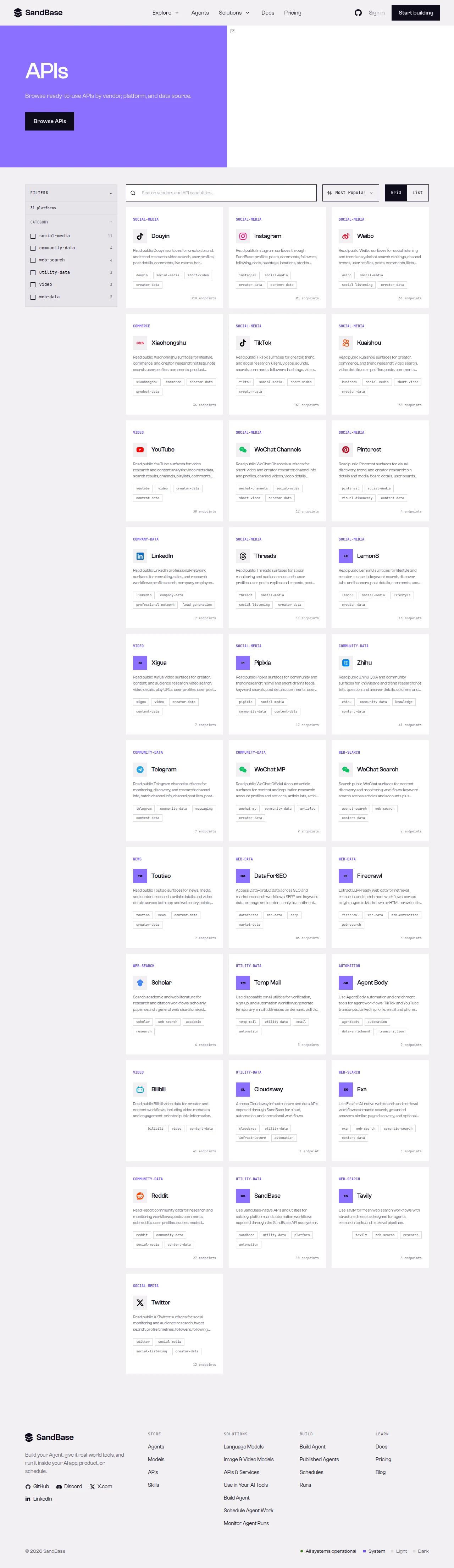 One key, one envelope — every platform reachable through the same convention.
Pick by where your audience is
The best “social data API” is the one for the platform your audience actually uses. A quick guide:
- US/EU consumer & B2C trends — Twitter/X, Instagram, Reddit, Pinterest.
- B2B and professional — LinkedIn.
- Short-video culture — TikTok globally; Douyin and Kuaishou for China.
- Chinese consumer research — Xiaohongshu (lifestyle/reviews), Weibo (broad social), Zhihu (Q&A/expertise), Toutiao (news feed).
- Creator/long-form video — YouTube globally; Bilibili and Xigua for China.
- Messaging & broadcast — Telegram channels.
Match the platform to the question first; the API convention is the same either way.
Why go through one API layer
Every platform below shares the same access pattern: POST https://api.sandbase.ai/v1/api/<vendor>/<path> with a Bearer key, returning id, status, model, and the payload on a completed run. That means one auth, one error path, and one JSON-reading helper across all of them.
import os
import requests

def call(vendor_path: str, payload: dict) -> dict:
    resp = requests.post(
        f"https://api.sandbase.ai/v1/api/{vendor_path}",
        headers={
            "Authorization": f"Bearer {os.environ['SANDBASE_API_KEY']}",
            "Content-Type": "application/json",
        },
        json=payload,
        timeout=90,
    )
    resp.raise_for_status()
    body = resp.json()
    if body.get("status") != "completed":
        raise RuntimeError(body.get("error", {}).get("message", "did not complete"))
    # Envelope can vary: prefer a top-level `output`, else `outputs[0].data`.
    output = body.get("output")
    if output is None and body.get("outputs"):
        output = body["outputs"][0].get("data", {})
    return output if output is not None else body.get("outputs", [{}])[0].get("data", {})
Business-payload fields differ per platform and are observed-only — always read defensively and confirm each against its endpoint reference. But the outer shape is shared, so an agent that searches TikTok can search Weibo with a path change.
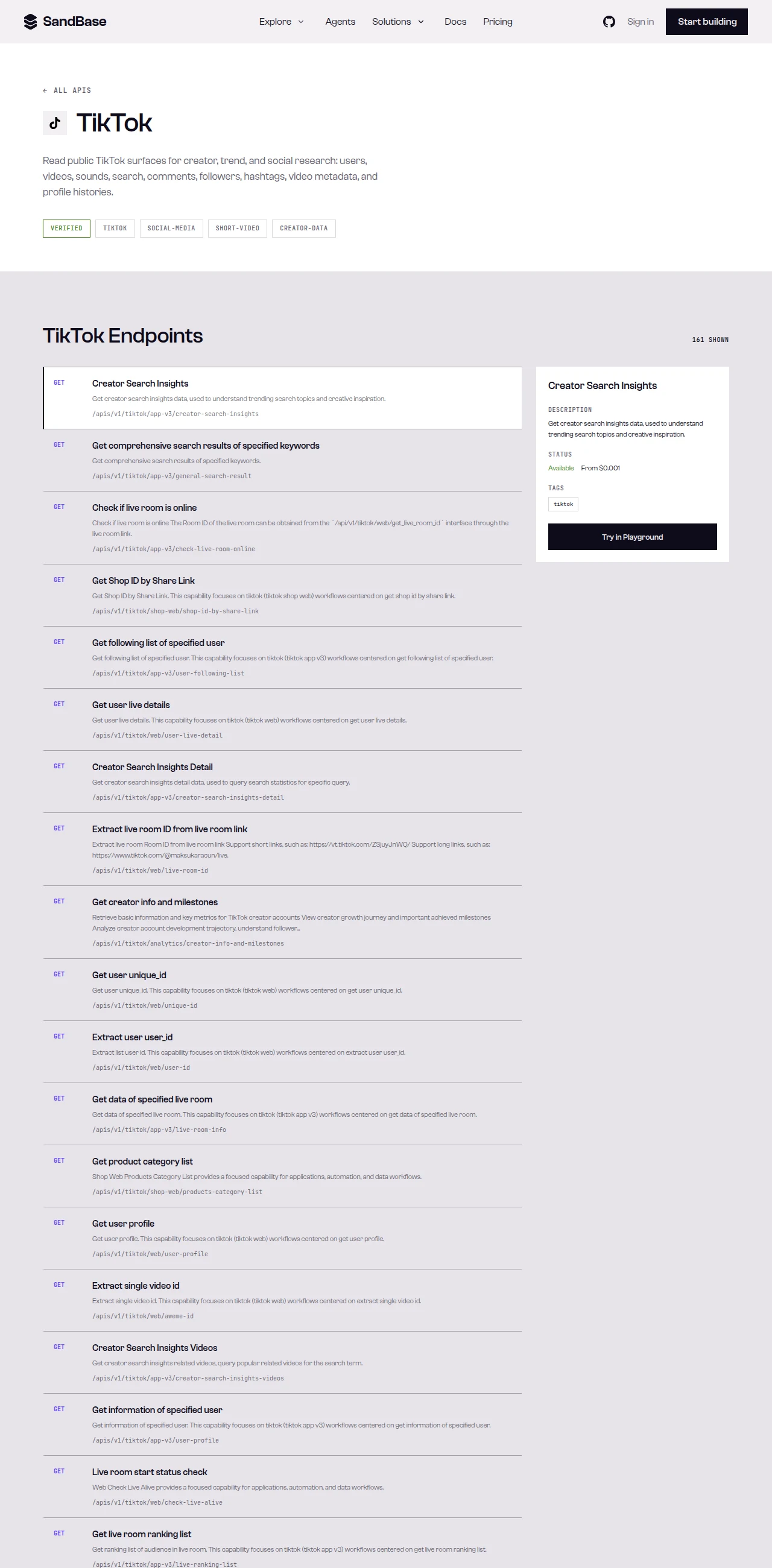 A single platform hub (TikTok) — each hub covers that platform’s endpoints in depth.
Common agent workflows
- Trend monitoring — poll a platform’s hot list or search on a schedule and diff results by a stable id. See platform monitoring tutorials like Weibo hot search monitoring and Pipixia hot board monitoring.
- Creator research — search a topic, open a profile, read recent posts. See Bilibili creator research and Threads creator research.
- Content discovery — search a keyword, open a post, profile the author. See Lemon8 content discovery.
- Cross-platform dashboards — merge signals from several platforms behind the shared helper.
Because the envelope is shared, these workflows are largely platform-agnostic — you swap the vendor path and adjust the field mapping.
 A Chinese-platform hub (Weibo) uses the same request convention as the rest.
Boundaries that apply everywhere
- Public, read-only. No posting, following, DMs, or private/account-only data on any platform here.
- Not official partnerships. SandBase does not own or operate these platforms; it provides uniform access to public data. Respect each platform’s terms.
- Business fields are observed-only. The references guarantee the envelope; treat platform-specific payload fields as observed and confirm live.
- Rate and volume. Treat responses as best-effort reads; retry with backoff on transient errors such as HTTP 429 and pace polling.
FAQ
Do I need a separate key per platform?
No. One SANDBASE_API_KEY covers every platform on this map. You switch platforms by changing the vendor path, not the auth.
Can I post or manage accounts with these? No. These are public, read-only data APIs. Use each platform’s official API for authenticated member actions.
Which platform should I start with? Start with where your audience is (see the guide above). For a global consumer view, Twitter/X, Instagram, and TikTok are common starting points; for Chinese markets, Xiaohongshu, Weibo, and Douyin.
Is the data real-time? These are synchronous reads. For “monitoring,” poll on a cadence and diff results by a stable id — see the linked monitoring tutorials.
Bottom line
There is no single best social media data API — there is the right one for your audience. This map groups the public platforms SandBase covers so you can pick fast, and because they all share one key and one envelope, trying several is cheap. Start with the platform that matches your question, read its hub for the endpoint detail, and wire the shared helper once.