Best Web Search API for AI Agents: Tested Monthly (Nov 2026)
Best web search API for AI agents, tested: Exa, Tavily, Firecrawl, Brave and Scholar on 30 verified questions. Accuracy, latency and cost per answer.

Kubernetes v1.37.2 shipped on October 28, 2026. Four days later we asked six search APIs when it was released. Only one put the date in front of the agent. Another went to the official Kubernetes site and came back with an older copy of the patch schedule, which still showed a planned date of October 13. An agent reading that result would have given a confident, wrong answer.
That is the problem this page measures. For an AI agent, a web search API is useful only if the text it returns actually contains the answer, and contains it quickly and cheaply. So instead of comparing feature lists, we send the same 30 questions to every API once a month and check whether the verified answer appears in the top five results. This is the November 2026 run: 30 questions, 3 runs each, 90 calls per API, all made through SandBase on 2026-11-01 (UTC).
Key takeaway
- Exa Search was the only API that returned the answer in all 90 calls (100%). Tavily, Firecrawl, Brave LLM Context and Scholar Web Search each reached 93.3%. Brave Web Search reached 53.3%.
- The gap was almost entirely in fresh facts from the last 30 days: Exa 6 of 6 questions, Firecrawl, Brave LLM Context and Scholar 5 of 6, Tavily 4 of 6, Brave Web 1 of 6.
- Scholar Web Search was the cheapest per correct answer at $3.86 per 1,000 answers, and returned the least text (317 tokens median). Exa cost $10.00 and Tavily and Firecrawl $10.71 at SandBase list prices on 2026-11-05.
- Brave LLM Context found answers 93.3% of the time, but only 44.4% of its calls included an official source in the top five. It often answers from secondary sites.
- Cloudsway and Google results via DataForSEO were also tested but are not ranked this month. Their calls hit SandBase integration problems (HTTP 503 and redirect-wrapped URLs) that would make the numbers about our gateway, not about them.
The ranking, by scenario
The 30 questions fall into five scenarios of six questions each. Every question has one verifiable answer, a primary source URL, and a list of authoritative domains. Before the run, a script fetched every source page and confirmed the answer was still there (30 of 30).
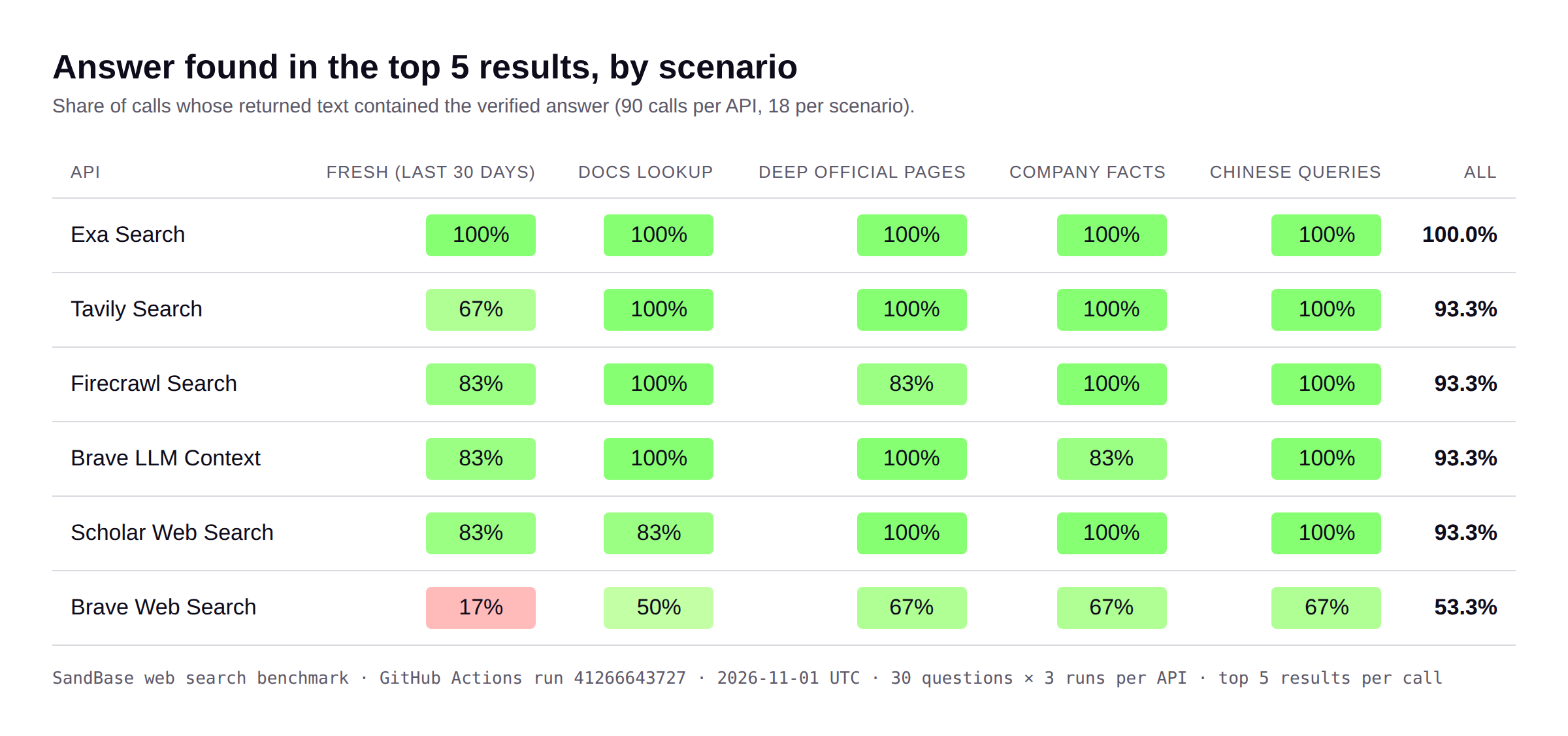
Caption: Share of calls whose top-five results contained the verified answer, by scenario. 18 calls per cell. GitHub Actions run 41266643727, 2026-11-01 UTC.
Four of the five scenarios separated the field very little. Docs lookups, deep official pages, company facts and Chinese queries were answered at or near 100% by every API except Brave Web Search. Freshness is where they split. All results were close to deterministic: in 30 questions, each API either answered a question in all three runs or in none of them.
| API | Answer in top 5 | Official source in top 5 | P50 latency | Median text returned | Price per call | Cost per 1,000 answers |
|---|---|---|---|---|---|---|
| Exa Search | 100.0% | 96.7% | 0.48 s | 1,647 tokens | $0.01 | $10.00 |
| Tavily Search | 93.3% | 73.3% | 0.55 s | 1,635 tokens | $0.01 | $10.71 |
| Firecrawl Search | 93.3% | 96.7% | 0.54 s | 497 tokens | $0.01 | $10.71 |
| Brave LLM Context | 93.3% | 44.4% | 0.92 s | 2,716 tokens | $0.005 | $5.36 |
| Scholar Web Search | 93.3% | 93.3% | 0.55 s | 317 tokens | $0.0036 | $3.86 |
| Brave Web Search | 53.3% | 20.0% | 0.55 s | 1,136 tokens | $0.005 | $9.38 |
“Cost per 1,000 answers” divides the per-call list price by the answer rate. It ignores the 100 free calls per organization per day that SandBase offers on most of these endpoints, and it ignores what your model spends reading the returned text. For a high-volume agent that second number can be larger than the search bill, which is why we report the text size.
Which one to choose
Choose Exa Search when freshness matters. It answered every question about releases from the previous 30 days, including the Kubernetes patch from four days earlier, where it returned the project’s GitHub releases page. It also had the highest share of official sources (96.7%, tied with Firecrawl). It costs twice as much per call as the Brave endpoints.
Choose Scholar Web Search or Firecrawl Search when context budget matters. Scholar returned a median of 317 tokens and Firecrawl 497, against roughly 1,640 for Exa and Tavily and 2,716 for Brave LLM Context. Both still answered 28 of 30 questions. Scholar is the cheapest per correct answer, but it missed the Python 3.14 end-of-life question and the Kubernetes patch, and had the slowest tail at 3.56 s P95.
Choose Brave LLM Context when you want grounding text without a second fetch, and check the sources. It returns ready-to-use passages and answered 93.3%, but more than half of its top-five lists had no official domain. For example, it answered “In which city is DeepSeek headquartered?” from CB Insights, a news site and Wikipedia mirrors, with neither DeepSeek nor Wikipedia itself in the list. That is fine for a chat answer and risky for anything you cite.
Tavily Search is a solid default for everything except very recent events. It was at 100% on docs, deep pages, company facts and Chinese queries, and 4 of 6 on fresh facts.
Don’t give Brave Web Search to an agent as its only tool. It uses the same Brave index as Brave LLM Context, yet answered 53.3% against 93.3%. The difference is the payload: Brave Web returns short display snippets, so the answer is usually on the linked page but not in the response. Pair it with a page fetch, or use the LLM Context endpoint instead.
Where the misses came from
The interesting failures were not random. Each one points at a different way a search result can mislead an agent.
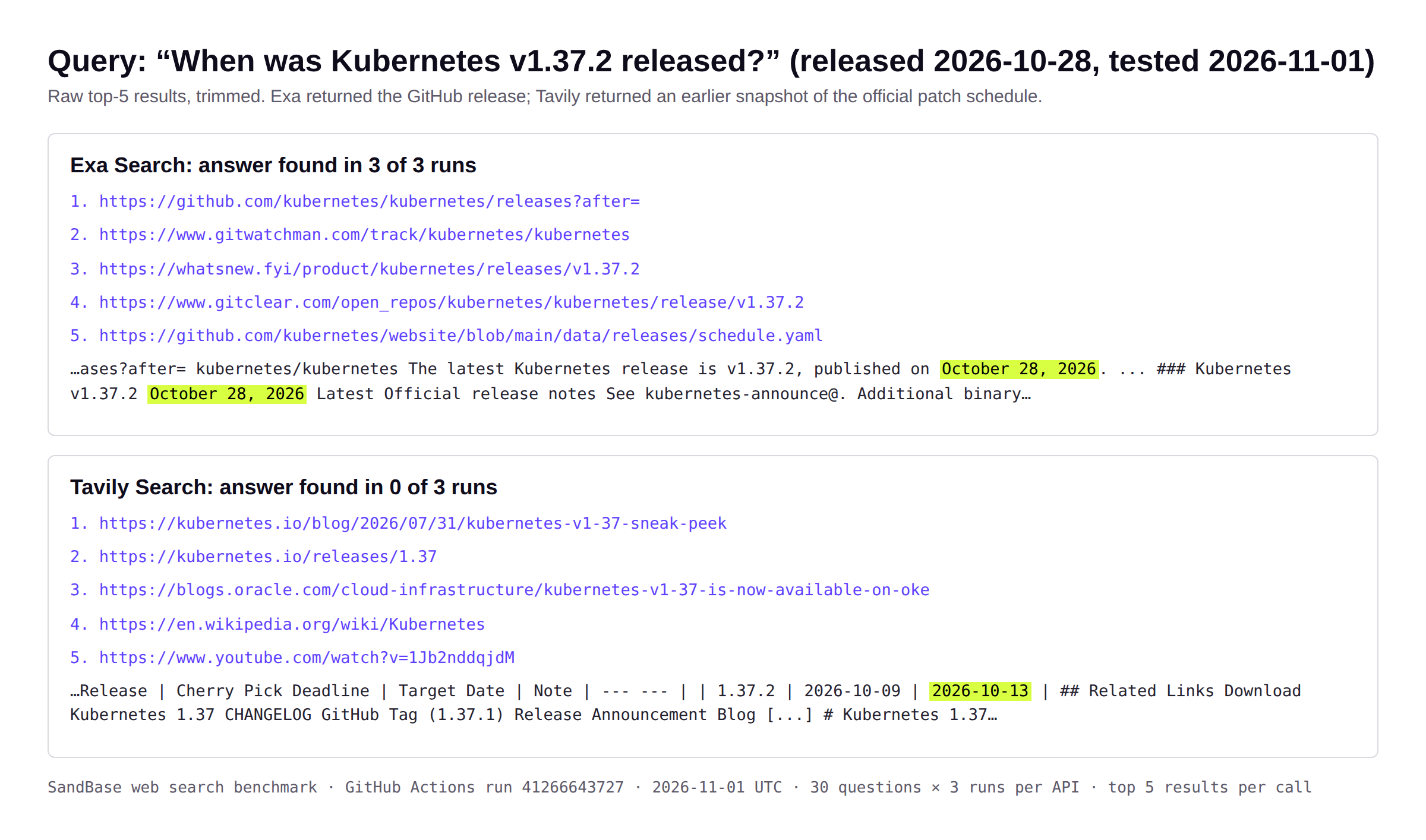
Caption: Trimmed raw results for “When was Kubernetes v1.37.2 released?” Exa returned the GitHub release dated October 28, 2026. Tavily returned kubernetes.io pages, including a patch schedule that still listed a target date of 2026-10-13.
A stale official page beats a fresh unofficial one. For the Kubernetes question, Tavily’s results were all on reputable domains, including kubernetes.io/releases/1.37. But the copy it returned was from before the release, with the patch still listed as upcoming. Only Exa reached a page that had the real date. We think this is the most important result for agent builders: a correct domain does not mean a current answer.
The same version number, different software. Asked for the Python 3.14.10 release date, Tavily returned Apache Camel 3.14.10 release pages and a game update on X that shares the version number. Its other result, the Python release schedule in PEP 745, listed 3.14.10 as expected in February 2027, an older plan that the actual release (October 25, 2026) superseded. The question is short and ambiguous, which is how agents often phrase queries.
The page was right, the snippet was not enough. Firecrawl found go.dev/doc/go1.27 for “Go 1.27.0 release date”, but the returned text said the release “arrives in August” without a day. The exact date is on a different go.dev page. This is a failure to return the right part of a page, not the wrong page.
Our own strictness. Brave LLM Context answered “When was Perplexity AI founded?” with “founded in 2022”. Our answer is the full date, 2022-08-22, so that counted as a miss. The question does not say which precision it wants, so we will make it explicit in the December run rather than change the scoring after the fact.
How we test
- Calls: 30 questions × 3 runs × 8 endpoints = 720 calls, 4 in parallel, from a GitHub Actions runner through
https://api.sandbase.ai/v1/api/<vendor>/<operation>. The query sent is the question text. Every API gets five results with its content or highlights option on where one exists: ExanumResults: 5with highlights, Tavilymax_results: 5(basic depth), Firecrawllimit: 5, Bravecount: 5(Web with extra snippets), Scholarmax_num_results: 5. - Scoring: “answer in top 5” is a plain text match of the verified answer, in common date formats, against all returned text. No LLM judges anything. We read 18 randomly chosen matches by hand and all 18 were the right fact for the right entity. “Official source” means at least one result URL is on the question’s authoritative domains, for example
kubernetes.ioorstats.gov.cn. - Questions: six each on fresh facts from the last 30 days (Firefox 159, Node.js 26 LTS, Python 3.14.10, Kubernetes v1.37.2, Go 1.27.3, DeepSeek-V4.1-Flash-1017), documentation lookups (support dates and API limits), deep official pages (release names, counts, dates), company facts, and Chinese-language queries about China’s official statistics and Chinese API docs. The fresh set changes every month and the other 24 stay fixed, so month-to-month changes are comparable.
- Prices: the per-call price shown on each SandBase API page on 2026-11-05.
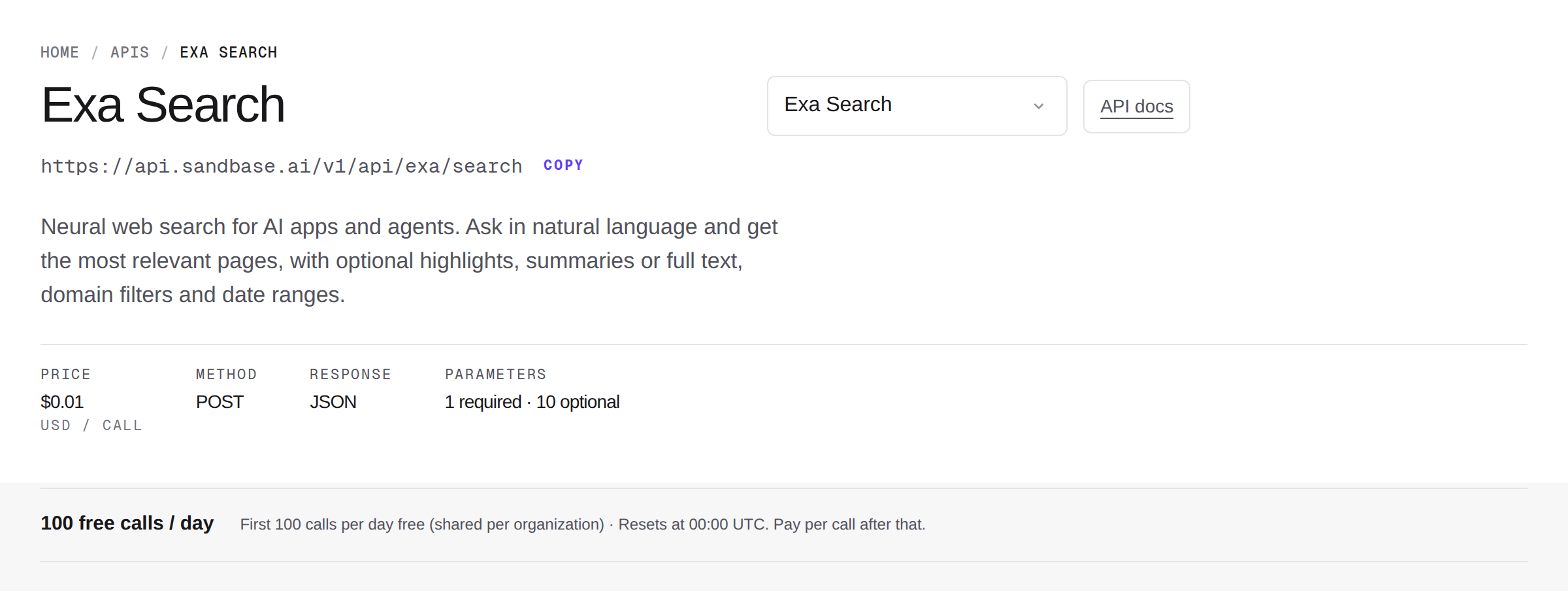
Caption: The SandBase Exa Search page on 2026-11-05: $0.01 per call, with the first 100 calls per day free per organization. Tavily, Brave and Scholar pages show the same daily allowance; the Firecrawl Search page lists $0.01 per call without it.
Speed and cost
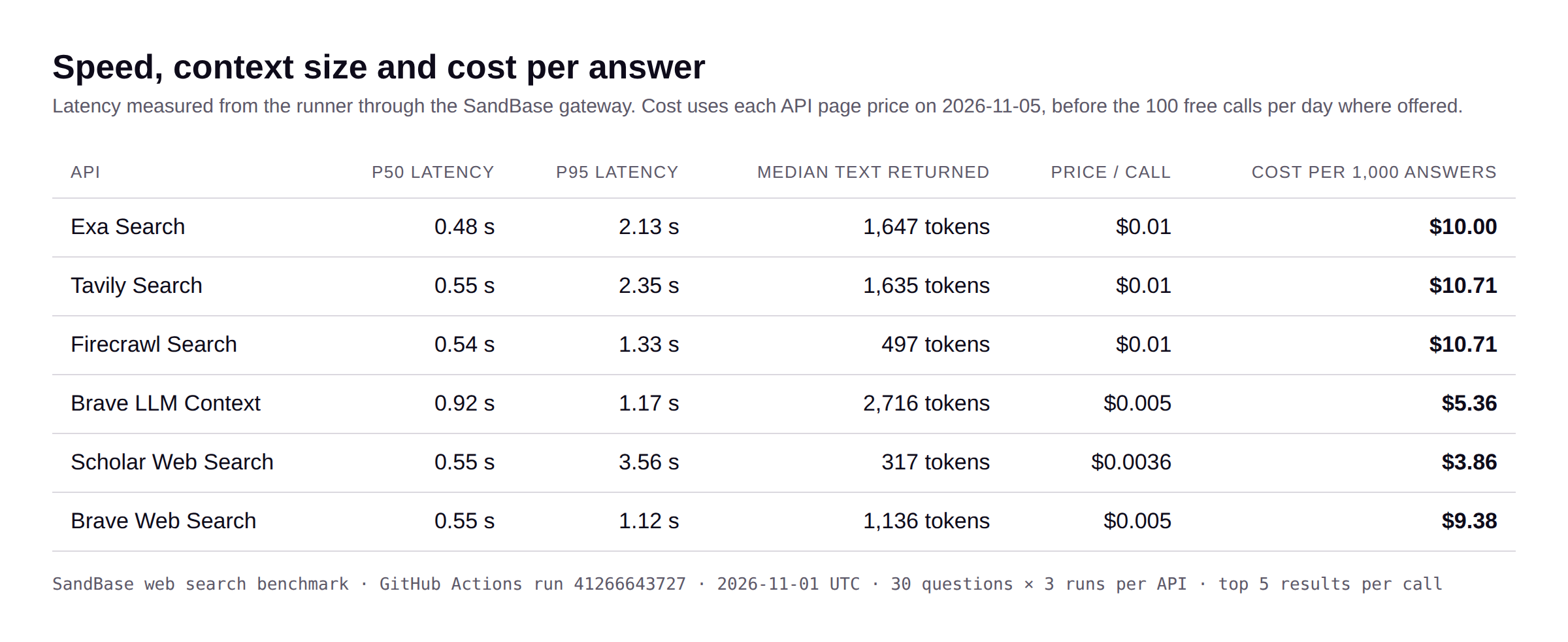
Caption: Latency from the runner through the SandBase gateway, median returned text estimated as bytes divided by four, and list-price cost per 1,000 correct answers.
Median latency was close: 0.48 to 0.55 seconds for five of the six APIs, and 0.92 seconds for Brave LLM Context, which assembles longer passages. The tails differed more. Scholar’s P95 was 3.56 seconds and Exa’s and Tavily’s above 2 seconds, while Brave’s two endpoints and Firecrawl stayed under 1.4 seconds. If your agent runs searches in sequence, the P95 is the number you will feel.
Calling one from an agent
All six APIs use the same request shape on SandBase, so switching is a one-line change of the model path and its parameters. A minimal call that fails loudly when the payload is missing:
import os, requests

def search(query: str) -> dict:
    r = requests.post(
        "https://api.sandbase.ai/v1/api/exa/search",
        headers={"Authorization": f"Bearer {os.environ['SANDBASE_API_KEY']}"},
        json={"query": query, "numResults": 5, "contents": {"highlights": True}},
        timeout=60,
    )
    r.raise_for_status()
    outputs = r.json().get("outputs") or []
    if not outputs or "data" not in outputs[0]:
        raise RuntimeError(f"no outputs[0].data in response: {r.text[:200]}")
    return outputs[0]["data"]  # Exa's search payload: titles, URLs and highlights
You can try it in the Exa Search API playground on SandBase. For how these tools behave inside a full agent loop with a model reading and citing pages, see our research agent search API benchmark. For a feature-by-feature comparison, read Exa vs Tavily vs Firecrawl vs SerpAPI.
What changes next month
The December run will rotate the six fresh questions, rerun Cloudsway and Google results via DataForSEO once their SandBase integration issues are confirmed fixed, and state the expected precision on date questions. If an API’s result changes, we will say what changed and why, in a “Since last month” section at the top of this page.
FAQ
What is the best web search API for AI agents in 2026?
In our November 2026 test, Exa Search was the only API that returned the answer to all 30 questions, and the only one that answered all six questions about events from the previous 30 days. Tavily, Firecrawl, Brave LLM Context and Scholar Web Search each answered 28 of 30.
Which search API is cheapest for agents?
Scholar Web Search at $0.0036 per call, which works out to $3.86 per 1,000 correct answers in this test. It also returned the smallest payload, a median of 317 tokens, which lowers what your model spends reading results.
Is Exa better than Tavily?
On this test set, yes for fresh facts (6 of 6 against 4 of 6) and for official sources in the top five (96.7% against 73.3%). On documentation, deep official pages, company facts and Chinese queries they tied at 100%. They cost the same per call on SandBase.
Why is Brave Web Search so much lower than Brave LLM Context?
They query the same Brave index. Brave Web returns short display snippets, so the answer is often on the linked page but not in the response. Brave LLM Context returns longer passages meant for a model to read.
How often is this ranking updated?
Monthly, at the start of each month, with the same 24 fixed questions and six new fresh-fact questions. Each update keeps the previous month’s numbers for comparison.
Limitations
This is a retrieval test, not an answer-quality test. It checks whether the answer is present in the returned text, not whether results are well ranked or whether a model would use them correctly. The questions are single-answer facts; open-ended research questions behave differently and are covered in our agent-loop benchmark. All calls went through the SandBase gateway from one runner on one day, so latency includes our gateway and the network path, and results for Cloudsway and DataForSEO are withheld for the reasons above. Text matching can miss a correct answer written in an unusual format, as with the Perplexity founding year. With 30 questions, a difference of one question is 3.3 points, so the four APIs at 93.3% should be read as tied.