Pinterest Public Data API | SandBase
Read public Pinterest search results, boards, and pins with one REST API. No Pinterest login, no SDK — one SandBase key, built for agent workflows.
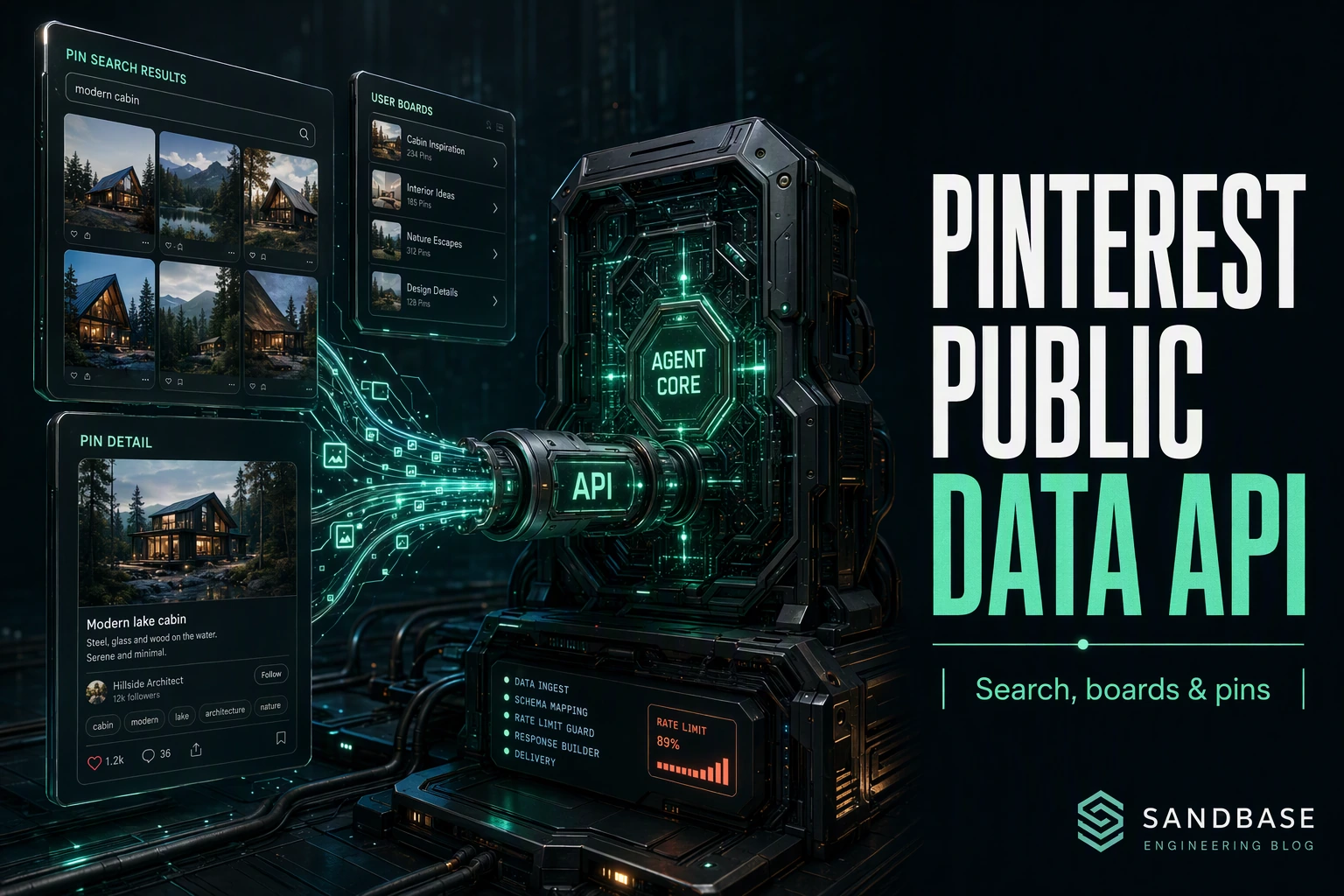
Pinterest is a visual discovery engine — a place where people plan home renovations, wardrobes, recipes, and trips. That makes it a rich signal for trend research, e-commerce inspiration, and creative planning. Getting at it programmatically usually means fighting a headless browser and rebuilding a scraper every time the site shifts.
The SandBase Pinterest public data API trades that setup tax for plain REST. It reads Pinterest’s public search results, user boards, and board pins through simple endpoints — one SandBase API key, no Pinterest login and no SDK. The endpoint reference defines the current parameters and response contract. The original 2026-09-27 UTC observations remain dated historical evidence; the current search and board guidance comes from the separate reference check described below.
This is not Pinterest’s official API. Use Pinterest’s official developer platform when you need authenticated member actions or a licensed data agreement. Use SandBase when your workflow needs public, read-only data for research and monitoring. Ready to try it? Get a SandBase API key and browse the Pinterest endpoints.
Key takeaway
- One API reads Pinterest’s public search results, user boards, and board pins.
- Each endpoint is
POST /v1/api/pinterest/<path>— pass only that endpoint’s params, no SDK, oneSANDBASE_API_KEY.- Endpoints key off natural inputs: a
queryfor search, ahandlefor a user’s boards, and aurlfor a board or pin.- Read-only public data only. There is no posting, no platform login on your side, and no private data; authenticate with a SandBase API key.
Current contract and historical evidence
The 2026-11-08 refresh checked the current pinterest/search and pinterest/board schemas and public samples without executing a paid business request. Use the documented outputs[0].data envelope, require status: "completed", and validate the payload’s pins array. Do not fall back to a top-level output or treat missing data as an empty result. Other endpoints in the capability map were not revalidated in this refresh.
The earlier 2026-09-27 UTC observations below remain historical. In particular, the old top-level output capture is not the current integration contract. For a checked, single-request Python implementation and existing-key/agent setup paths, use the Pinterest visual research tutorial.
Which Pinterest API do you need?
| Your need | Choose | Why |
|---|---|---|
| Post, save pins, or act as a member | Pinterest’s official platform | Member and account operations run through Pinterest directly. |
| Read public search, boards, or pins | SandBase Pinterest public-data API | Plain REST, one SandBase key, structured JSON for read-only workflows. |
| Private or account-only data | Neither public workflow | That data is out of scope for this public-data guide. |
What you can get from the Pinterest API
Grouped by job:
- Search — keyword search returning public pins.
- User boards — the public boards for a given
handle. - Board — the pins on a board, addressed by its
url. - Pin — a single pin’s data, addressed by its
url.
Check each endpoint’s live API reference for the exact parameters before you build; availability differs by endpoint.
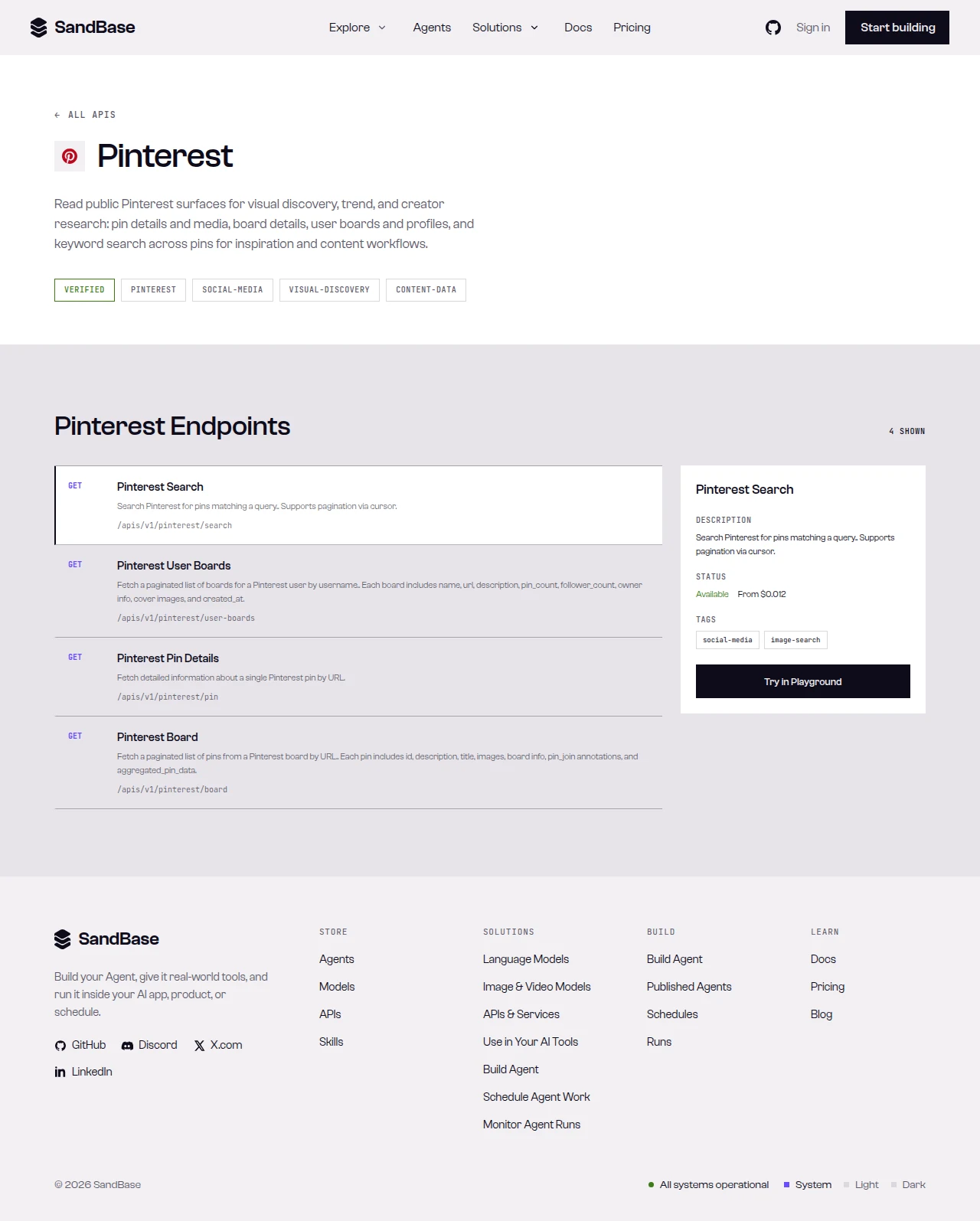 Historical catalog screenshot, 2026-09-27: endpoint paths and the then-listed search price “From $0.012.” This is not the current $0.018 inspected price.
What Pinterest provides vs. what SandBase adds
Public data comes from Pinterest. SandBase does not own or operate Pinterest; it provides a uniform API layer for eligible public-data workflows. Each capability becomes one stable endpoint, auth collapses to a single key, and responses come back as predictable JSON — so an agent can walk from a keyword to a set of pins, or from a handle to its boards, along one convention instead of maintaining a scraper.
Quick start: one search request
Use the Model API POST path, not the catalog GET path. Configure SANDBASE_API_KEY locally, then choose one keyword. This sends one initial request with cursor omitted and trim: true selected explicitly; the schema declares neither optional field’s default.
curl --fail-with-body --connect-timeout 10 --max-time 90 \
  -X POST https://api.sandbase.ai/v1/api/pinterest/search \
  -H "Authorization: Bearer $SANDBASE_API_KEY" \
  -H "Content-Type: application/json" \
  -d '{"query": "home office setup", "trim": true}'
The command prints the response; it does not validate application-level completion. Before using it, check status: "completed" and the object at outputs[0].data with a pins array, or use the checked Python helper in the linked tutorial. The current public search sample omits success; do not require that flag to appear. If it is present, require the boolean true: reject an explicit false or malformed value even when pins is an empty list. A missing list is an error, not proof that a query matched nothing.
Current free inspection lists $0.018 per call for search and board, with no free_quota entry for either. Do not infer eligibility from other APIs. Neither endpoint was executed for this update. Upstream credit counters in a reference payload are not your SandBase balance or this call’s dollar charge.
Historical search capture, 2026-09-27
Run bb49ff54-271a-403b-82c7-ca510922c580 was originally preserved as the following trimmed illustration. The ellipses, placeholder URL and title: {} are retained exactly for provenance; they are not a reusable cursor, a current title type or a freshly verified response. The original Python examples are archived rather than recommended.
{
"id": "bb49ff54-271a-403b-82c7-ca510922c580",
"model": "pinterest/search",
"status": "completed",
"output": {
"success": true,
"pins": [ { "id": "…", "title": {}, "url": "https://www.pinterest.com/pin/…" } ],
"cursor": "…"
}
}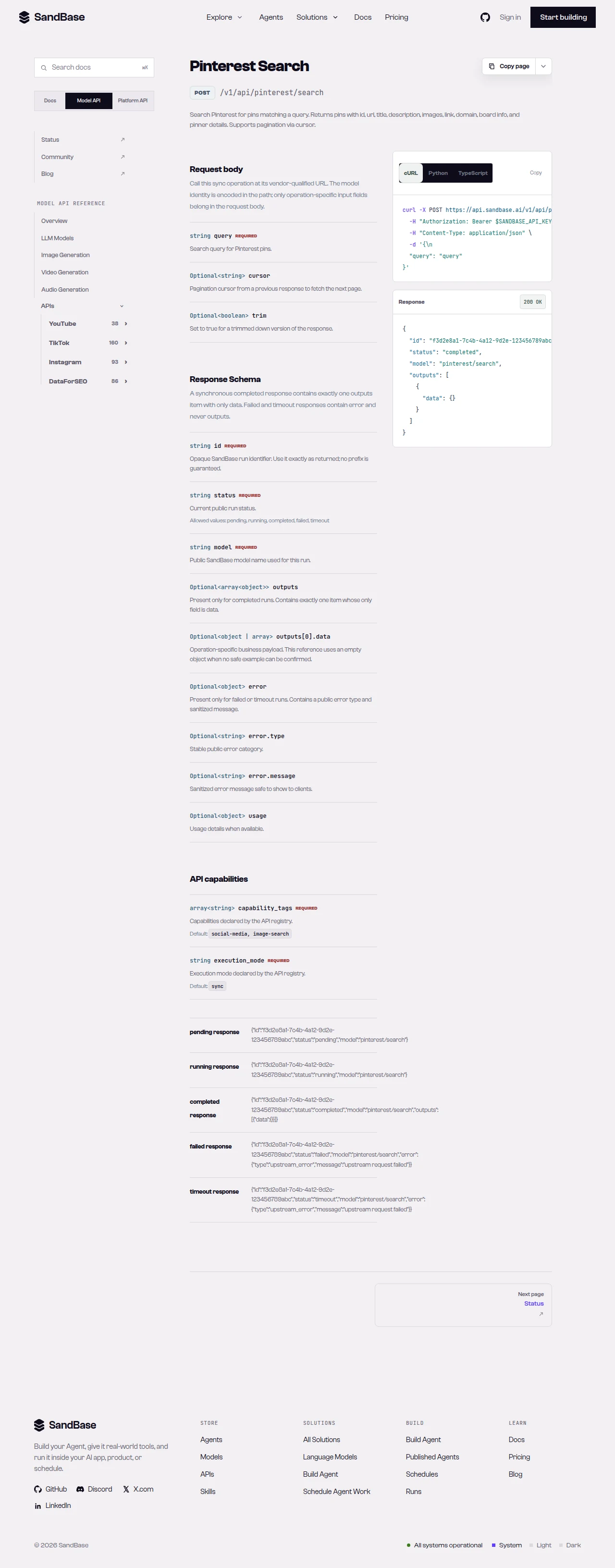 Historical search reference screenshot, 2026-09-27. Current search and board contracts were inspected separately on 2026-11-08.
Capability map
| Capability | Endpoint | Input | Typical use |
|---|---|---|---|
| Search | pinterest/search | query | Keyword pin discovery |
| User boards | pinterest/user-boards | handle | A user’s public boards |
| Board | pinterest/board | url | Pins on a board |
| Pin | pinterest/pin | url | A single pin’s data |
For search and board, current schemas declare an optional string cursor. This refresh did not test pagination; use a complete response and a separate request limit before implementing continuation. Reference placeholders and truncated tokens cannot be used.
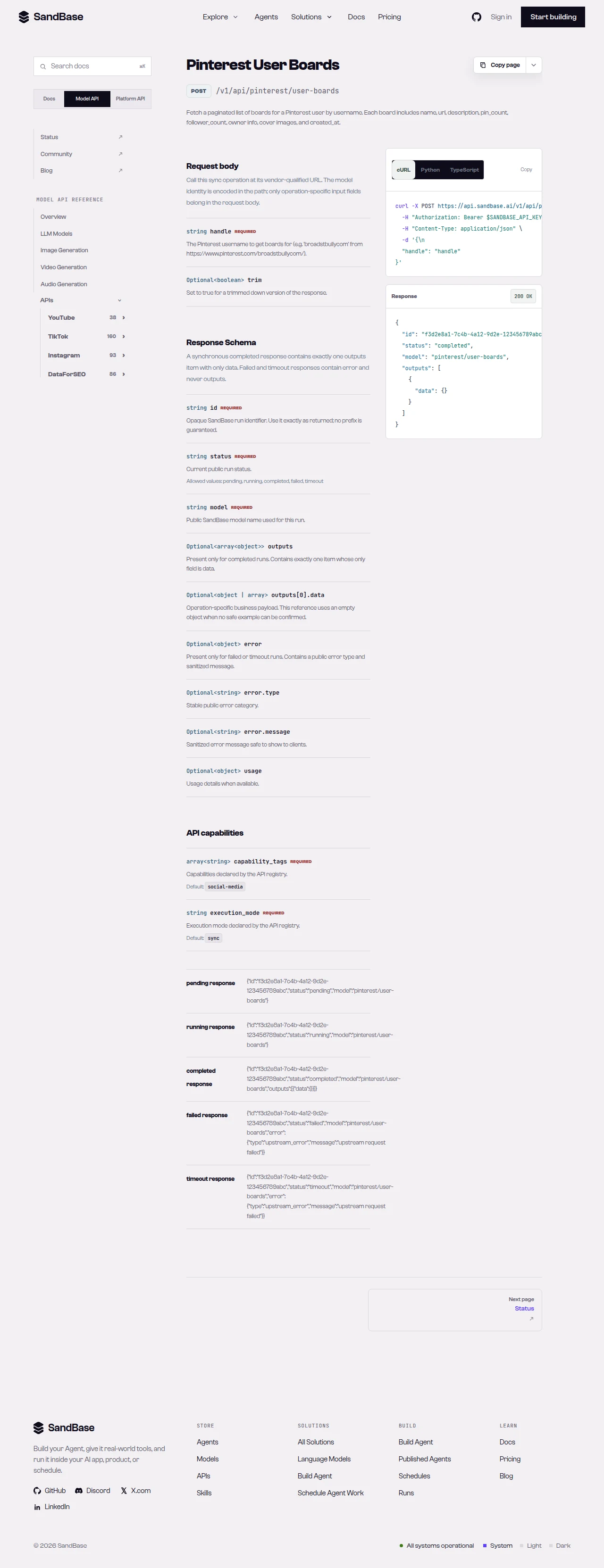 Historical User Boards reference, 2026-09-27: handle and trim inputs. This endpoint is shown for the original capability map; its current behavior was not revalidated in this refresh.
Choose the task before chaining calls
A keyword and an already selected board are independent inputs. Use search for the former and board for the latter; the tutorial now makes exactly one selected request. Listing a user’s boards and then opening every result can expand the workload unexpectedly. Inspect those additional endpoints and agree on a budget before building a chain. Shared authentication does not guarantee identical business fields across endpoints.
Common use cases
Theme discovery
Use one search page to collect visual directions for review. Keep the query and retrieval date with the sample; a returned page is not evidence of a platform-wide trend or popularity ranking.
A known board’s references
Use a full public board URL to inspect its first returned page. The reference example is https://www.pinterest.com/pinterest/official-news/. Inspect metadata before deciding whether you need another page or specific image assets. A JSON response does not automatically download images or establish reuse rights.
Other Pinterest tasks
The capability map includes user-board discovery and pin details from the original article. They remain separate tasks to inspect before use; this refresh did not verify their current parameters, prices or business responses.
Limitations and boundaries
- Public reads. This guide concerns public research, not posting, saving or private-board access.
- Current envelope. Read
outputs[0].data; reject incomplete status and missing or malformed data rather than silently returning an empty list. - One page is a sample. Do not assume complete coverage or automatically retry, paginate or download every image. Inspect a complete response and agree on the next task first.
- Metadata is not uniform. Optional titles, image structures and counters may differ. Preserve missing values rather than manufacturing values for ranking.
- Independent product boundaries. SandBase provides an API layer; this guide does not claim an official Pinterest partnership or rights to republish returned content.
FAQ
Do I need a Pinterest developer app or login?
No. You authenticate to SandBase with your SANDBASE_API_KEY. These read endpoints do not require a Pinterest account or OAuth on your side.
Why does the historical sample use output?
It records the 2026-09-27 observation. Current examples use only outputs[0].data; the old shape is preserved as history, not a compatibility recommendation.
What identifies a search, a user’s boards, a board, or a pin?
A query drives search, a handle drives user-boards, and a url addresses a board or a pin.
Can I read private or account-only data? No. The API returns public data only. Private and account-authorized content are out of scope.
Start with a search
Reuse your existing SandBase connection, select search or a known board, and inspect one result before expanding. The visual research tutorial includes input checks, timeouts, response validation and setup instructions. When you are ready:
Found this useful? Share it