Xigua Video Public Data API | SandBase
Read public Xigua Video search, users, videos, and comments with one REST API. No Xigua login, no SDK — one SandBase key, built for agent workflows.
Xigua Video is ByteDance’s long-form video platform in China — video search, creator channels, and comment threads that map onto content research, creator analytics, and trend detection. Getting at it programmatically usually means reverse-engineering the app, juggling tokens, and rebuilding a scraper each time the app changes.
The SandBase Xigua public data API removes that setup tax. It reads public Xigua video search, user profiles, videos, and comments through plain REST endpoints — one SandBase API key, no Xigua login and no SDK. The endpoint API reference is the source of truth for each parameter and for the response envelope. The original search JSON below comes from the recorded 2026-09-27 UTC experiment. The 2026-10-07 saved empty-card example and the undated single-video README are separate public reference evidence, not new executions. Inspect each selected route rather than treating historical fields as universal guarantees.
This is not Xigua’s official open platform. Use Xigua’s official channels when you need authenticated member actions or a licensed data agreement. Use SandBase when your workflow needs public, read-only data for research and monitoring. Ready to try it? Get a SandBase API key and browse the Xigua endpoints.
Key takeaway
- One API reads public Xigua video search, user profiles, video detail, and comments.
- The Model API endpoints in this guide are called with
POST /v1/api/xigua/<path>— pass only that endpoint’s params, no SDK, oneSANDBASE_API_KEY.- Endpoints key off natural identifiers: a
keywordfor search and auser_idfor a creator.- It returns public, read-only data only. There is no posting, no platform login on your side, and no private data; authenticate with a SandBase API key.
Current scope: a search page or a known video
The 2026-11-08 repair checked free inspect and public references for search-video and one-video, with no new business request. Wider profile, post, comment and playback capabilities remain historical catalog navigation from the original hub, not newly validated workflows.
Choose a keyword page when you need candidates, or one metadata lookup if you already have a numeric item_id. The video research tutorial explains the exact status checks, existing-key and connected-agent paths, and why an empty-content card is not a video. It makes no automatic detail, comment, pagination or download request.
Both selected routes list $0.001 and eligibility for an organization’s shared 100-call daily quota across eligible APIs, resetting at 00:00 UTC. Eligibility does not establish remaining allowance. No balance, quota or charge was checked; a single successful call is not promised to be free.
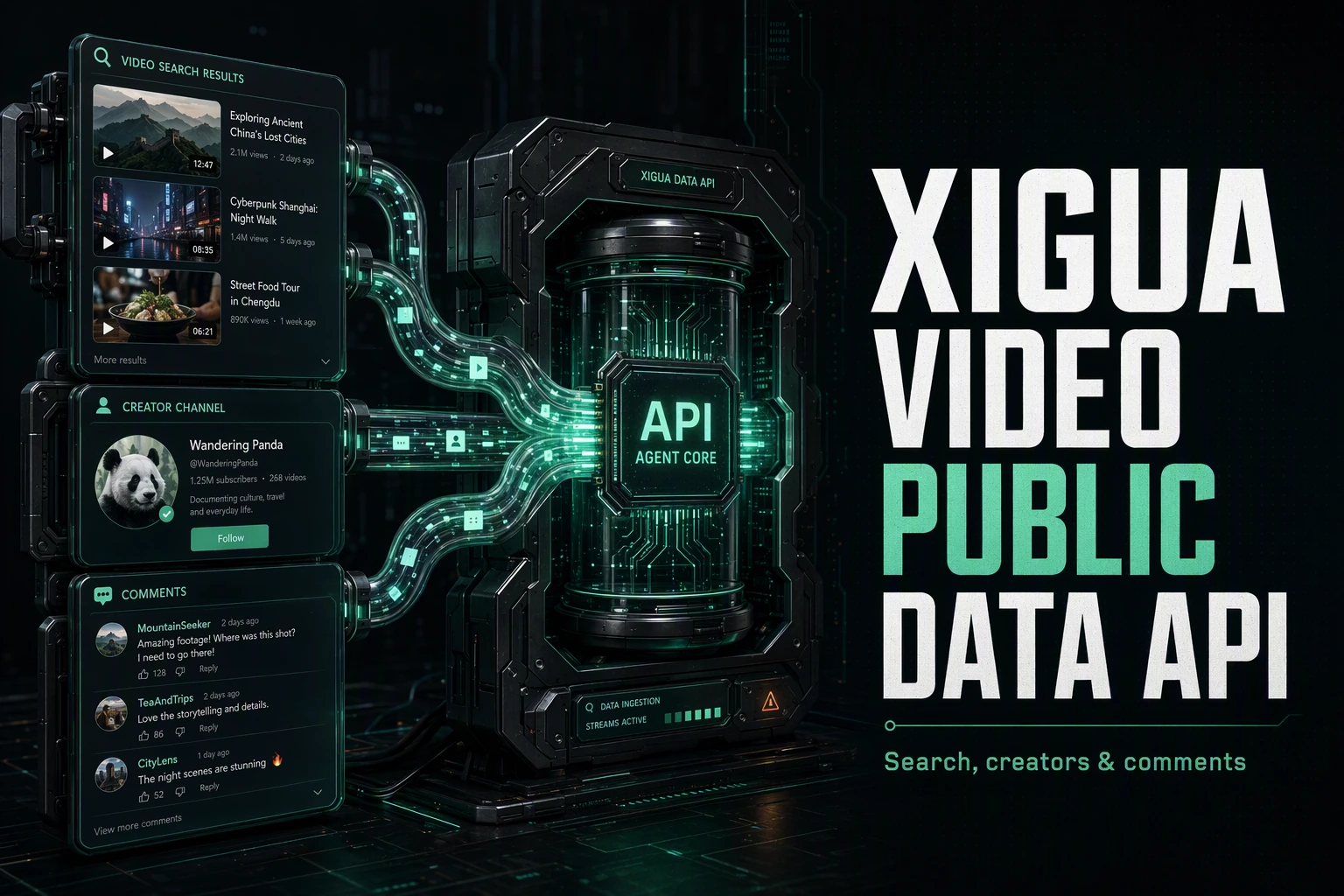
The retained cover is conceptual artwork. Its names, cards, counts and analysis labels are illustrative rather than a new response, verified account or measured outcome.
Which Xigua API do you need?
| Your need | Choose | Why |
|---|---|---|
| Post, act as a member, or use account-authorized data | Xigua’s official channels | Member and account operations run through Xigua directly. |
| Read public search, users, videos, or comments | SandBase Xigua public-data API | Plain REST, one SandBase key, structured JSON for read-only workflows. |
| Private or account-only data | Neither public workflow | That data is out of scope for this public-data guide. |
What you can get from the Xigua API
The catalog is organized on an app-v2 surface. Grouped by job:
- Search — video search by keyword.
- Users — public user info and a user’s post list.
- Videos — a single video and its play URL.
- Comments — a video’s comment list.
Check each endpoint’s live API reference for the exact parameters before you build; availability differs by endpoint.
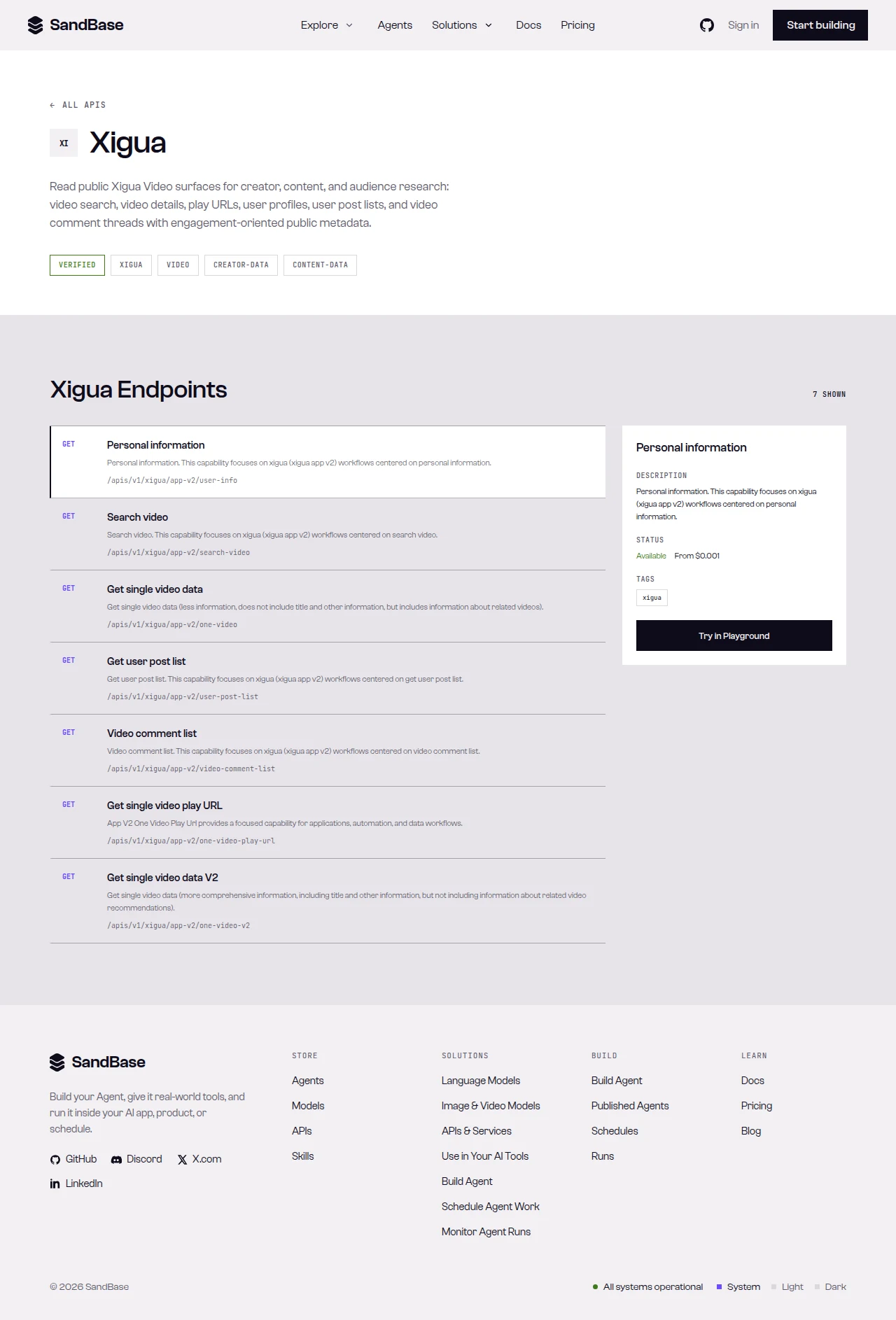 Historical Xigua catalog, including seven entries and the old one-video-v2 listing. It is not current availability, quota or business-run evidence.
What Xigua provides vs. what SandBase adds
Public records come from Xigua; SandBase supplies the authenticated API entry point. Shared authentication and a run envelope do not make business responses interchangeable. Search uses integer err_code 0, while the selected one-video reference uses message success and an inner data object. Check the status, structure, inputs, availability and budget for each route separately.
Quick start: one search page
Keep SANDBASE_API_KEY in the local runtime. Send a keyword and explicit integer offset zero. The command limits connection and total time without retrying or following redirects; it prints the response and does not perform business validation.
curl --fail-with-body --connect-timeout 10 --max-time 90 \
  -X POST https://api.sandbase.ai/v1/api/xigua/app-v2/search-video \
  -H "Authorization: Bearer $SANDBASE_API_KEY" \
  -H "Content-Type: application/json" \
  -d '{"keyword":"OpenAI","offset":0}'
Check completed status, an object at outputs[0].data, integer err_code 0 and a results array whose cards contain data objects. A structurally valid card need not be a video. For the independent known-video task, select /v1/api/xigua/app-v2/one-video with only {"item_id":"7354954305222377999"}; require message success and an inner data object instead. Do not send both as hidden setup steps. The ID is the public reference example, not a newly executed request.
Existing agents should reuse credential configuration. New projects can give their agent SKILL.md, quickstart.md and the human quickstart, plus the chosen keyword or ID. Do not put the key in a prompt. Ask for one checked result and a description of missing fields before expanding the workload.
Original September search evidence
The original hub recorded run 5e3db57f-0804-4bc2-b73f-987d616d1956 on 2026-09-27 UTC. Its trimmed JSON is preserved exactly, including the placeholder. It is historical evidence, not a current success or a guarantee of ten video candidates:
{
  "id": "5e3db57f-0804-4bc2-b73f-987d616d1956",
  "status": "completed",
  "model": "xigua/app-v2/search-video",
  "outputs": [
    {
      "data": {
        "err_code": 0,
        "count": 10,
        "offset": 10,
        "has_more": true,
        "results": [ { "id": "…", "data": {} } ]
      }
    }
  ]
}
The old Python is preserved in the historical archive. It is not the current quickstart: accepting an absent err_code and accessing nested data without shape checks could hide a failed integration.
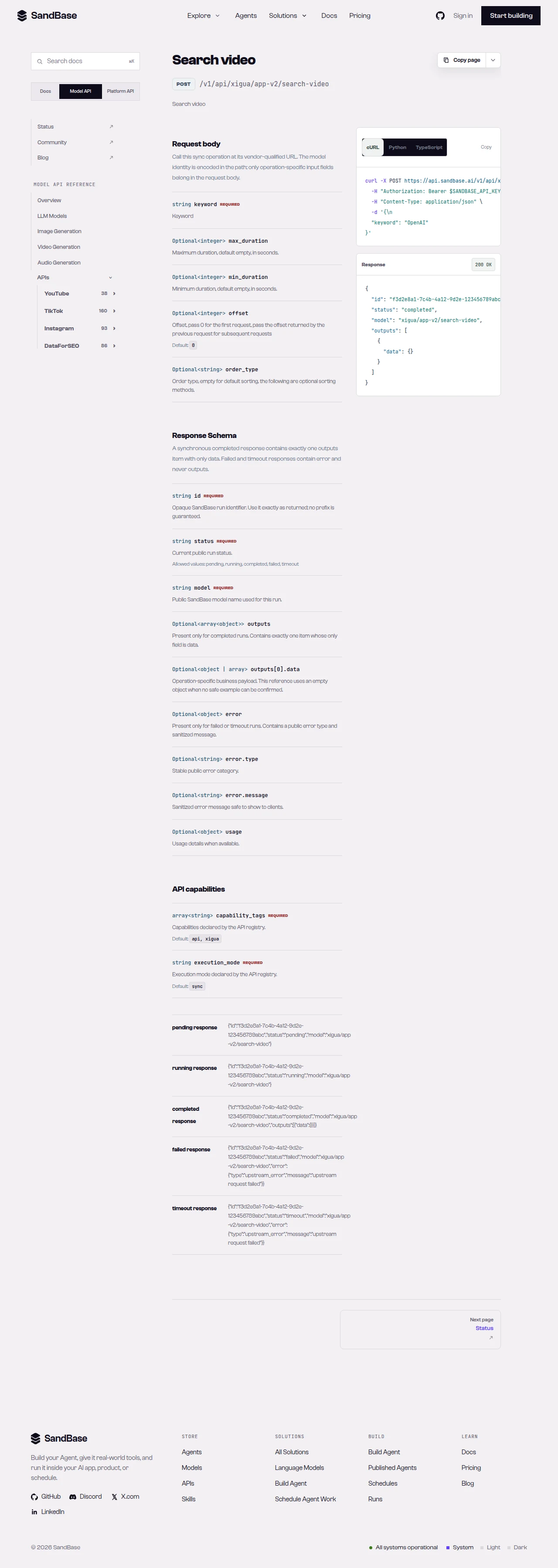 Historical search-video parameter/reference screenshot, not proof of a newly successful search or a universal payload shape.
Capability map
Historical navigation from the original September hub. Other routes and their parameters have not been revalidated in this repair.
| Capability cluster | Representative endpoint | Typical use |
|---|---|---|
| Search | xigua/app-v2/search-video | Keyword video discovery |
| User info | xigua/app-v2/user-info | Public creator signals by user_id |
| User posts | xigua/app-v2/user-post-list | A creator’s video list |
| Video detail | xigua/app-v2/one-video | Read a single video |
| Comments | xigua/app-v2/video-comment-list | Engagement and sentiment inputs |
For the selected search, the schema describes a response-derived offset after page one. Continuation and stopping behavior are not tested here; do not copy a rule to other endpoints.
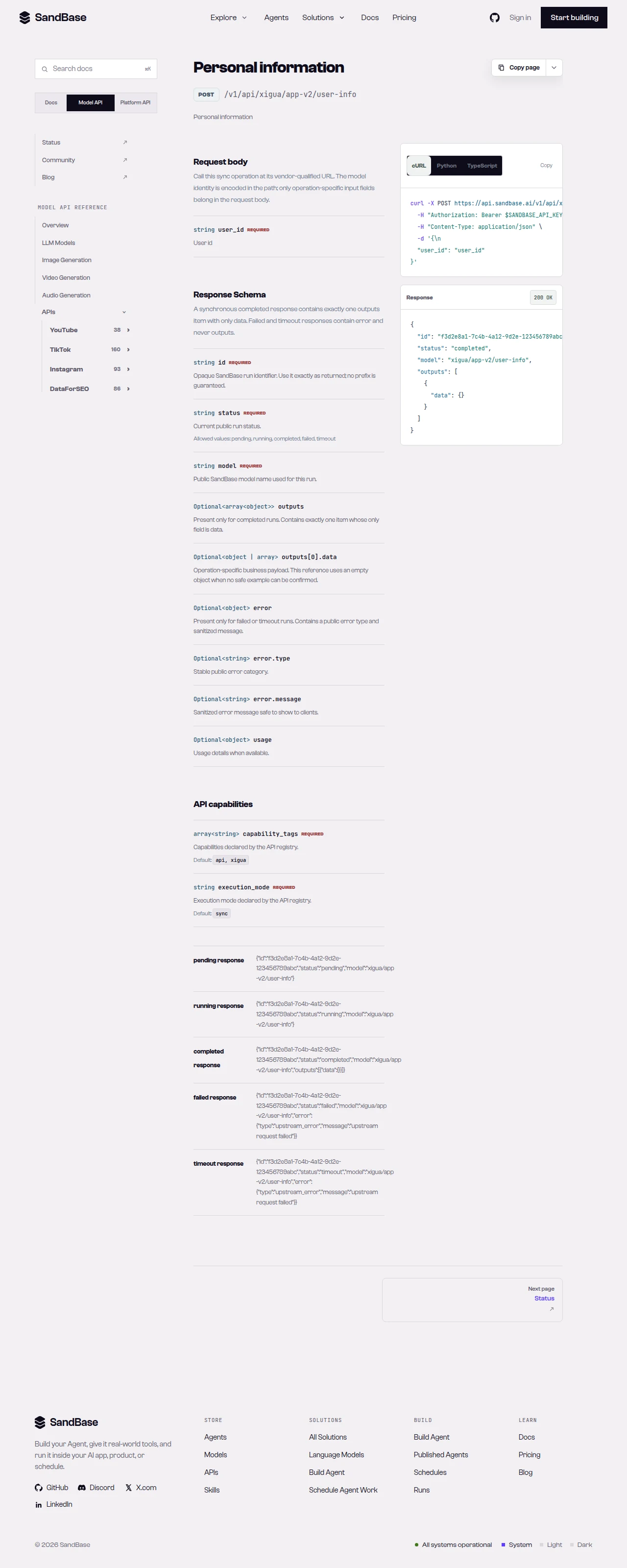 Historical user-info reference showing required user_id, not an endpoint list. User profiles were not revalidated; the empty data example is a documentation placeholder, not a business result.
Inspect a candidate before adding a request
The full public search example saved on 2026-10-07 for 美食 (food) has count 10, offset 10 and has_more true, but its results contains an Inner_EmptyContent card rather than a video. Its wrapper ID 16b7eb80-0 is not an item_id. The tutorial preserves a small dated fragment without diagnostic strings or executable presentation assets.
Only review explicit nested data.group_id or data.id_str values as possible video IDs; do not infer them from wrapper IDs, HTML or tracking strings. The short README excerpt stops before results, while the field table describes video cards. Neither a clipped example nor the table guarantees every response contains a video. Count, success status and list length alone cannot establish the number of usable candidates.
An empty-content card with has_more true is also a reason not to loop blindly. The current tutorial makes one request, does not increment offsets and does not decide the next call from a generic flag. Its optional local ID helper skips empty-content cards and does not choose or fetch a video automatically.
Choose a subsequent research question separately
A search page can help discover candidate content if usable nested IDs are present. A known-video lookup can expose limited metadata; neither is a complete topic study. Further creator profiles, post histories, comment samples and playback URLs are catalog possibilities rather than validated steps in this repair.
For creator research, verify the user-info route’s current identifier and business structure before relying on an author field. For sentiment analysis, verify the comments route, sampling and budget before collecting text. For media work, check a dedicated capability rather than interpreting a related-video link as a direct download. Keep each decision separate from the initial request.
Preserve meaning when reporting metadata
The selected one-video README calls its JSON a trimmed real response but gives no run date, and there is no saved full example. The tutorial explicitly labels this as public-reference evidence. It checks message success and data object, not search err_code. A complete SandBase run is not by itself a complete business record.
The shown fragment includes digg_count 42555, danmaku_count 36 and delete 0. These are sample observations, not current measurements for an arbitrary video. Related-video and author fields described elsewhere in the reference should be inspected when present; they are not mandatory keys invented by this tutorial. Missing data remains unknown, while zero and false retain their own meanings.
The October 1 article note recorded that the older one-video-v2 had become unavailable and was replaced based on schema review without re-running the full workflow. This is a dated migration note, not a fresh availability claim. The selected lighter route does not promise a title, transcript or direct download. An empty data object passes the outer structure check only; it does not establish that the video is available or that you have all its metadata.
Do not execute HTML, scripts or CSS returned in search cards, or download linked media merely to fill a missing field. A presentation fragment is not an instruction for your agent. If a later application renders highlighted text, plan and test safe handling separately. Like counts are not view counts; cumulative figures are not engagement rates; one result page cannot establish a whole market’s content supply.
One selected request lists at $0.001; choosing two independently lists at $0.002 before quota effects. The old automatic research pattern involved one search plus detail and comments for every usable item, or 1 + 2N requests before pagination and retries. Comments pricing was not rechecked here, so this is workload accounting rather than a price quote for that chain.
Limitations and boundaries
- Public, read-only data only; no account actions or private-content access.
- HTTP status, SandBase completion and provider business status are separate checks. Stop on malformed JSON, missing data or an unexpected shape rather than defaulting to an empty success.
- Search uses keyword and integer offset; one-video uses numeric item_id as a string. Other endpoints need their own references and validation.
- No automatic retries, pagination, detail/comments loop, download or model analysis. A timeout may leave the result unknown; inspect the outcome and budget before resending.
- No official Xigua partnership is implied. SandBase supplies an access layer, not ownership of the underlying platform or data.
FAQ
Does search always return ten videos? No. A saved successful response contains an empty-content card despite count ten. Inspect results[].data and distinguish presentation cards from usable video candidates.
Can I use the card’s id as a video ID? No. Review explicit nested group_id or id_str fields. Wrapper IDs, placeholders and encoded presentation content are not interchangeable with item_id.
Why are the success checks different? The selected search reference uses integer err_code 0, while one-video uses message success plus an inner data object. A shared SandBase envelope does not standardize these business values.
Does this verify paging or provide a transcript? Neither. This repair checks one search page or one metadata lookup. Continuation, comments, playback and transcription need separate investigation.
Start with one checked result
Reuse an existing key or follow the setup guide. Choose search-video or one-video, and follow the video research tutorial for bounded validation. Expand only when the first result identifies a concrete question worth another request.
Found this useful? Share it