Qwen4-Max vs Qwen3.8 Max: Measured TTFT, TPOT, Throughput, and Cache Hit Rate on SandBase
A single-day SandBase streaming probe of Qwen4-Max and Qwen3.8 Max: time to first token, time per output token, decode throughput, and prompt-cache hit rate. Not official vendor latency.
On 16 November 2026, from 14:44:02 to 14:52:06 Asia/Shanghai, one box sent streaming Chat Completions through the SandBase gateway to alibaba/qwen4-max and alibaba/qwen3.8-max. Qwen3.8 Max often emitted the first reasoning token earlier. It also thought longer, so the first answer token arrived about 2.2 seconds later than on Qwen4-Max. On the fixed-length decode, Qwen4-Max was clearly faster.
This is a single-box, single-day SandBase-gateway probe. It is not official vendor latency, and it is not a published benchmark.
If what you care about is when the visible answer starts, and how fast tokens arrive after that, Qwen4-Max was the better of the two on the main decode workload. If what you care about is the first reasoning token, Qwen3.8 Max was often earlier. Turning thinking off did not make Qwen4-Max’s time to first token better in this sample. Prefix-cache hits were high on Qwen4-Max, and those hits did not consistently shorten time to first token.
How to call the new ID, including official limits and the card price, is Qwen4-Max Is Generally Available. Whether to move production traffic, and the separate 9-task practical probe (accuracy, wall clock, and tokens — not this latency suite), is Qwen4-Max vs Qwen3.8 Max.
Key takeaway
- The probe ran on 16 November 2026, Asia/Shanghai, via
POST https://api.sandbase.ai/v1/chat/completionswith streaming on. It is gateway data from one box on one day, not an official latency claim.- On the main decode workload, default thinking, concurrency 1, n=7: Qwen3.8 Max’s first-answer median was 4670 ms against 2424 ms on Qwen4-Max, about 2.2 seconds later. Decode throughput medians were 93.1 versus 54.1 token/s.
enable_thinking=falseon Qwen4-Max made time to first token equal time to first answer token, and the TTFT median was not better than default thinking (2372 vs 1915 ms). n=7. That gap is not a stable conclusion.- Second-call prompt-cache hit rates were 96.2% on Qwen4-Max, 69.1% on Qwen3.8 Max, and 94.8% with Qwen4-Max thinking off. Hits did not consistently reduce TTFT.
- Four requests at once is a light extra, not a capacity test and not an SLA.
Open Qwen4 Max when the new production ID is the one you will send. The display name is “Qwen: Qwen4 Max”. The SandBase ID is alibaba/qwen4-max. The card route is Chat Completions only. On 16 November 2026 the hero was $1.67 input and $5.00 output per 1M tokens, cache read $0.08, cache write $2.08, 1M context, 131.1K max output, and no 10% off. The schema input price is 1.666667, which is the $1.67 the hero prints. Official Singapore (International) pay-as-you-go is $1.50 / $4.50. Official Beijing and Global list is $1.413 / $4.24. Official max output is 131,072 in non-thinking mode and 262,144 for thinking plus the final answer. The hero’s 131.1K matches the non-thinking cap.
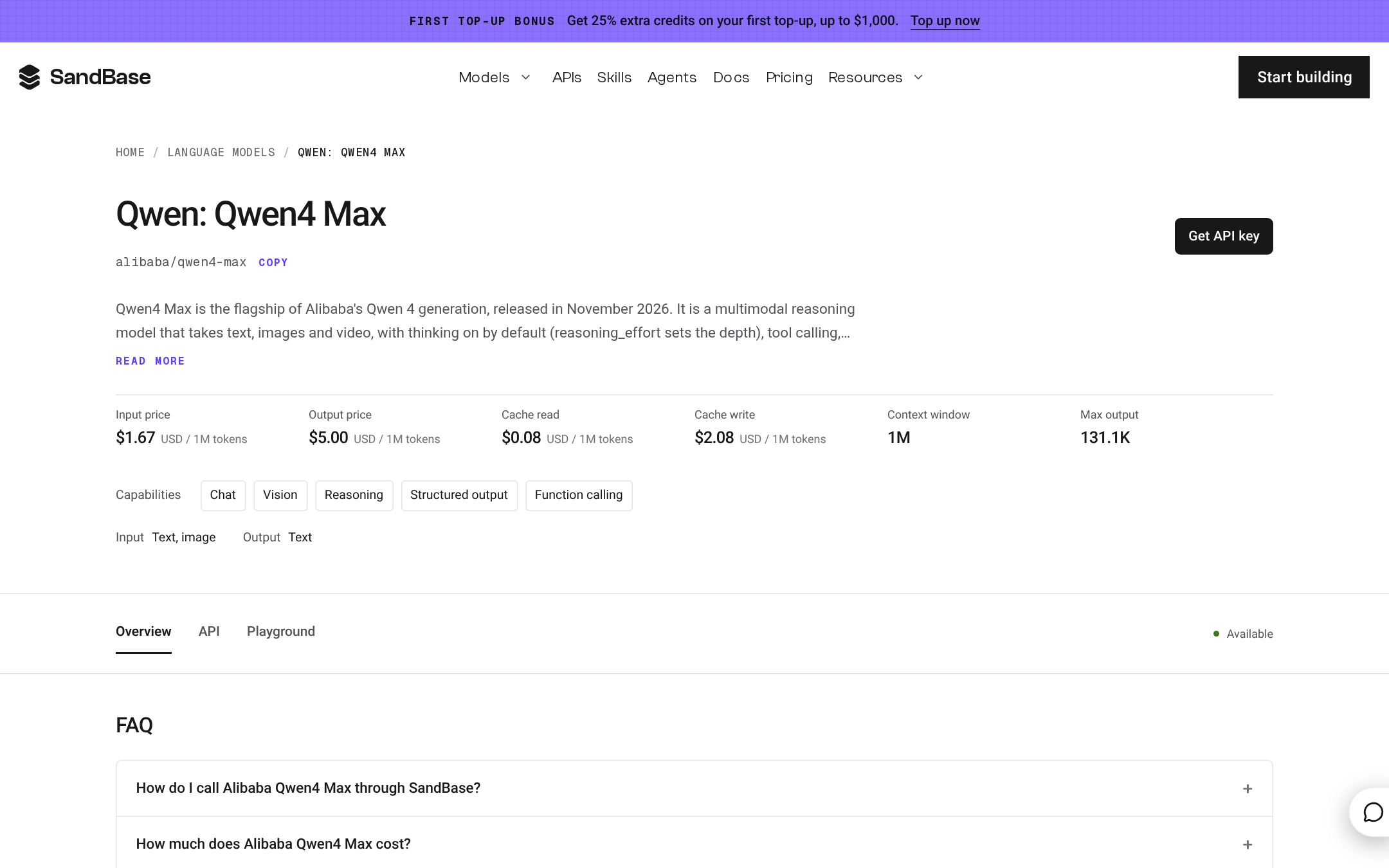
Live SandBase Qwen4 Max card at /models/alibaba/qwen4-max, captured 16 Nov 2026, Asia/Shanghai (HTML and .md both HTTP 200). Hero is $1.67 / $5.00, with cache read $0.08 and cache write $2.08 per 1M tokens, 1M context, and 131.1K max output. There is no 10% off badge. These SandBase prices are above the official Singapore list of $1.50 / $4.50, and above official Beijing / Global $1.413 / $4.24, but still below SandBase Qwen3.8 Max at $1.80 / $5.40. The card hero max output of 131.1K matches the official non-thinking cap.
Confirmed versus unknown
The numbers below are medians and p95s from this probe. They are not a vendor speed claim, and they are not a ranking against models that were not called.
| Confirmed for this probe | Do not treat as known |
|---|---|
16 November 2026, 14:44:02–14:52:06 Asia/Shanghai. The window includes a 14:44:02–14:44:10 parameter check. The suite itself ran 14:44:42–14:52:06. Endpoint POST https://api.sandbase.ai/v1/chat/completions, stream=true, temperature=0, stream_options.include_usage=true. | Vendor-side raw latency, another gateway, another region, or another day. |
Models: alibaba/qwen4-max (default thinking, plus a separate enable_thinking=false pass) and alibaba/qwen3.8-max (default thinking only). 95 records, all HTTP 200, all finish_reason=stop. Warmups are in the raw log and out of the summary stats. | Latency for Gemini 4 Carbon, GPT-6 Astra, Claude Fable 5.2, or any model that was not in the call list. |
| Headline medians in the tables. Workload A is the main decode comparison. Workload B is the cache comparison. Concurrency 4 is a light extra. | A production promise that a cache hit will lower TTFT. In this sample, hits did not consistently do that. |
enable_thinking=false was accepted and effective: HTTP 200, reasoning_tokens=0, no reasoning_content in the stream. | A stable law that thinking-off TTFT is worse than the default. The gap is n=7, and the spread was wider with thinking off. |
Thinking text arrived in delta.reasoning_content. Returned cache fields: usage.prompt_tokens_details.cached_tokens and usage.prompt_tokens_details.cache_write_tokens. cache_write_tokens was 0 on every call, including misses. | Capacity, queueing under load, or any SLA. Four concurrent requests do not measure that. |
Both models are generally available, with live SandBase cards. Card prices and official list prices are the 16 November figures in the captions. Preview alibaba/qwen4-max-preview is still live and still set to retire after 25 November 2026, 24:00 UTC+8. | A SandBase 10% off for Qwen4-Max, or a SandBase free-token grant. The official Singapore pay-as-you-go note of 1 million free tokens is a QwenCloud term. The SandBase card does not state it. |
The main result: short prompt, fixed-length decode
Read the four names before the table. They are not interchangeable.
- TTFT is milliseconds from request send to the first streamed token that has any text in
delta.contentordelta.reasoning_content. Empty role, keepalive, and empty-string events do not count. TTFT includes queueing and prefill. With thinking on, this is often a reasoning token, not the answer. - Time to first answer token is milliseconds from request send to the first non-empty
delta.content. That is the more useful product number when thinking is on. - TPOT is
(t_last_token - t_first_token) / (usage.completion_tokens - 1), in milliseconds.completion_tokensincludes thinking tokens when the API bills them as output. A trial is invalid for TPOT if there are fewer than 2 completion tokens, timestamps are missing, or the whole reply arrives in one chunk. - Decode throughput uses the same span and the same validity rule:
(completion_tokens - 1) / (t_last_token - t_first_token), in token/s. End-to-end throughput iscompletion_tokens / (t_last_event - t_send), so it includes the wait before the first token. Do not mix the two.
Workload A is a short prompt and a fixed 32-line completion, alternating fixed sentences, no numbering and no commentary, max_tokens=512, concurrency 1. One warmup per model pass was discarded. The table is 7 trials. Output was about 350–530 tokens, which is long enough for stream intervals to be measurable. Unless a cell says otherwise, the pair is median (p95). For TTFT and TPOT, p95 is the slower tail. For a throughput row, p95 is the higher rate, not a worse case.
| Metric | Qwen4-Max default | Qwen3.8 Max default | Qwen4-Max thinking off |
|---|---|---|---|
| TTFT (ms) | 1915 (2871) | 1474 (2330) | 2372 (4350) |
| Time to first answer token (ms) | 2424 (3699) | 4670 (5356) | 2372 (4350) (= TTFT) |
| TPOT (ms/token) | 10.75 (17.05) | 18.48 (21.33) | 10.31 (12.30) |
| Decode throughput (token/s) | 93.1 (104.6) | 54.1 (61.1) | 97.0 (100.7) |
| End-to-end throughput (token/s) | 58.3 (71.2) | 44.8 (50.8) | 56.1 (71.1) |
| Median prompt / completion / reasoning tokens | 134 / 369 / 16 | 160 / 483 / 129 | 135 / 352 / 0 |
The product reading, only for this probe:
- Qwen3.8 Max’s first reasoning token was often earlier. Its TTFT median is 1474 ms against 1915 ms. Default thinking was also longer: median 129 reasoning tokens against 16. The first answer token was about 2.2 seconds later (4670 ms versus 2424 ms).
- Qwen4-Max decoded faster on this workload. TPOT median 10.75 ms versus 18.48 ms. Decode throughput 93.1 versus 54.1 token/s. End-to-end throughput still favors Qwen4-Max here (58.3 versus 44.8 token/s), and it is a different statistic because it includes the wait for the first token.
- The interval from the first reasoning token to the first answer token, on workload A, was a median of 477 ms on Qwen4-Max, 2995 ms on Qwen3.8 Max, and 0 with thinking off. Those interval medians are the figure to quote. They are not the headline TTFT medians subtracted from the headline first-answer medians.
Turning thinking off
The third column is a separate Qwen4-Max pass with the official parameter enable_thinking=false. The API accepted it. Every trial was HTTP 200, reasoning_tokens was 0, and the stream had no reasoning_content. TTFT and time to first answer token are the same number in that column, which is what you would expect once there is no reasoning text to emit first.
The TTFT median was not better than default thinking: 2372 ms versus 1915 ms, and the p95 was wider (4350 ms versus 2871 ms). Decode throughput was slightly higher (97.0 versus 93.1 token/s). TPOT median was 10.31 ms versus 10.75 ms. This is n=7. Do not treat the TTFT gap as a stable conclusion, and do not turn thinking off in order to buy an earlier first token. This sample does not show that.
Official Qwen4-Max default reasoning_effort is high, not the preview’s xhigh. This probe left that default alone, except for the thinking-off pass.
How we measured
One box, one afternoon, through the SandBase gateway. Clocks are Asia/Shanghai. The parameter check ran 14:44:02–14:44:10. The suite ran 14:44:42–14:52:06. The recorded window for the whole run is 14:44:02–14:52:06. The client stamped time.perf_counter() immediately before the POST.
The request was POST https://api.sandbase.ai/v1/chat/completions with stream=true, temperature=0 (accepted), and stream_options.include_usage=true. The final SSE chunk carried usage. Chunks were OpenAI-style chat.completion.chunk events. Thinking text arrived in choices[0].delta.reasoning_content. Answer text arrived in choices[0].delta.content. The first events can be an empty role chunk. Those are ignored for TTFT. On 69 of 72 non-warmup trials in the short, decode, and cache workloads, the HTTP response headers and the first SSE token arrived almost together (gap under 5 ms). TTFT still includes queueing and prefill. That near-tie is a method note, not a headline.
Models were alibaba/qwen4-max and alibaba/qwen3.8-max. Thinking stayed at the API default unless the pass is marked thinking off. The log has 95 records, counting the parameter checks, warmups, and two concurrency-batch aggregates. Every request returned HTTP 200 with finish_reason=stop. Warmups are excluded from the summary medians.
Workload A, above, is the decode comparison to use for TPOT and throughput. Workload B, next, is the cache comparison: unique memoranda of about 2.9k–3.0k tokens, five miss/hit pairs per model pass, max_tokens=256. Workload C is the same prompt as A, one serial warmup, then four requests at once, default thinking only. A short-reply workload (a one-word “OK”, max_tokens=128) was also run. Its TTFT variance is noted later. It is not used for TPOT or throughput.
Prompt-cache hit rate
Each cache pair was the same legal-style memorandum with only the last line changed (Record tag: Bn-1, then Bn-2), plus a one-word yes/no question about a notice-period clause. Every pair used its own prefix, so a later “miss” was not already warm from an earlier pair. One warmup pair was discarded. max_tokens=256. Every answer was Yes. Hit rate is cached_tokens / prompt_tokens, from the usage fields the gateway actually returned. Miss is the first call of the pair. Hit is the immediate second call.
| Model | 1st call (miss) median hit rate | 2nd call (hit) median hit rate | 2nd-call median cached / prompt | Miss median TTFT (ms) | Hit median TTFT (ms) |
|---|---|---|---|---|---|
| Qwen4-Max default | 0% (cached=0) | 96.2% | 2816 / 2926 | 4448 | 3795 |
| Qwen3.8 Max default | 0% | 69.1% | 2048 / 2965 | 2495 | 2616 |
| Qwen4-Max thinking off | 0% | 94.8% | 2816 / 2971 | 3160 | 4502 |
Prefix cache worked, in the billing sense the usage object reports. The first call of each pair had cached_tokens of 0. The immediate second call read cache.
Do not read that table as “a hit made the first token faster.” Qwen4-Max with default thinking had a slightly lower hit-median TTFT (3795 ms versus 4448 ms). Qwen3.8 Max and Qwen4-Max with thinking off had a higher hit-median TTFT (2616 vs 2495, and 4502 vs 3160). n=5, and the spread is large. A billing hit and gateway latency are different things. This sample does not support a claim that cache hits reduce TTFT.
cache_write_tokens was 0 on every trial, including the misses. Qwen3.8 Max’s second call cached exactly 2048 tokens. Qwen4-Max cached 2816. Those are the observed counts. The probe does not establish why the cached lengths differ.
Short answers are the wrong place for a headline throughput number. One Qwen4-Max default miss on this workload returned its tokens in a single burst that is unusable as a decode rate, and the uncleaned mean decode for workload B is not a result. After that trial is dropped, the cleaned median decode is 41.4 token/s and the cleaned median TPOT is 24.2 ms (n=9). The main throughput comparison remains workload A.
A light concurrency-4 probe
Same prompt as workload A, max_tokens=512, default thinking only. One serial warmup, then four requests at once. That is the whole design.
| Metric | Qwen4-Max | Qwen3.8 Max |
|---|---|---|
| Concurrency-4 TTFT median (p95), ms | 4377 (5186) | 1693 (2103) |
| Versus workload A, concurrency 1 TTFT median | 1915 (about 2.3×) | 1474 (about 1.15×) |
| Per-request decode throughput median (token/s) | 91.3 | 58.6 |
| Batch wall time (s) | 9.857 | 10.993 |
| Batch aggregate output (all completion tokens / wall) | 152.2 token/s (1500 tok) | 170.7 token/s (1876 tok) |
Qwen4-Max’s TTFT median rose from 1915 ms at concurrency 1 to 4377 ms at concurrency 4. Qwen3.8 Max moved from 1474 ms to 1693 ms. Per-request decode throughput stayed in the same pattern as workload A: 91.3 token/s versus 58.6 token/s. The slightly higher batch aggregate on Qwen3.8 Max (170.7 versus 152.2 token/s) is because that batch emitted more completion tokens (1876 versus 1500), including more thinking, not because a single request decoded faster.
This is a light probe. It is not a capacity test, and it is not an SLA.
Short replies, kept out of the throughput comparison
A separate workload asked for exactly the single word OK and nothing else, max_tokens=128, one warmup plus 7 trials. TTFT variance was high. The p95 was often past 5 seconds. Output was only a handful of tokens. With thinking off, the two tokens often arrived in one chunk, so TPOT was invalid. Do not use this workload for TPOT or for decode throughput.
| Metric | Qwen4-Max default | Qwen3.8 Max default | Qwen4-Max thinking off |
|---|---|---|---|
| TTFT (ms) | 2354 (5482) | 2047 (4606) | 2288 (5119) |
| Time to first answer token (ms) | 3069 (6644) | 2482 (5219) | 2288 (5119) |
| Median completion / reasoning tokens | 13 / 10 | 31 / 28 | 2 / 0 |
What this does not tell you
It does not tell you Alibaba’s raw serving latency, a number from another gateway, or what the same prompts would do on another day. It does not include Gemini 4 Carbon, GPT-6 Astra, or Claude Fable 5.2. Those three were not called. Nothing here is a latency ranking against them. Price, context, and access for that set, now that Qwen4-Max has a public list price, are in the 16 November flagship comparison. The 15 November preview-era note, at a different slug, is what you could compare while Qwen 4 was still preview-only.
It also does not tell you that a cache hit will make the first token faster in your production prefix, that thinking-off TTFT is stably worse, or that four concurrent requests describe capacity. The 9-task probe in the switch post (8 pass, 1 partial, wall time and token counts) is a sibling measurement. It is not a second latency table, and this page does not paste it.
Stay on Qwen3.8 Max when the account is already standardized there, or when you want that card’s 10% off and you have not re-checked agents against the new default effort. On 16 November 2026 the hero was $1.80 / $5.40, 10% off the $2 / $6 list, cache read $0.23, cache write $2.25, 1M context, and 131.1K max output. Official Alibaba max output for qwen3.8-max remains 128k. The card prints 131.1K. Cite the host you will actually call. The long page for that model is Qwen 3.8 Max: Alibaba’s 2.4T Multimodal Flagship.
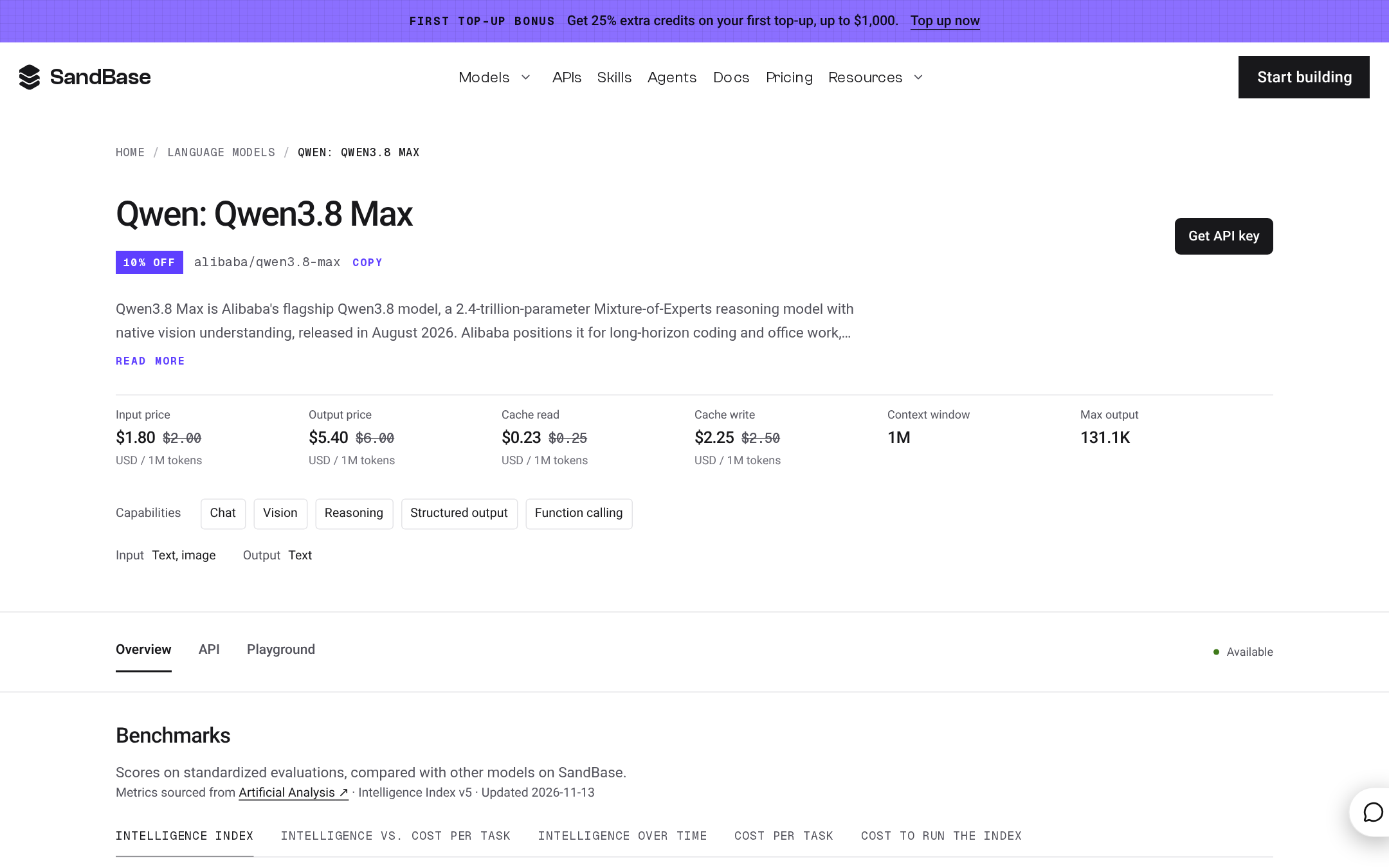
Live SandBase Qwen3.8 Max card at /models/alibaba/qwen3.8-max, captured 16 Nov 2026, Asia/Shanghai. Hero is $1.80 / $5.40 (10% off the $2 / $6 list), with cache read $0.23 and cache write $2.25 per 1M tokens, 1M context, and 131.1K max output. Official Alibaba max output for qwen3.8-max remains 128k; cite both figures and name the source.
What to call today
New production on SandBase uses alibaba/qwen4-max. The preview ID is still up, and it is the wrong default. Qwen4 Max Preview was still live on 16 November at $2.00 / $6.00, cache read $0.25 and cache write $2.50, with the hero context window printed as N/A and max output 131.1K. Official copy still describes that preview as retiring after 24:00 on 25 November 2026 (UTC+8). Historical Token Plan setup stays in the 13 November access guide. The 15 November switch note, Qwen4-Max-Preview vs Qwen3.8 Max, is the preview-era decision and stays that way. The 15 November status page, Is Qwen 4 Out?, is the preview record, with its own same-day GA update.
Official list prices used above are the QwenCloud pricing page. Official context and output caps are the QwenCloud latest-model page. Both were the 16 November pages. This note does not re-litigate the launch. The GA post owns the call shape, the 131,072 / 262,144 caps, and the gap between the official list and the card.
The Qwen hub returns HTTP 200, and its title is still “Qwen API: Alibaba Qwen3.8, 3.7 and Open-Weight Models | SandBase”. That stale title is not evidence that Qwen4-Max is missing. The individual card is the page to open.
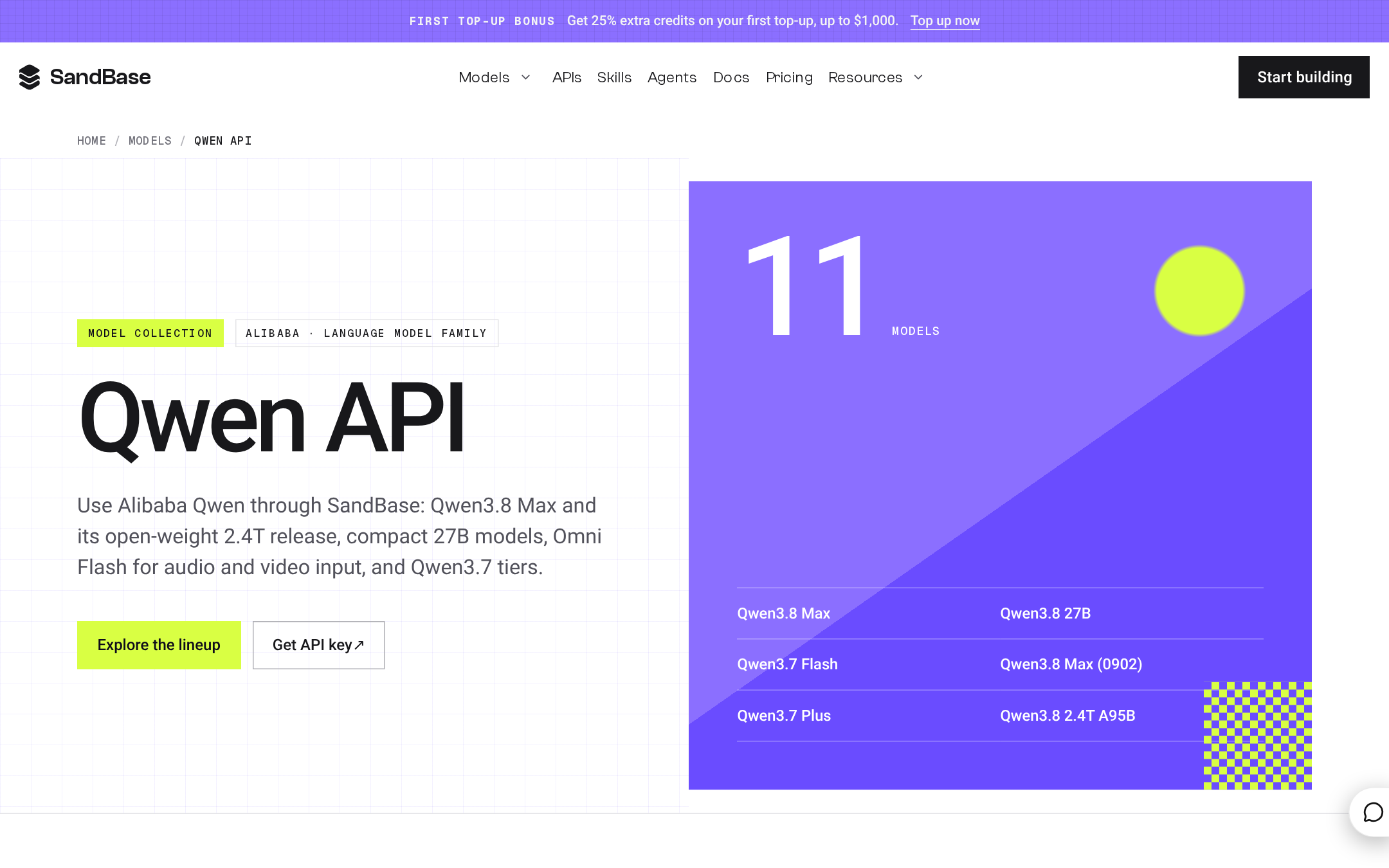
Live SandBase Qwen hub at /models/qwen, captured 16 Nov 2026, Asia/Shanghai. The page title and hero lineup are still Qwen3.8 / Qwen3.7 — they do not yet mention Qwen4-Max, even though the individual Qwen4-Max card is live and listed in the sitemap and llms-full.txt. Use this only to disclose the stale hub, not as a reason to say the model is missing from SandBase.
Sign up redirects to the login page. Create a key, then send one bounded streaming request through the first API call doc. The model string is alibaba/qwen4-max. Read the first answer token and the decode rate on your own prefix before you move a queue. The medians on this page are the scope of what this probe measured.
FAQ
Is this official Qwen latency?
No. It is a single-box SandBase streaming measurement on 16 November 2026. Official docs do not publish these TTFT, TPOT, or throughput figures. Do not quote the table as a vendor benchmark.
Did cache hits make TTFT faster?
Not consistently in this sample. The second call did read cache. Qwen4-Max’s default-thinking hit median was slightly lower. The other two passes were higher. n=5. A cache hit on the bill is not the same claim as a faster first token.
Should I turn thinking off to get a faster first token?
Not on the evidence here. Thinking off made TTFT equal to time to first answer token, and the TTFT median was 2372 ms against 1915 ms with default thinking. The sample is 7 trials, and the spread was wider. Decode throughput was only slightly higher.
Were Gemini 4 Carbon, GPT-6 Astra, or Claude Fable 5.2 measured?
No. This probe called alibaba/qwen4-max and alibaba/qwen3.8-max only. The flagship comparison linked above is about price, context, and access. It is not a latency table for those three models.
Related reading
- Qwen4-Max Is Generally Available
- Qwen4-Max vs Qwen3.8 Max: Should You Switch Production Traffic?
- Qwen4-Max vs Gemini 4 Carbon, GPT-6 Astra, and Claude Fable 5.2
- Is Qwen 4 Out?
- Qwen4-Max-Preview access and limits
- Qwen4-Max-Preview vs Qwen3.8 Max
- Qwen 4 vs Gemini 4 Carbon, GPT-6 Astra, and Claude Fable 5.2 (15 November)
- Qwen 3.8 Max: Alibaba’s 2.4T Multimodal Flagship
Streaming medians are from one SandBase gateway probe on 16 November 2026, 14:44:02–14:52:06 Asia/Shanghai. Card heroes and official list prices were checked the same day. Workload A is the decode comparison. Workload B is the cache comparison. Concurrency 4 is a light extra. The short-reply workload is not a throughput result.
Found this useful? Share it