Qwen4-Max-Preview: Access, Token Plan, and the November 25 Deadline
Qwen4-Max-Preview is available through Token Plan until November 25. Learn the access limits, reasoning-budget changes, and a reversible evaluation workflow.
A model upgrade is easy to try when the endpoint and billing model stay familiar. Qwen4-Max-Preview changes both the access decision and the evaluation deadline. Alibaba’s preview runs from November 11 at 10:00 through November 25 at 24:00, 2026, UTC+8, and the model is scheduled to retire afterward. Treat it as a time-bounded experiment with an exit path, not a permanent replacement chosen from a launch screenshot.
Key takeaway
- The exact preview identifier is
qwen4-max-preview. - Access currently requires Token Plan; ordinary pay-as-you-go access is not supported.
- The preview supports text generation, image/video understanding, reasoning, tools, and structured output.
- Request budgeting and multi-turn reasoning behavior need attention during migration.
- The November 13 SandBase catalog check found no exact Qwen4 listing; this guide does not claim a working SandBase route.
This article reviews official documentation, not inference results. No benchmark, latency, or reliability result is claimed from a live Qwen4 run.
What is available, and for how long?
Alibaba’s model documentation establishes the preview status and its access conditions. The documented context is 1M tokens; the maximum output budget is 393,216 tokens shared between reasoning and the final answer. Compatibility includes OpenAI Chat Completions, Responses, and Anthropic Messages.
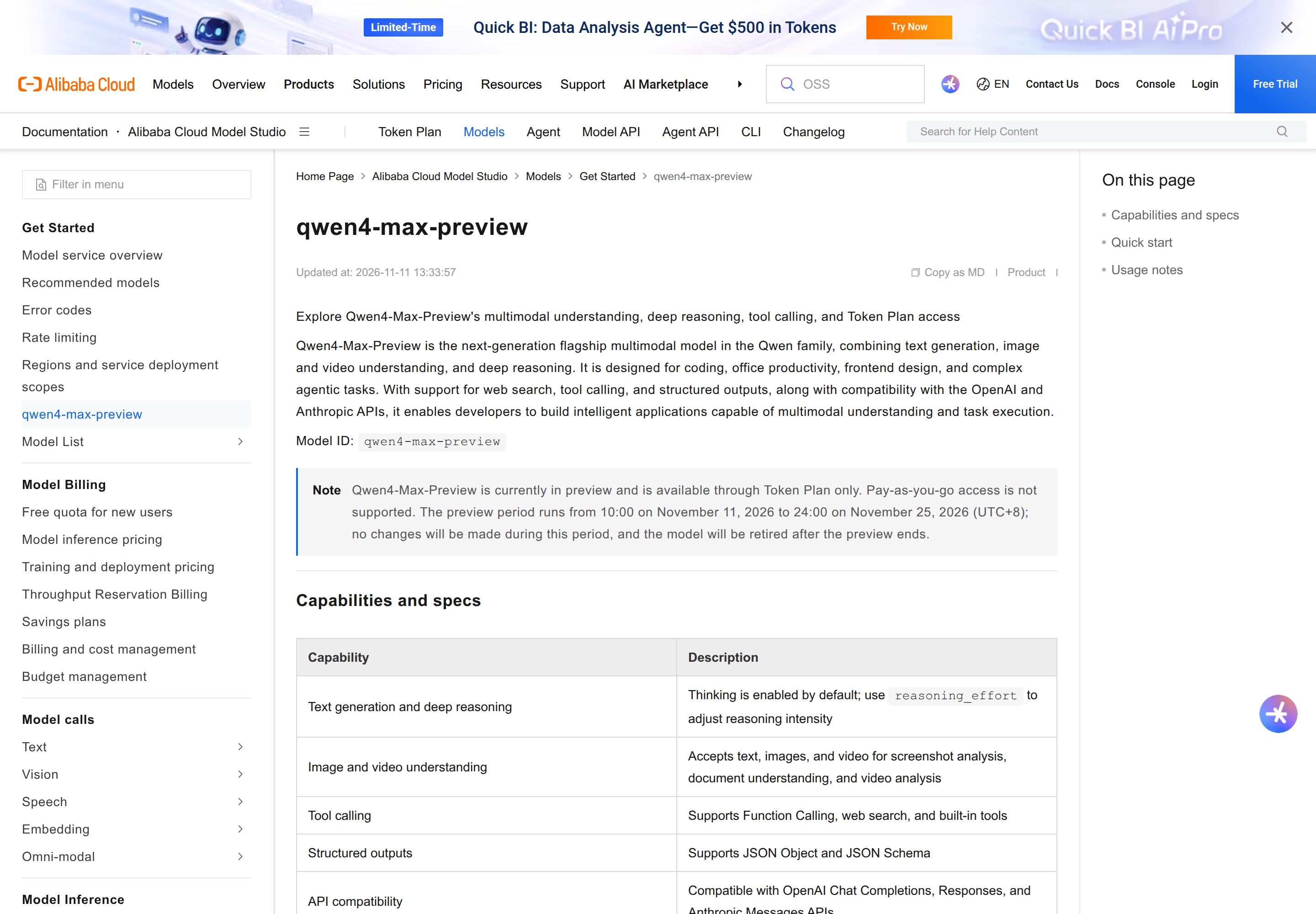 Alibaba’s model page captured November 13. The preview window and Token Plan requirement are access conditions, not optional footnotes.
A compatible protocol can reduce integration work, but it does not erase model-specific semantics. A client may send a familiar JSON request while using the wrong credentials, reasoning controls, or output budget. Separate those failure classes before deciding that a model is unreliable.
| Question | Current documented answer |
|---|---|
| Is this general availability? | No; it is a preview with a retirement date |
| Can a regular metered API key be assumed to work? | No; use the dedicated Token Plan access path |
| Is there a universal per-million-token price here? | No ordinary pay-as-you-go quote is provided for this preview |
| Are weights downloadable? | No open-weight release was verified for this model |
| Is the announced output limit all visible answer text? | No; reasoning shares the budget |
The ending time matters operationally. November 25 at 24:00 UTC+8 means the end of that date, not a promise of an additional day. Put the deadline in the application’s release notes and select a fallback before starting a user-facing trial.
Three migration details that can distort an evaluation
Output tokens now include reasoning
For this preview, Alibaba says max_tokens is equivalent to max_completion_tokens: both limit reasoning plus final-answer tokens. A limit copied from an older workflow and sized only for the visible answer may truncate the result before enough answer space remains.
When a run stops early, preserve its finish reason and usage. Retry with a justified budget only after examining whether the output was constrained. Otherwise, an evaluation can confuse a deliberately small budget with a capability failure. The reverse also matters: an extremely generous budget can conceal a model’s tendency to spend more on easy work.
Thinking controls are not interchangeable
Documented reasoning_effort choices are low, medium, and the default xhigh. Do not combine this parameter with thinking_budget. A reusable client should validate the selected model’s supported settings rather than assuming every provider accepts the same list.
Compare effort settings as separate configurations. If one candidate uses its most expensive reasoning mode and the incumbent uses a short-answer mode, the result is a configuration comparison as much as a model comparison. Record both instead of presenting a single unqualified winner.
Multi-turn state needs the right field
Alibaba’s Chat Completions guidance enables preserve_thinking by default and asks clients to return historical reasoning in reasoning_content. It should not be concatenated into ordinary content.
Inspect the adapter between your agent framework and the provider. If that layer silently drops unknown fields, the second turn can differ from the documented workflow even when the first turn succeeds. Test a real tool round trip and a follow-up correction; a one-turn greeting cannot establish multi-turn compatibility.
Access and cost: keep the plan separate from the model
Use the dedicated Token Plan credentials and base URL from Alibaba’s documentation. The listed international base is https://token-plan.ap-southeast-1.maas.aliyuncs.com; use the plan guide to select the complete endpoint for your protocol. Do not send a SandBase key to that address.
The Model Studio model catalog identifies the preview alongside other models. The catalog is useful for finding documentation, but a row in a directory is not proof that your account has the necessary entitlement.
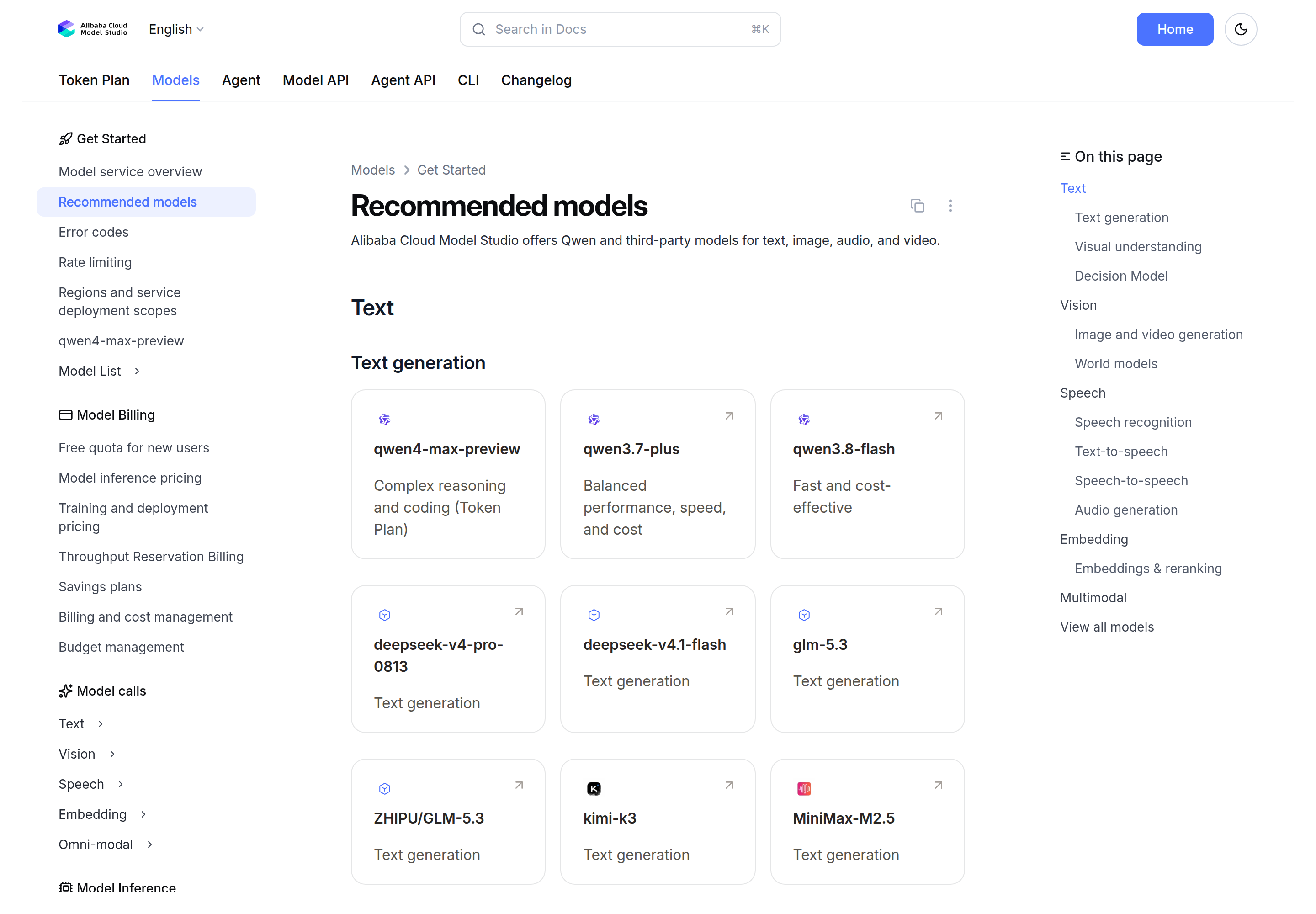 The Model Studio catalog captured November 13. Model discovery and successful authenticated access are distinct checks.
There is no defensible “$X per million Qwen4 tokens” calculation from the preview page alone. A subscription fee, promotional credit conversion, and metered API price are different quantities. Track the actual plan-credit consumption of your tasks, and state the plan and date when comparing cost.
| Experiment budget | What to fix before running |
|---|---|
| Access | Correct plan, region, credentials, and protocol |
| Workload | Same task set and acceptance criteria |
| Reasoning | Explicit effort setting and output ceiling |
| Cost | Actual plan usage, including failed attempts |
| End of preview | Fallback model and retirement handling |
Where Qwen4 fits in a model evaluation
The strongest reason to evaluate the preview is a workflow that needs both visual input and code or tool execution. Examples include turning a supplied screenshot into an interface, interpreting a document before changing application logic, or making a small browser-facing repair and inspecting the rendered result.
These are proposed test cases, not observed Qwen4 successes. Each needs an external check. For an interface task, compare the rendered page at the required viewport. For extraction, compare against a prepared answer key. For code, run the relevant tests and inspect changes outside the requested scope.
Do not use the preview as the only route for a service that must operate unchanged after November 25. Even excellent results today do not remove a documented retirement. Keep model selection in configuration and preserve a fallback contract that your application has already tested.
For a confirmed alternative on SandBase, inspect Qwen3.8 27B. It is a different, smaller model and must not be described as Qwen4 or as a performance-equivalent replacement.
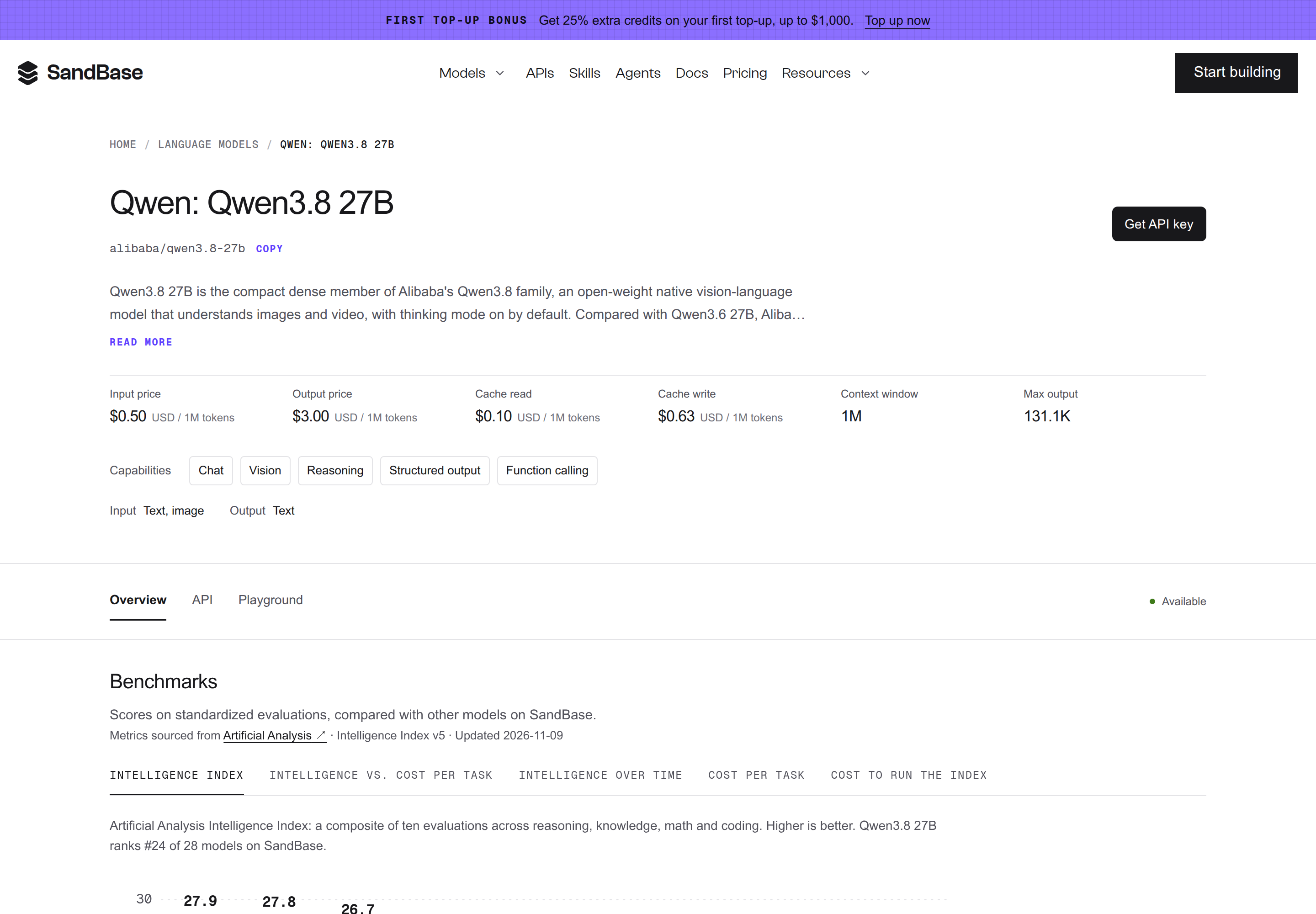 An existing Qwen3.8 route captured November 13. Its presence does not imply Qwen4-Max-Preview is available through SandBase.
A useful two-week preview plan
Start with a request that proves authentication and the intended model ID. Then run a structured-output case, a tool-call round trip, a visual task, and a deliberately constrained output-budget case. Save errors as well as successes. The goal is to establish which parts of the adapter work before testing a complex application.
Next, replay representative historical tasks. Keep the input artifacts immutable and record changes in prompt, effort, and tools as separate variants. If you revise the prompt after seeing a failure, replay the incumbent with the same revision. Otherwise the comparison rewards whichever model received more tuning.
Finally, decide what the preview taught you: a model capability worth tracking, an adapter fix useful across providers, or a workflow unsuitable for the current access conditions. An experiment can be useful without ending in a production migration. Retire trial-specific routing when the preview ends; do not quietly change to another model while preserving a Qwen4 label.
For another newly announced execution model, see our Gemini 4 Hydrogen guide. Compare the access contracts before comparing outputs: a limited preview and an ongoing API offer create different operational commitments.
Keep the preview experiment portable
Store the request configuration beside each result: model ID, service base, protocol, effort, output ceiling, and whether the client preserved reasoning history. Keep credentials out of these records. This is particularly important for Qwen4 because a later permanent release may reuse the family name while changing the access contract or supported settings.
A useful final artifact is a short compatibility report rather than a collection of attractive answers. Record which client features worked, which required adapter changes, and which remain untested. Mark an unsupported field separately from a model-quality failure. When the preview closes, that report remains useful for evaluating the next supported release without pretending that its behavior is already known.
FAQ
Is Qwen4-Max-Preview free?
The official page specifies Token Plan access. It does not establish a universally free public API or a normal pay-as-you-go tariff.
Can I use an existing OpenAI-compatible client?
Potentially, through the documented compatible protocols. Check credentials, the dedicated base URL, reasoning fields, and multi-turn state instead of assuming a model-string change is sufficient.
Will my application keep working after November 25?
The documentation says this preview model retires after the preview period. Plan a verified fallback rather than assuming automatic continuity.
Is Qwen4 on SandBase?
No exact listing was found in the November 13 catalog check. Use Alibaba’s documented preview access; do not invent a SandBase model string.
Next step: validate the adapter on one bounded workflow and record the retirement date beside the model configuration.
Found this useful? Share it