Hunyuan Smart Topology vs Tripo Remesh in 2027
Remesh the same 500,000-triangle GLB with Hunyuan and Tripo. Compare delivered counts, UVs, actual charges, surface deviation, and close-up renders.
We sent the same 500,000-triangle robot GLB to Hunyuan Smart Topology and Tripo Remesh. Hunyuan Low returned 7,245 triangles in 131,280 bytes, with no UV layer. When we entered 7,245 as Tripo’s target and enabled baking, it returned 9,022 triangles in 5,510,780 bytes and still showed the robot’s blue eyes and waist stripes. Those outcomes make a practical distinction for a team deciding whether it needs a small mesh for later editing or a colored asset that can be rendered immediately.
Key takeaway
- Hunyuan Low returned 7,245 triangles and cost $0.75 on this GLB. Blender found zero UV layers and zero materials in the imported result.
- Tripo with a 7,245 target delivered 9,022 triangles. A 20,000 target delivered 21,833. Both jobs cost $0.42 and each result had one UV layer and two images referenced by material nodes.
- Source-to-output sampled p95 distances were 0.418% for Hunyuan Low, 0.274% for Tripo’s 7,245 target and 0.190% for its 20,000 target, after each model was centered and scaled independently.
- The two near-budget jobs had different final triangle counts and only Tripo was asked to bake. The numbers describe those settings on one robot, and they cannot isolate the underlying algorithm.
One mesh, two different controls
The source is the same original 3.0 GLB from the Hunyuan 3D 3.0 vs 3.1 Pro test. It contains 500,000 triangles, one UV layer and an embedded color image. Both routes received the same asset URL. We used triangle mode on both. The API controls differ in a way that affects how a team can set a budget. Hunyuan Smart Topology takes a named density. Tripo Remesh takes a numerical face target and exposes a bake switch.
We requested Hunyuan Low, which returned 7,245 triangles. The first Tripo request set a target of 20,000, and the second requested 7,245 to match the observed Hunyuan density more closely. Both Tripo requests asked the service to bake textures. We saved actual output counts and file sizes independently. Any interpretation of the two original outputs includes the selected route settings, including bake.
Read the two surface distances separately
The Blender calculation centers each mesh and scales its longest bounding-box dimension to one. It then samples up to 10,000 vertices in stored vertex order and finds their closest distance to triangles on the other mesh. A p95 of 0.4% means that the selected p95 sample distance is 0.004 times that longest normalized dimension. The distances do not translate to millimeters unless the scene has independently known physical units and a different, scale-preserving calculation is used.
Source-to-output measures how far sampled original vertices are from the simplified surface. Output-to-source measures how far sampled new vertices are from the original surface. A thin protrusion that disappears may show up in the first direction and still contribute little to the second direction. Dense vertex clusters can dominate both samples, and the sample is not uniform across surface area. It is sensible to read these numbers with the hand and waist crop. A small global p95 can coexist with damage to an important localized feature.
Compare the delivered counts, material and charges
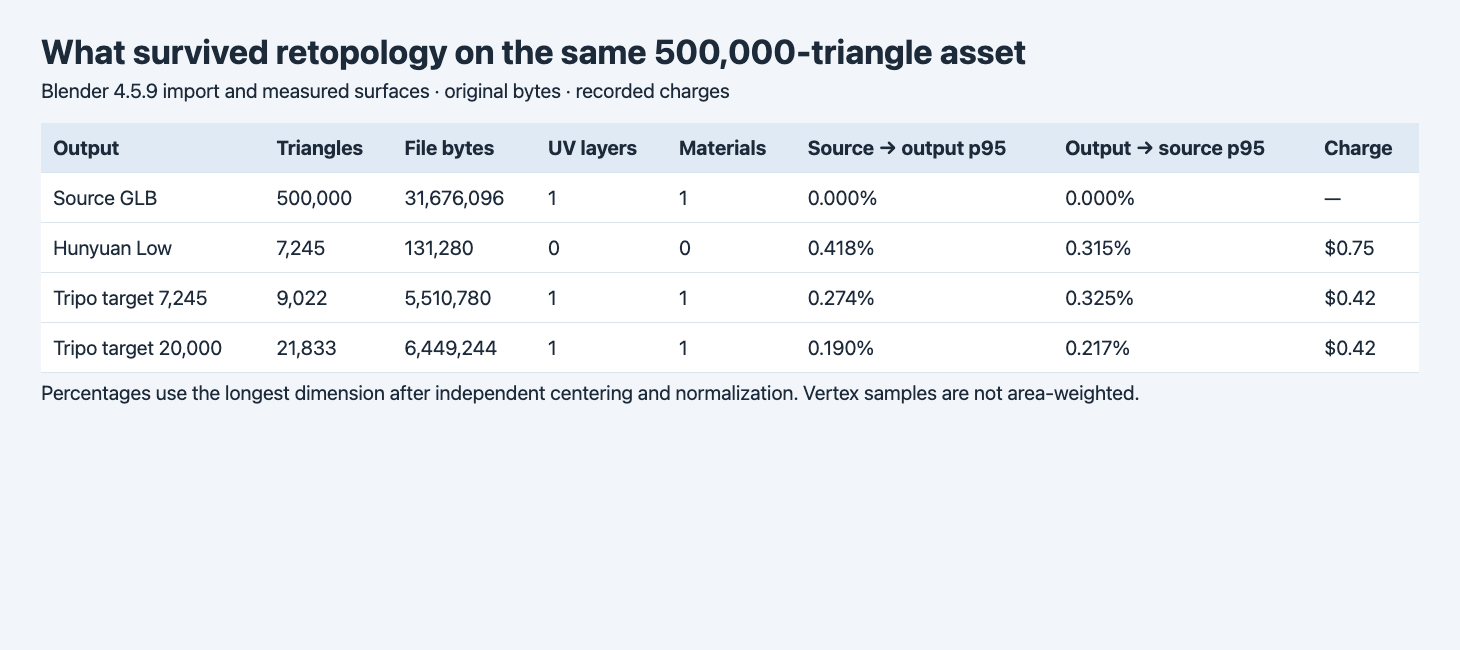
The table combines Blender 4.5.9 import results with original download sizes and actual charges. The source row is a self-comparison and carries no new remesh charge.
| Original GLB or remesh request | Delivered triangles | GLB bytes | UV layers | Images linked from materials | Source → output p95 | Output → source p95 | Remesh charge |
|---|---|---|---|---|---|---|---|
| Source | 500,000 | 31,676,096 | 1 | 1 | 0.000% | 0.000% | — |
| Hunyuan Low | 7,245 | 131,280 | 0 | 0 | 0.418% | 0.315% | $0.75 |
| Tripo target 7,245 | 9,022 | 5,510,780 | 1 | 2 | 0.274% | 0.325% | $0.42 |
| Tripo target 20,000 | 21,833 | 6,449,244 | 1 | 2 | 0.190% | 0.217% | $0.42 |
We recorded $1.59 for the three remesh jobs, excluding the earlier generation of the source. The 7,245 Tripo request delivered 1,777 more triangles than requested, about 24.5%. The 20,000 request delivered 1,833 more. A hard triangle cap must be applied to the actual export. If the only number stored in a batch database is the submitted face target, a file that exceeds the cap can slip into the release. If you convert formats after checking, count again after that conversion. Triangle and quad export comparison
With the nearer triangle counts, Tripo’s source-to-output p95 was lower, and its output-to-source p95 was slightly higher. Those directions measure different sets of points and are sensitive to how each mesh uses its vertices. The 20,000 target returned the lowest p95 in both directions of the three remeshes, with the largest downloaded remesh. Its result does not make 20,000 the right setting for another asset. Pick a polygon budget the renderer can handle and inspect which parts of the particular source survive under that budget.
See what the rendered robot retained
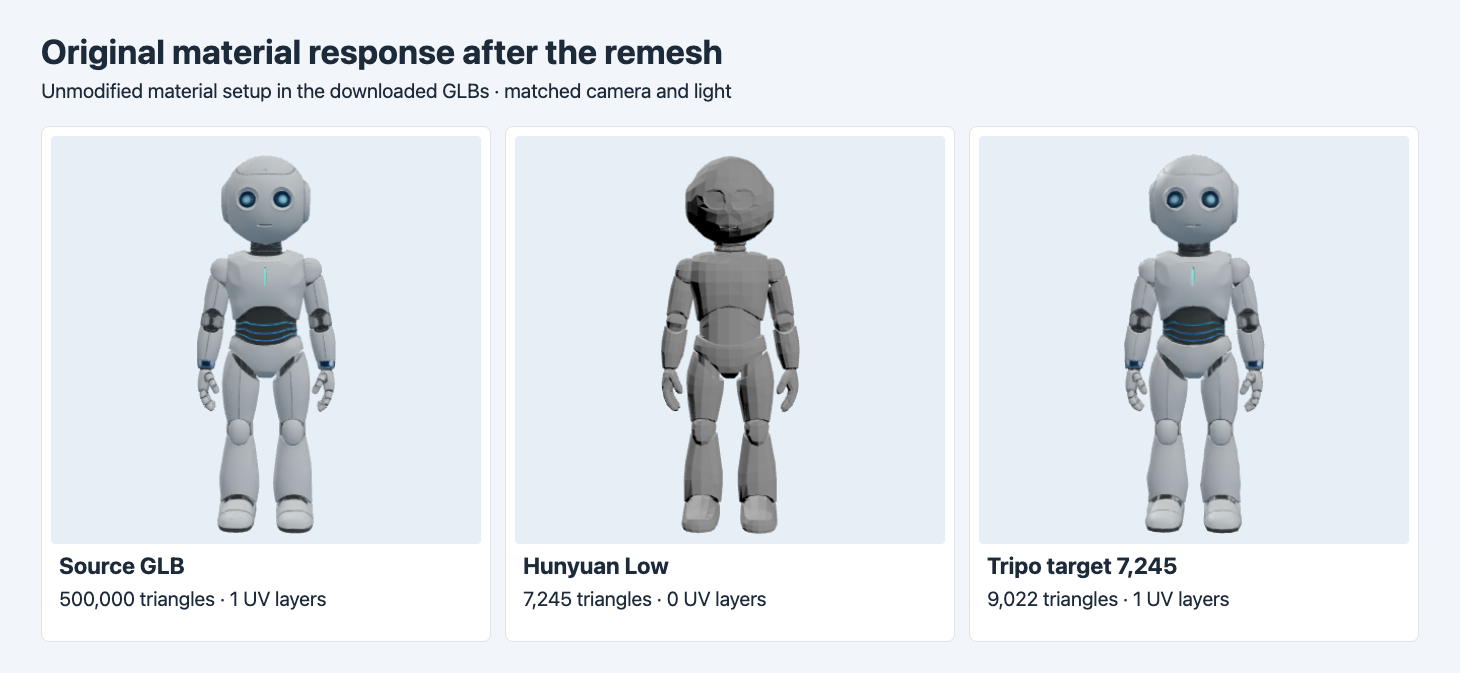
The source and the Tripo bake show blue eyes and waist stripes. The original Hunyuan output contains no material or UV data in this test.
The visible trade-off is easiest to see in the full-color comparison. The Hunyuan result is a compact shape with faceted surfaces. The Tripo result is much larger and preserves recognizable color details, including the circular blue eyes and the three waist lines. Blender found a UV layer and two images referenced by the material nodes. A UV layer on the output confirms it has texture coordinates. To claim the original UV islands were preserved, a test would also have to compare the actual UV mapping. The recorded setting asked for baking and the article treats the result as a usable textured copy of this source.
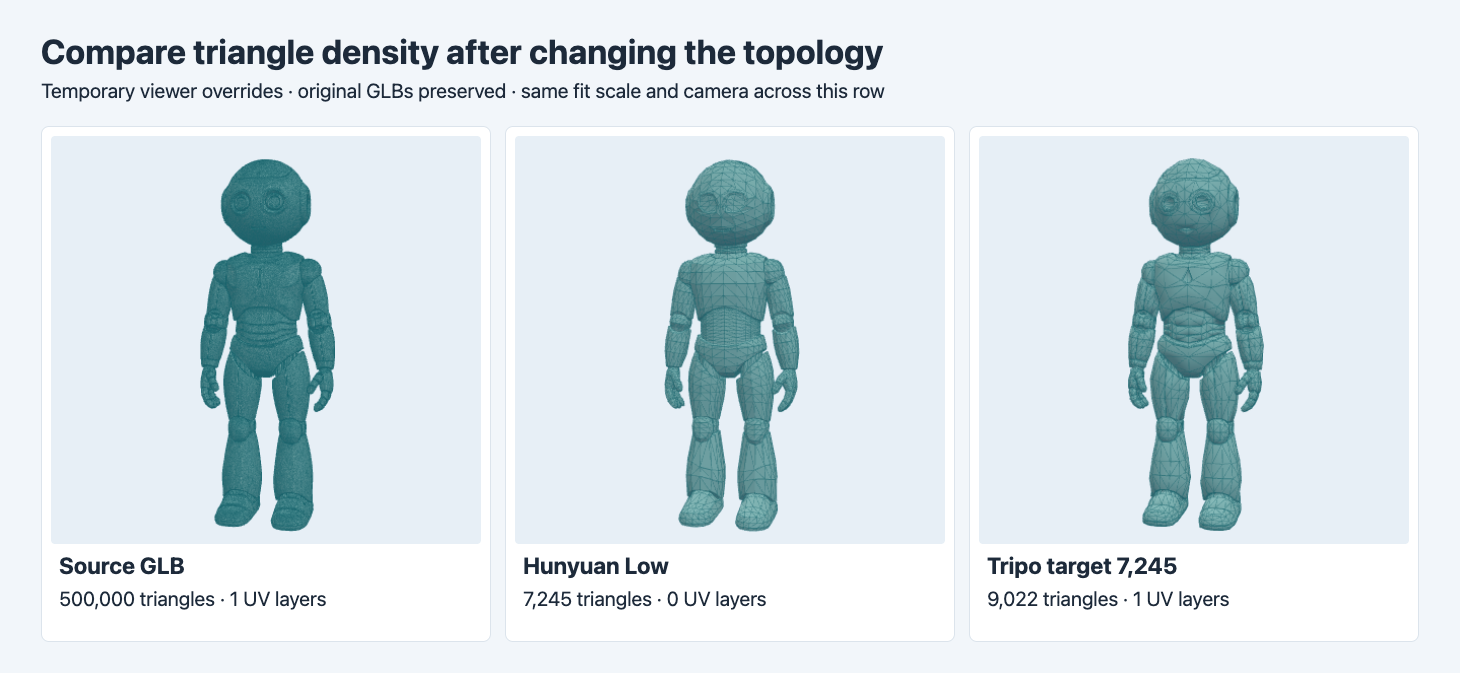
Wireframes show how the two reduced meshes distribute their remaining triangles around the face, torso and limbs. The original is too dense at this viewing distance to read individual edges.
The edges show a strong difference in triangle distribution on the chest and forearms. On the dense original, individual edges are too close together to follow at this camera distance. Both remeshes make the large structural panels easier to inspect. A three-dimensional render of the whole character can still hide lost seams in the hand and waist. If the model will be viewed at arm’s length in a product demo, take a close view at the actual expected screen coverage.
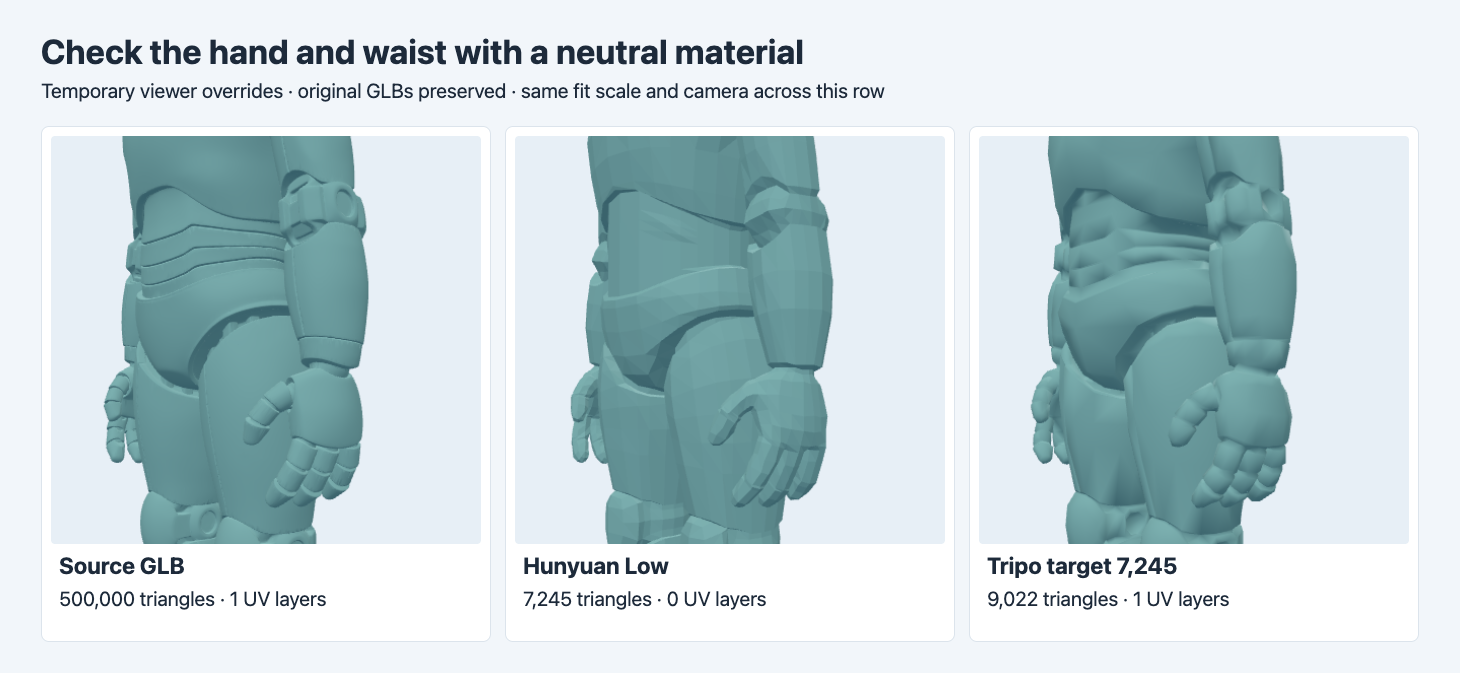
The same matte override exposes finger segmentation and waist relief. The Hunyuan surface is more visibly faceted. Tripo retains a clearer waist ridge in this view.
The source has individual creases between the finger segments and raised waist bands. Hunyuan’s wrist and fingers are visibly flatter and the waist has broad facets. In Tripo the wrist and fingers stay easier to distinguish and the waist ridges remain visible, though the surface still differs from the source. Since the materials were overridden in this screenshot, these differences are visible without the blue waist texture. The views indicate how the files might read when rotated or viewed close up. We did not test deformation, rigging, UV seams on a moving asset or runtime frame rate.
Choose based on what you need to ship
| Need | Start with | Acceptance check |
|---|---|---|
| Very small geometry for a downstream material workflow | Hunyuan Low | Check close-up geometry, and budget an unwrap and material step. |
| Colored output directly from the remesh job | Tripo with baking enabled | Count exported triangles and verify visible detail and any target viewer requirements. |
| Maximum of 8,000 triangles for this asset | Hunyuan Low passes the triangle cap in this test | Require materials separately if needed, and check any new export again. |
| Preserve thin or high-value details | Compare several settings against the original | Use fixed close-ups and inspect the chosen object in the destination renderer. |
For a repeatable trial, save the original file hash and submit the same accessible GLB URL to each route. The JSON below gives the closer-budget Tripo request. Use a server-side bearer token with POST https://api.sandbase.ai/v1/run, save the job ID, and read its status with GET /v1/run/{id}. On Hunyuan the request uses input_file_type: "glb", polygon_type: "triangle" and face_level: "low" in place of the Tripo controls. Both operations can incur a charge.
{
  "model": "tripo3d/tripo/remesh",
  "model_url": "https://static.sandbase.ai/examples/tencent/hunyuan-3d/3.1/smart-topology/input_input_file_url_0.glb",
  "face_limit": 7245,
  "quad": false,
  "bake": true
}
This is a public example URL for checking the request shape. To compare the same way we did, substitute your own original textured asset on both routes. Measure the raw download, evaluate the exported triangles and check texture response in your intended renderer. Record the working settings beside the resulting GLB so the next asset has a comparable history.
The textured 21,833-triangle result later became the fixed input for two Meshy rigging calls. See the single versus multi-animation test for the returned skeletons and a matched-frame look at the forearm deformation.
If you can control the count at generation time, the Tripo P2 face-limit comparison measures that route alongside remeshing a denser parent, with delivered counts and original GLB sizes for both.
FAQ
Was 7,245 a hard cap for Tripo?
The request accepted 7,245, and the tested GLB contained 9,022 triangles. Enforce your own hard cap after download if the renderer requires one.
Can I assume Hunyuan kept the source UV layout?
The tested Hunyuan file had zero UV layers in Blender. The tested Tripo files had UV data with baked images. Neither statement measures UV island correspondence.
Does the lower p95 establish which remesher is more accurate?
It reports sampled vertex-to-surface deviation from this particular source, after normalization. Visual checks and matched settings across more assets are needed for a wider comparison.
Found this useful? Share it