Meshy Single vs Multi-Animation Rigging in 2027
Compare Meshy rigging on the same robot. See actual charges, GLB and FBX exports, joint hierarchy, sampled animation frames and validator results.
On the same 21,833-triangle robot, a single Meshy rigging job cost $0.32 and returned a skeleton plus Double Combo Attack. The multi-animation job cost $0.44 and returned the attack and Idle as separate GLB and FBX pairs. At 1.72 seconds, both attack files show the same kind of stretched surface near a forearm. All five exported GLBs also report six validator errors each. The side-by-side files show why you need separate checks for the response structure, skeleton, and moving mesh before using the assets in a game.
Key takeaway
- The multi-animation job returned two result items keyed by action ID. Each had an animated GLB and FBX. The two items provided separate rig links that served byte-identical GLBs and byte-identical FBXs.
- All five output GLBs kept 21,833 triangles and used the same ordered hierarchy of 24 skin joints. Attack 92 had 66 channels and a duration of 2.867 seconds in both routes. Most decoded track values differed between the two attack exports.
- Both attack exports played in Three.js. At 1.72 seconds a thin sheet of stretched geometry is visible near the forearm in both. The validator separately reported six non-unit vector errors and one warning per output GLB.
- Both routes rejected the 500,000-triangle original. The subsequent matched trials used the same textured remesh, with the height, template and finger settings fixed.
Use the same input and change the action request
We used the silver robot from the Hunyuan Smart Topology and Tripo Remesh comparison. The original Hunyuan GLB contains 500,000 triangles. On November 14, 2026, we submitted it to both routes and received an upstream 422 in each case. Both error bodies identified the input count and a limit of 380,000 triangles. Meshy’s direct API documentation also lists a 380,000-triangle cap and describes an over-limit request as 400. Code handling the SandBase route should keep the returned error details along with the status. Meshy Rigging API documentation
We reused the 21,833-triangle result of the earlier Tripo run that requested 20,000 triangles and baked the textures. The file weighs 6,449,244 bytes, has two embedded images and contains no skin or animation. The original count and the requested remesh target are different fields in our records. Measuring the resulting triangles before submission is the reproducible check.
Both completed requests used the same remeshed file, 1.7 meters for estimated character height, the meshyrig template and no finger bones. The Meshy Rigging route on SandBase used enable_animation: true and animation_action_id: 92. The Meshy Multi-Animation route on SandBase used animation_action_ids: [92, 0]. This gives one matching action to inspect across routes and a second action to check the shape of the multi response.
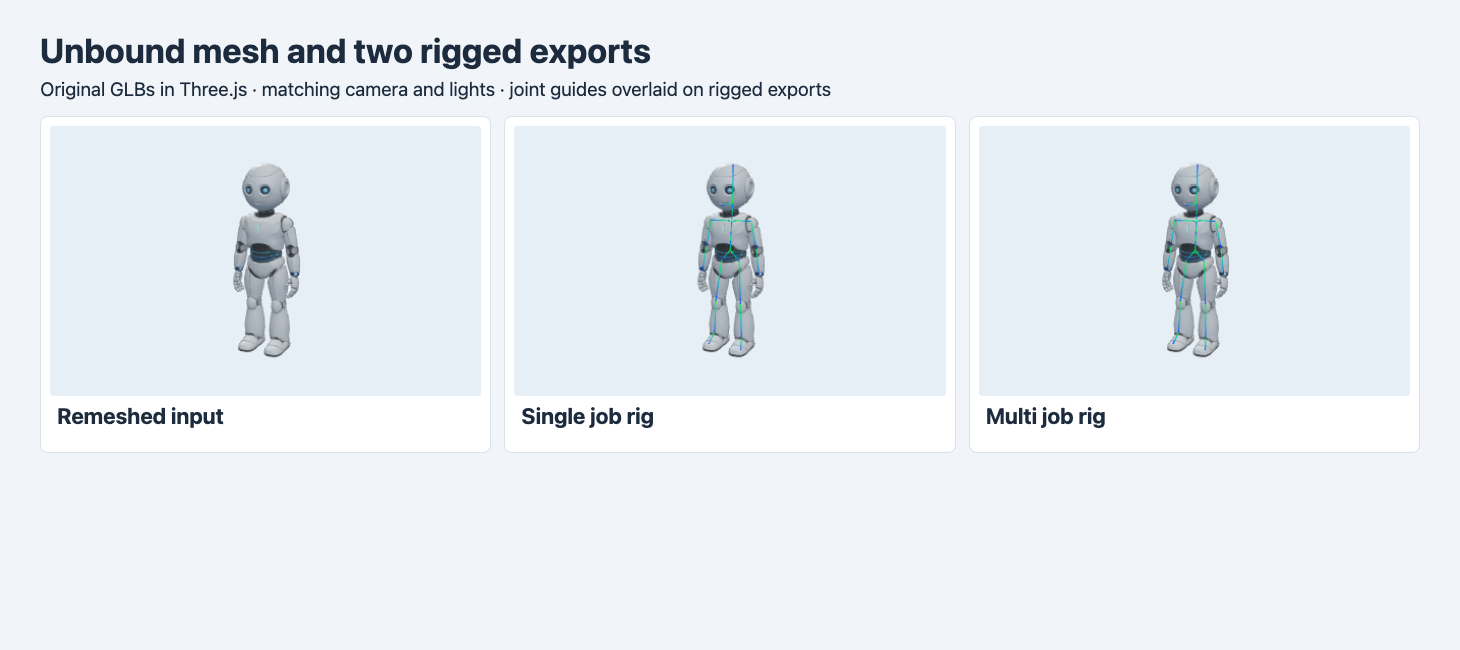
The unbound input is on the left. The center and right panels are the original rigged exports with a Three.js joint guide drawn over each model.
Read the response fields before downloading
The single run returned one result item. Its url and fbx fields pointed to the rigged files, and animation_glb and animation_fbx pointed to the action files. The multi run returned two items, for IDs 92 and 0. In those items url pointed to the action GLB, animation_fbx to the action FBX, and rigged_glb and fbx to that item’s rig exports. The two items used different download links. After downloading both pairs, we verified matching SHA-256 hashes within each format. A downloader that assigns the same meaning to url across both routes can save the wrong file under the rig filename.
| Route | Requested actions | Rig file pair | Animated file pairs | Settled charge |
|---|---|---|---|---|
| Single | 92, Double Combo Attack | 1 | 1 | $0.32 |
| Multi | 92, Double Combo Attack, and 0, Idle | 1 shared | 2 | $0.44 |
The additional $0.12 is the difference between these two completed jobs. The comparison excludes the earlier mesh-generation and remesh charges. The two rejected runs had no settled charge in the receipts available for this test. We did not run two separate single-action jobs, so there is no observed two-single total or timing comparison. The useful billing unit here is the requested action set and the number of exports that survive your own checks.
Use the model and action ID as metadata, then put the actual downloaded file under your own stable asset ID. Test for duplicate and missing actions when handling the multi array. If you consolidate the rig files, compare hashes after downloading because the links may differ. In JavaScript, use a presence check or nullish test for action_id; Idle is ID 0, so a truthiness check would skip a valid result. If a later application needs a single character file with a clip library, plan a separate consolidation step and test the consolidated export in that application.
Compare the attack and inspect the deformation
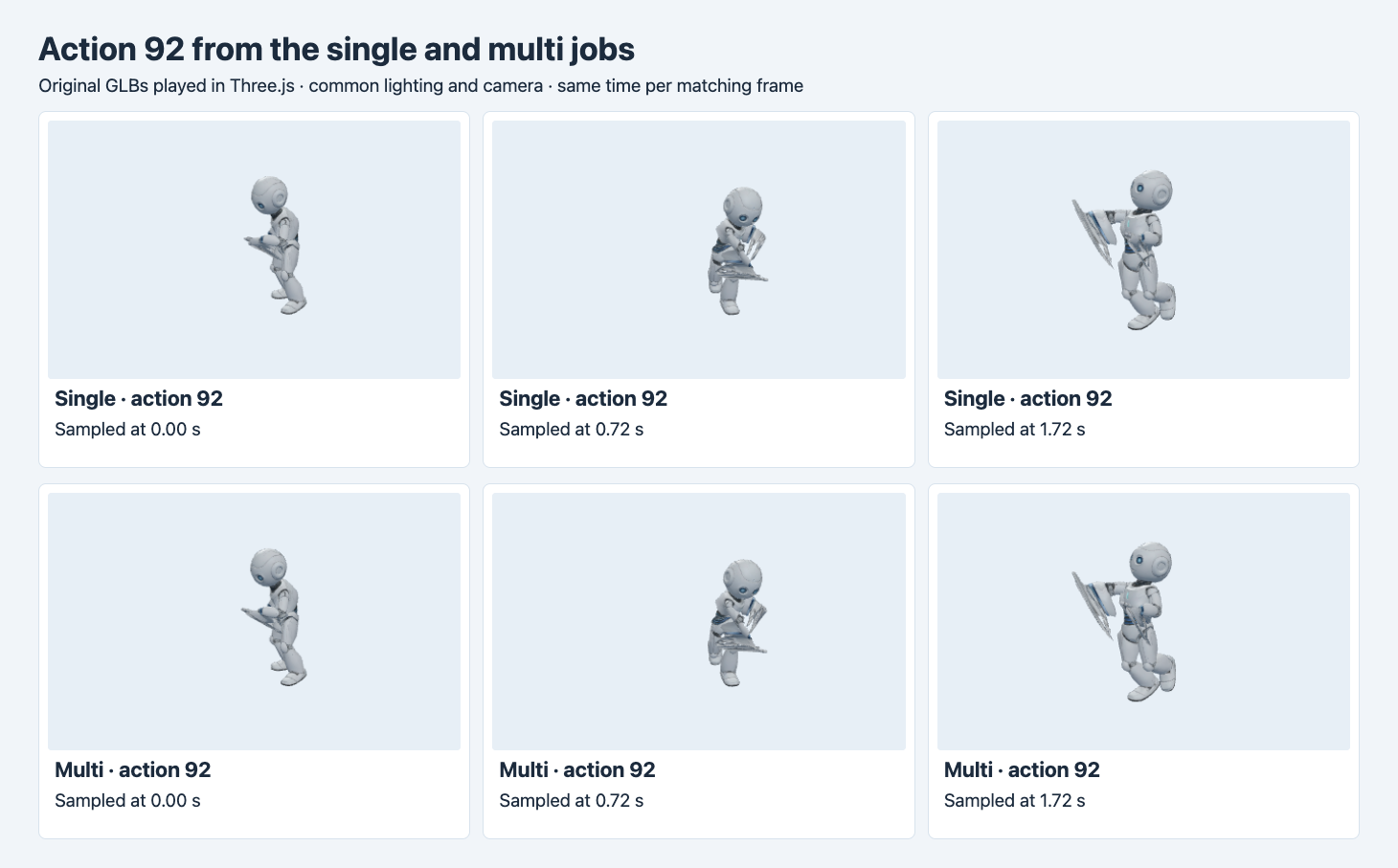
Both rows play the original attack GLBs at 0.00, 0.72 and 1.72 seconds with a fixed camera and lighting. The far-right column shows a sheet-like stretch near the forearm in both exports.
We read the original GLB containers and matched joint order and parent names. The single attack file measured 7,543,296 bytes and the multi attack measured 7,542,940 bytes. Each contained one 66-channel attack clip. Comparing the decoded input and output accessors by target joint name and channel path, the timestamp arrays matched in all 66 channels. Only two channels had exactly matching output arrays. The largest absolute differences in stored components were about 0.0513 for quaternion rotation and 0.550 for translation. These are differences in file values and carry no direct interpretation as degrees, world-space meters or visible displacement.
The hierarchy check helps you identify candidates for animation reuse. To decide whether a clip can safely move between rigs, compare joint transforms, inverse bind matrices and the resulting skinned pose in your target engine. In the sampled GLBs the inverse bind matrices already differed. The screenshots play each clip with the rig embedded in its own file. In that paired setup, the full-character poses are close at the chosen frames, with visible small differences. Playing each file on its own is a useful check before attempting any clip transfer.
The attacking forearm is the more consequential issue on this robot. A thin triangular surface extends away from it around 1.72 seconds in both versions. The pictures establish where and when the issue is visible. To debug it, inspect nearby triangles in the bind pose and view the vertex influences around the elbow, wrist and adjoining torso in a DCC tool. Compare the same pose after any repair, with the same camera and clip. This trial does not isolate which mesh, weights or export step produced the stretching.
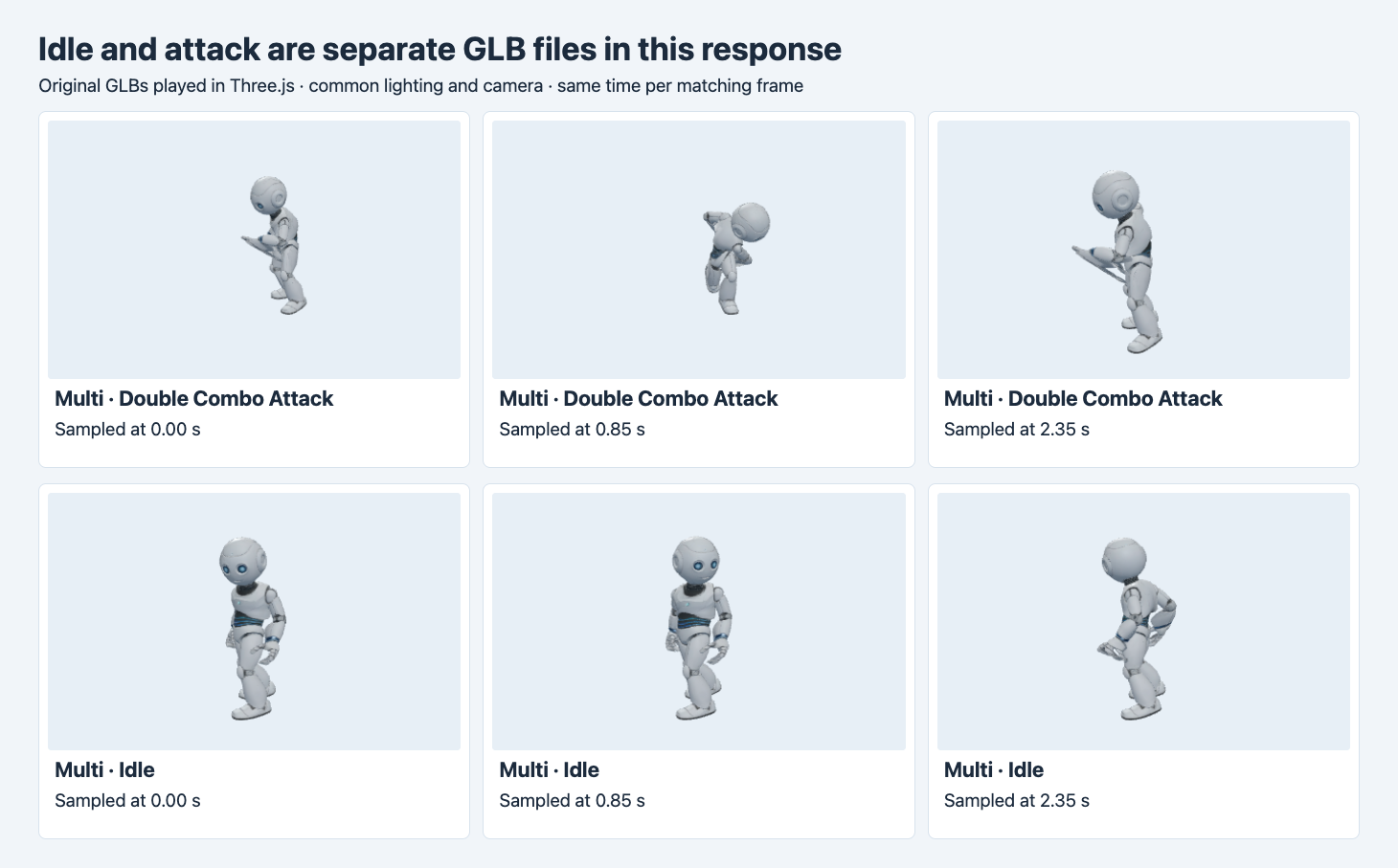
Double Combo Attack is on the top row and Idle on the bottom. Each row samples its own GLB at 0.00, 0.85 and 2.35 seconds.
Check the GLB and FBX independently
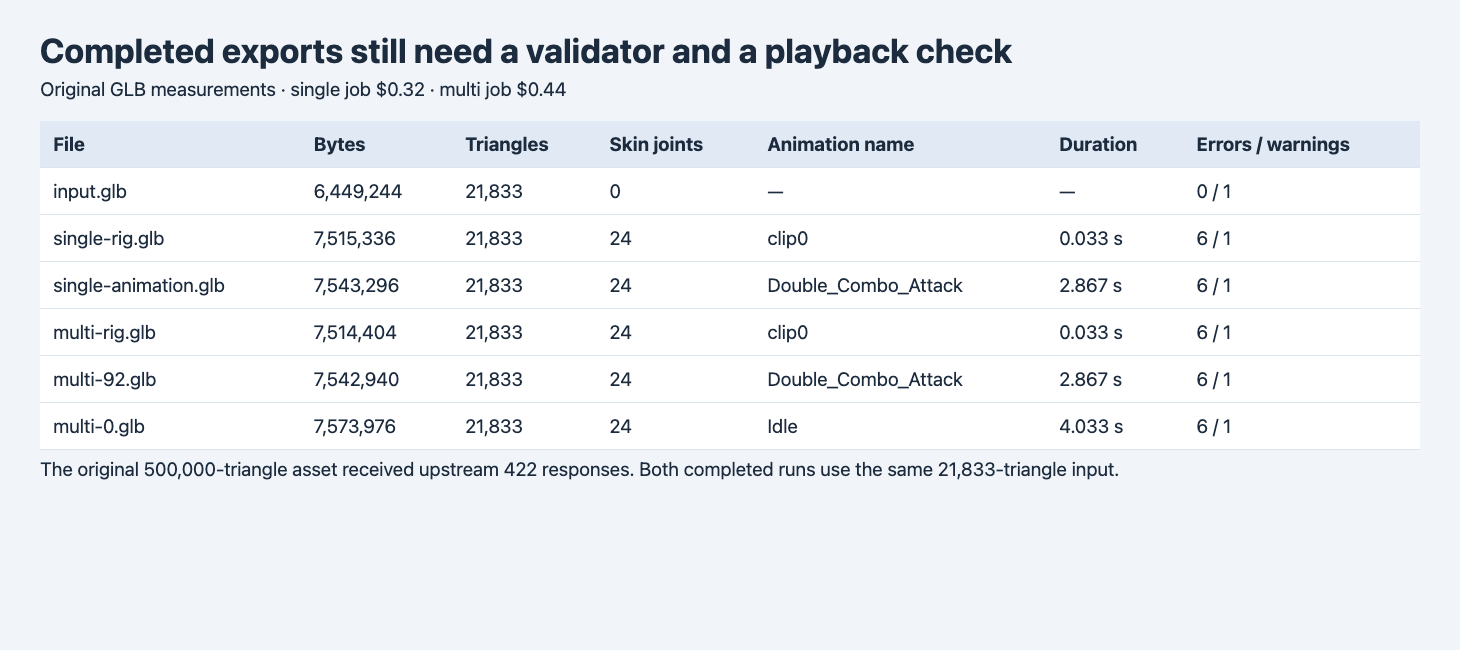
The two rigged GLBs each contain an approximately 0.033-second clip0. The attack and Idle clips are in their separate exports.
All five output GLBs reported six ACCESSOR_VECTOR3_NON_UNIT errors and one NODE_SKINNED_MESH_NON_ROOT warning. The remeshed input reported zero errors and one warning about generated tangent space. A successful render is an observation about what Three.js displayed. Keep the validator result as its own acceptance field, especially if a downstream importer treats those errors as fatal. The validator code does not identify the cause of the forearm stretch.
We also imported the five original FBX files separately into empty Blender 4.5.9 scenes. Each produced one mesh and one 24-bone armature. At 30 fps, the action range for each attack FBX was frame 1 to 86, and Idle was frame 1 to 121. Counting the frame intervals gives 2.833 and 4.000 seconds in those imports. The GLB durations were measured from their animation accessor timelines, at 2.867 and 4.033 seconds. These are measurements of specific exports with specific readers. Set loop boundaries and action events against the version the game will use.
Select the job by the deliverable
Use the single route when you have one preview motion or want to run a deformation test before paying for more actions. Use the multi route when one character needs a known set of motions and your importer can associate several files with the same source rig. For both routes, log the source hash and actual triangle count before submitting. Then save the run ID, persist returned files as soon as they are ready and inspect each original separately.
For the multi call, send the following JSON to POST https://api.sandbase.ai/v1/run with a server-side bearer token. Replace the example URL with your own accessible textured humanoid GLB below the triangle limit. Poll the returned run ID via GET /v1/run/{id}. The action request can incur a charge.
{
  "model": "meshy/rigging/multi-animation",
  "model_url": "https://example.com/assets/character.glb",
  "height_meters": 1.7,
  "skeleton_template": "meshyrig",
  "include_fingers": false,
  "animation_action_ids": [92, 0]
}
Keep intake, technical validation and visual approval as separate states. A high triangle count is an intake failure that requires a changed input. The non-unit vectors are a file-level issue, and the stretching is an issue visible in a particular moving pose. This separation helps you decide whether to prepare the asset again, repair a file, or reject a specific action after review. For further checks on an original GLB, see the generated GLB QA workflow.
For the next step after download, the Godot character animation walkthrough replays action 92 and Idle in the engine, then compares bone motion and low toe-marker movement.
FAQ
Does multi-animation put both clips in one GLB?
For this response, each action had its own GLB and FBX. The rigged GLB was a separate shared file with a short clip0. Test the response fields before treating any file as a combined clip library.
Does a 24-bone result guarantee character compatibility?
The count is a useful inventory measurement. This one-robot test found matching names and parent links across the exports, and differing inverse bind matrices across the attack pair. A transfer to another file or engine needs its own joint mapping and pose checks.
SandBase ran the two API routes and supplied the settled charges. The screenshots are our renders of the downloaded GLBs. The cover is an illustration.
Found this useful? Share it