Hunyuan 3.1 Pro vs Tripo P2: 40K and 50K Polygon Budgets Tested
Compare Hunyuan 3D 3.1 Pro and Tripo P2 on two shared face budgets, with actual triangle counts, GLB bytes, charges and geometry differences.
At a requested 40,000 faces, Hunyuan 3D 3.1 Pro returned exactly 40,000 triangles and Tripo P2 returned 45,007. At 50,000, they returned 50,000 and 57,908. The counts came from four original GLBs generated from the same front render, with textures off. The 40K Tripo output had the closest observed rear-connector depth in one small region, while the 50K Hunyuan had the smallest depth difference over the full back. If you have to fit a scene under a triangle budget and keep a usable silhouette, verify both at export.
Key takeaway
- Hunyuan’s
face_countwas exact for both requests in our test. Tripo’sface_limitwas advertised as a maximum and its two delivered triangle counts were 12.52% and 15.82% over the respective requests. The actual comparison point is the triangle count in the downloaded file. - Hunyuan charged $0.525 per run. Tripo charged $1.20. Each Tripo file was more than three times as large as the corresponding Hunyuan file. Both had no images, and the Tripo files carried normals and UVs.
- Tripo at 40K gave a side silhouette intersection-over-union of 63.40%, the highest of the four here. Hunyuan at 50K gave the lowest mean rear depth difference at 6.73% of the normalized longest side.
- The extra triangles did not consistently improve shape. Use a hard size gate for compliance and inspect the accepted front, profile and rear at their intended camera angles.
Use the overlap in the request schemas
Hunyuan 3D 3.1 Pro accepts a face target between 40,000 and 1,500,000. The inspected Tripo P2 triangle request accepts 48 to 50,000 through face_limit. We chose both ends of their common interval. The quad option has a separate maximum of 25,000. Here we turned quad off. Hunyuan used Geometry mode, with PBR disabled. Tripo used texture: false, pbr: false and seed 42. Hunyuan’s inspected route did not expose a corresponding seed.
We sent the exact same 768 × 768 front render for all four requests on November 14, 2026 UTC. It shows a small authored equipment case with a carry handle, controls, base feet and a colored projection. We kept the local reference GLB for measurement and withheld the other views from all four jobs. The surface reference is a 972-triangle model we used to render the input. Its low count reflects how the simple object was authored.
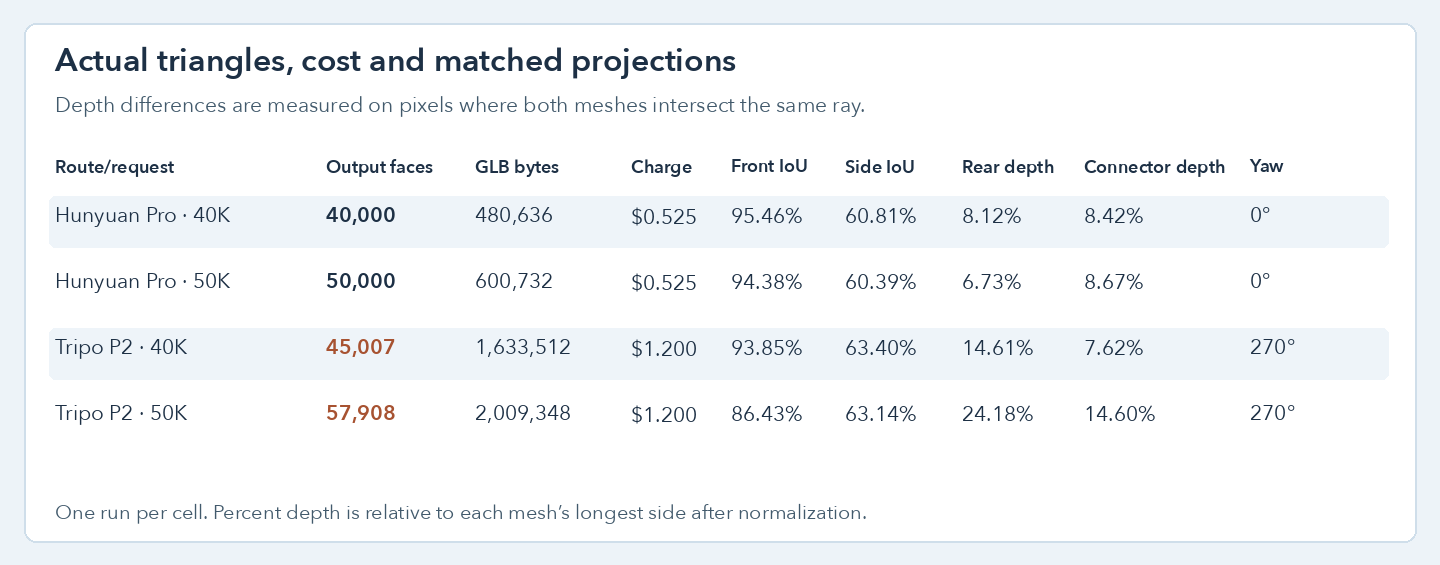
Four single-run measurements. The face and byte columns come from the downloaded GLBs. The geometry metrics use the local reference and front-selected yaw.
Hunyuan’s $0.525 consisted of its $0.375 listed base plus the $0.15 face target charge. Each Tripo geometry-only job settled at $1.20. The four-run bill was $3.45, with no extra views and no retries. Prices reflect the exact tested routes and request modes. If you add textures or input views, inspect the price for those settings.
| Route and request | Exported triangles | Difference | GLB size | Actual charge |
|---|---|---|---|---|
| Hunyuan Pro, 40,000 | 40,000 | 0 | 480,636 bytes | $0.525 |
| Hunyuan Pro, 50,000 | 50,000 | 0 | 600,732 bytes | $0.525 |
| Tripo P2, 40,000 | 45,007 | +5,007 (12.52%) | 1,633,512 bytes | $1.20 |
| Tripo P2, 50,000 | 57,908 | +7,908 (15.82%) | 2,009,348 bytes | $1.20 |
For a 45,000-triangle hard budget, the 40K Tripo file would miss by seven faces. The 40K Hunyuan file would leave 5,000 for other scene work. Count the actual delivered mesh before routing it to an optimization or rejection step. When instanced meshes are present, decide whether the budget counts unique geometry or every drawn instance. Each output here had one node and one mesh, so there was no instance ambiguity.
Separate geometry count from file size
All four outputs contained triangular geometry, passed the glTF validator with zero errors and zero warnings, and had no embedded images. The 40K Hunyuan file devoted 239,904 bytes to position attributes and 240,000 bytes to indices. The 40K Tripo file devoted 510,852 bytes to positions, another 510,852 to normals, 340,568 to UVs, and 270,042 to indices. At the 50K request the pattern was similar. Each source pushed a different vertex layout and the actual counts differed. The higher byte total therefore has several causes even without textures.
The asset loader can shade a position-only mesh by constructing normals, and different engines can recompute or preserve them differently. An asset with stored normals and UVs has a different starting point if a later workflow wants to apply a material. The reported byte sizes are complete source GLBs. They exclude HTTP compression, textures added later, GPU working buffers and the viewer bundle. For a hard file cap, store bytes alongside triangle and vertex counts.
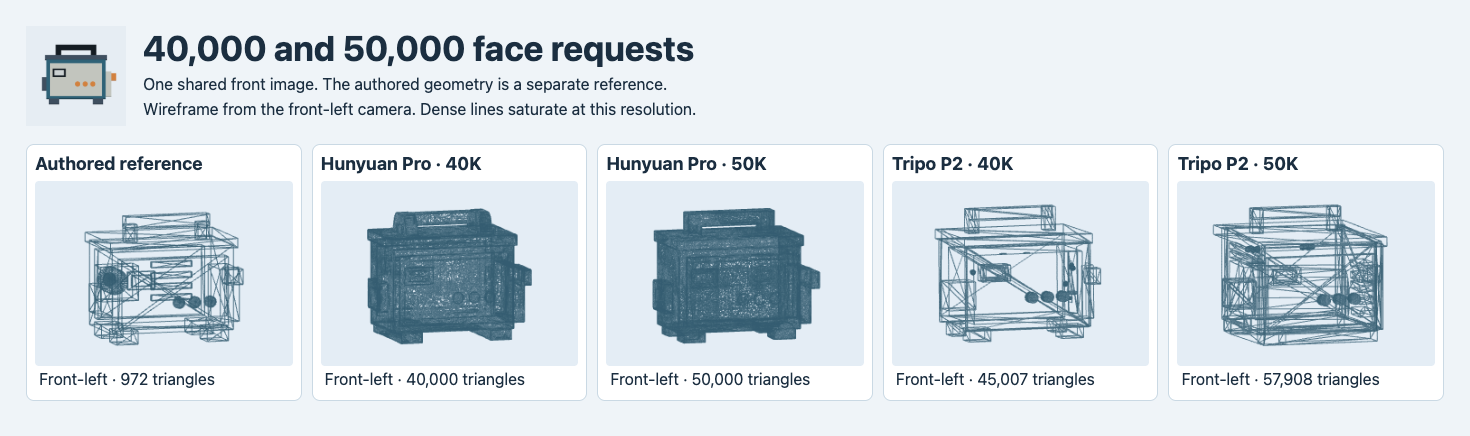
The viewer draws original triangle edges with the same framing and per-file yaw correction. Dense lines saturate at this print size. The stored face counts come from the geometry, not the line density in the image.
Compare shape against a reference with matched cameras
In Blender 4.5.9, we independently centered each mesh and divided its positions by the longest side of its bounds. A 128 × 128 orthographic grid cast rays from each side. To match yaw, we considered four quarter turns and selected the highest front silhouette overlap minus the mean front depth difference. This used the front only, so the profile, back and connector region were read after the alignment choice. Hunyuan used native yaw and Tripo was rotated 270° in the measurement coordinate system. The neutral screenshots use the same alignment.
For the silhouettes we use intersection-over-union. Count the pixels hit by both meshes and divide by pixels hit by either. Mean first-hit depth uses only rays that hit both. The values express the difference as a percentage of normalized longest side, and tell you how far the visible surface moves along the camera ray in shared pixels. They do not recover physical dimensions. Depth error does not penalize missing pixels, so use it with overlap.
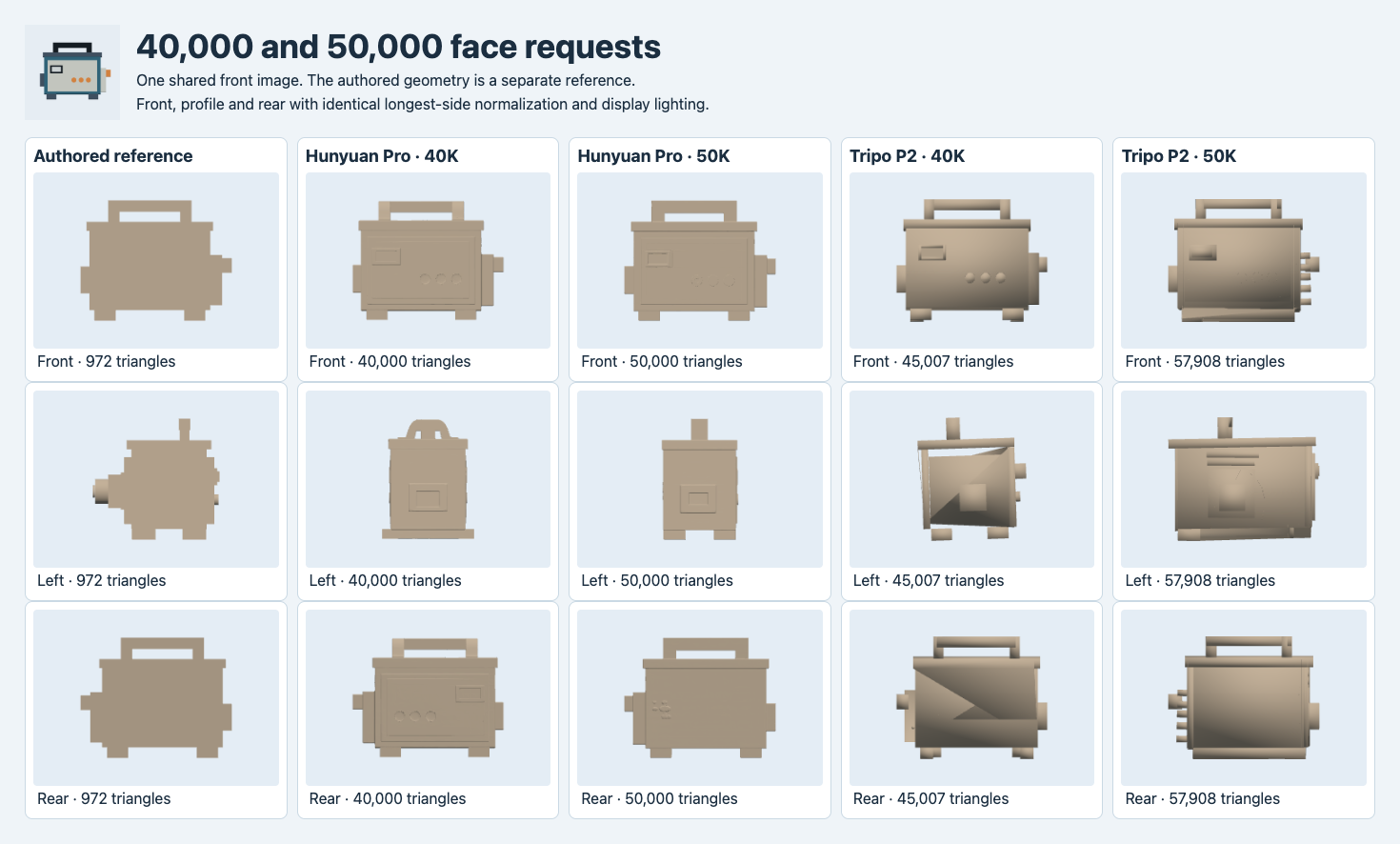
The image at top left is the shared input. The first column is the authored mesh. Both Tripo outputs are aligned by the front score. All renders use a shared neutral material, though original normals are used where available.
| Route and request | Front IoU | Left IoU | Back mean depth | Rear connector mean depth |
|---|---|---|---|---|
| Hunyuan Pro, 40K | 95.46% | 60.81% | 8.12% | 8.42% |
| Hunyuan Pro, 50K | 94.38% | 60.39% | 6.73% | 8.67% |
| Tripo P2, 40K | 93.85% | 63.40% | 14.61% | 7.62% |
| Tripo P2, 50K | 86.43% | 63.14% | 24.18% | 14.60% |
The distinct control features and carrying hole read more clearly at some angles than others. On Tripo’s 40K front, all three raised buttons are visible under the display. In its 50K front they are faint under the same imaging setup. Both Hunyuan exports retain the opening in the front handle, with different profile contours. The Tripo 50K side has more horizontal projections than the source. Use the screenshots to identify where to look and the depth samples to estimate its extent. Shading alone cannot establish whether a groove or connector is actually present, especially with different normals.
The 50K Hunyuan had the best whole-back mean depth, while its connector result moved slightly away from the reference compared with 40K. Tripo at 40K had the lowest connector-region mean on this object even though the rest of the rear was further away than Hunyuan. This region was a fixed rectangle in the reference back raster. These are averages over the visibly shared surface. Only the front image was supplied, so hidden features had to be inferred by each route.
Apply the budget after measuring the export
Keep the two request parameters distinct in your configuration and persist the actual export measurements. A practical acceptance check records the number of triangles, byte size, attributes and any submeshes rendered together. Follow it with a small panel showing the silhouette and the most important functional surface. If either check fails, keep the raw asset and use an explicit post-generation remesh or choose a different request. A remesh can alter surface detail, so test the repaired file against the asset you approved, as in the generation versus remesh comparison.
Choose the 40K Hunyuan configuration from this batch when an exact modest triangle count and low source bytes are the priority. Inspect Tripo’s 40K output when the local side and connector shapes are more important and you can accommodate the extra faces or fit them in a separate pass. Move to an extra input view if unseen geometry matters more than the polygon count. See what held up on the same fixture in the multi-view 3D API comparison.
Frequently asked questions
Are these face counts the same as polygon counts in my modeling tool?
In this experiment every primitive was decoded as triangles. Tools can count quads or n-gons before triangulation, so compare the triangulated mesh from the export path used for release.
Does 50,000 triangles always preserve more detail than 40,000?
The four outputs were independent generations. Hunyuan’s whole-back mean improved at 50K and its front silhouette decreased slightly. Tripo’s front and back metrics also changed, with the 50K result further from the reference in these observations. A single generation at each count does not separate setting effects from generation variability.
Should a GLB with zero validation warnings pass the scene budget?
Check both independently. All four passed format validation, while both Tripo files exceeded the requested count. A budget check should fail on the actual exported triangles, bytes or instance workload specified by your runtime.
Found this useful? Share it