Hunyuan vs Tripo vs Meshy for Text-to-3D in 2027
Six text-to-3D runs on two game props compare Hunyuan, Tripo and Meshy by actual cost, GLB size, triangles and model renders.
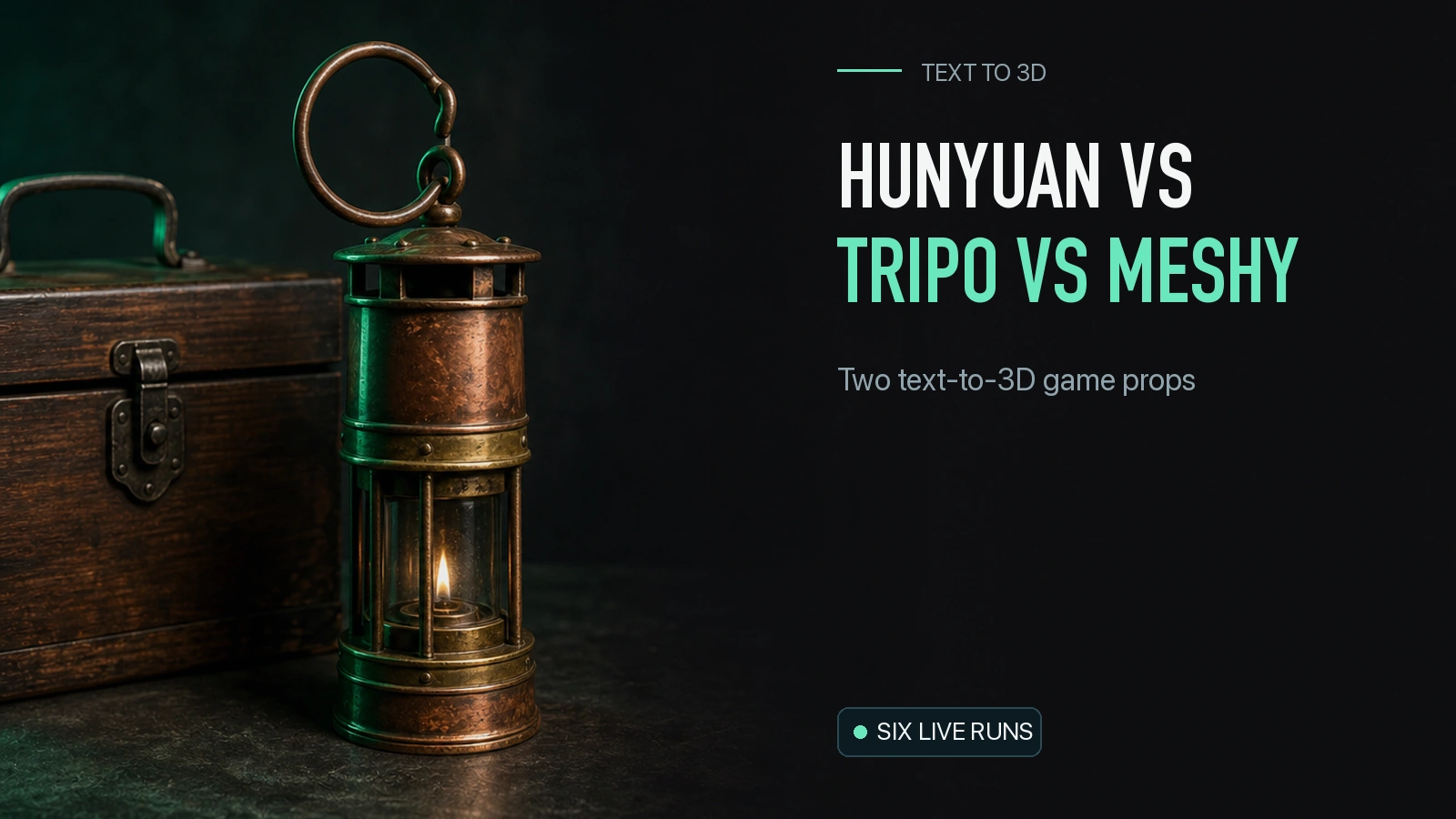
Every API returned a valid GLB for the tool chest, and every chest had a carrying handle on both ends in our renders. The prompt had asked for a single handle on the right. The same three models produced recognizable mining lanterns, but their chamber shapes and material fields varied. Six real calls to Hunyuan 3D 3.1 Pro, Tripo H3.1 and Meshy 7.1 show where a text-to-3D preview can pass a format check and still miss a usable game-prop brief.
Key takeaway
- All six jobs returned original GLBs with zero Khronos validator errors and warnings. Across the six requests, SandBase recorded $4.410 in charges.
- Tripo was the smallest and cheapest of the tested outputs for both briefs. Its files were 2,047,652 and 2,004,668 bytes, with $0.240 charged per run.
- Hunyuan delivered exactly 40,000 triangles for both requests. Tripo and Meshy delivered from 34,410 to 39,183 triangles under the 40,000 request settings.
- All three tool chests show a handle on both ends in the latch-aligned orbits, so none met the single-right-handle requirement on this run.
- Every lantern had an opaque GLB material with an amber-toned base color in the preview. The tests did not deliver or measure physically transmitting glass.
Match the prompts and the settings the APIs share
We wrote two short production briefs for an isolated prop. The copper mining lantern required a large open D-shaped carrying handle, an amber cylindrical chamber, four exterior bars and a dark round base. The wooden tool chest called for a closed rectangular box with corner brackets, two lid straps, a square brass latch and exactly one open carrying handle on the right end. Both briefs asked for an isolated object, with no floor or text. Each route received the same prompt bytes for the same object.
We used a target of 40,000 in the face or polygon field exposed by each API. Hunyuan took face_count, Tripo took face_limit, and Meshy took target_polycount. We chose textured output, disabled the documented PBR add-ons and selected triangle topology where there was a field for it. Tripo and Meshy received seed 42. The Hunyuan route exposes no seed in the inspected schema. A shared number on two endpoints does not imply matching internal generation state. The test controls the text and closest available settings and keeps those provider differences visible.
We reviewed each GLB with identical viewer lights and per-file normalized framing. For the chests, we chose the broad face with the visible brass latch as the front. The Tripo export needed a 90-degree camera offset to align that face with the other two. With the front defined this way, the side to the viewer’s right is the right end. This matters for an asymmetric brief, because a default axis can face a handle instead of the latch.
Compare the actual files and charges
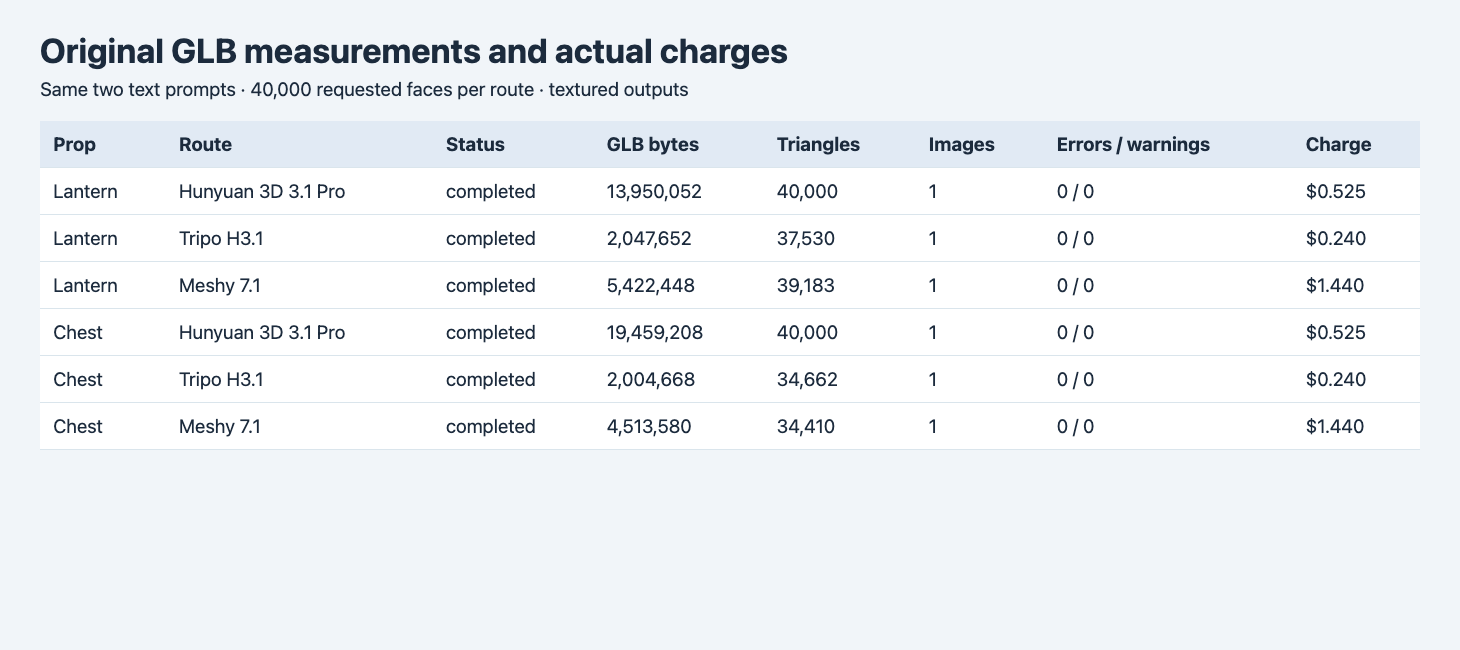
The table was generated from the original GLBs and the six settled completion receipts. Times were not independently instrumented.
| Brief | Route | GLB bytes | Delivered triangles | Images | Validator errors / warnings | Actual charge |
|---|---|---|---|---|---|---|
| Lantern | Hunyuan 3D 3.1 Pro | 13,950,052 | 40,000 | 1 | 0 / 0 | $0.525 |
| Lantern | Tripo H3.1 | 2,047,652 | 37,530 | 1 | 0 / 0 | $0.240 |
| Lantern | Meshy 7.1 | 5,422,448 | 39,183 | 1 | 0 / 0 | $1.440 |
| Chest | Hunyuan 3D 3.1 Pro | 19,459,208 | 40,000 | 1 | 0 / 0 | $0.525 |
| Chest | Tripo H3.1 | 2,004,668 | 34,662 | 1 | 0 / 0 | $0.240 |
| Chest | Meshy 7.1 | 4,513,580 | 34,410 | 1 | 0 / 0 | $1.440 |
Tripo accounted for $0.480 of the six-run bill, Hunyuan for $1.050 and Meshy for $2.880. A cap of 5,000,000 bytes would admit both Tripo originals and the Meshy chest. The Meshy lantern and both Hunyuan files would exceed it. The most expensive route did not have the largest output for either prop. A size ceiling, a triangle ceiling and an actual invoice each need their own recorded field. Measure and reduce GLB size for web delivery
The six files each carried one base-color image, with no metallic-roughness or normal image in the inspected material slots. The three lantern materials used the opaque alpha mode, and none declared a transmission extension. An orange panel in a preview therefore demonstrates an amber-like appearance in this setup. A real-time scene that needs to show the light source through the chamber should inspect and configure material transmission separately.
Lantern: a front view can hide the loop
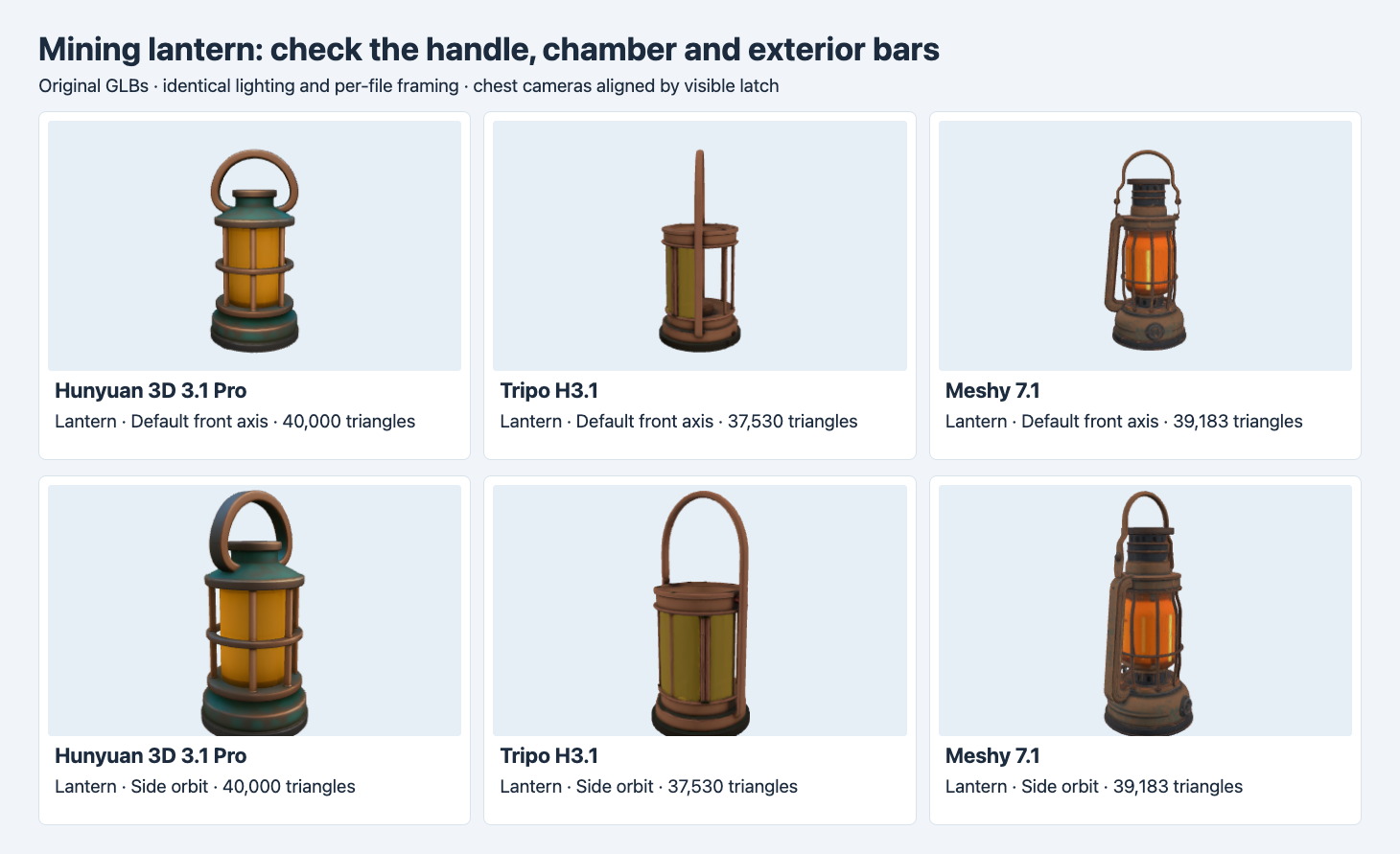
The top row uses each export’s default front axis. The side orbit reveals the opening of the Tripo handle, which looks edge-on in its first view.
Hunyuan produced a compact lantern with a thick open top loop, broad green rings and an amber-colored cylinder. The external bars read clearly in the side view. Tripo’s handle looked almost like a vertical rod in the default view. Rotating the camera exposed a tall open loop and also showed that part of the chamber is visibly open between the bars from the opposite view. Meshy produced a narrower, more weathered lantern with a dark cap, orange center and thin guard elements. The handle opening is visible above the cap.
The images establish that all three have a recognizable opening and some visible external guard geometry. We did not certify an exact four-bar count from the rendered stills. A strict prop gate can require a full rotation or a geometry inspection before counting. If you only need a background prop, start from the silhouette and total bytes. For a close interactive prop, check the depth of the loop and the chamber material from the camera angles a player can reach.
Chest: the extra handle appears on the other end
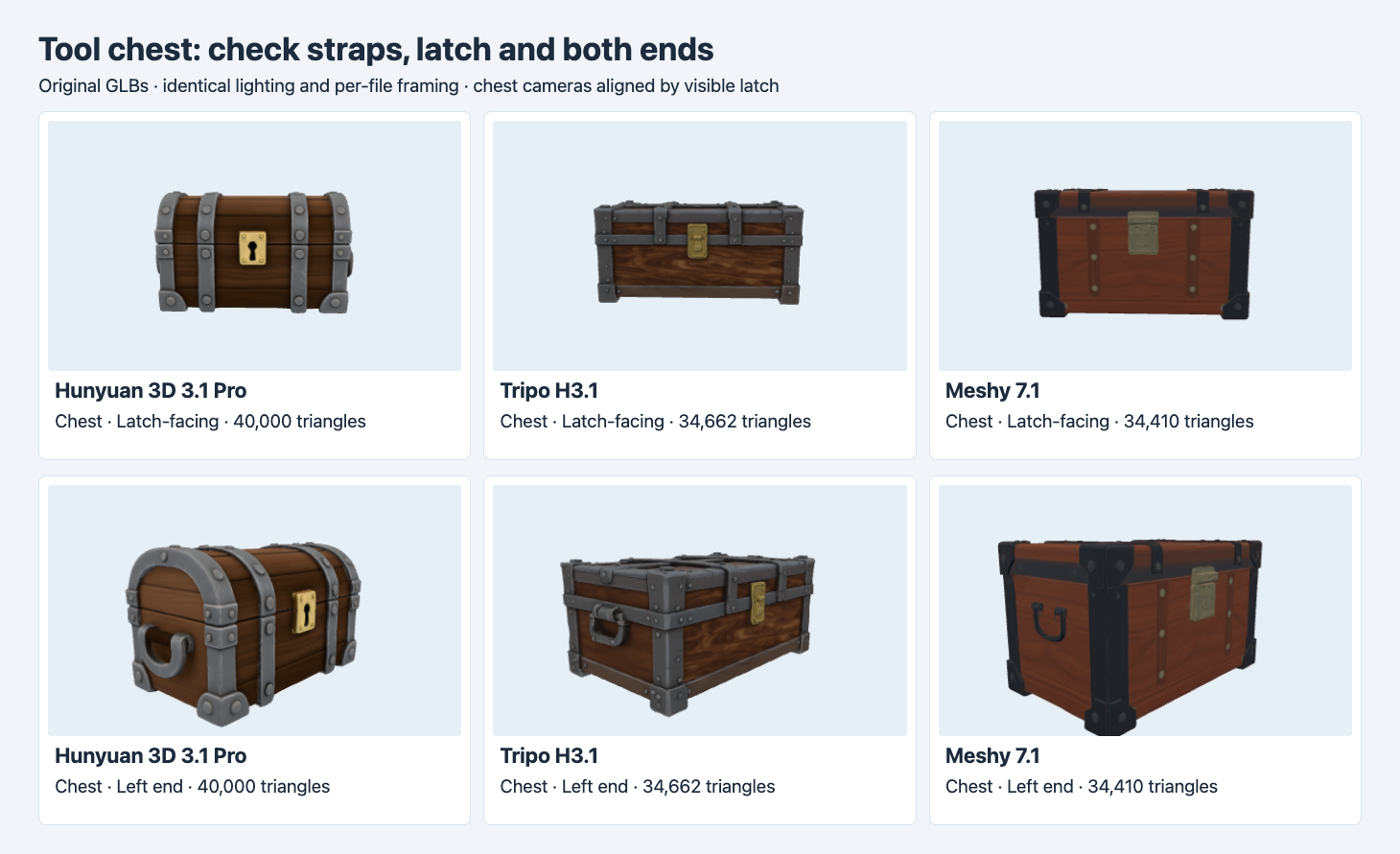
The front is defined by the brass-colored latch, independent of the export axis. Each left-end view shows a handle that the brief did not request.
The three models agreed on a wooden body and reinforced corners. Hunyuan interpreted the brief with a domed lid and broad metal bands, even though the brief requested a rectangular body. Tripo rendered a flatter lid and a narrow metal border with more conspicuous wood grain. Meshy kept a boxier silhouette with dark corner plates and a brass-colored latch. The shared failure appears after rotating. Every chest shows a handle on the left, and every one also shows a handle on the right. The right-end requirement alone would be a false pass for a single-handle prop.
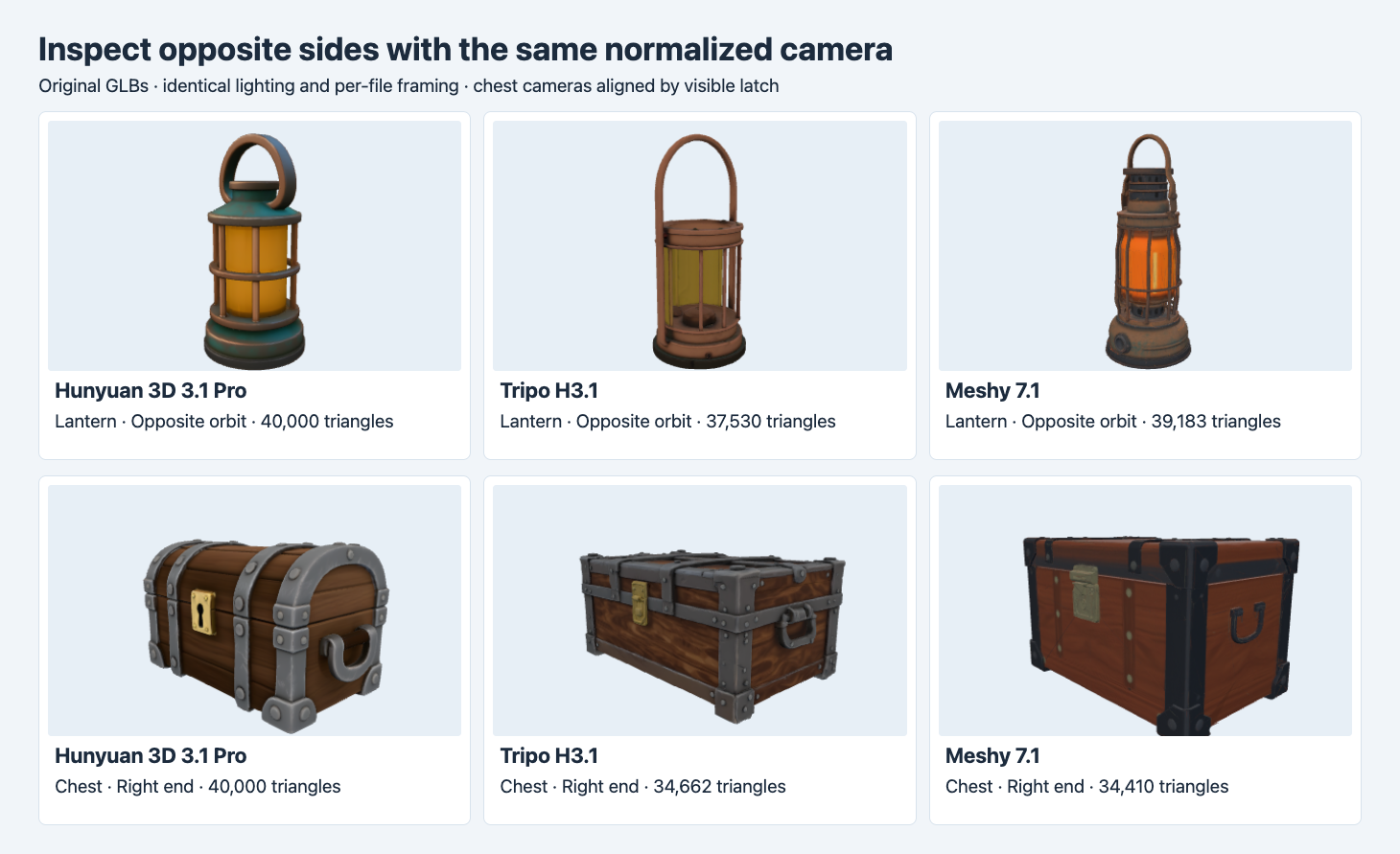
The lower row shows that a right-end handle is present on every chest. Read it with the left-end row above to check the duplicate.
A batch QA rule can encode this distinction by recording required and forbidden elements. The right-end handle is required. A left-end handle is a separate failure. Preserve both renders when a human reviewer makes that decision, so someone can check the handedness later without reopening all six models. If you plan to repair the wrong side manually, track the time and compare it with the cost of more generations. The $4.410 observed here covers generation only. Calculate generation cost per accepted 3D asset
Choose the first route by your prop constraints
| Requirement | First trial | Verify after download |
|---|---|---|
| Small original GLB for an early prototype | Tripo H3.1 | Confirm materials and geometry from more than one angle. |
| Reproduce the exact tested triangle target | Hunyuan 3D 3.1 Pro | Count exported triangles and check the larger file against your byte budget. |
| Compare a flat-sided chest silhouette | Tripo or Meshy | Face the latch first, then check both ends against the one-handle rule. |
| Transparent lantern chamber or exact hardware count | Review all materials and mesh features | Check transmission and count hardware before marking a prop accepted. |
Start from Tripo H3.1 Text to 3D if the trial has a tight GLB budget, or try Hunyuan 3D 3.1 Pro Text to 3D to compare the fixed count and silhouettes. For Meshy the tested model ID is meshy/7.1/text-to-3d. Send the request to POST https://api.sandbase.ai/v1/run using your server-side bearer token. Save the run ID and poll GET /v1/run/{id} for the original output and receipt.
{
  "model": "tripo3d/tripo-h3.1/text-to-3d",
  "prompt": "A single closed compact fantasy tool chest game prop, rectangular walnut body, dark steel corner brackets, two horizontal steel straps wrapping over the lid, a small square brass latch on the front, and a single open D-shaped carrying handle on the right end. Isolated object, no floor or text.",
  "texture": true,
  "pbr": false,
  "quad": false,
  "face_limit": 40000,
  "seed": 42
}
We used these two original files in a Tripo Segment part inspection, with detached handle and latch views and per-object boundary counts.
For a separate four-route test with exact counts, divider orientation and part organization, see the 12-GLB prototype comparison.
FAQ
Did all three providers reach 40,000 triangles?
Hunyuan did on both files. The other four delivered fewer triangles. Read the final export rather than using the requested field as a measured output.
Does a valid GLB mean the prompt was followed?
The six files passed structural validation. The three chests still showed two handles when the brief requested one. Evaluate the delivered parts with a separate visual review.
Which is best for my props?
The data cover two prompts and one result per route and prompt. Repeat with your prop list and the same acceptance views before extrapolating to a catalog.
Found this useful? Share it