Tripo P2 Face Limit vs Remesh: Eight GLBs Measured
Eight Tripo GLBs reveal how direct face limits and a separate Remesh step affect triangle counts, shape, file size and cost.
Requesting 8,000 faces did not produce an 8,000-triangle file in either Tripo workflow. Tripo P2 gave us 8,635 triangles on a curved horn and 8,089 on a robot. Generating the denser version first and sending it to Tripo Remesh with the same 8,000 target yielded 10,751 and 9,925. A second set of remesh jobs with lower targets narrowed the gap in triangle counts. The direct files were smaller and cheaper. The remeshes followed their parent surfaces more closely in the measured test.
Key takeaway
- Treat the requested count and the exported triangle count as separate fields. Both direct runs and both initial remeshes exceeded 8,000.
- Direct generation cost $1.32 per asset. The $1.32 parent generation plus one remesh at $0.42 cost $1.74. Keeping the parent can be valuable when you need to derive several versions.
- The adjusted remeshes delivered 10,683 and 8,903 triangles. They still had 23.7% and 10.1% more triangles than the corresponding direct files.
- Evaluate parent preservation, visible features and container checks separately. In this experiment the denser parent is a reference for one workflow, with no independently scanned geometry for either asset.
Use the same reference and separate the branch points
We used two public references: the curved horn from the Rodin and Meshy STL comparison and the silver robot from our earlier mesh tests. The horn has tall tips, narrow bands and textured relief. The robot has small eye and panel details, a pronounced waist and rounded limbs. We used the same image per subject, which lets us see where the two workflows differ without changing the reference.
For each image Tripo P2 Image to 3D ran once with face_limit: 8000 and once with face_limit: 45000. Both used the same numeric seed, triangle topology, standard texture, texture: true and pbr: false. These are separate generations. A fixed seed does not establish that changing a request option preserves the generated surface. The 45K request produced the parent for the second route.
Then we sent each finished parent GLB to Tripo Remesh, asking for triangle topology and texture baking. We first tried an 8,000 target on both. After inspecting the actual files, we asked for 6,400 on the horn and 6,500 on the robot in separate runs against their unchanged original parents. The point of the adjustment was to get closer to the delivered counts of the direct files. It does not establish a reusable target formula.
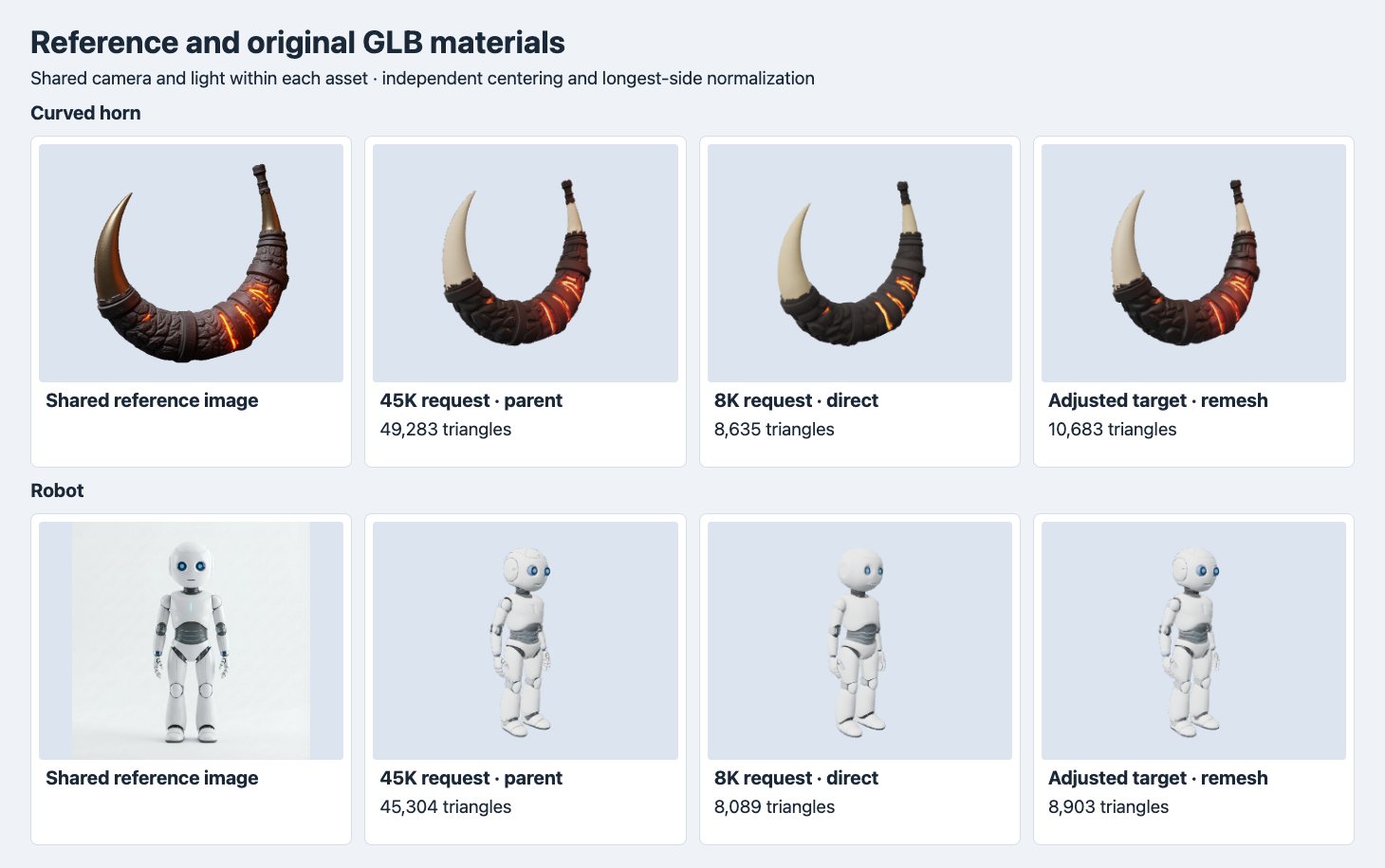
The figures use the final comparison remesh for each asset. Camera and lighting are shared within a row. Each asset is independently centered and normalized to its longest side.
Check the actual files against the budget
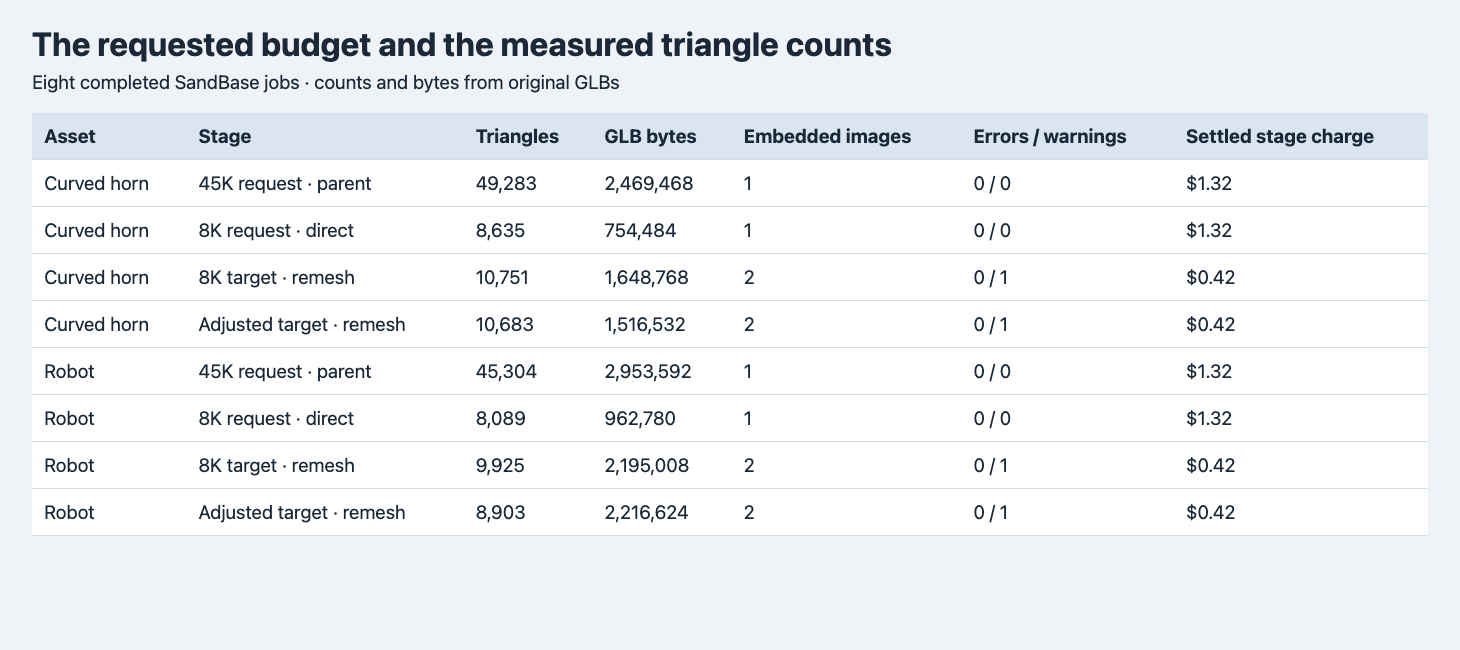
The 45K P2 request is the generation step of the two-job path. Both remesh targets are shown for each subject.
| Asset | Generation or remesh request | Delivered triangles | Original GLB bytes | Stage charge |
|---|---|---|---|---|
| Horn | P2, 45,000 | 49,283 | 2,469,468 | $1.32 |
| Horn | P2, 8,000 | 8,635 | 754,484 | $1.32 |
| Horn | Remesh, 8,000 | 10,751 | 1,648,768 | $0.42 |
| Horn | Remesh, 6,400 | 10,683 | 1,516,532 | $0.42 |
| Robot | P2, 45,000 | 45,304 | 2,953,592 | $1.32 |
| Robot | P2, 8,000 | 8,089 | 962,780 | $1.32 |
| Robot | Remesh, 8,000 | 9,925 | 2,195,008 | $0.42 |
| Robot | Remesh, 6,500 | 8,903 | 2,216,624 | $0.42 |
If the published asset has a strict ceiling, count the actual triangles in the exact delivery file. A viewer’s rendering pass is also different from a file-level count if it draws instances or renders only parts of a scene. The GLBs here each contain one measured mesh primitive, making the original-file count straightforward. Keep the direct and parent hashes separate and, for a remesh, record which parent file was used. This matters when testing a different target later.
For a viewer, record an independent byte cap as well. The adjusted robot remesh shed 1,022 triangles versus the first remesh, while its GLB grew by 21,616 bytes. Keep the original artifact around until both checks pass. If you’re making a second variant, verify it with the same settings and inspect it at the intended display size. A close-up reveals small seams that a rotating thumbnail may hide.
For one fresh final asset, the direct path was one paid job. Parent generation plus one remesh was two paid jobs in sequence and cost $1.74. If the 8,000 remesh needed a follow-up as it did in this experiment, the parent and both remeshes cost $2.16. Across all eight jobs, the test settled at $6.96. The time difference that follows from the workflow is the extra dependent job. We did not capture consistent completion timestamps to compare elapsed run times.
Compare the shape to the parent and check the texture separately
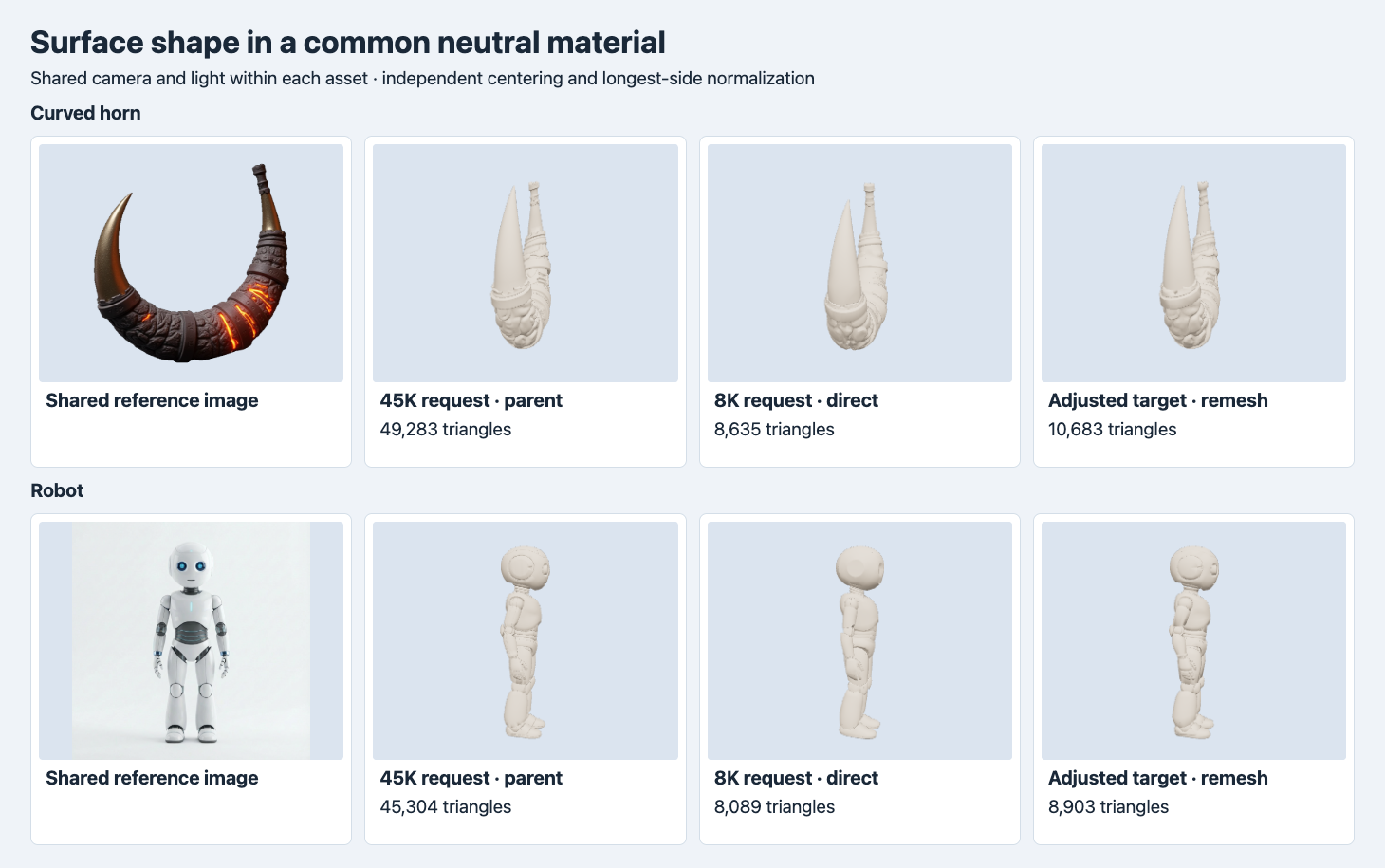
The neutral override removes the delivered material colors. The image column is the original reference, and the three GLB views within each row use a common camera.
On the horn, compare the pointed end and the bands near the wider side. The direct mesh changes the tip profile and the position of one band relative to the parent. The adjusted remesh follows those contours more closely. On the robot, compare the eye surround and the edge of the head cap. The direct result smooths their transitions into the rounded side of the head. The adjusted remesh keeps more of the outlines visible in the parent. The comparisons describe these views of these outputs, with one generation per request setting.
To measure differences, we used Blender 4.5.9 to import the original artifacts. We independently centered and scaled each mesh by its longest side, then took up to 10,000 vertices in stored order from one model and queried the nearest triangle on the other. Read the 95th percentile as a fraction of the normalized longest side. The sample is not uniform in surface area. We measured both directions, because a feature that disappears from one model may affect the two directions differently.
| Asset | Low-count route | Parent to output p95 | Output to parent p95 |
|---|---|---|---|
| Horn | Direct | 2.480% | 2.564% |
| Horn | Remesh, 8,000 | 0.485% | 0.517% |
| Horn | Remesh, 6,400 | 0.277% | 0.295% |
| Robot | Direct | 1.633% | 1.525% |
| Robot | Remesh, 8,000 | 0.221% | 0.239% |
| Robot | Remesh, 6,500 | 0.287% | 0.326% |
Lowering the requested horn target from 8,000 to 6,400 removed just 68 delivered triangles. The robot’s change from 8,000 to 6,500 removed 1,022. The final remesh kept 2,048 extra triangles on the horn and 814 on the robot compared with the direct file. Those extra faces are one reason to read this as a comparison of two delivered workflows at nearby budgets. In the robot case the lower remesh target also increased both distance measures slightly. A single target number predicted neither the shipped count nor the change in surface.
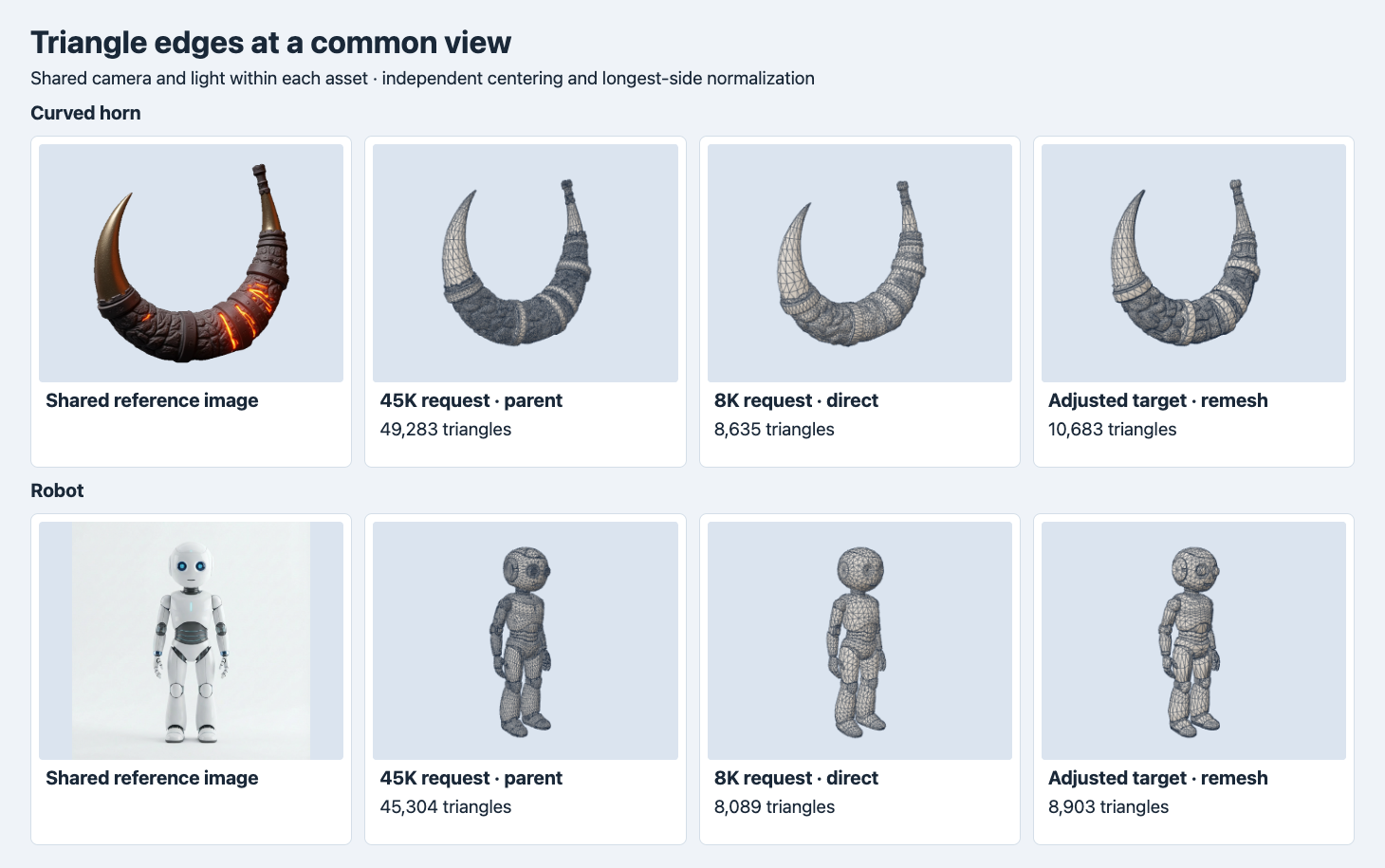
The line overlay displays triangle edges on the original geometry using the same view within each row. It does not change the stored mesh.
The distance metric answers how closely the output follows the chosen denser P2 parent. Remesh begins with that parent, while the direct result comes from a different generation, even with the same seed and reference. The results do not show which file is more accurate against a real-world object. Use the distance alongside the neutral view when you already approve the parent shape. Use a separate acceptance view if you are choosing which geometry to approve in the first place.
In the colored renders a shaded groove or colored band can remain visible after its surface shape has changed. Inspect the neutral render for the actual geometry and the colored render for delivery appearance. The original P2 GLBs each had one embedded JPEG for base color. The remeshes had two embedded JPEGs for base color and normals, and each gave a generated-tangent-space warning. The format validator gave zero errors across the eight results. A target renderer may handle the tangent frame differently, so check the material under your own lighting. Related tests on a different source are in the Hunyuan and Tripo retopology comparison.
The P1 vs P2 comparison at 20K uses these same input images to compare original GLB packages and materials before remeshing.
Reproduce the direct path and inspect before proceeding
Use the following request to try one direct triangle budget. Send it with a server-side bearer token to POST https://api.sandbase.ai/v1/run, then poll the resulting ID with GET /v1/run/{id}. Each call can incur a charge.
{
  "model": "tripo3d/tripo-p2/image-to-3d",
  "image": "https://static.sandbase.ai/examples/meshy/relief/input_image_0.png",
  "face_limit": 8000,
  "quad": false,
  "texture": true,
  "texture_quality": "standard",
  "pbr": false,
  "seed": 42
}
To test the second path, submit that asset again at a larger face setting, download and review the parent, then submit that exact GLB to Remesh as model_url. Set face_limit, quad: false and bake: true. Measure the result before replacing the file in your catalog. Start with a direct low-count route when you want a small preview and every extra job matters. Start with a verified parent and remesh when keeping its accepted surface and appearance is the main concern. For an engineering cap, make verification of the exported count a gate in either flow.
The Meshy 7.1 geometry-resolution test holds the target at 30,000 and varies the geometry pass. It shows how the setting affects surface detail and connectivity at a similar delivered triangle count.
The 40K and 50K test against Hunyuan Pro measures actual direct output counts and compares each to an authored reference.
FAQ
Is the face setting a guaranteed hard cap?
The inspected P2 schema calls it a maximum and the remesh schema calls it a target. The initial jobs here still returned more than 8,000 triangles in all four files. If you have a strict limit, enforce it on the downloaded data.
Is this a comparison of speed or of quality?
It measures task count, settled charges, file output, observed shapes and similarity to an approved candidate parent. No end-to-end time or independent surface ground truth was collected.
SandBase ran and billed the eight jobs on November 14, 2026 UTC (November 15 in China Standard Time). The figures use original GLB outputs, with neutral and wireframe views indicated. The cover is illustrative.
Found this useful? Share it