Best YouTube Data API Alternatives in 2027
Best YouTube Data API alternatives in 2027: Google's default quota versus SandBase's 54 public-surface cards for search, channels, and captions.

One hundred search.list calls is the entire default daily bucket for YouTube search. YouTube Data API alternatives in 2027 are a choice between asking Google for more of that quota and paying per call for a different, third-party surface. As of 18 Nov 2026, Google’s default allocation is 100 search.list calls, 100 videos.insert calls, and 10,000 units per day for other endpoints, resetting at midnight Pacific Time. SandBase, on the 18 Nov 2026 catalog check (Asia/Shanghai), listed 54 YouTube cards for public search, channels, captions, and transcripts. Keep Google when you upload, when compliance requires the official API, or when 100 searches a day is enough. Use SandBase when the job is public-surface lookup on a different path.
Key takeaway
- Google’s default YouTube Data API quota is 100
search.listcalls, 100videos.insertcalls, and 10,000 units per day combined for all other endpoints. It resets at midnight Pacific Time, and Google says the default can change.search.listandvideos.inserthave their own buckets. Each call costs 1 in that bucket. Invalid official requests still cost at least one quota point.- The SandBase YouTube hub listed 54 endpoints on 18 Nov 2026. The cards are third-party public-surface data.
- Those cards are not an upload pipeline and they do not inherit Google’s quota clock.
- Official quota-extension prices were not on the pages opened that day and stay Unknown. A pricing-page sample showed some YouTube endpoints at $0.001 after the free allowance. That sample is not the price of all 54 cards.
What the official YouTube Data API meters
The current docs home is YouTube Data API. The older /youtube/v3 path redirected there on 18 Nov 2026. Quota language is on the quota-cost page, which confirmed this wording: projects that enable the YouTube Data API have a default quota allocation of 100 search.list calls, 100 videos.insert calls, and 10,000 units per day combined for all other endpoints.
Daily quotas reset at midnight Pacific Time. The default is subject to change. Every request, including an invalid one, costs at least one point. search.list and videos.insert do not draw the 10,000-unit pool. Each has its own bucket, default 100 per day, and each successful use of that method costs 1 inside its bucket. A monitor that issues 101 searches hits the search bucket even if the rest of the project has units left.
Quota extensions go through Google’s request form. The pages opened on 18 Nov 2026 did not publish a dollar price for an extension, so extension pricing is Unknown. The docs navigation also references compliance audits. This article does not describe the audit process beyond that reference. The official API is a Google Cloud quota product with OAuth, Cloud project setup, and Google’s terms. It is not a published dollars-per-call rate card for the default allocation.
What 54 SandBase cards cover
The hub is YouTube Data APIs on SandBase. On the 18 Nov 2026 catalog check (Asia/Shanghai) the title was “YouTube Data APIs: Videos, Channels and Captions,” with 54 endpoints. Confirmed card pages:
- Video search, “YouTube Video Search API: Localized Results by Upload Date.”
- Channel info, “YouTube Channel Info API: Retrieve Profiles and External Links.”
- Captions, “YouTube Caption API: Retrieve Transcript Tracks by Language.”
- Video transcript, “YouTube Video Transcript API: Pricing & Specs.”
The hub also names channel search, channel videos, shorts, playlists, lives, community posts and comments, hashtag search, shorts search, a caption job result, and a full transcript route. Those names are the grouping from the hub. This article does not treat them as a method-for-method map onto official YouTube Data API resource names. Paths, auth, and the quota model differ. The screenshots below are catalog cards. They are not evidence of official API compatibility.
Per-card list prices for all 54 routes were not extracted from the hub Markdown. The pricing page’s sample of endpoints inside the daily free allowance included some YouTube endpoints at $0.001 after the free allowance. A sample is not a roster. It does not assign $0.001 to the search card, the caption card, or any card the sample did not name. The live card is the price. Whether a given card carries pricing.free_quota stays Unknown until you open it.
The data-API catalog the same day was 2,247 endpoints from 182 providers. That figure can change and is separate from llms.txt’s combined models-and-APIs total of 2,777. A wider social index is social media APIs. No latency test was run. Speed is Unknown.
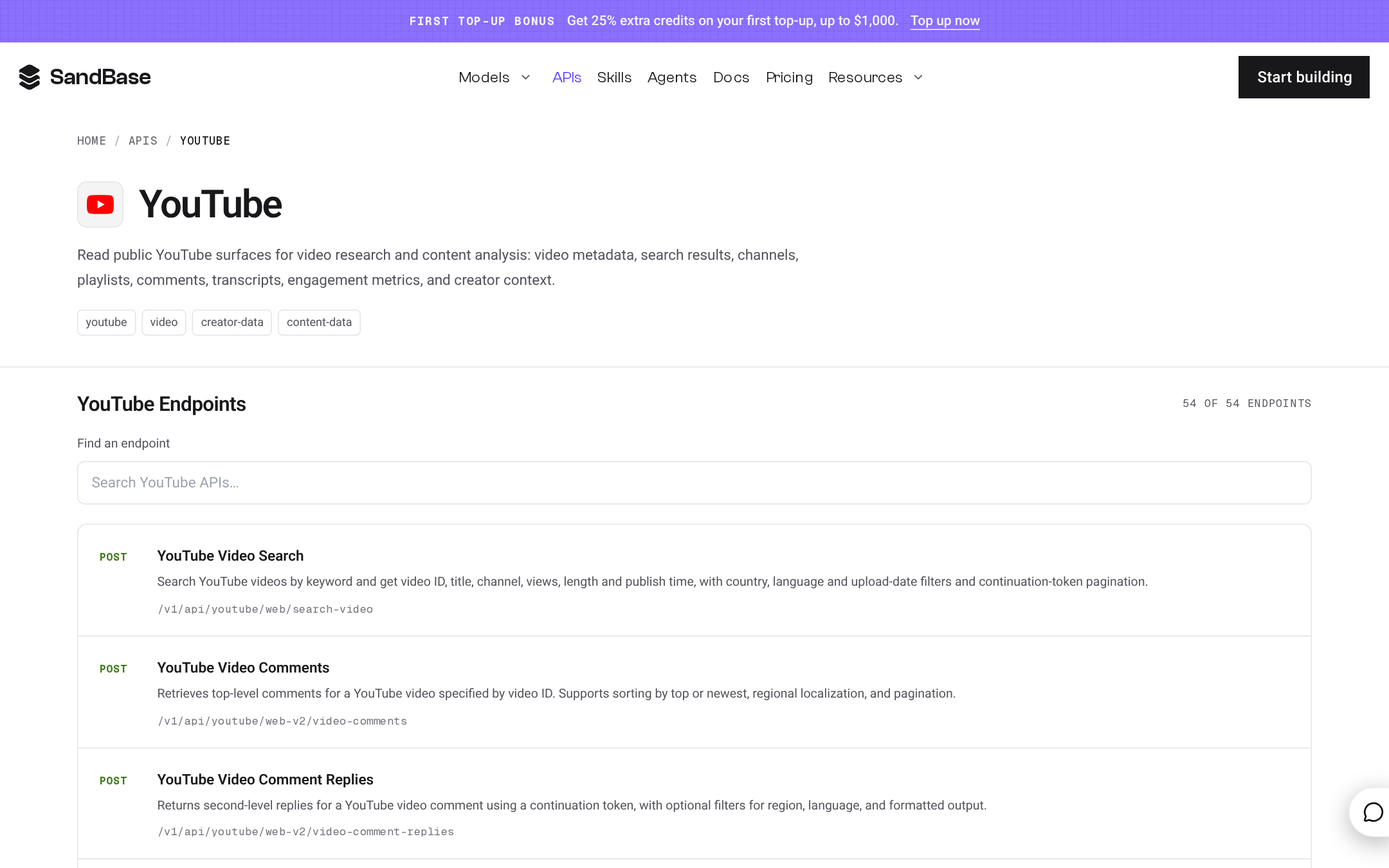
SandBase YouTube catalog hub for videos, channels, and captions, captured logged out in a light theme on 18 Nov 2026 (Asia/Shanghai). This is a catalog card page, not an official YouTube Data API compatibility claim. The banner reads “FIRST TOP-UP BONUS Get 25% extra credits on your first top-up, up to $1,000.”
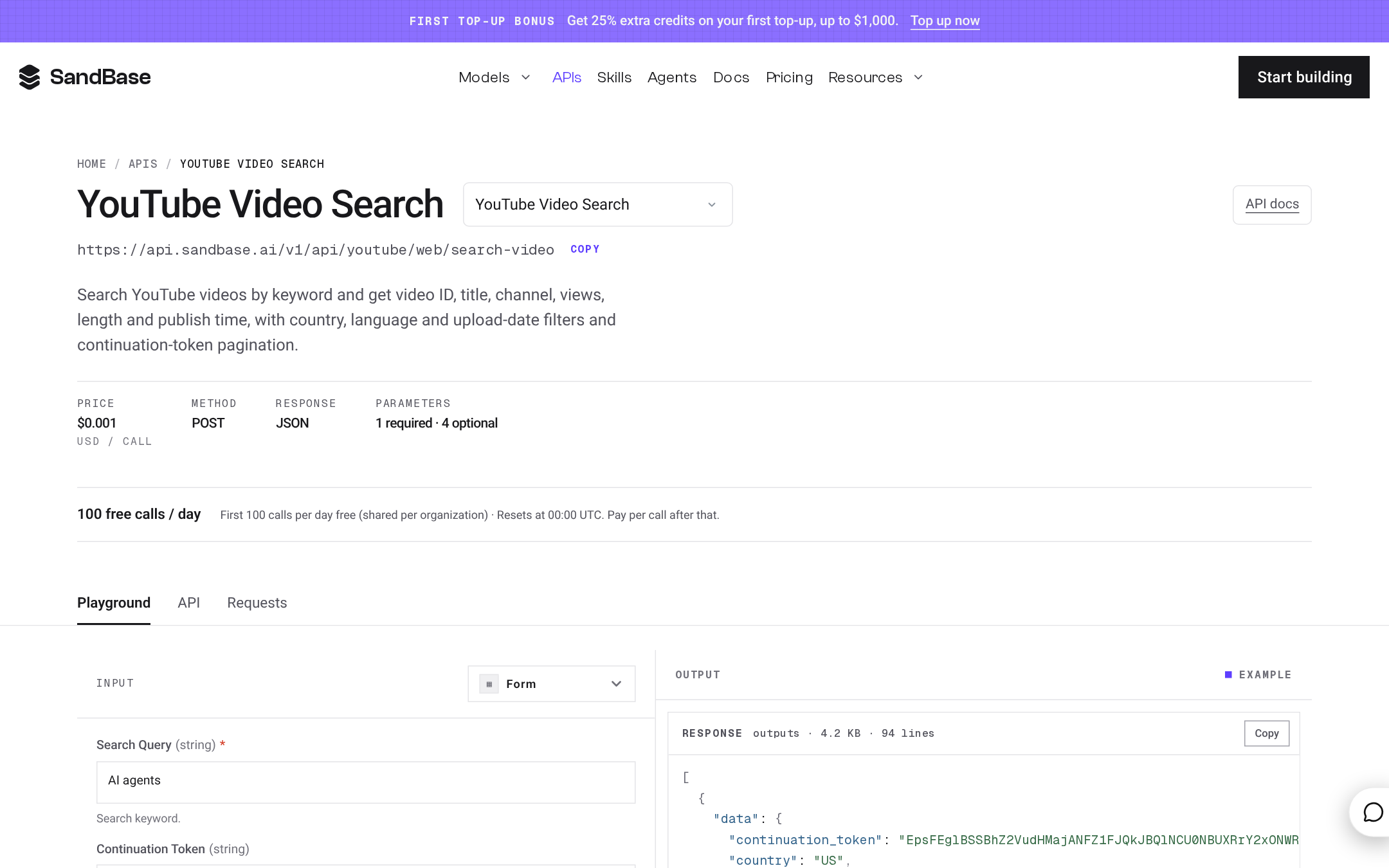
SandBase YouTube video-search card, captured logged out in a light theme on 18 Nov 2026 (Asia/Shanghai). The page is a public-surface search card, not official search.list. The banner reads “FIRST TOP-UP BONUS Get 25% extra credits on your first top-up, up to $1,000.”
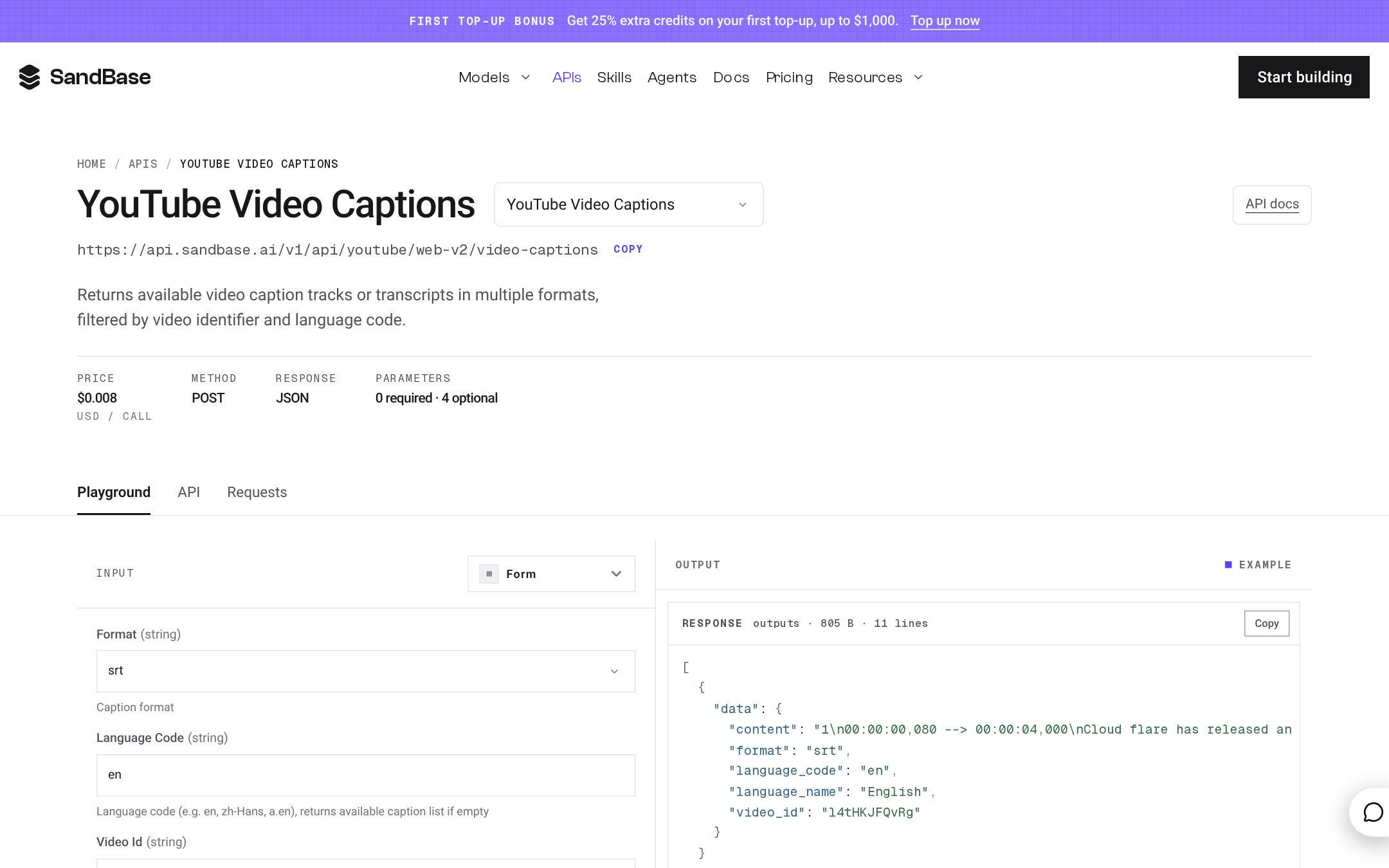
SandBase YouTube captions card for transcript tracks by language, captured logged out in a light theme on 18 Nov 2026 (Asia/Shanghai). A catalog card, not an official captions method. The banner reads “FIRST TOP-UP BONUS Get 25% extra credits on your first top-up, up to $1,000.”
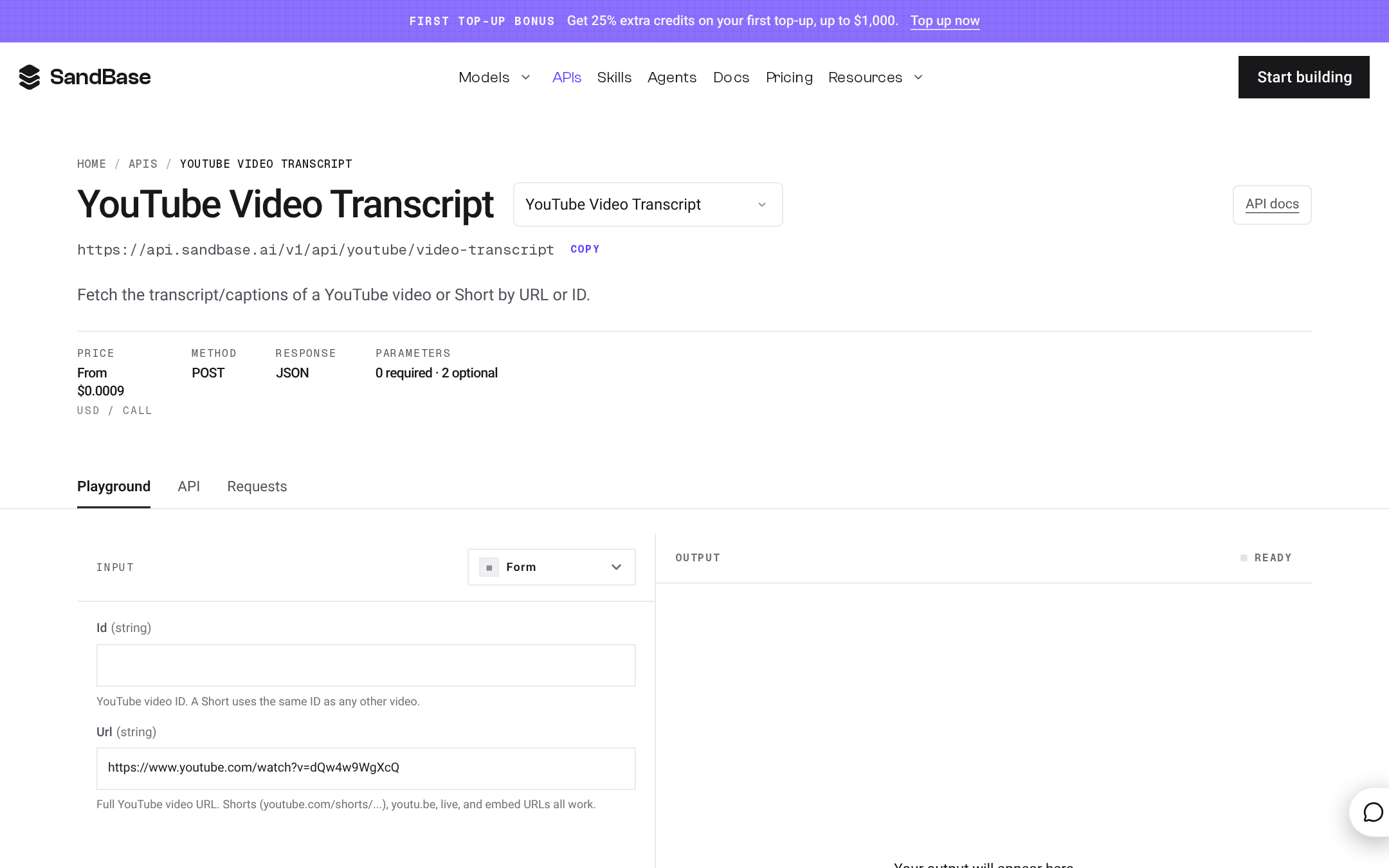
SandBase YouTube video-transcript card, captured logged out in a light theme on 18 Nov 2026 (Asia/Shanghai). The card is public-surface transcript data, not an official API upload or partner feature. The banner reads “FIRST TOP-UP BONUS Get 25% extra credits on your first top-up, up to $1,000.”
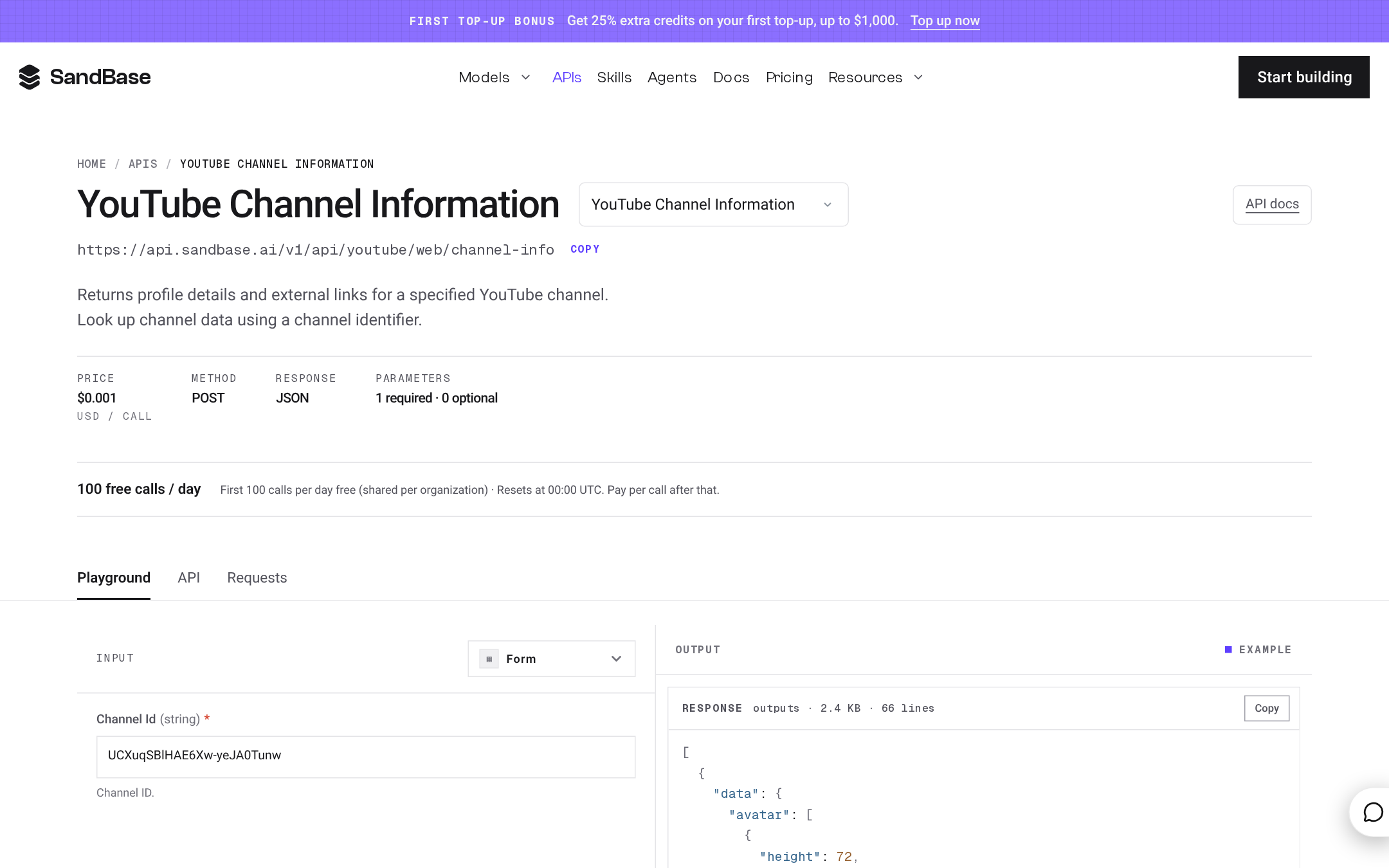
SandBase YouTube channel-info card, captured logged out in a light theme on 18 Nov 2026 (Asia/Shanghai). Catalog metadata for a public channel, not a Google Cloud quota method. The banner reads “FIRST TOP-UP BONUS Get 25% extra credits on your first top-up, up to $1,000.” Confirm the promotion on the pricing page.
YouTube Data API alternatives side by side
| Question | Official YouTube Data API | SandBase YouTube hub |
|---|---|---|
| What it is | A Google Cloud quota product | Third-party public-surface cards, 54 on 18 Nov 2026 |
| Default meter | 100 search.list, 100 videos.insert, 10,000 units/day for other endpoints. Resets midnight PT. Subject to change. | 100 free calls per UTC day only when the live card is eligible. Otherwise billed from the first call. |
| Search | search.list spends its own 100-call bucket | A search card with its own path and price. Not a quota clone. |
| Upload | videos.insert has its own 100-call bucket | Not an upload pipeline |
| Captions and transcripts | Official methods, still on Google’s quota | Caption and transcript cards on the hub |
| Extension or list price | Extension dollars Unknown | Full 54-card price list Unknown. Sample entries at $0.001 are a sample only. |
| Terms | Google’s API agreement, with compliance audits referenced in the docs | A third-party catalog. It does not replace a direct Google agreement. |
Nothing in the table is a ranking. Best Data API Providers in 2027 keeps the same rule for the rest of the catalog.
How to call video search
Submit with POST /v1/api/youtube/web/search-video, Bearer auth, and a JSON object. The contract is API passthrough, checked 18 Nov 2026. Leave out model. The URL identifies the card. Do not reuse the Firecrawl scrape body from that page.
This comparison did not run a new paid call, so the fields stay on the live video search card. An empty object only inspects the route, which is what the passthrough page allows. Useful calls use the card’s fields. Read outputs[0].data and treat those names as undocumented until your own response shows them. An asynchronous capability can be polled with GET /v1/run/{id}. That poll is not how you submit the call.
import os
import requests

payload = {}  # replace with the fields shown on the live tool card before sending

response = requests.post(
    "https://api.sandbase.ai/v1/api/youtube/web/search-video",
    headers={
        "Authorization": f"Bearer {os.environ['SANDBASE_API_KEY']}",
        "Content-Type": "application/json",
    },
    json=payload,
    timeout=90,
)
response.raise_for_status()
body = response.json()
outputs = body.get("outputs") or []
if body.get("status") != "completed" or not outputs or not isinstance(outputs[0], dict):
    raise RuntimeError(f"SandBase call did not complete: {body.get('status')} {body.get('error')}")
data = outputs[0].get("data")
Captions use /v1/api/youtube/web-v2/video-captions. The transcript card uses /v1/api/youtube/video-transcript. Channel info uses /v1/api/youtube/web/channel-info. Each one has its own fields.
A UTC allowance is not a Pacific quota
Google’s bucket resets at midnight Pacific Time and is scoped to a Cloud project and to named methods. SandBase’s allowance, from the billing guide and pricing as of 18 Nov 2026, is different: every organization gets 100 free data API calls per UTC day for eligible search, social, scraping, e-commerce, and finance tools. The 100 are shared by every eligible data API and every key in the org. Reset is 00:00 UTC. Unused calls expire.
Models that chat, and media models, are not in that set. Pricier or formula-priced data APIs bill from the first call. The billing page names some batch endpoints, crawl endpoints, Xiaohongshu Pugongying (PGY), and Douyin Xingtu kol-* routes as examples. Eligibility is pricing.free_quota on the live card via sandbase_inspect. No field means the tool is always billed.
The 101st eligible call still runs, and it is billed. It is not rejected. A zero balance can spend leftover free calls. The pricing page list is a sample, which is why “some YouTube endpoints at $0.001” does not price the other cards, and why a card absent from the sample is not automatically excluded. Plans are pay per call with no subscription: Start ($0), Build (Metered), Scale (Custom). Catalog reads are $0. Failed calls are not charged. Agent sandboxes are free for now. Fair-use caps may apply, and pricing will be announced before that changes.
Then check pricing and signup. Signup currently redirects to login.
When not to switch: stay on the official YouTube Data API
Stay when the product must upload video. videos.insert is an official bucket of 100 calls a day by default. The SandBase hub is not that pipeline.
Stay when the legal or compliance owner requires a direct Google API agreement, official OAuth scopes, or the audit path the docs navigation points at. A third-party card does not inherit those terms.
Stay when 100 search.list calls per Pacific day, plus the 10,000-unit pool for other official methods, already covers the workload at the default allocation. An extension may still be the right official next step. Its price is Unknown, so compare it only after Google’s form tells you the number.
Stay when you need YouTube partner features this catalog does not list. Completeness of every public YouTube surface versus 54 cards is Unknown. Latency was not measured, so a speed requirement is not a reason this article can support.
Where the catalogs do not meet
The call paths differ. Official clients that post to Google’s YouTube Data API will not run unchanged against /v1/api/youtube/.... Auth differs: a SandBase bearer key is not a Google Cloud OAuth token. The quota model differs, including the rule that invalid official requests still cost a point. Official analytics and partner APIs are not claimed here. Card-level prices outside the unnamed $0.001 sample stay on the live cards. The screenshot banner about 25% extra credits on a first top-up, up to $1,000, is a promotion in the 18 Nov 2026 captures.
Which workload moves
A weekly research job that searches a handful of queries and pulls one channel profile can live on the default official quota. One hundred searches a Pacific day is the whole search.list bucket, so a discovery agent that pages through results will exhaust it before the 10,000-unit pool matters.
A transcript desk is the other common reason teams look past that bucket. The SandBase hub has caption and transcript cards, and the existing tutorials show how those cards fit a pipeline. They do not rewrite the quota rules above, and they do not turn a transcript card into videos.insert. Use YouTube Public Data API on SandBase for the search and channel orientation, the transcript pipeline and the transcript generator for transcript workflows, channel research, comment analysis, and Shorts trend research for those narrower jobs.
If a sampled card really is $0.001 and eligible, 101 calls would consume the shared 100 and bill the next one. This article does not know that the search card is one of the sampled endpoints. Open the card, read pricing.free_quota and the price, and only then multiply.
FAQ
What is the default official quota, and when does it reset?
100 search.list calls, 100 videos.insert calls, and 10,000 units per day for the other endpoints, resetting at midnight Pacific Time. Google says that default can change. Invalid requests cost at least one point.
Can these cards upload a video?
No. The hub is public-surface lookup, including search, channels, captions, and transcripts. videos.insert stays on the official API, in its own default bucket of 100 calls a day.
Are all 54 cards $0.001?
Unknown. The pricing page sample included some YouTube endpoints at $0.001 after the free allowance. It did not name all 54. The live card is the price, and it is also where free-allowance eligibility is shown.
Related reading
The six tutorials above are the implementation layer. Social-data context is in Best Social Media Data APIs for AI Agents (2026). Nearby cluster pieces are Best AnyAPI Alternatives in 2027, Best TikHub Alternatives in 2027, and Best Data API Providers in 2027.
Open the YouTube hub, then the video search card with the passthrough reference. Pricing and access are pricing and signup.
Found this useful? Share it