Kling 4.0 Flash Is on SandBase: 720p, 20 Seconds, and What It Costs
Kling 4.0 Flash is on SandBase at 720p and up to 20 seconds, From $0.47. The official API opened 4 Nov 2026. Four /v1/run cards; the old hub still says Coming soon.
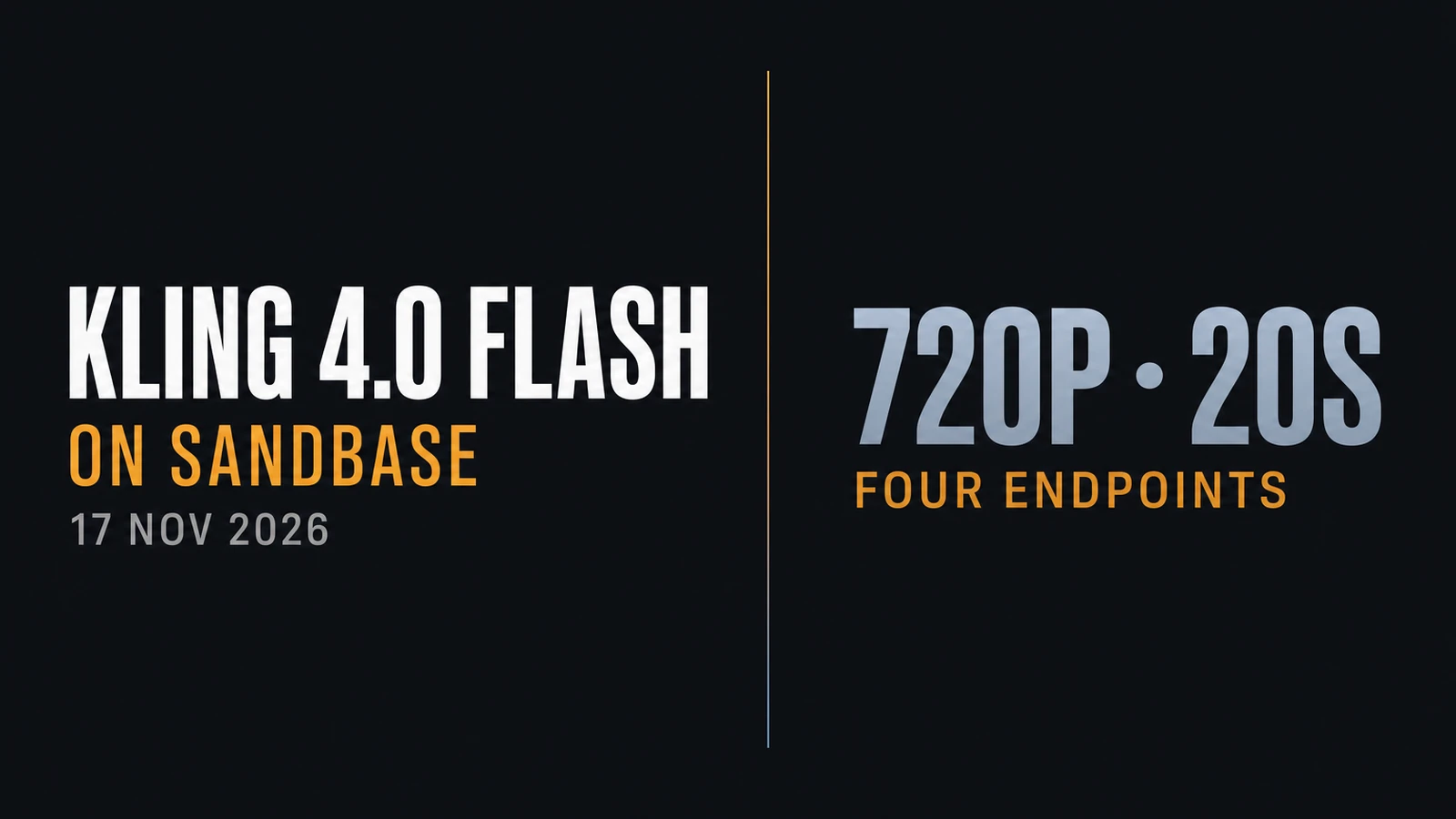
Kling 4.0 Flash is the 720p, 20-second tier of Kling 4.0, not a new generation. The official API opened on 4 November 2026. SandBase listed four Flash endpoints; the www sitemap lastmod on those cards is 16 November 2026, 08:00 Asia/Shanghai. Use Flash when 720p and 20 seconds are enough. If the job needs 1080p, 30 seconds, a last frame, or a custom voice, open the non-Flash Kling 4.0 cards instead.
The 23 October posts on this blog treated Flash as early access for Ultra Yearly subscribers, and as something still to watch on the API. They did not document a callable Flash API. This page does. The official changelog heading is the date to cite. The sitemap stamp is a listing timestamp, not a second launch announcement.
Key takeaway
- Official name: Kling 4.0 Flash. The Kling API changelog entry for 4 November 2026 is titled “Kling 4.0 Flash API Is Now Available, with Native Video Generation up to 20s.” Duration is 3–20 seconds. Resolution is 720P only.
- SandBase lists four IDs and displays them as Kling V4 Flash. Heroes are From $0.47 (text, image, reference) and From $2.52 (video edit). Per-second rates of $0.094 with no input video and $0.063 with input video match the official pricing page.
- Call
POST https://api.sandbase.ai/v1/run, then pollGET https://api.sandbase.ai/v1/run/{id}. The first API call doc shows how to get a key; its walkthrough uses chat completions and does not show this video request.- Flash image-to-video is a start frame only.
voice_idsare not on the Flash reference card. Both stay on the non-Flash Kling 4.0 endpoints.- The hub card at
kwaivgi/kling-video/v4still says the public API has not opened and that price is “Coming soon.” That card is stale. Do not cite it as current availability.
What official docs confirm
The citable official pages are the changelog and the video pricing markdown. Official per-endpoint HTML at the Flash text, image, and omni paths returned HTTP 200 on 17 November 2026 and was still a client-rendered shell, with no crawlable specs. Those shells are not the source for the numbers below.
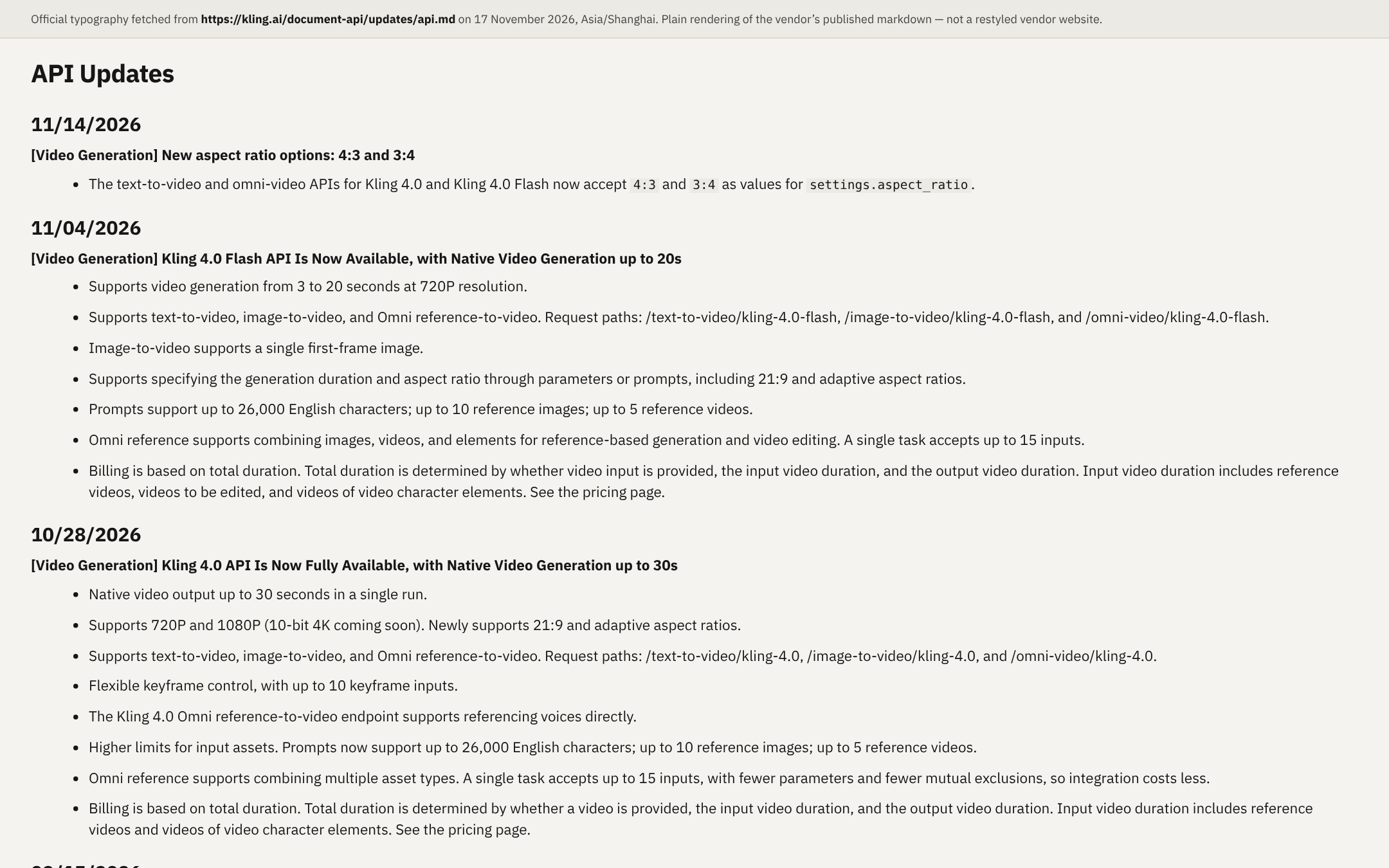
Official typography fetched from https://kling.ai/document-api/updates/api.md on 17 November 2026, Asia/Shanghai, and shown as a plain rendering of the vendor’s published markdown — not a restyled Kling website. The 4 November 2026 entry is titled “Kling 4.0 Flash API Is Now Available, with Native Video Generation up to 20s,” and states 3–20 seconds at 720P. The 14 November 2026 entry adds 4:3 and 3:4 for settings.aspect_ratio. Official per-endpoint HTML pages were still JS shells on this check and were not screenshotted.
The Kling API changelog says the Flash API covers text-to-video, image-to-video, and Omni reference-to-video / editing. The official paths named there are /text-to-video/kling-4.0-flash, /image-to-video/kling-4.0-flash, and /omni-video/kling-4.0-flash. Image-to-video is a single first-frame image. Prompts go up to 26,000 English characters. Reference limits are up to 10 images and 5 videos, and up to 15 Omni inputs.
On 14 November 2026 the same changelog added 4:3 and 3:4 for settings.aspect_ratio on text-to-video and omni-video, for both Kling 4.0 and Kling 4.0 Flash. Whether the SandBase Flash cards accept those two ratios is untested. The live Flash text-to-video enum is only 16:9, 9:16, 1:1, and 21:9.
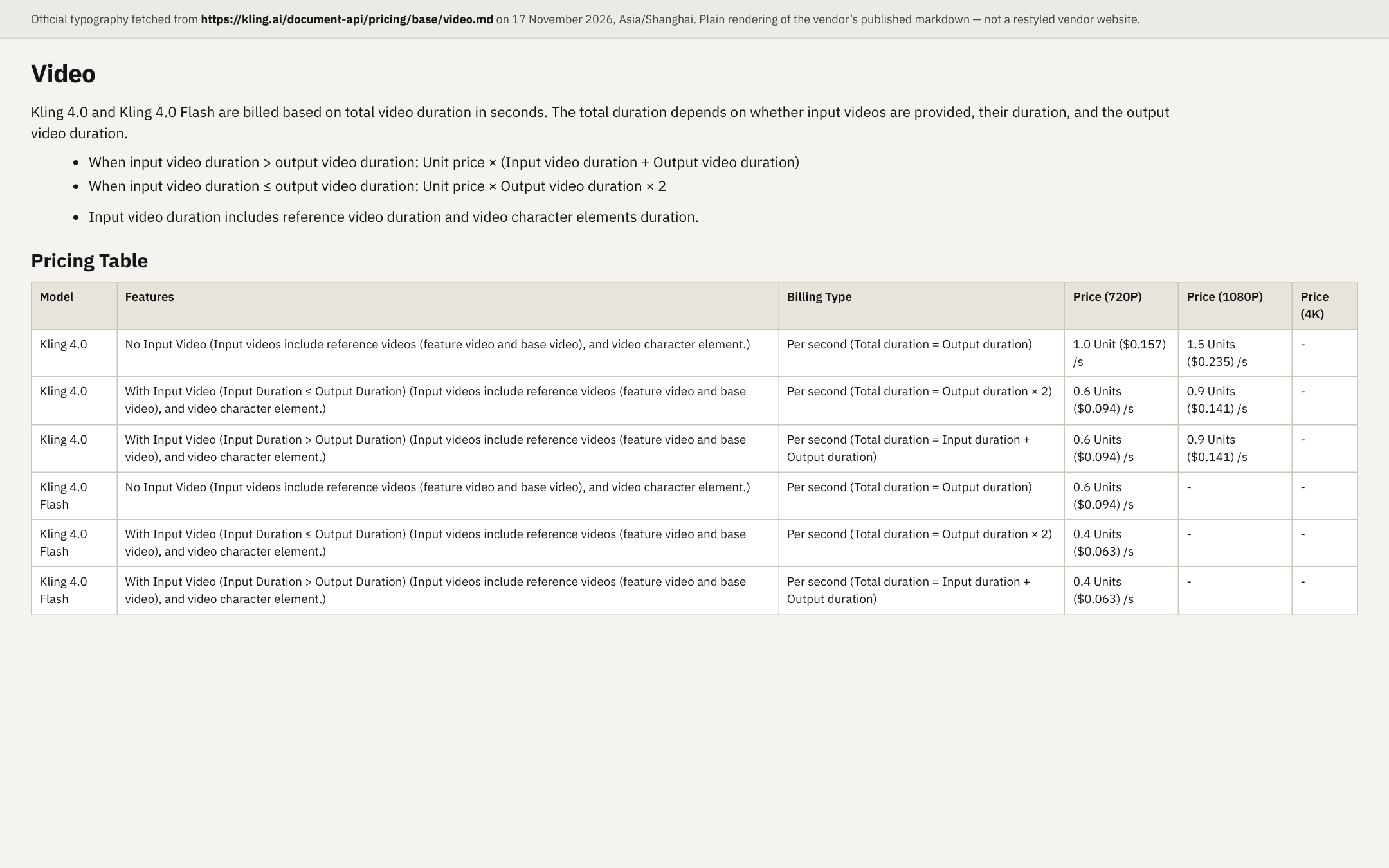
Official typography fetched from https://kling.ai/document-api/pricing/base/video.md on 17 November 2026, Asia/Shanghai, plain rendering of the vendor’s published markdown. Official Kling 4.0 Flash, no input video, is 0.6 Units ($0.094)/s at 720P; 1080P and 4K columns are “-”. With input, official Flash is 0.4 Units ($0.063)/s. These are official rates, not a SandBase price table (SandBase matches them on the live Flash cards).
The official video pricing page is 720P only for Kling 4.0 Flash. The 1080P and 4K columns are dashes. With no input video, the rate is $0.094 per second and the billed duration is the output. With input video, the rate is $0.063 per second. If the input is shorter than or equal to the output, billed duration is output × 2. If the input is longer than the output, billed duration is input + output.
What SandBase lists today
SandBase’s display name is Kling V4 Flash. The official name is Kling 4.0 Flash. That is a label difference, not a second product. The same split already exists between “Kling 4.0” in official docs and “Kling V4” on the non-Flash cards.
Open the Kling V4 Flash text-to-video card. The three siblings are image-to-video, reference-to-video, and video edit. The collection page is Kling 4.0. All four endpoint cards say to call POST https://api.sandbase.ai/v1/run.
| SandBase display | Model ID | Hero | What the card bills |
|---|---|---|---|
| Kling V4 Flash Text to Video | kwaivgi/kling-video/v4/flash/text-to-video | From $0.47 per run | $0.094/s at 720p. 5s $0.47, 10s $0.94, 20s $1.88 |
| Kling V4 Flash Image to Video | kwaivgi/kling-video/v4/flash/image-to-video | From $0.47 per run | Same 720p / 3–20s / $0.094/s table. Start frame only |
| Kling V4 Flash Reference to Video | kwaivgi/kling-video/v4/flash/reference-to-video | From $0.47 per run | Images only $0.094/s. With reference videos, $0.063/s on output plus input |
| Kling V4 Flash Video Edit | kwaivgi/kling-video/v4/flash/video-edit | From $2.52 per run | $0.063/s on input plus output. 5s $0.63, 10s $1.26, 20s $2.52 |
The www sitemap lastmod on the Flash endpoints is 2026-11-16T00:00:00.000Z, which is 16 November 2026, 08:00 Asia/Shanghai. Treat that as when the URLs were stamped in the sitemap. The official opening remains 4 November 2026.
How billing works
SandBase’s no-input rate of $0.094 per output second, and its with-input rate of $0.063 per second, match the official pricing page. Say that once and then read the card table, because the hero “From” line is the default 5-second call, not a flat fee.
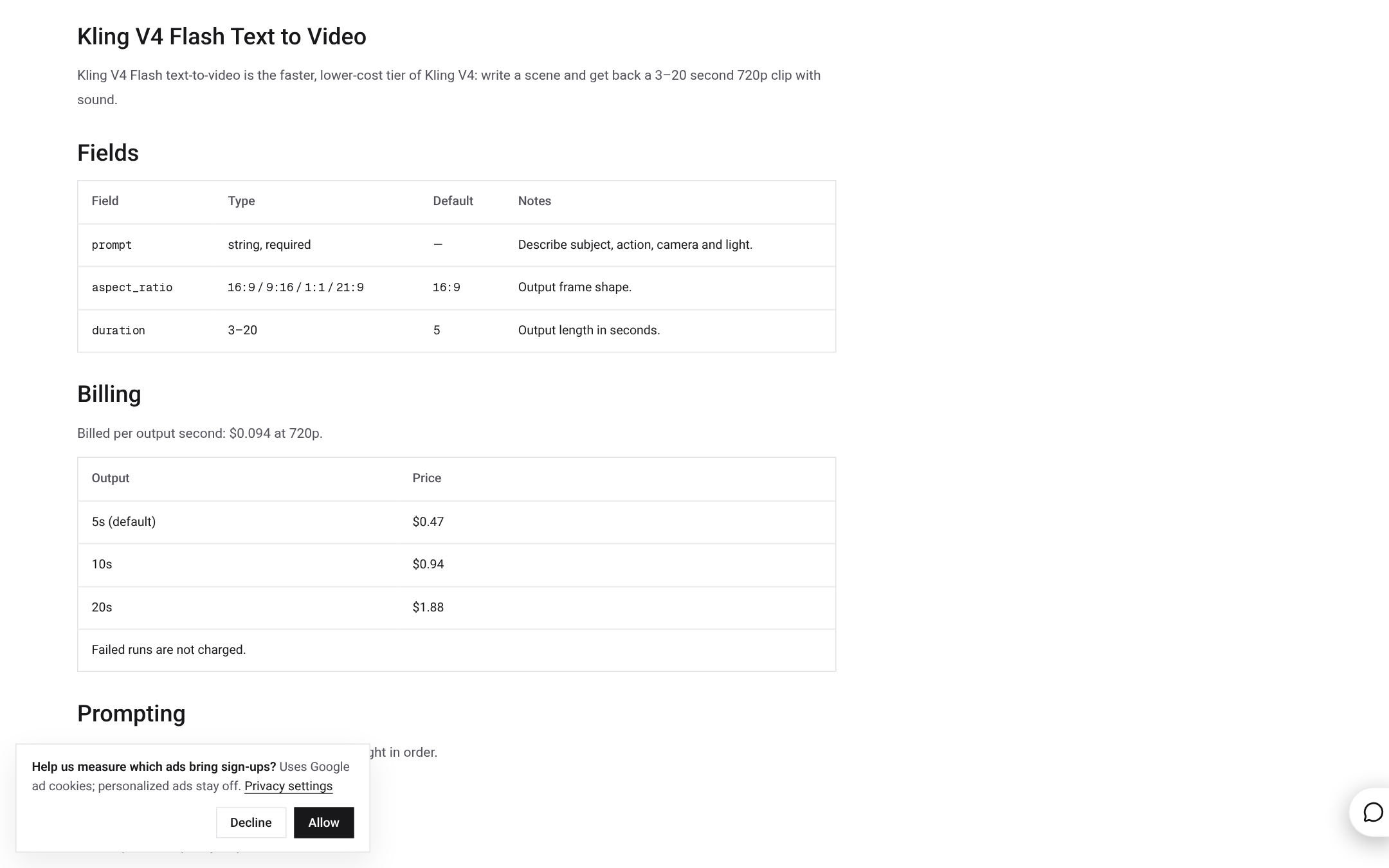
Live SandBase card for kwaivgi/kling-video/v4/flash/text-to-video, captured 17 November 2026, Asia/Shanghai. The README bills $0.094 per output second at 720p and prints 5s (default) $0.47, 10s $0.94, and 20s $1.88. Duration is 3–20 seconds. These SandBase rates match official no-input $0.094/s. (A site cookie prompt is visible at the lower left and does not cover the billing table.)
Text-to-video and image-to-video bill output seconds only, at $0.094. The printed rows are 5 seconds $0.47, 10 seconds $0.94, and 20 seconds $1.88. The text-to-video README says failed runs are not charged.
Reference-to-video splits. Images only stay on $0.094 per output second, so a 5-second images-only call is the same $0.47. Add reference videos and the rate drops to $0.063 per second of output plus input, with the input counted at least as long as the output. The card’s worked rows: 5s images only $0.47; 10s images only $0.94; 5s output plus an 8s reference video $0.819; 10s output plus a 4s reference video $1.26. The first video example is input longer than output, so 8 + 5 seconds at $0.063. The second is input shorter than output, so the output is counted twice: 20 seconds at $0.063. That is the official duration rule, printed as dollars on the SandBase card.
Video edit bills input and output at $0.063 per second. Output keeps the source length, so the charge is 2× the source. Printed rows: 5s $0.63, 10s $1.26, 20s $2.52. The hero From $2.52 is that 20-second row. If the card cannot read the source length, the quote assumes a 20-second source.
Text, image, reference, and edit
Each card accepts a different job. Mixing them up is how a 720p request turns into a support ticket about a missing last frame.
Text-to-video fields are prompt, aspect_ratio (16:9 / 9:16 / 1:1 / 21:9, default 16:9), and duration (3–20, default 5). There is no resolution field, because output is 720p only.
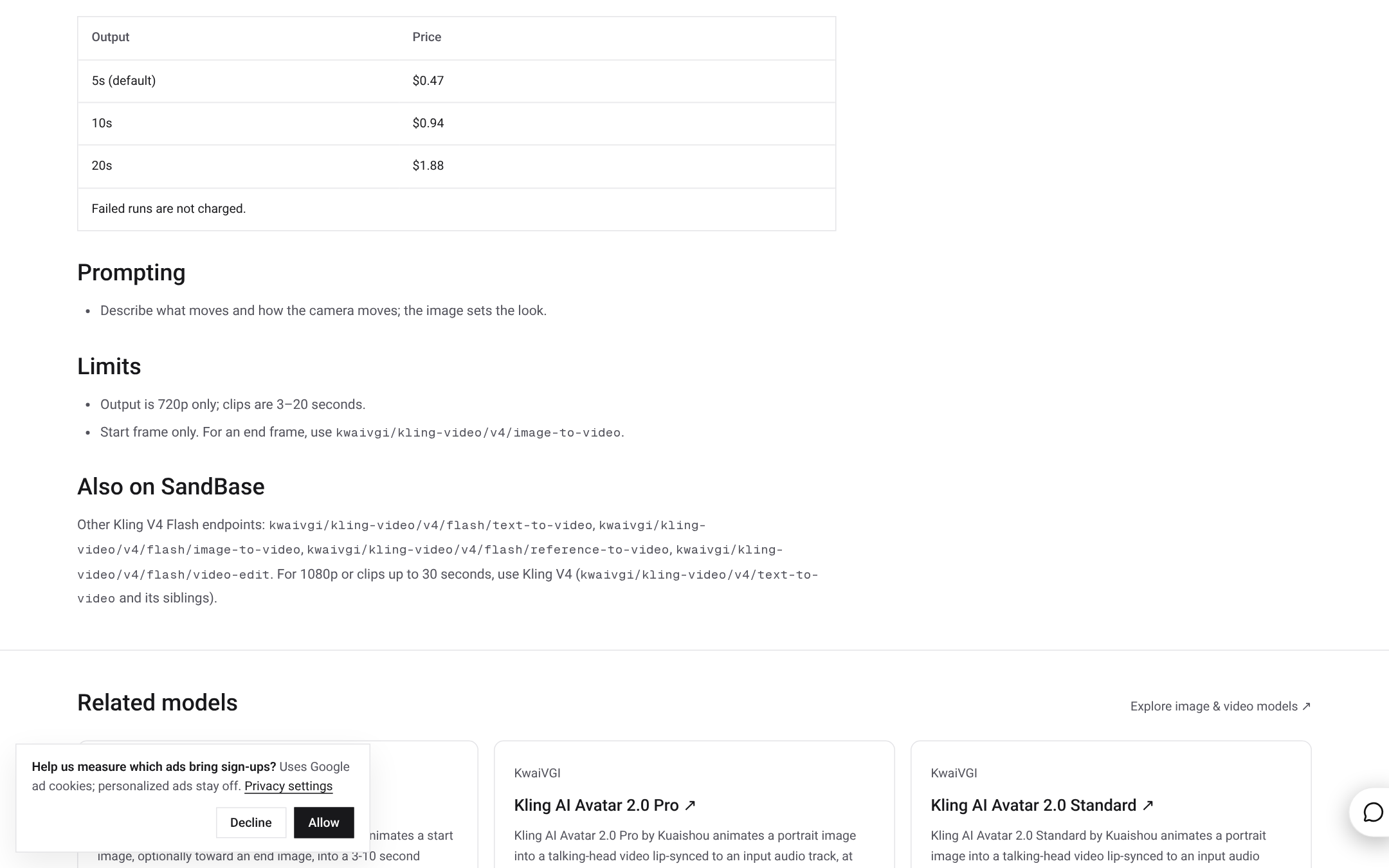
Live SandBase Flash image-to-video README, captured 17 November 2026, Asia/Shanghai. Limits: 720p only, 3–20 seconds, “Start frame only. For an end frame, use kwaivgi/kling-video/v4/image-to-video.” The visible table rows include 5s $0.47, 10s $0.94, and 20s $1.88.
Image-to-video takes a start frame (image) and does not list end_image. The card points at kwaivgi/kling-video/v4/image-to-video when you need a last frame. That non-Flash card is 3–30 seconds and 720p or 1080p. Do not send an end frame to the Flash ID and expect it to be ignored quietly. Use the card that documents the field.
Reference-to-video accepts up to 10 images and 5 videos. Each reference video is 3–20 seconds, and the videos together are capped at 20 seconds. The card says custom voices (voice_ids) are only on kwaivgi/kling-video/v4/reference-to-video. Flash reference is images and videos, not a voice slot.
Video edit takes a source of 3–20 seconds. The output keeps that length. It is the expensive Flash card, because both sides of the clip are billed, and the hero assumes the long quote when length cannot be read.
How to call it on SandBase
Create a SandBase API key. That URL redirects to the login page. The first API call page is the right place to see an authenticated request shape for chat models. It documents POST https://api.sandbase.ai/v1/chat/completions. Kling 4.0 Flash does not use that route. The live model card is the request template.
The text-to-video card prints this call. Poll GET https://api.sandbase.ai/v1/run/{id} until the status is completed or failed.
curl -X POST https://api.sandbase.ai/v1/run \
  -H "Authorization: Bearer $SANDBASE_API_KEY" \
  -H "Content-Type: application/json" \
  -d '{
  "model": "kwaivgi/kling-video/v4/flash/text-to-video",
  "prompt": "A detective in a black trench coat stands on a rooftop in the rain, looking through a telescope at the street below.",
  "duration": 5,
  "aspect_ratio": "16:9"
}'
Change model to the image, reference, or edit ID when that is the job, and send the fields that card lists. A 5-second text call at the default aspect ratio is the $0.47 row. A 20-second text call is $1.88. There is no 30-second duration on these four IDs.
The stale “Coming soon” hub card
One page on the same family still talks as if none of this shipped.
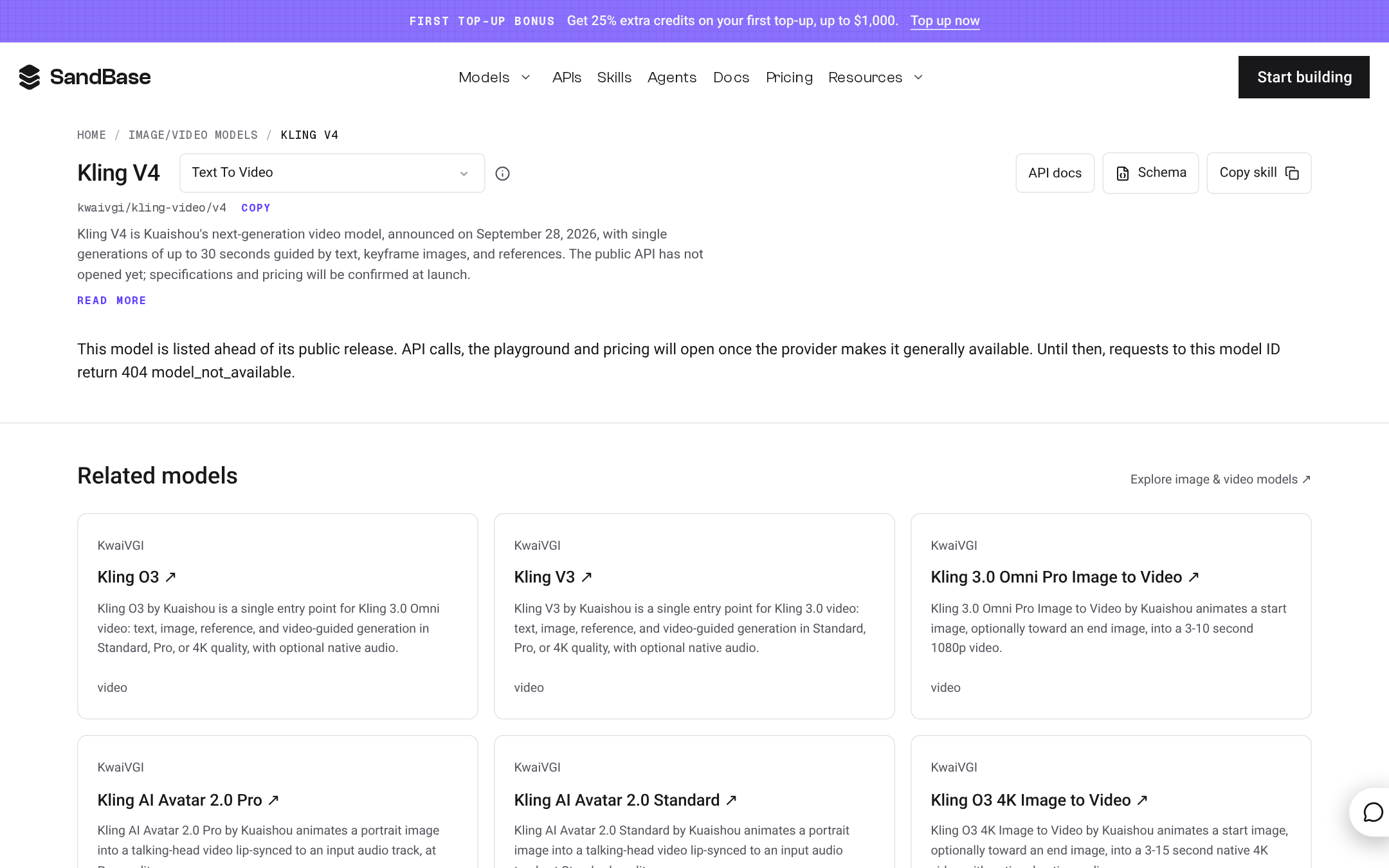
Live but stale SandBase hub card at kwaivgi/kling-video/v4, captured 17 November 2026, Asia/Shanghai. The blurb still says the model was announced 28 September 2026 and “The public API has not opened yet; specifications and pricing will be confirmed at launch.” Do not cite this card as current Flash or V4 availability. Use the four live Flash endpoint cards instead.
The hub at kwaivgi/kling-video/v4 still says the public API has not opened and that price is coming soon. Endpoint HTML pages in this family embed that blurb in a related-model payload. That does not mean the Flash cards themselves say “Coming soon.” Their heroes print From $0.47 and From $2.52. Use the four endpoint cards, or the Kling 4.0 collection, when you need a current price.
What remains unknown
SandBase Flash text-to-video does not list 4:3 or 3:4, even though the official changelog added both ratios on 14 November 2026 for text-to-video and omni-video. This check did not submit those values. If a client must send 4:3, confirm the card enum before you depend on it.
End frame and voice_ids are not unknown. They are documented as absent on Flash and present on the non-Flash image and reference cards. Official 1080P and 4K for Flash are dashes on the pricing page, not a hidden SandBase tier.
Who should start with Flash
Start on Flash when the deliverable is 720p, 20 seconds or shorter, a start frame is enough, and you do not need a custom voice. The SandBase per-second rates match the official $0.094 and $0.063 figures, so the tradeoff is the cap, not a quiet markup against Kling’s own Flash price.
Move to Kling 4.0 when any of those caps bite. The Kling V4 text-to-video card is 3–30 seconds at 720p or 1080p, hero From $1.18. The comparison of the two tiers, including the 5-second and 10-second rows, is Kling 4.0 Flash vs Kling 4.0. Seedance 2.5 Flash, listed on SandBase the same sitemap day, is a different family with its own resolution and draft rules: Seedance 2.5 Flash on SandBase.
The October record of what Kling 4.0 itself shipped, what the four non-Flash endpoints cost in a live run, and how that model compared with Seedance 2.5, Veo 3.1, and Wan 3.0, stays in what shipped, the API guide, and the same-prompt comparison. Those posts are the 23 October reading. They are not a Flash source.
FAQ
Which model ID do I send?
kwaivgi/kling-video/v4/flash/text-to-video for a prompt-only clip, or the image, reference, or video-edit sibling. All four go to POST https://api.sandbase.ai/v1/run. The official name is Kling 4.0 Flash. SandBase’s display name is Kling V4 Flash.
Is Flash 1080p or 30 seconds?
No. Official pricing marks 1080P and 4K as dashes, and the duration cap is 20 seconds. SandBase’s four Flash cards match that: 720p only, 3–20 seconds. 1080p and 30 seconds are on the non-Flash Kling 4.0 cards.
Does Flash image-to-video accept an end frame?
No. The card is start frame only and tells you to use kwaivgi/kling-video/v4/image-to-video for an end frame. voice_ids are likewise only on the non-Flash reference card.
Why does one Kling page still say the API has not opened?
That is the hub card at kwaivgi/kling-video/v4, still worded as a pre-launch page on 17 November 2026. The four Flash endpoint cards are the live listings. Do not budget from the hub.
Do the SandBase rates match official Kling prices?
On the rates this page quotes, yes. Official no-input Flash is $0.094/s at 720P, and official with-input Flash is $0.063/s. The SandBase Flash cards print the same per-second figures. The hero From $0.47 is 5 × $0.094.
What to open
Call the Flash text-to-video card when 720p and 20 seconds are the job. If they are not, open the Kling V4 text-to-video card and read the tier comparison before you copy a Flash model ID into a 1080p client.
Official changelog and pricing markdown, and the four SandBase Flash cards, checked 17 November 2026, Asia/Shanghai. Sitemap lastmod is labeled as a listing stamp. The hub card is cited only as a stale page.
Related reading
- Kling 4.0 Flash vs Kling 4.0: 720p and 20s vs 1080p and 30s
- Kling 4.0 Launch: What Shipped, What Didn’t, and the $18B Question
- Kling 4.0 API: Four Endpoints, Real Costs, and the Gaps
- Kling 4.0 vs Seedance 2.5 vs Veo 3.1 vs Wan 3.0: Same Prompt
- Seedance 2.5 Flash Is on SandBase: 480p/720p, 30 Seconds, No Draft Mode
Found this useful? Share it