Best Amazon Product Data API Alternatives in 2027
Best Amazon product data API alternatives in 2027: SandBase's 14 third-party product cards versus official Creators API and Selling Partner paths.
Keyword search, an ASIN detail page, and a review sample are the lookups most product researchers run. Amazon product data API alternatives in 2027 start by naming which Amazon API you mean. Associates documentation that used to live on PA-API 5 now points at a Creators API migration. Selling Partner is the seller API for orders, inventory, and listing writes. SandBase is a third path: third-party product data. On the 18 Nov 2026 catalog check (Asia/Shanghai) the Amazon hub listed 14 endpoints, with keyword search and the product card each at $0.015 per call. Keep the Creators API when an Associates program requires it, and keep Selling Partner when you must write seller records.
Key takeaway
- On 18 Nov 2026 the SandBase Amazon hub listed 14 endpoints. Keyword search and the product card were each $0.015 per call.
- The old PA-API 5 documentation URL redirected to an Amazon Associates page titled “Amazon.com Associates Central - Creators API Documentation,” with copy on migrating from PA-API 5.
- Official Creators API prices and the current feature list were not extracted. They stay Unknown.
- Selling Partner (orders, inventory, listing writes) is an official seller API and was not part of this hub.
- Neighboring store hubs that returned HTTP 200, including 1688, TikTok Shop, Walmart, eBay, AliExpress, Temu, and Google Shopping, are separate catalogs on the same key.
Which Amazon API the phrase usually means
“Amazon product data API” is three families, and only one of them is on the SandBase hub.
Associates and advertising-side product data used to be documented as PA-API 5. On 18 Nov 2026, https://webservices.amazon.com/paapi5/documentation/ returned a redirect to the Creators API deprecation page, which responded with the title “Amazon.com Associates Central - Creators API Documentation.” The extracted copy includes “Migrating from PA-API 5” and a pointer toward moving from PA-API to the Creators API. Official PA-API 5 is in a deprecation and migration. This article does not recommend new integrations on PA-API 5. Official Creators API prices, quotas, and the full current feature list were not extracted from that page, so those items stay Unknown. SandBase does not implement the Creators API.
Selling Partner is the official API sellers use for operational writes and reads: orders, inventory, listings. It was not in the 14-card hub. A team that must create or update seller records stays on Selling Partner. Official Selling Partner fees were not fetched on 18 Nov 2026 and stay Unknown.
The third family is third-party product research: keyword results, ASIN details, reviews, deals, and sellers, billed per call. That is the SandBase Amazon hub. It is product-data lookup. It is not an Associates credential, not an advertising API, and not a license to use Amazon brand assets beyond what your own program allows.
What the 14-card hub listed
The hub is Amazon APIs on SandBase. On the 18 Nov 2026 catalog check (Asia/Shanghai) the title was “Amazon APIs: Keyword Product Search and ASIN Details,” with 14 endpoints. HTML pages confirmed in that check, besides the hub, were Search (“Amazon Search API: Products, Prices and Prime by Keyword,” $0.015 per call), Search Products (“Amazon Product Search API: Search by Keyword or ASIN,” $0.014286 per call), and Product (“Amazon Product API: Variants, Purchase Options by ASIN,” $0.015 per call).
The other list prices below come from the hub Markdown on the same date. “From” is a floor on that card, not a promise that every call bills at the floor. The live card is the rate you will be charged.
| Hub card | SandBase list price, 18 Nov 2026 |
|---|---|
| Search | $0.015 per call |
| Search products | $0.014286 per call |
| Product | $0.015 per call |
| Best sellers | $0.014286 per call |
| Deals | From $0.00085 per call |
| Fresh | $0.01 per call |
| Offers | From $0.00085 per call |
| Product detail | $0.014286 per call |
| ASINs | From $0.0033 per call |
| Category products | $0.014286 per call |
| Reviews | From $0.016 per call |
| Autocomplete | $0.00015 per call |
| Seller | From $0.00085 per call |
| Seller products | From $0.00085 per call |
Open the hub and the card before you send traffic. Reading the catalog, the schema, and the price is $0. The count can change. The page has no date stamp.
The same check put this hub inside a data-API catalog of 2,247 endpoints from 182 providers on sandbase.ai/apis. That total can change, and it is separate from the combined models-and-APIs figure in llms.txt (2,777). The e-commerce category title was “E-commerce Data APIs: Amazon, Walmart, TikTok Shop and 1688.” Same-key neighbors that returned HTTP 200 were Google Shopping, TikTok Shop, 1688, Walmart, eBay, AliExpress, and Temu. This article does not quote endpoint counts for those neighbors. They are other catalogs, not Amazon clones.
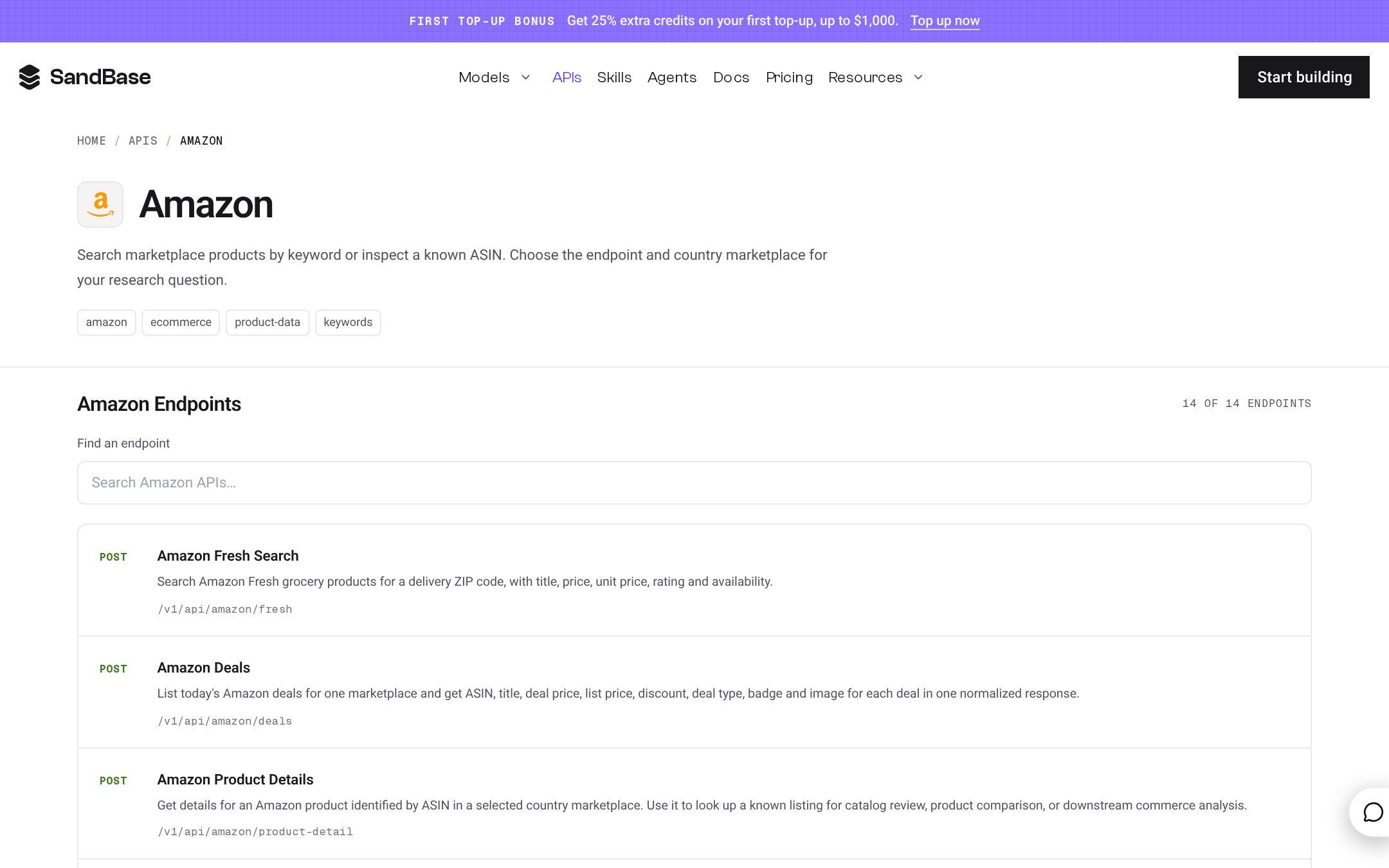
SandBase Amazon hub for keyword product search and ASIN details, captured logged out in a light theme on 18 Nov 2026 (Asia/Shanghai). The top banner reads “FIRST TOP-UP BONUS Get 25% extra credits on your first top-up, up to $1,000.” Confirm that promotion on the pricing page.
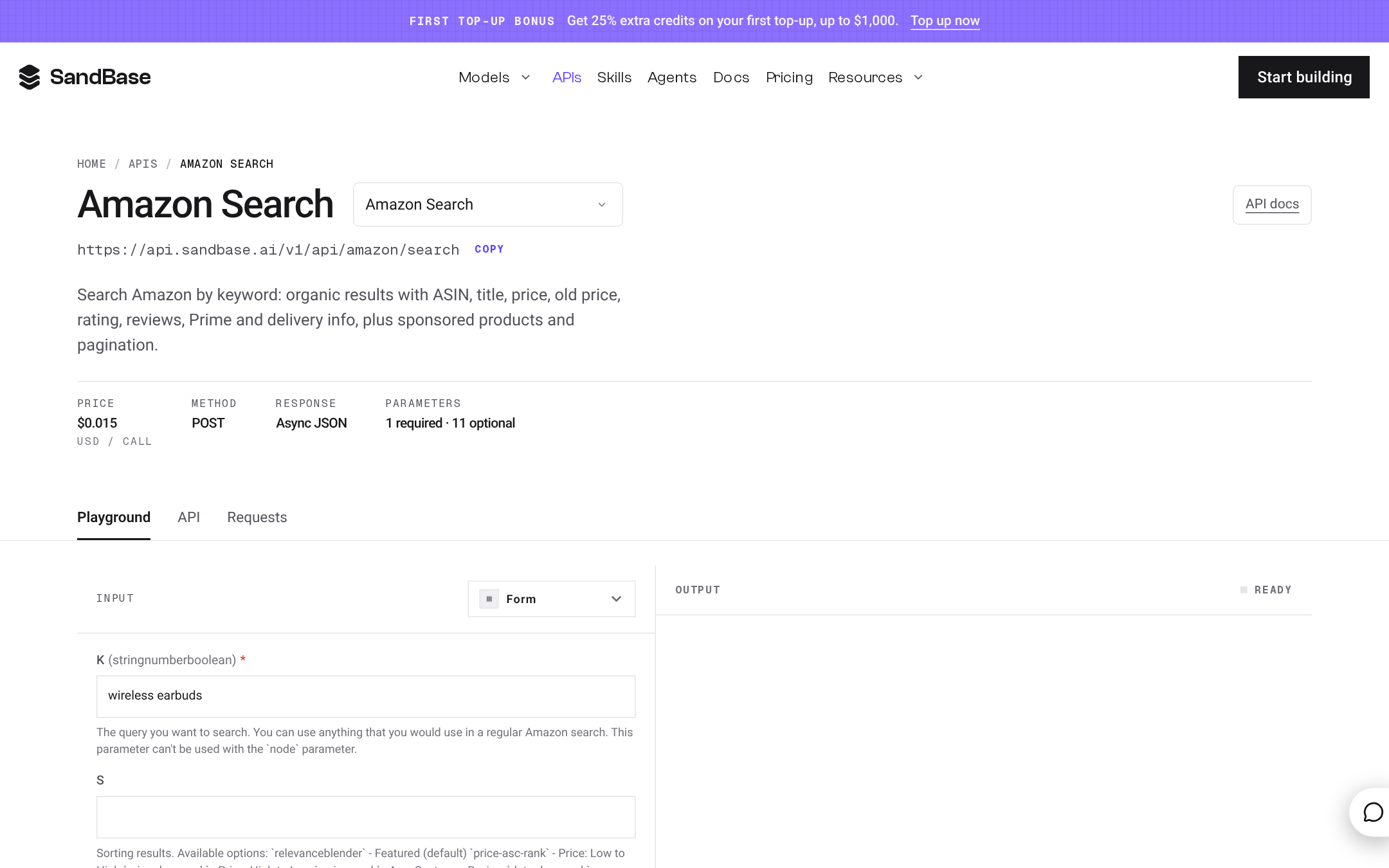
SandBase Amazon Search card, captured logged out in a light theme on 18 Nov 2026 (Asia/Shanghai). The page is the keyword-search route. The banner reads “FIRST TOP-UP BONUS Get 25% extra credits on your first top-up, up to $1,000.”
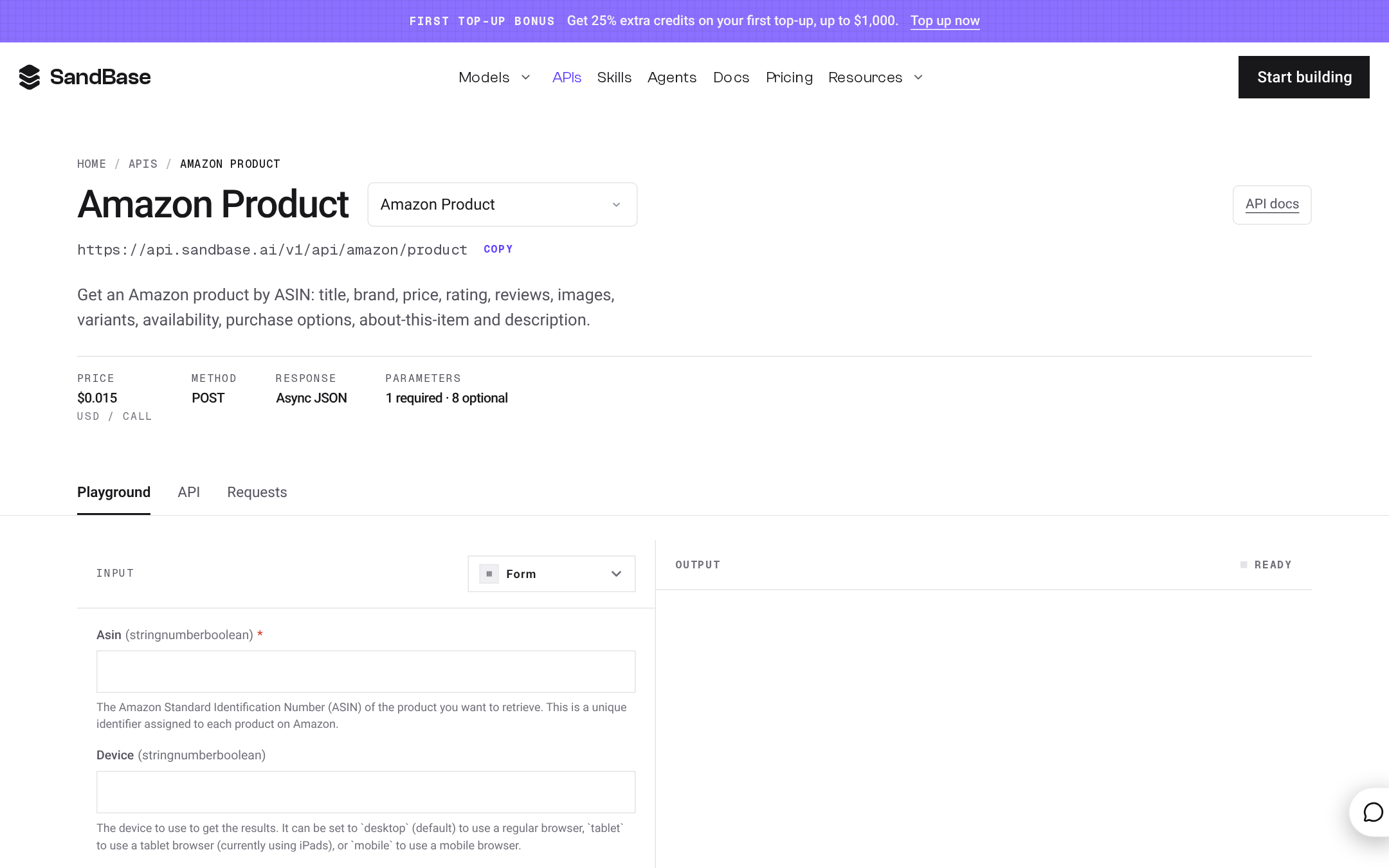
SandBase Amazon Product card for variants and purchase options by ASIN, captured logged out in a light theme on 18 Nov 2026 (Asia/Shanghai). The banner reads “FIRST TOP-UP BONUS Get 25% extra credits on your first top-up, up to $1,000.” It is a capture, not a standing discount on the $0.015 list price.
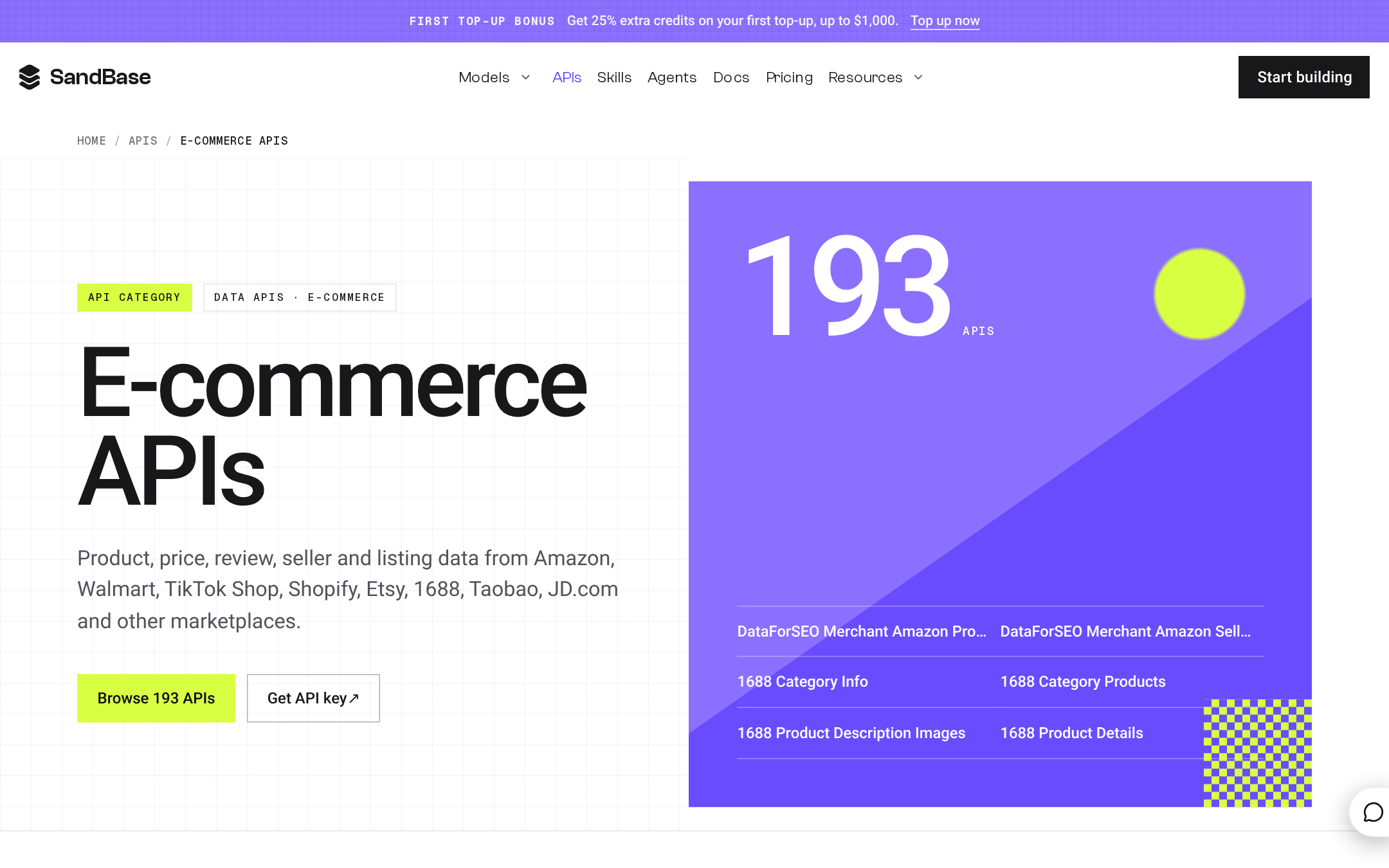
SandBase e-commerce category page, captured logged out in a light theme on 18 Nov 2026 (Asia/Shanghai). The page groups store catalogs including Amazon, Walmart, TikTok Shop, and 1688. The banner reads “FIRST TOP-UP BONUS Get 25% extra credits on your first top-up, up to $1,000.”
Amazon product data API alternatives side by side
The rows are different products. The table is not a rank.
| Path | Who it is for | What 18 Nov 2026 confirmed | Price |
|---|---|---|---|
| Official Creators API | Associates and creator programs | PA-API 5 docs redirect to a migration page. New PA-API 5 work is the wrong default. | Official prices Unknown |
| Official Selling Partner | Sellers writing orders, inventory, listings | Not on the SandBase Amazon hub | Official fees Unknown |
| SandBase Amazon hub | Research lookups: search, ASIN detail, reviews, deals, sellers | 14 cards. Search and product at $0.015. Reviews from $0.016. Autocomplete at $0.00015. | SandBase list prices above |
| Other SandBase store hubs | The same key, a different store | Google Shopping, TikTok Shop, 1688, Walmart, eBay, AliExpress, Temu returned HTTP 200 | Counts and prices for those hubs are on the live pages |
A like-for-like saving versus the Creators API cannot be computed while official prices are Unknown. Best Data API Providers in 2027 maps the wider catalog as lanes, not a winner’s list. Best JustOneAPI Alternatives in 2027 is the neighboring piece if 1688 and other marketplaces are the actual comparison.
How to call Amazon search
Data APIs use POST /v1/api/{vendor}/{endpoint} with Bearer auth and a JSON object. The reference, checked 18 Nov 2026, is API passthrough. Omit the optional model field. The URL is the identity. The only example body on that page is Firecrawl scrape. Leave it there.
This comparison did not run a new paid call, so business fields are not listed. Replace the empty object with the fields on the live Amazon Search card before you send it. An empty object is what the passthrough page allows when you are inspecting the route. Read outputs[0].data, and treat names inside it as undocumented until your own response shows them. If the call is asynchronous, poll GET /v1/run/{id}. That is a poll, not the submit path for a data API.
import os
import requests

payload = {}  # replace with the fields shown on the live tool card before sending

response = requests.post(
    "https://api.sandbase.ai/v1/api/amazon/search",
    headers={
        "Authorization": f"Bearer {os.environ['SANDBASE_API_KEY']}",
        "Content-Type": "application/json",
    },
    json=payload,
    timeout=90,
)
response.raise_for_status()
body = response.json()
outputs = body.get("outputs") or []
if body.get("status") != "completed" or not outputs or not isinstance(outputs[0], dict):
    raise RuntimeError(f"SandBase call did not complete: {body.get('status')} {body.get('error')}")
data = outputs[0].get("data")
The product card uses the same client with the path /v1/api/amazon/product. Search-products is /v1/api/amazon/search-products. Each card has its own fields.
What one research key is allowed for free
As of the 18 Nov 2026 pricing page and billing guide, plans are pay per call and there is no subscription: Start ($0), Build (Metered), Scale (Custom). Every organization also gets 100 free data API calls per UTC day for eligible search, social, scraping, e-commerce, and finance tools. Eligible calls are shared across those tools and across all of the org’s keys. The counter resets at 00:00 UTC. Unused calls do not carry over.
Language models and media models are outside that allowance. Some data APIs bill from the first call, including pricier or formula-priced ones such as some batch endpoints, crawl endpoints, Xiaohongshu Pugongying (PGY), and the Douyin Xingtu kol-* routes. A tool is eligible when the live card shows pricing.free_quota (sandbase_inspect). A tool without that field is always billed. The hub prices above do not, by themselves, prove these 14 cards are inside the allowance. Open the card.
Past the 100th eligible call, requests still complete and are billed. They are not rejected. A zero balance can still spend remaining free allowance. The pricing page sample of included data APIs is a sample. A card missing from the sample can still be eligible. Failed calls are not charged. Agent sandboxes are free for now, with fair-use caps possible, and sandbox pricing will be announced before it changes.
When the card looks right, check pricing and open signup, which currently redirects to sign-in.
Price a sourcing pass on list rates
Twenty keyword searches at $0.015 are $0.30 if billed at that rate. Twenty product lookups at $0.015 are another $0.30. Twenty review calls, using the published floor of $0.016, are at least $0.32, and the card can price them higher because the hub says “From.” The floor for that 60-call pass is about $0.92 before any free allowance. Twenty autocomplete calls at $0.00015 are $0.003. Reviews, not the keyword step, dominate a loop that pulls a review sample for every ASIN.
That arithmetic is list-price math. It is not a bill from a call this article ran. If the cards are eligible, part of a UTC day can fall inside the shared 100 calls. If a card is formula-priced and lacks pricing.free_quota, it bills immediately. Speed is Unknown. No latency figure was measured.
For a workflow that already reads price bands and review concentration, the existing guide Amazon Opportunity Scanner walks that research task. A cross-store loop is covered in Price Comparison Agent for Google, Amazon and TikTok Shop. Neither guide turns this hub into official Associates data.
When not to switch: an official Amazon program
Stay on the official Creators API when you are in Amazon Associates or a creator program that requires Amazon’s own product API. PA-API 5 is the migration source, not the place to start a new client. SandBase’s 14 cards do not satisfy a program rule that names the Creators API.
Stay on Selling Partner when the work is seller operations: orders, inventory, or listing writes. Those routes were not on this hub.
Stay on the official program when you need an Amazon data license or brand-usage terms a third-party catalog does not grant. This check did not find those terms on the SandBase pages.
Stay when an official support channel, DPA, or enterprise contract is the buying criterion. Per-call cards do not replace that paperwork. If the decision is latency, mark it Unknown and do not switch on a speed claim this research never made.
Catalog gaps still open
There is no SandBase page that implements official PA-API, the Creators API, Advertising API, or Selling Partner. Official Creators API prices remain Unknown. “From” prices on deals, offers, ASINs, reviews, seller, and seller-products need the live card before you budget a batch. Endpoint counts for Walmart, eBay, and the other neighbors were not copied into this article. The top-up banner in the screenshots is a promotion visible on 18 Nov 2026, not a change to the list prices.
FAQ
Is the SandBase Amazon hub the Creators API?
No. It is third-party product data: 14 lookup cards on 18 Nov 2026. The Creators API is Amazon’s Associates path, and the PA-API 5 docs now redirect there. Selling Partner is a separate seller API.
What did search and the product card cost?
The hub Markdown listed search at $0.015 per call and the product card at $0.015 per call. Search-products was $0.014286. Reviews started at $0.016. Confirm the live card on the day you call, because the catalog can change.
Should a new build target PA-API 5?
The documentation URL followed on 18 Nov 2026 landed on a Creators API page about migrating from PA-API 5. Build new official Associates work against the current Creators API docs. Use the SandBase hub only for the third-party research lookups it actually lists.
Related reading
Read Amazon Opportunity Scanner before you script price bands, and the Google, Amazon, and TikTok Shop price comparison when the loop leaves Amazon. Wholesale search on 1688 is 1688 Product Finder. TikTok Shop search is TikTok Shop Product Research API. The marketplace comparison in this cluster is Best JustOneAPI Alternatives in 2027, and the lane map is Best Data API Providers in 2027.
To call it: open the Amazon hub, then the Search card beside the passthrough reference, then pricing and signup.
Found this useful? Share it