TRELLIS.2 vs Meshy 7 Retexture: UV Layout and Seams Tested
Four retextures on one robot compare original UV preservation, embedded material maps, exact GLB bytes and color discontinuities at 1,199 shared seams.
Four retextures on the same robot all returned 8,089 triangles. Only the two Meshy files kept the original UV-to-face correspondence at the precision examined. TRELLIS.2 split the same surface across a denser layout with 1,870 additional measured seam edges. Its baked base color had a smaller jump at the original seams on both trial finishes. If you need a new colorway for an existing mesh, decide whether you can ship a new atlas alongside each material or need the texture to fit the original UVs.
Key takeaway
- Both routes processed the same mesh with the same two reference images on November 14, 2026 UTC. Meshy with original UV enabled retained the same 1,199 eligible seam edges and the same normalized position-to-UV mapping at the tested precision.
- TRELLIS.2 returned 7,780 position records and 3,069 measured seams. Meshy retained 5,435 position records and 1,199 seams. All four had the source’s triangle count, and their normalized surfaces were closely aligned.
- On the exact same 1,199 source seam edges, TRELLIS.2’s 90th-percentile base-color jump was 4.67 and 4.33 RGB levels. Meshy’s was 7.33 and 6.33. These measure encoded color, which can legitimately change where a pattern crosses an edge.
- TRELLIS.2 charged $0.24 per result and packed two 2K maps. Meshy charged $0.33 and packed one 2K map with PBR disabled. Reused runs represented $1.14 in generation fees. The seam sampling and atlas visualizations are new.
Fix the mesh and match the visual guides
We reused the four original deliveries from the robot color-variant project. The source is one textured Tripo P2 robot GLB, 962,780 bytes and 8,089 triangles. The two guides were authored color renders of that same robot, one blue-green with dark sections and pale bands, the other terracotta with cream and pale accents. Both routes received the same source file. For each palette we supplied the same reference PNG.
TRELLIS.2 Retexture used image, generation resolution 1024, 2,048 texture size and seed 42. Meshy 7 Retexture used the same PNG via image_style_url, texture_resolution: "2k", enable_original_uv: true and enable_pbr: false. The route names describe the exact services used. Both received image guidance and generated equal pixel-dimension atlases, while they had different material flags and UV controls. The comparison covers one robot and one output per route for each of two palettes. Its measurements apply to the listed UV and material settings.
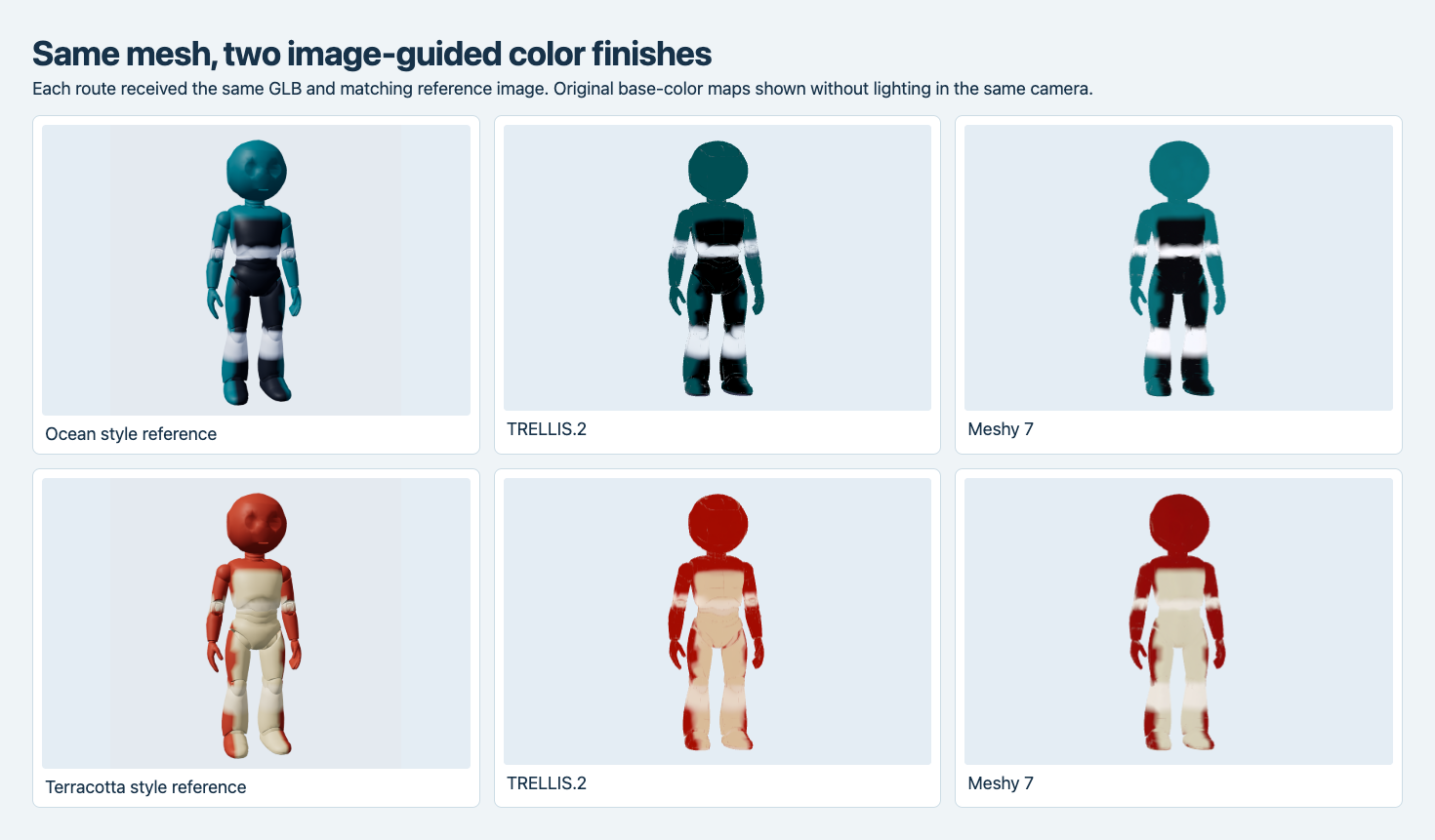
The left column shows the two guides. Both output columns use the delivered mesh and base-color map under a flat material. The illustration on the cover is separate.
Broad color regions survived on both outputs: blue-green outer panels and pale bands in the ocean version, red side regions and cream centers in the warmer finish. The flat render is intended to show the images baked into the two meshes. It removes directional light and ignores the metallic-roughness map, so it cannot rank how the two route materials look with scene lighting.
Check UV correspondence in addition to triangle count
| Delivered output | Triangles | Position records | GLB bytes | Embedded maps | Actual fee |
|---|---|---|---|---|---|
| Source | 8,089 | 5,435 | 962,780 | Base-color JPEG | Prior generation |
| TRELLIS.2 ocean | 8,089 | 7,780 | 5,060,248 | Base-color PNG and metallic-roughness PNG | $0.24 |
| Meshy ocean | 8,089 | 5,435 | 2,223,216 | Base-color JPEG | $0.33 |
| TRELLIS.2 terracotta | 8,089 | 7,780 | 5,728,716 | Base-color PNG and metallic-roughness PNG | $0.24 |
| Meshy terracotta | 8,089 | 5,435 | 2,153,632 | Base-color JPEG | $0.33 |
All four results opened as GLBs and gave zero format errors and warnings. All embedded maps were 2,048 pixels square. File bytes include material data plus meshes, index buffers and container structure, so equal resolution and face count can still produce very different package sizes.
The exports also had different stored coordinate scales. The source’s longest axis was about 0.9995 in the file, TRELLIS.2 about 0.99999, and Meshy 2.0. This is a file-space observation, not a physical dimension. After normalizing the original and the outputs independently, a two-way point-to-triangle check covered all stored vertices. The largest sampled distances were below 0.00000004 of the normalized longest dimension. The preserved surface says little about whether a texture can be carried back to the original.
To check that mapping, we normalized the position scale, paired each triangle corner’s position with its UV and sorted out the order of both triangles and corners before comparing. Both Meshy exports matched the source’s rounded corner-position and UV sets at four and five decimal places. Their raw index ordering still differed. Neither TRELLIS.2 export matched at those precisions, including after testing a V-axis flip. The UV atlas illustrates why comparing position records or triangle counts by themselves is insufficient.
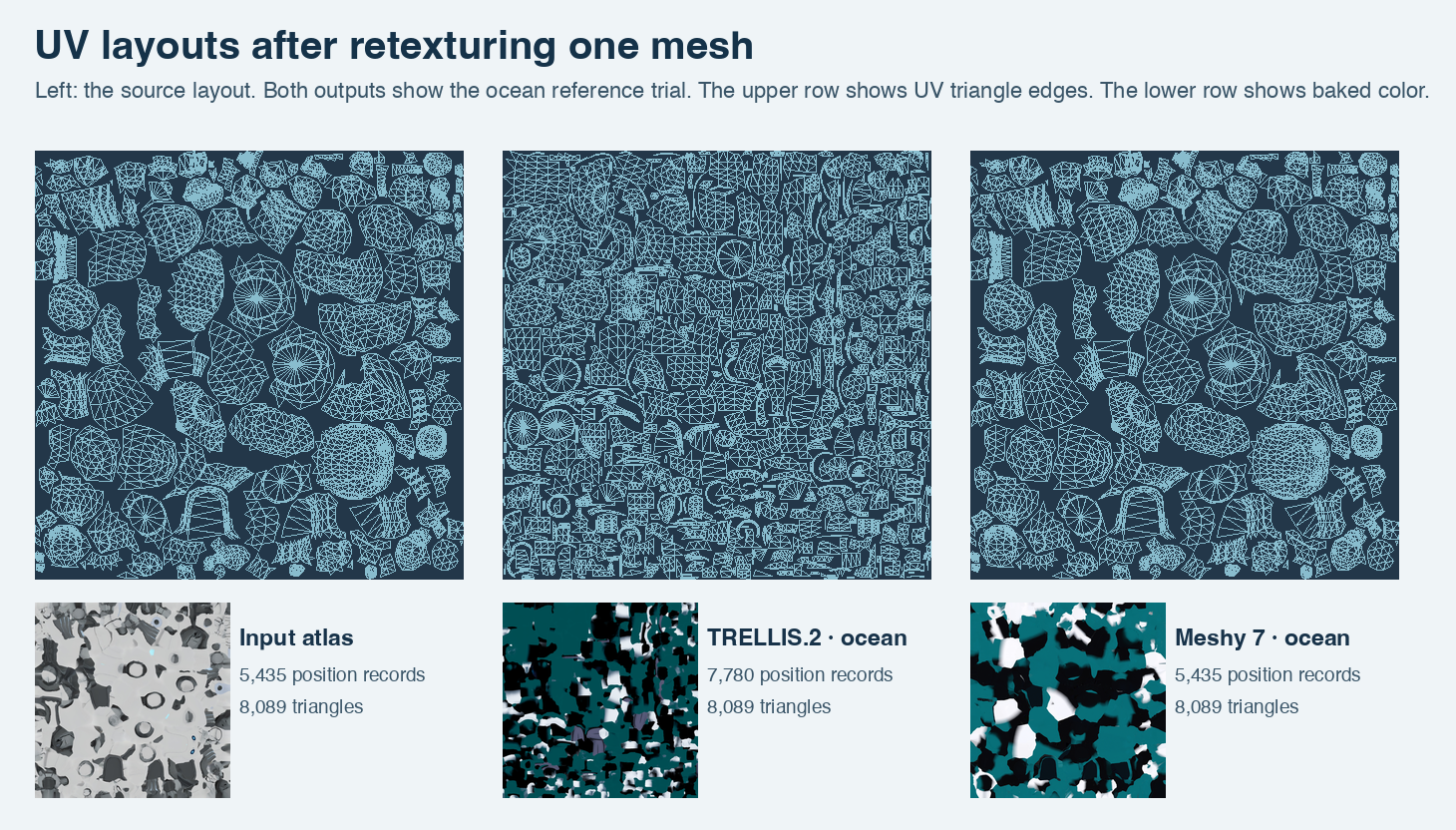
The original and Meshy atlas edges line up visually. TRELLIS.2 keeps the shape but encodes it using differently sized chart islands. The thumbnail images below are the embedded colors.
Compare the same physical seam edges
A seam starts where two neighboring mesh triangles share a location along a physical edge but assign different texture coordinates to it. We matched side pairs using normalized spatial endpoints rounded at a grid of 0.00001 of the longest side. We kept edges with exactly two adjacent triangles and a length of at least 0.002 of that normalized side threshold. In each atlas we sampled three locations along the edge. For each side the sample is nudged 6% of the way toward the triangle’s third corner. Compare the nearest encoded RGB texels on the two sides, then average their absolute per-channel differences.
Meshy had the same 1,199 eligible edges as the source. TRELLIS.2 had those edges and 1,870 additional eligible cuts. Since the counts differ, the main comparison below uses only the same physical subset, with 3,597 sample pairs per file. On those shared cuts TRELLIS.2 had a lower 90th percentile for each guide. Some large changes in color are intended design boundaries. The number does not measure semantic correctness, color-matching against the reference, shader response or visible seam intensity at all zoom levels.
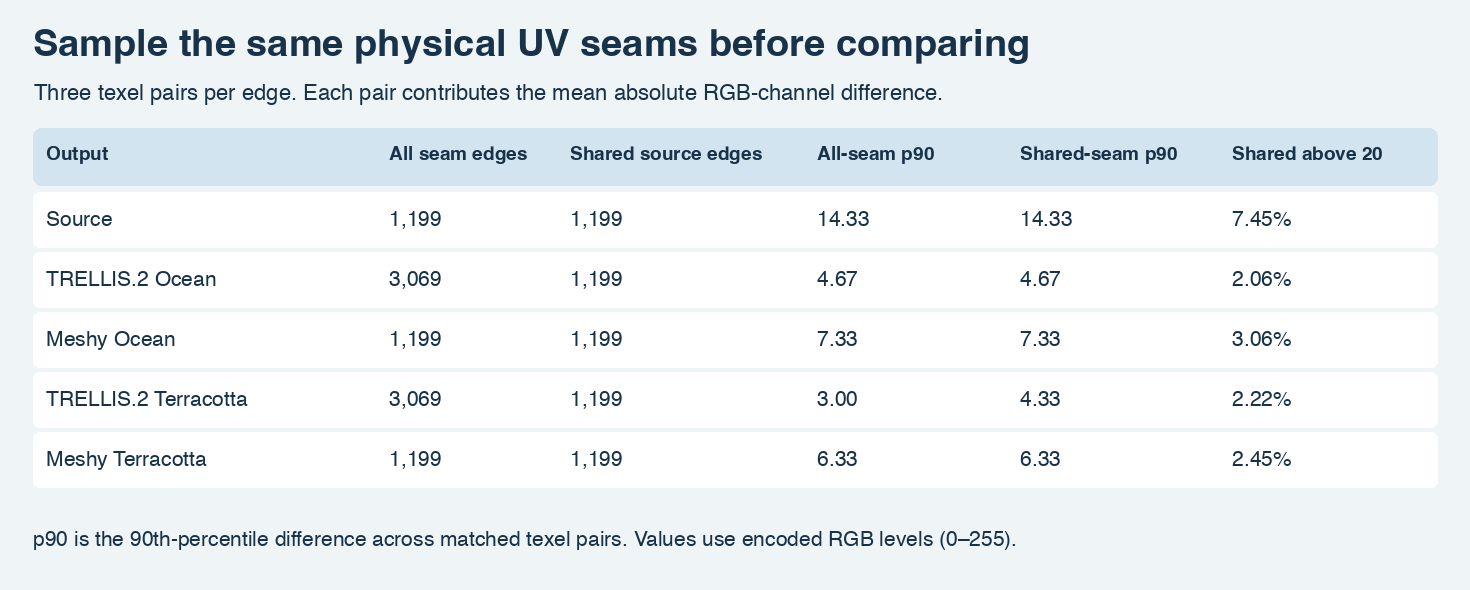
The two p90 columns distinguish all measured cuts and cuts present on the original mesh. For TRELLIS.2 terracotta, p90 is 3.00 across all eligible cuts and 4.33 across the shared cuts. The shared-edge column compares only the corresponding physical locations.
Test the base-color swap in the viewer
For one operational check, we swapped each ocean base-color image onto an unchanged copy of the source robot with its original UVs. No geometry or UV data were copied from the returned GLB. Meshy’s ocean colors mapped back in recognizable bands. With the TRELLIS.2 image on the old UVs, color patches were scrambled. The source and delivery objects have the same overall profile after scale normalization, but that does not make textures interchangeable.
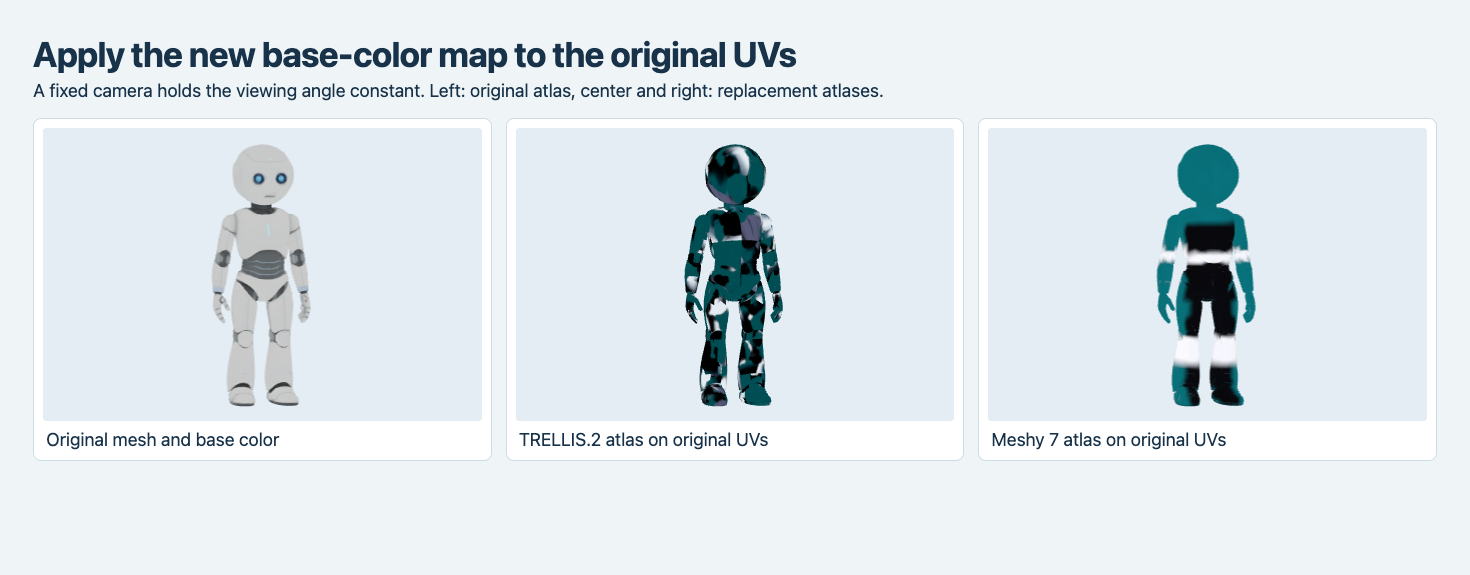
All three renderings use the original mesh and UVs. Only the base-color map changes. A TRELLIS.2 output can be used with its own UVs.
If active material variants already rely on the approved UVs, verify matching corner positions and UVs before a texture swap. If the target accepts a full new material-bearing GLB, a changed atlas is workable and the seam test should use the actual target asset. Store the original and final package paths independently so future work can find the matching map. For a paired generation with a shape image and a finish image, see the Meshy 7.1 texture guidance test, which starts before the UV handoff.
Budget the actual files for a color selector
The Meshy deliveries were 4,376,848 bytes in total as two separate GLBs. A client keeping the 962,780-byte original GLB and downloading both standalone Meshy JPEGs would transfer 4,794,192 bytes before any transport compression. In this example that is 417,344 bytes more than the two complete replacements because the original GLB still carries its own smaller atlas. This calculation counts only the three asset files and assumes a fresh download of all three. If the original is already cached, only the variant images are additional transfers. For a chooser that loads one color at a time, compare that single request sequence separately.
See the TRELLIS.2 input-format test for the behavior of a single route with GLB, OBJ, PLY and STL inputs.
The decimation order test measures how local geometry reduction before or after Meshy retexturing affects the final GLB and seam samples.
Frequently asked questions
Which retexture was cheaper?
At the observed settings, two TRELLIS.2 calls cost $0.48 and two Meshy calls cost $0.66. That excludes the earlier source job, asset checking and any future rebake. The figures describe two image-guided finishes, not arbitrary resolutions and flags.
Does a lower seam score mean the model matches the reference better?
It means sampled baked color changed less as the measurement crossed those cuts. An intentionally sharp color boundary can have a large difference. Verify the object from the needed camera and review the material under the lighting used in the actual application.
Can I copy all the resulting textures onto the original mesh?
The swap shown tests only base color for one palette. Match the original UVs and confirm the material slot, color handling and any normal or metallic-roughness data separately before applying all maps in a finished pipeline.
Found this useful? Share it