TRELLIS.2 Retexture Inputs Tested: GLB, OBJ, PLY and STL
Six TRELLIS.2 retexture requests compare four input formats, optional UVs, atlas retention, output geometry and GLB validation.
TRELLIS.2 accepted six versions of the same untextured receiver in GLB, OBJ, PLY and STL and returned six textured GLBs. Four files had errors for zero-length vertex normals, even though all six rendered in the browser. Supplying a UV layer made no difference to the bytes of the returned GLB pair. It coincided with a file about 80% bigger in the PLY pair. Comparing formats only by a successful status would miss both differences.
Key takeaway
- All six inputs had 10,140 triangles and used the same image, 1024 generation resolution, 2,048 texture size and seed 42. All completed at $0.24 each, for a total of $1.44.
- The two GLB inputs produced byte-identical outputs at 4,032,124 bytes. PLY and STL without UV coordinates also produced byte-identical outputs, at 4,093,836 bytes.
- All six deliveries used a different UV mapping from the authored layout. Across 9,692 unambiguous matching triangles per result, zero of 29,076 compared corners matched the source UVs within 0.0001, including with a V-axis flip.
- Both original GLB-input deliveries had 1,138 zero-normal errors. The OBJ and PLY inputs with UVs each gave 868. Only the no-UV PLY and STL results passed with zero errors and warnings for this fixture.
Make the input matrix from one unpainted mesh
We reused the authored weather receiver from the Rodin prototype experiment so the original shape and front reference were available. For this test, the receiver’s materials were removed and its mesh components were joined as one Blender mesh object. A new Smart UV Project provided UV coordinates without an embedded texture. The route received one of six files derived from that intermediate plus the exact same front three-quarter render. The renderer’s image contained the teal housing, blue screen and orange controls. The input meshes had no baked color to transfer.

This is the shared reference image, reused from the earlier experiment. All six requests received these same PNG bytes. The results below were generated for the format test.
The TRELLIS.2 Retexture route lists these four input formats. We exported GLB and binary PLY with and without UVs. The OBJ included face-corner texture indices and had no companion material file. The binary STL contained triangle geometry and no UV layer. PLY’s optional s and t vertex properties were present on one file and absent on the other. The GLB pair differed by the exported TEXCOORD_0 attribute and the corresponding container data. All inputs used consistent axes.
Each input contained 10,140 raw triangles. Comparing sorted triangle positions rounded to four decimal places yielded the same records across all inputs. The text OBJ writer approximates floating-point positions when formatting them, so some entries differ at another rounding precision. GLB, PLY and STL also serialize normals, positional records and triangle connectivity differently. Treat the matrix as a comparison of actual exports from the same source and use the within-format pairs to examine the presence of UVs.
Compare the file before and after the call
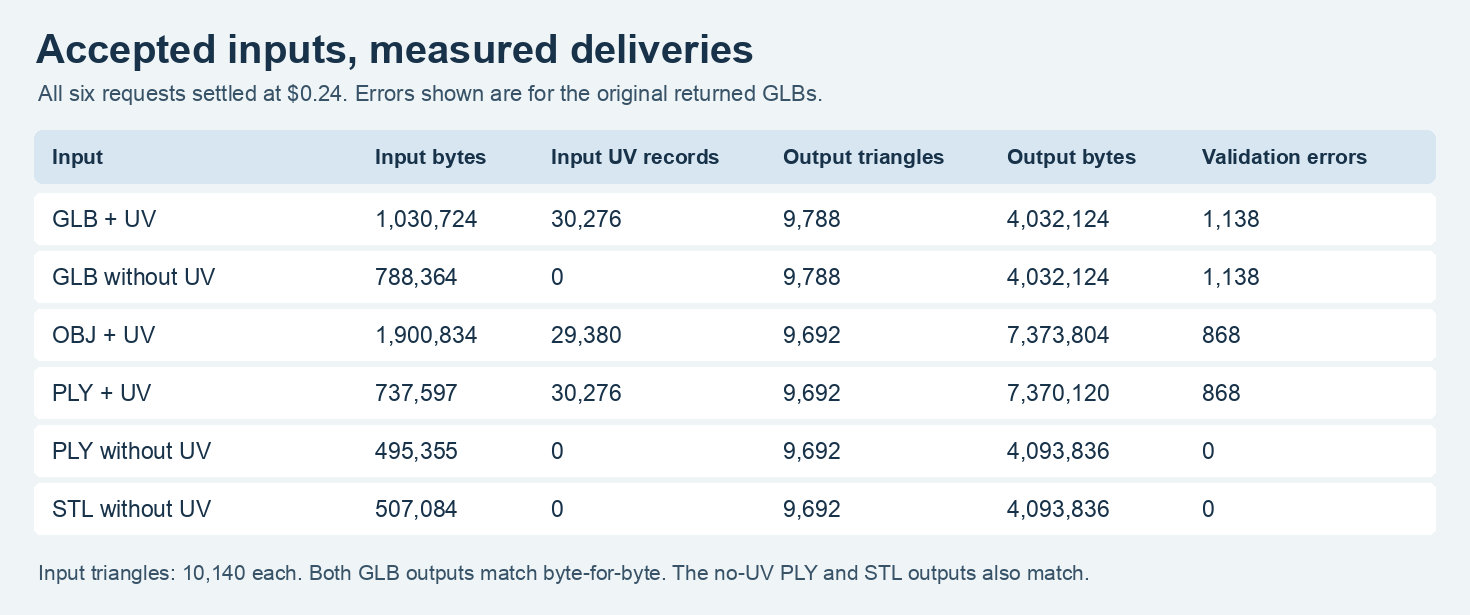
The table counts the raw data in each file, before any download compression. Each row is a separate completed job, including the pairs with identical output hashes.
The source files ranged from 495,355 bytes for the no-UV PLY to 1,900,834 bytes for the OBJ with UVs. The response size does not preserve that ordering. Both GLB variants returned 9,788 triangles. All other variants returned 9,692. The outputs saved as GLB regardless of what went in. Each contained a 2,048-square base-color PNG and a 2,048-square metallic-roughness PNG. The choice of input file did not change the settled charge with these settings.
For the GLB pair, adding 30,276 UV records increased the upload by 242,360 bytes. Both outputs were exactly 4,032,124 bytes, and their SHA-256 digests matched. For the PLY pair, the UV properties added 242,242 input bytes. The PLY with UVs returned 7,370,120 bytes, 3,276,284 more than the PLY without UVs. Their triangle counts were equal. The texture dimensions were also equal. The difference includes more stored position records plus larger encoded images. In the PLY output with UVs the two embedded PNGs accounted for 6,326,272 bytes, compared with 3,751,040 bytes in the paired result.
The no-UV PLY and the no-UV STL gave the same SHA-256 and a clean validation result. Those are two independently submitted jobs that delivered one unique byte sequence. For storage or QA, deduplicate the delivered files by hash and keep the request records separately. There were four unique GLBs across six successful jobs. With one result per input, those pair matches belong to this receiver, route settings and date.
Separate shape, UV mapping and shading
The triangles and position counts tell you the files were rebuilt or cleaned up, but the remaining surfaces can still be close. After centering and independently rescaling the longest dimensions, we sampled both directions between the source mesh and each result. We checked up to 10,000 stored vertices per direction against the nearest target triangle. The largest measured distance was below 0.00000051 normalized units across the six deliveries, with the largest discrepancy on the OBJ case. This quantifies proximity on those sample points and does not establish the original connectivity, exact dimensional fit or every interior surface.
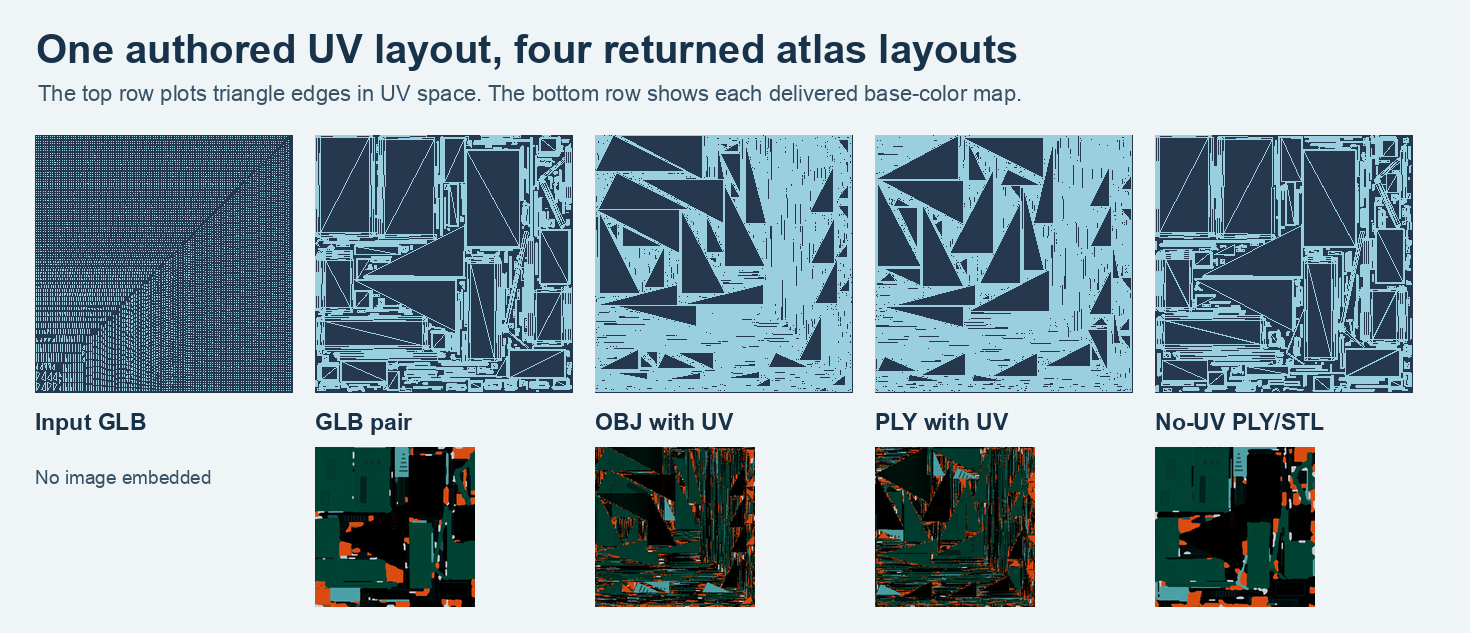
Each panel uses the actual triangle corner coordinates from its GLB. The untextured input provides UV coordinates only. In the returned files, the chart and the baked image are used together.
For the mapping check, we grouped triangles by the same three sorted positions after centering and normalizing them on a 0.0001 grid. Duplicated position keys and keys with coincident corners were excluded. Each result shared 9,692 unique triangle keys with the reference. For each matching location, we compared the same three physical corners. A match required both coordinates to agree within 0.0001. No corner matched in any condition, including a second comparison after reversing V. The drawn charts show how different the delivered atlases are. A known UV pipeline needs this correspondence check even when the surface looks familiar. See the retexture seam and UV comparison for an output where a different route preserved the mapping at tested precision.
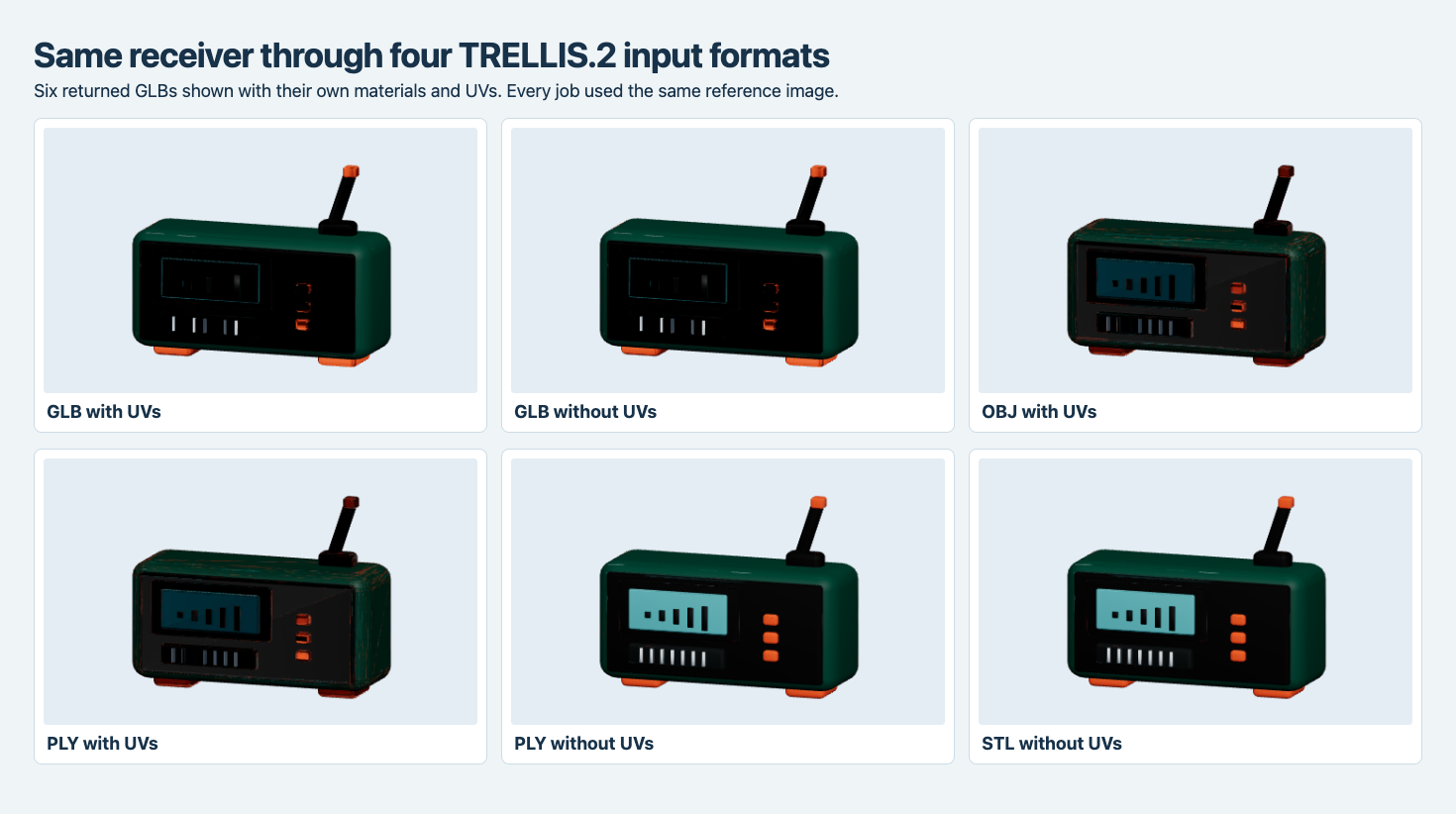
All six use the same scene lighting. No normals or textures were replaced. In this view, the no-UV PLY and STL screen and buttons are distinct. The GLB pair has a much darker screen, and the UV-bearing OBJ and PLY show small colored streaks across the casing.
The glTF Validator reported only ACCESSOR_VECTOR3_NON_UNIT as an error on the four affected files. The messages point to the vertex NORMAL accessor, where the affected vectors had length zero. Rendering these files in Chromium establishes that this viewer could load them. It leaves shading in other pipelines and strict importer acceptance open. Before attributing every visual artifact to normals, inspect the baked color map too. The format cases differ in both the vertex data and the baked maps. For a worked fix on an independently generated asset, see the zero-normal repair walkthrough and the Khronos validator issue reference.
Put the output checks where the file is ingested
After a request completes, save the original response alongside the returned asset’s SHA-256, input format and input UV count. Run format validation on the exact bytes you plan to hand off. For this matrix that would have admitted two deliveries and grouped them as one unique validated file. Keeping both request records still tells you that the clean result came from two different inputs. If an importer silently recalculates normals, its working copy can look convincing while the original asset still fails the audit.
For a pipeline that needs to preserve an existing atlas, attach the UV correspondence result to that same file record. Both clean deliveries here would have gone into the full-asset replacement path, since neither could reuse the old layout. A preview pipeline without that requirement can instead inspect the delivered GLB as one package. It can review the front plate at the final viewing size and use the file’s own mesh and material together.
Frequently asked questions
Can I submit an untextured model that has no UVs?
Yes for these actual no-UV GLB, PLY and STL inputs. Each returned a textured, UV-mapped GLB. The original GLB-input output had validation errors, so use the output report to decide whether the asset can move into a target engine.
Should I strip UVs before calling TRELLIS.2?
Keep the source with its original UVs if another process or existing texture depends on them. For a retexture trial use a separate export. With this particular fixture a no-UV PLY returned a smaller, clean delivery. The GLB duplicate hashes also show how checking the returned asset can answer whether a second UV-bearing input buys anything for your own fixture.
Can I use the generated PNGs separately from the returned GLB?
The tested images are baked for the output atlas. None shared the source’s rounded corner mapping. Store the output mesh with the textures it expects, or rebake from the new mapping and test the target asset in its original UV layout.
Found this useful? Share it