Retexture Before or After Decimation? A 12K Triangle Test
Two Meshy retextures per workflow compare reducing a mesh before painting and painting before reduction at approximately 12,000 triangles.
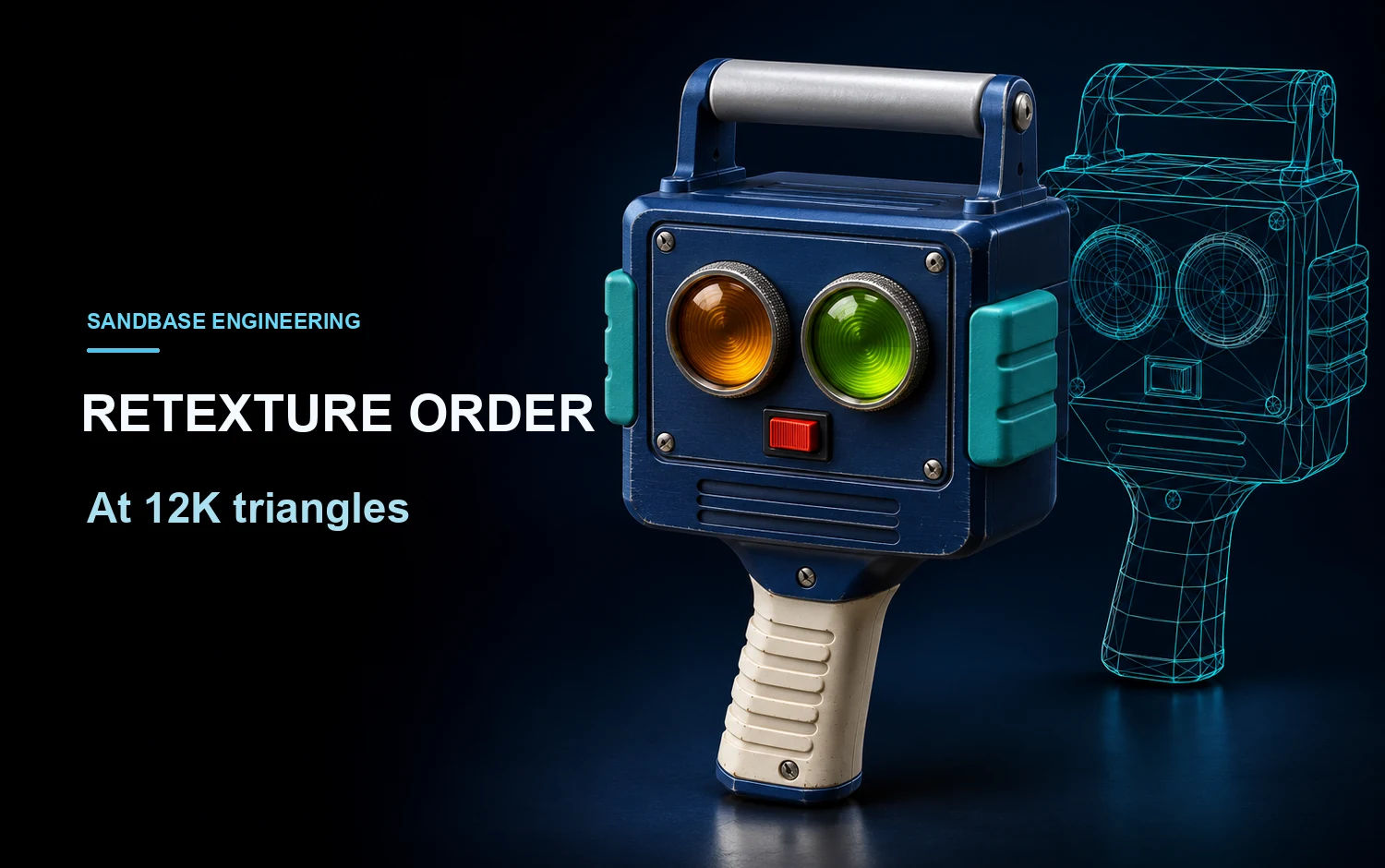
On one handheld prop, reducing the mesh before retexturing cut the upload from 1,159,708 bytes to 375,544. The opposite order delivered final GLBs about 76 KB smaller on average. Both orders finished near 12,000 triangles, with the handle opening and two raised front controls visible in the geometry. They also shared a visible texture error. Both painted the front’s colored lenses onto a rear panel that had no such features in the mesh.
Key takeaway
- One Tripo H3.1 source supplied both branches. We ran Meshy 7 Retexture twice at each input density, with original UV enabled, 2K base color and PBR maps disabled. Each run settled at $0.33, for $1.32 total.
- Reduce-first outputs measured 12,000 triangles. Retexture-first outputs measured 47,484 before local reduction and 11,999 after. All four final GLBs had zero validator errors and warnings.
- Within each order, decoded positions, normals, indices and UV arrays matched across repeats. The two generated JPEGs in each order differed. Across orders the geometry and texture could both differ.
- In the fixed front preview, mean absolute RGB difference was 1.92–1.98 levels within an order and 2.40–3.15 across orders. On the opposite side the ranges overlapped. None of these scores measures resemblance to the reference or surface realism.
Hold the source, texture guide and target count constant
The source is the image-generated GLB from the Tripo H3.1 modality test. It is a navy handheld inspection tool with an open gray handle, an amber lens and a smaller lime lens rising from the front, a red bar and teal side pads. The reference image for both retexture branches is the same authored front view used in that earlier test. It gives the texture route one view of the desired finish. The new experiment asks what happens when one local geometry step changes place in the pipeline.
We removed the original material and exported the source with its UV coordinates. The original-density export held 47,498 triangles. A Blender 4.5.9 Collapse Decimate pass targeting 12,000 produced the other upload. We used the measured input triangle count to set the ratio and enabled triangulation for the collapse pass. No image was packed into either upload. Both came from the same source geometry and kept their own UV attributes.
Each Meshy 7 Retexture request used image_style_url, texture_resolution: "2k", enable_original_uv: true and enable_pbr: false. We made two independent requests for each file with no seed exposed in the route schema. The source and experiment account record use November 14, 2026 UTC. The four returned images are new. Comparison across orders therefore covers geometry reduction plus how two independent retexture jobs responded to each input.
Finish the two orders without changing the paint
When reducing first, we used the original API output as the final file. It retained 12,000 triangles. When painting first, both API outputs returned 47,484 triangles. We applied the same Collapse settings to target 12,000, using the new measured count. Each local result had 11,999. The Blender exporter produced the geometry and UVs. A second packaging step copied the matching source material and JPEG from that API output into the reduced GLB, then confirmed the embedded base-color image had the same SHA-256 as before reduction. No image compression or rebake was added.
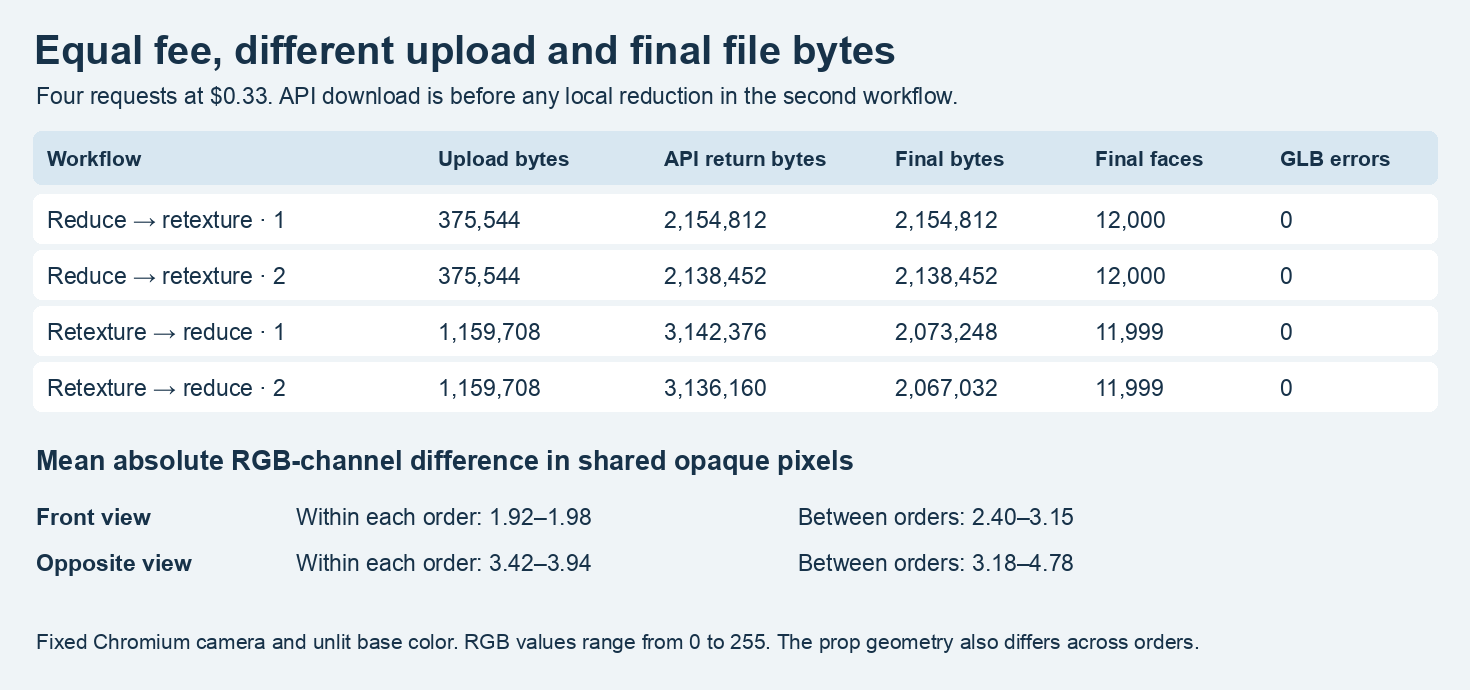
The download column is what the API returned. On the bottom two rows, final bytes reflect the separate local collapse and packaging step. Each request settled at $0.33.
The low-density upload was 67.62% smaller, using 784,164 fewer bytes. The two reduce-first API downloads were also the final files at 2,154,812 and 2,138,452 bytes. Retexture-first had to download 3,142,376 and 3,136,160 bytes before producing files of 2,073,248 and 2,067,032 bytes. The mean final bytes favor the second order by 76,492 bytes in this fixture. If the upload and API return both count against a transfer budget, the first order averaged 2,522,176 bytes, compared with 4,298,976. This sum counts asset payload bytes per request and omits the common reference image, protocol overhead and caching.
The four final maps were 2,048-pixel square JPEGs. Decoded position, normal, index and UV arrays had the same digests within each order. The maps did not. Comparing the arrays instead of the outer GLBs separates texture variation from a new geometry layout. Across orders those arrays differed as expected. Original UV in the API settings was not a request to undo what the Blender reduction had already done.
Inspect the geometry and the paint separately
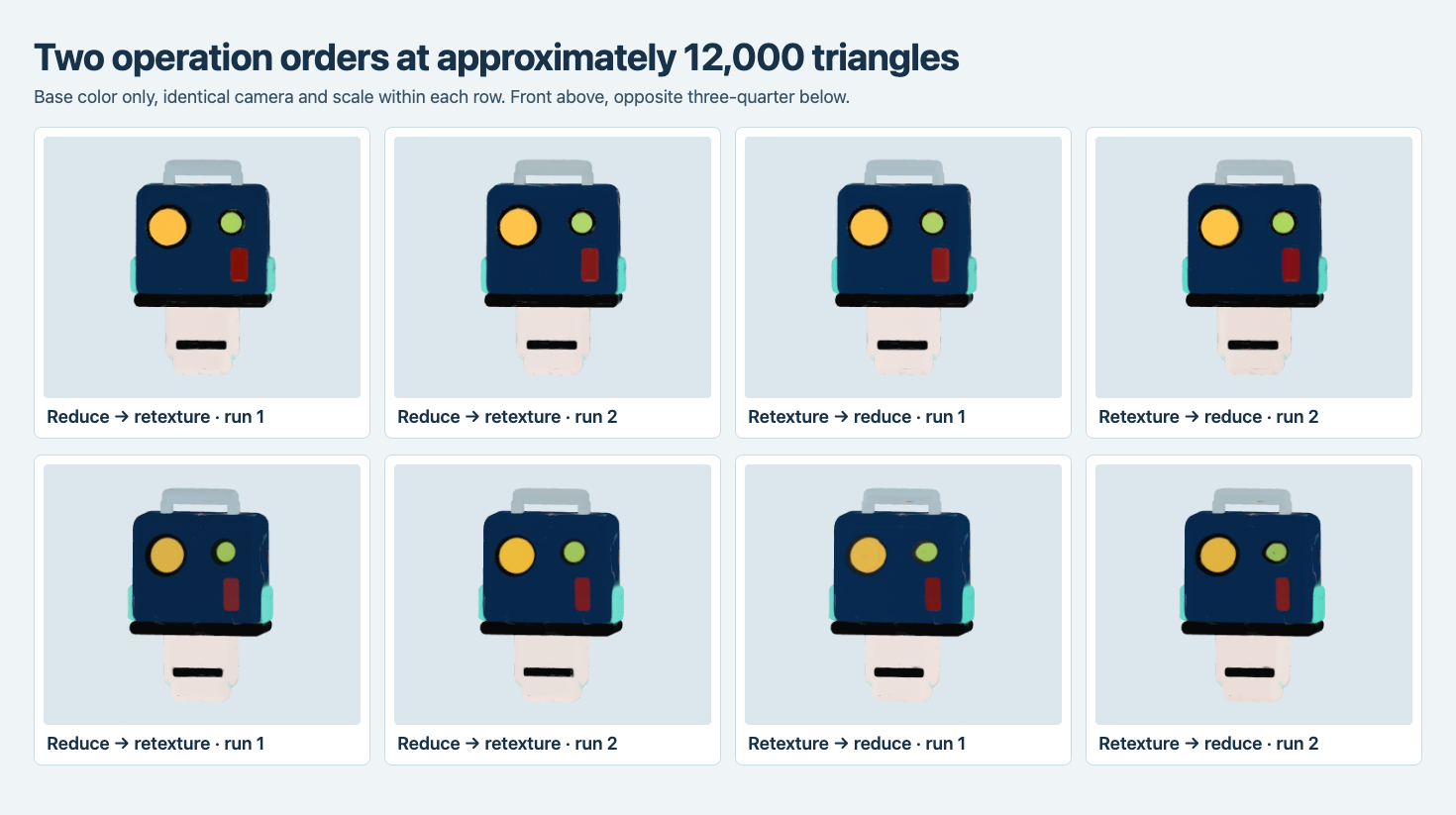
Unlit base-color views of all four final files. The top row faces the controls. The bottom row looks from the opposite three-quarter camera. The comparison uses each file’s own UVs and color image.
We centered each asset’s bounds and scaled its longest side to the same reference length. Against the original-density source, bidirectional vertex samples had maximum distance below 0.00064 of that length across the final files. The direction from delivered vertices to the source surface had 95th percentiles from 0.0002818 to 0.0002823. We sampled up to 10,000 stored vertices before calculating the distance to the nearest triangle on the other surface. Those samples and the pictures both show a close outer shape. They leave connectivity, hidden surfaces and exact seam behavior as separate questions.
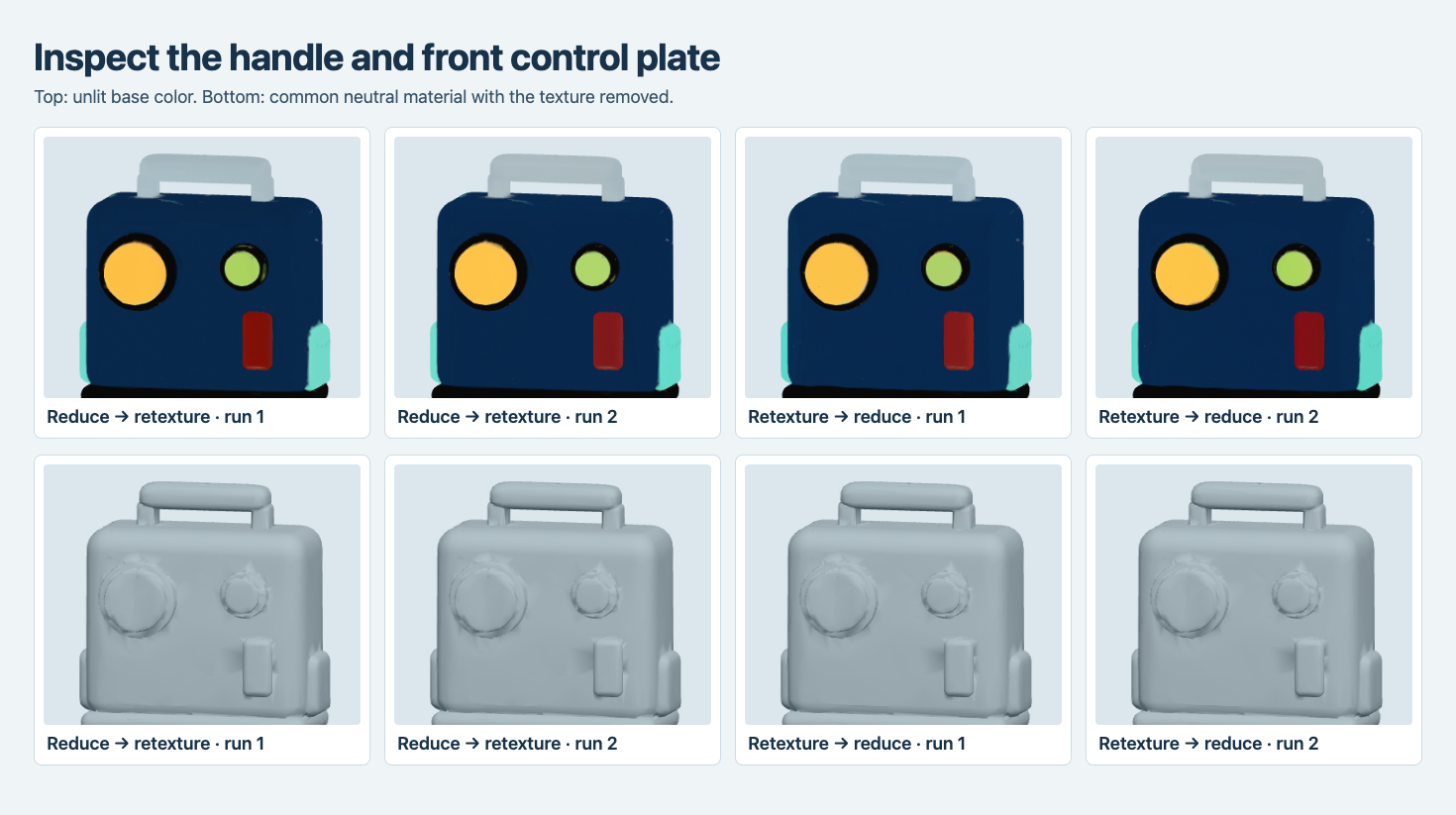
The close view crops away the grip to show the upper handle and control plate. All four retain the handle opening and raised front controls after we remove the material maps for the lower row.
To compare the paint at viewing scale, we rendered 352 × 290 pixels per view with a common orthographic camera. The pixel comparison uses only positions where both images are fully opaque. At each position we take the absolute differences in red, green and blue, then average those values over the compared positions. These are encoded RGB levels from 0 to 255. Across workflows the sampled silhouettes overlap at least 99.99% on the selected front and opposite views. The pixel metric can still include small geometry or UV differences because it compares rendered outputs.
The two exact front repeat contrasts were 1.98 and 1.92 mean RGB levels within each order. The four cross-order contrasts ranged from 2.40 to 3.15. At the opposite camera, the within-order means ranged from 3.42 to 3.94, against 3.18–4.78 across orders. Some cross-order pairs were closer than the repeated results within one order, so operation order by itself does not explain all the differences.
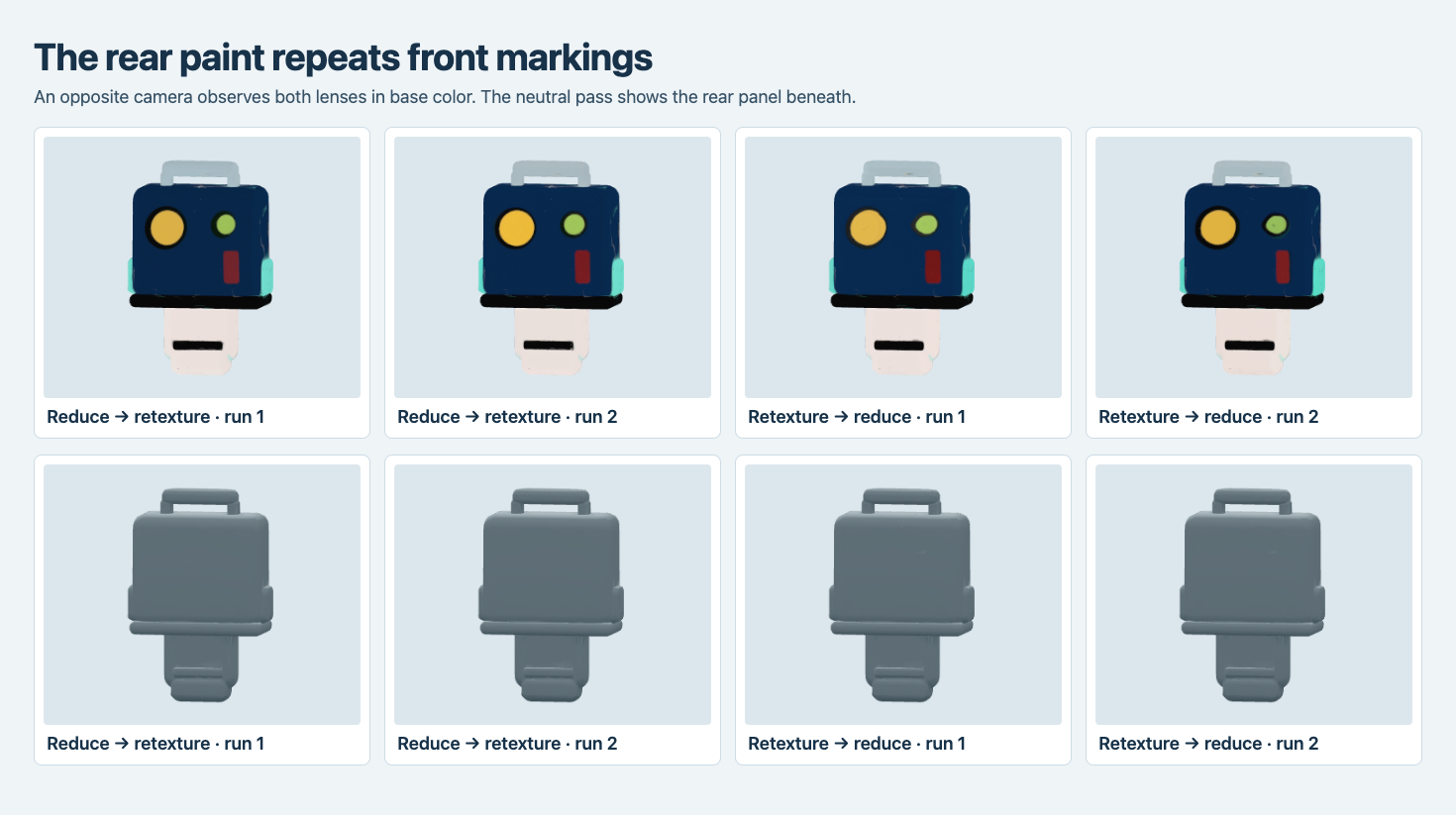
The rear panel shows the two lens marks in base color above. The corresponding geometry below has a plain panel. This appears in both repeats of both orders.
The location of a design matters more than the mean pixel score for some assets. All four rear previews show the colored circles and bar from the image guide on a plain panel. None of the rear neutral renders has corresponding lens geometry. Review assets in the positions that will be shown in the application. A close front preview or a high silhouette score will not reveal an invented rear motif. For a separate practical test of original UV mapping, see the TRELLIS.2 and Meshy 7 seam comparison.
Inspect color on corresponding seam edges
We also measured jumps across UV edges on each final mesh. A seam candidate is a rounded physical edge with exactly two adjacent triangles, different UVs on the two sides and length of at least 0.002 of the longest mesh dimension. Reduce-first had 2,536 eligible edges per file. Retexture-first had 740. Counts alone do not tell you whether a texture line is conspicuous when rendered.
We centered the normalized endpoints and paired edges that were mutual nearest matches, with each endpoint within 0.0005 of the longest side. That aligned 737 edges. We sampled each at 25%, 50% and 75% of its length, nudged each side 6% toward its triangle’s third corner, and averaged the absolute channel difference of the two nearest texels. Across the 2,211 paired samples, the 90th percentiles were 3.33 and 3.00 RGB levels on reduce-first, and 3.00 in both versions of retexture-first. The matched subset gives a more like-for-like comparison than mixing the 1,796 additional reduce-first edges into the metric. A sharp color boundary can still be intentional.
Frequently asked questions
Which order should I use at a hard face cap?
Both finished at or below 12,000 in this test. Uploading the smaller mesh saves bytes and gives the API control of the final GLB. Retexturing first preserves an intermediate of higher density and requires a local reduction and verification step. Check the actual final triangle count either way.
Does a preserve-UV option save the original atlas after reduction?
The low upload already contained UV changes from mesh collapse. When we reduced a painted GLB locally we preserved the original JPEG bytes, while the decoded UV array changed with the new mesh. For a texture-only swap on an installed model, compare corner mappings directly before using the image.
Can I use the difference score as a texture quality score?
It measures disagreement between rendered deliveries under fixed cameras. It does not decide which paint job follows the intended front or back markings. Pair the numbers with a view-based acceptance check and compare the relevant features to the brief.
Found this useful? Share it