Meshy 7.1 vs Rodin 2.5 in 2027: Product GLBs in a Mobile Viewer
Meshy 7.1 and Rodin 2.5 generate the same label printer from one image. Compare PBR maps, file size, measured mobile-viewer load, and visual details.
The same product image yielded an 8,549,388-byte GLB from Meshy 7.1 and a 6,550,668-byte GLB from Rodin 2.5. Both kept the visible display, three orange buttons and a paper label. Neither reproduced the two rear features we held back from the input image. After the same web optimization, the files took median times of 3.52 and 2.14 seconds from model request to the first rendered frame in the local throttled mobile viewport. The search for a usable product asset therefore has two steps. Check what the generation got right, then compare the optimized files that a customer might download.
Key takeaway
- Rodin cost $0.48 and Meshy cost $1.44 on this input, for $1.92 total on November 14, 2026 UTC. The source models had 50,000 and 43,712 triangles respectively.
- Both routes supplied base color, metallic-roughness and normal maps. The original maps were 2,048 × 2,048. The two web variants used 1,024 × 1,024 maps, WebP base color and Draco.
- With the same 5 Mbit/s download profile, the first rendered frame improved from 13.95 to 3.52 seconds for Meshy and from 10.72 to 2.14 seconds for Rodin. Each of the four files was measured five times.
- The optimized files still miss the reference rear vent and connector. If the back needs to match the actual SKU, obtain a rear reference or edit the mesh before considering either asset finished.
Share the front picture and keep a reference behind it
The fixture is an authored teal label printer with a dark base, a bright display, three front buttons and a protruding label. The reverse has six narrow grille marks and a separate orange connector surround. We rendered a 768 × 768 front three-quarter image and gave exactly that PNG to both routes. The backing geometry and rear render stayed local. Those views let us distinguish an approximation of the known back from an attractive generic shell.
Meshy 7.1 Image to 3D used standard geometry, texture and PBR enabled, triangle topology and target_polycount: 50000. The inspected wrapper had no equivalent seed exposed. Rodin 2.5 Image to 3D ran on Gen-2.5-High with one image and material: "PBR", quality_mesh_option: "50K Triangle" and seed 42. We requested GLB and left optional effects off. One job per route demonstrates the complete delivery in those settings. It leaves variability across other products, angles and seeds unmeasured.
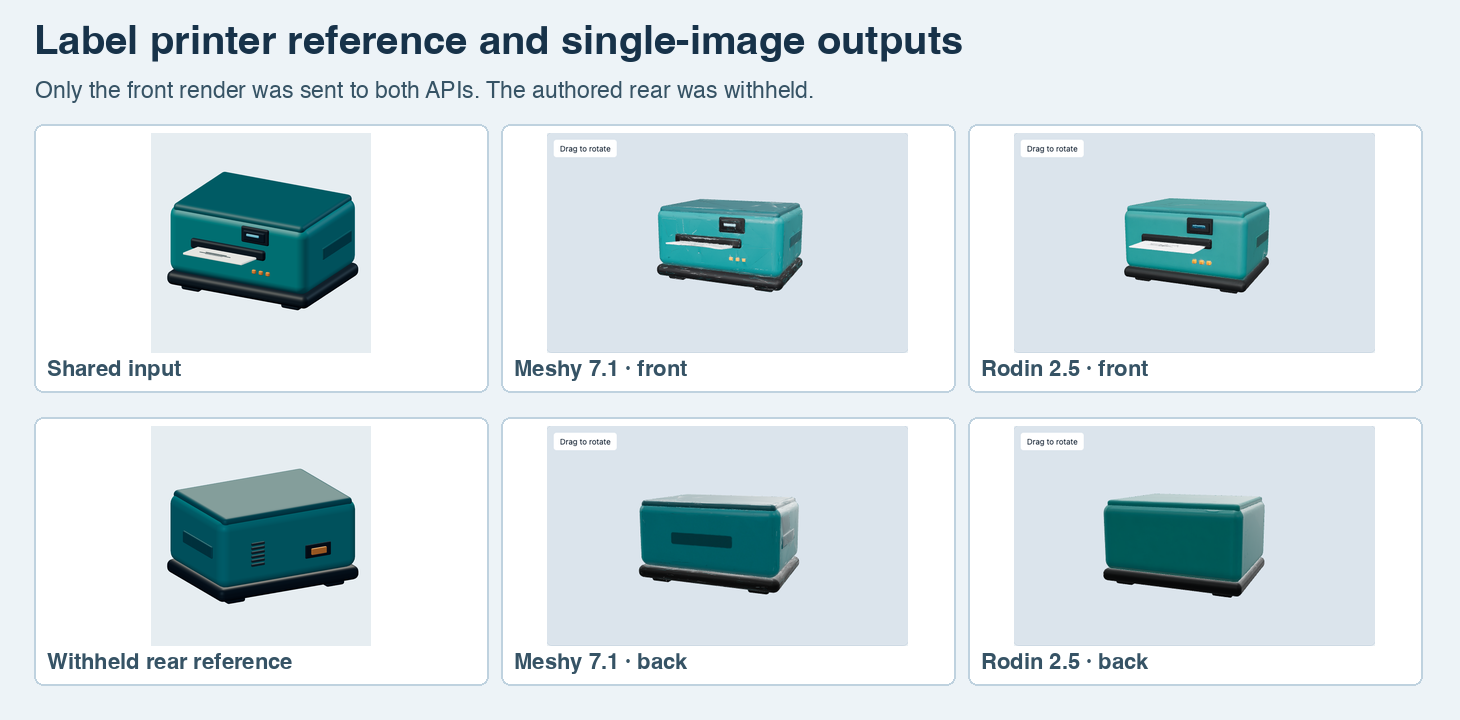
The front image went into both jobs. The reference rear is rendered from the authored mesh. All output views show the untouched GLBs.
Both outputs offer a recognizable front three-quarter presentation. The Meshy surface shows visible fine marks and irregular shading across the shell in this viewer. The Rodin shell looks smoother and its label sticks farther out in the displayed frame. On the opposite side, Meshy shows a dark rectangle across the back while the corresponding Rodin area is largely plain. The test viewer does not reveal the reference combination of fine vent slats and a separate orange connector on either file. These are visible comparisons at known angles. A single image gives the models no direct evidence for the two omitted features.
Compare the PBR material payload as well as the triangle count
| Measure | Meshy 7.1 | Rodin 2.5 |
|---|---|---|
| Settled generation charge | $1.44 | $0.48 |
| Requested triangles | 50,000 | 50,000 |
| Original triangles | 43,712 | 50,000 |
| Original GLB bytes | 8,549,388 | 6,550,668 |
| Original material maps | Base color, metallic-roughness, normal | Base color, metallic-roughness, normal |
| Original map resolution | 2,048 × 2,048 | 2,048 × 2,048 |
| Web GLB bytes | 1,770,660 | 902,304 |
| Web triangles | 43,712 | 49,996 |
| Web format validation | 0 errors, 1 tangent-space warning | 0 errors, 1 tangent-space warning |
Meshy had fewer triangles yet used more bytes in every export stage. The largest of its final embedded maps was the normal-map PNG at 1,286,332 bytes. The corresponding Rodin map was 199,170 bytes. Both were 1,024 pixels square after resizing. The encoding of a texture, the contents of its pixels and the rest of the model all contribute to size. A PBR checkbox and a nominal map size therefore do not give a phone transfer budget.
Both original GLBs and both web files passed format validation without errors. Each carried the same warning, MESH_PRIMITIVE_GENERATED_TANGENT_SPACE. Check the response to light when the viewer generates tangent space for a normal map. The warning does not identify which marks in the pictures came from the normal map. The article compares the actual rendered result of the complete material and mesh.
Export both originals with one recipe
We kept the original download and applied the same glTF Transform 4.5.1 commands to both. First resize all three texture maps from 2,048 to 1,024 square. Next re-encode only base color as WebP at quality 82, preserving the resized normal and metallic-roughness maps in their prior formats. Then compress the mesh with Draco, with 14-bit position and 12-bit UV quantization. Retain the matching viewer and decoder where you host the web variant.
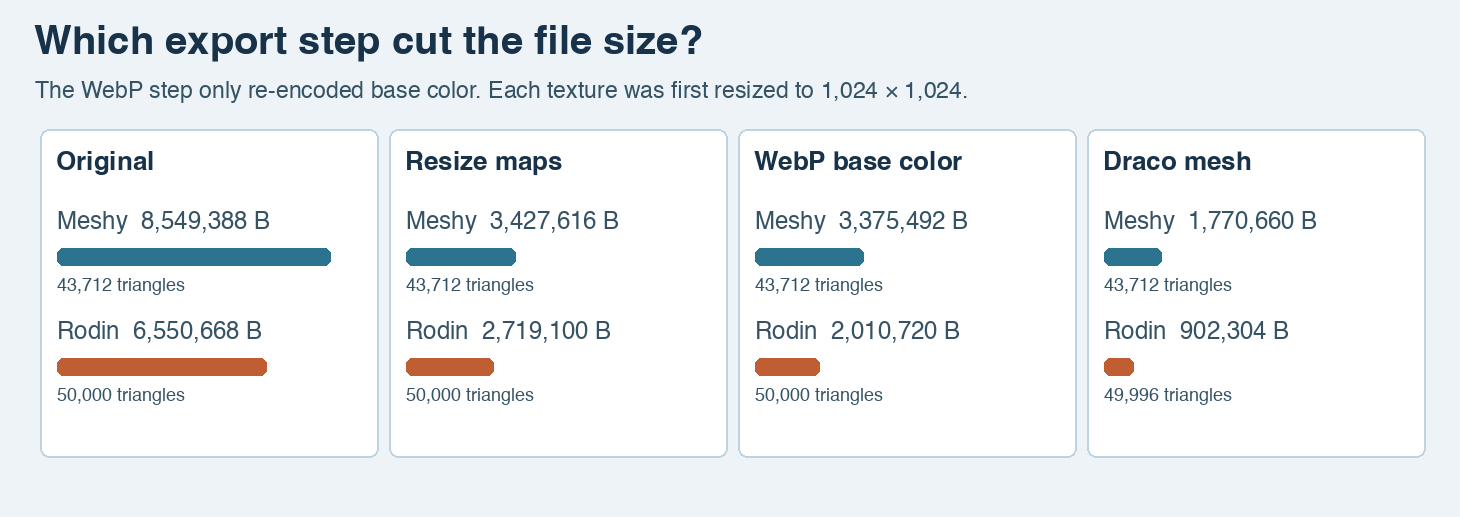
The first drop is texture resize. The WebP stage only converts base color. Draco reduces mesh bytes and the final Rodin count is four triangles below the original.
Meshy went from 8,549,388 to 3,427,616 bytes after resizing, then to 3,375,492 with base color re-encoded. Rodin went from 6,550,668 to 2,719,100 and then to 2,010,720 bytes. After Draco the two files saved 79.29% and 86.23% respectively compared with their originals. The Meshy index count stayed the same. Rodin exported four fewer triangles after the compression step, so this setup does not promise identical indices or topology. Apply the validator and review the loaded derivative after compression, especially around thin product details.
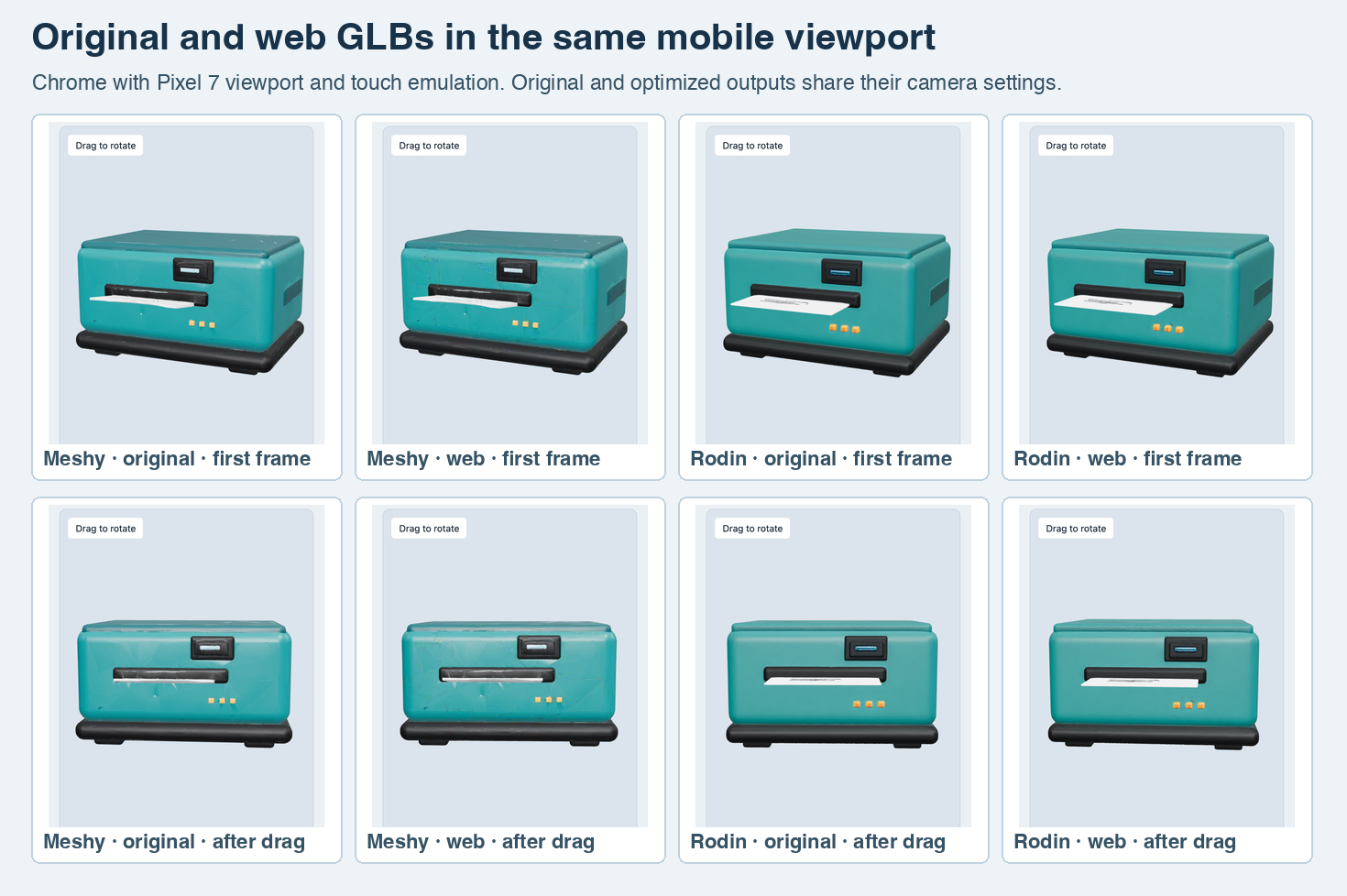
Each vertical pair shows the same GLB before and after a browser touch drag. Each horizontal pair compares that route’s original and optimized front.
In the mobile captures the front controls and protruding label remained visible. For a narrow pixel check we cropped the fixed front frame consistently, drew the union of pixels sufficiently different from the viewer background, and compared corresponding pixels in each route’s original and web variant. The mean absolute difference across RGB channels was 1.76 on Meshy and 0.94 on Rodin, on a 0–255 scale. The share of masked pixels with any channel more than 10 levels apart was 4.04% and 0.59%. These numbers check changes within each route, in one view with fixed lighting. They do not measure accuracy against the authored image or quality across all views.
Measure model loading and verify touch movement
The viewer test ran on an Apple M4 with software-rendered Chrome 157.0.8103.52, a Pixel 7 viewport and touch emulation. The local HTTP server returned the files under Chrome’s 100 ms latency and 625,000 bytes per second download profile. Cache was disabled and each measurement used a new browser context. We timed from immediately before the GLB fetch through its first rendered frame after parsing. Page shell and script startup happened before that clock. The observed web timing includes the Draco loader’s work.
| File | Median GLB download | Median parse to scene | Median request to frame | Median tracked transfer |
|---|---|---|---|---|
| Meshy original | 13.83 s | 0.07 s | 13.95 s | 8,549,574 bytes |
| Meshy web | 2.95 s | 0.56 s | 3.52 s | 2,022,088 bytes |
| Rodin original | 10.62 s | 0.06 s | 10.72 s | 6,550,854 bytes |
| Rodin web | 1.56 s | 0.57 s | 2.14 s | 1,153,731 bytes |
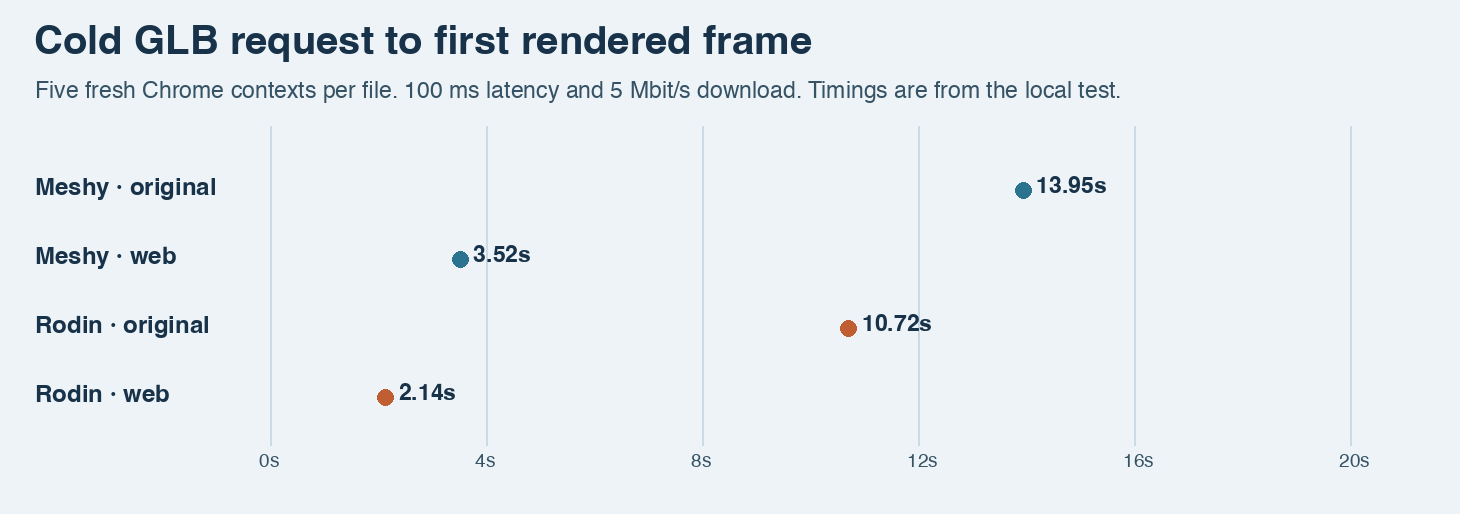
The dot marks the median request-to-frame time. Each group contains five runs. The reported transfer includes the GLB and its Draco JavaScript/Wasm decoder traffic when used, plus associated HTTP overhead.
The optimized GLBs traded extra parsing work for substantially lower model transfer time in this profile. For a cold visit, the two Draco files needed roughly 251 KB of decoder transfer in addition to the GLB. A browser that already has the decoder cached would have a different total. All four asset variants showed the rear when the fixed-view button was tapped, and all moved after a touch drag in the emulated viewport. These measurements do not describe device frame rate, thermal behavior, a real phone radio or a live production CDN.
Decide what counts as a completed model
For this front-first preview, Rodin was cheaper to generate, produced the smaller optimized file and retained a visually smoother front under the shared lighting. Meshy remains a usable front candidate if its shell style suits the page or you already standardize on its export. At the measured generation prices, 100 single submissions would cost $144 for Meshy or $48 for Rodin before retries, cleanup, embedding and delivery. Neither source meets a strict rear fidelity check, so quoting $0.48 or $1.44 as the price of a finished SKU would undercount the required work.
For rollout, track approval of the front and rear details for each SKU alongside the optimized file budget. Check the same front details before and after conversion. For unseen surfaces use the multi-view API comparison. For an inspectable deployment pattern with a browser demo, see the rotatable GLB workflow.
The GLB and USDZ scale comparison uses the original Rodin printer in both formats and checks physical units at a common camera scale.
Frequently asked questions
Which route made the smaller product GLB?
For this printer and these settings, Rodin was smaller before and after the same optimization. The final files were 902,304 and 1,770,660 bytes, before any decoder transfer. Compare your own PBR map contents and size as well as triangle counts.
Can I use these timings to promise a 2.14-second first frame?
Use them as evidence for the stated local setup. Retest with the viewer, CDN, device and loading conditions your customers actually use, including whether the decoder is already cached.
Did a higher triangle count recover the unseen rear?
Neither file matched the withheld rear grille and separate connector. More triangles are useful for representing details the surface contains. The lack of a rear input is a distinct constraint.
The same printer also appears in our Meshy 6 to Meshy 7.1 migration test, with individual axis dimensions, texture slots and an emission probe.
Found this useful? Share it