Best Text-to-3D APIs for Prototyping in 2027: 12 GLBs Tested
Four text-to-3D APIs face three prototype briefs. Compare actual cost, exported mesh size, leg counts, tray-divider orientation and portal geometry.
Every API returned a GLB for the requested three-legged stool. At three different heights near the floor, every resulting mesh showed four legs. The same four routes had much less trouble generating an open stone arch, while only two put a raised tray divider along the requested axis. If you’re choosing a text-to-3D API for prototypes, judge whether the GLB satisfies the condition that matters. A download without errors can still miss the brief.
Key takeaway
- Hunyuan 3D 3.1 Pro and Tripo H3.1 produced the red tray with a raised longitudinal divider. The Tripo file was 1,686,024 bytes and cost $0.24. The Hunyuan file was 11,205,844 bytes and cost $0.525.
- All 12 requests completed and returned GLBs that opened in the test browser and passed format validation without warnings. All four stools failed the exact leg count.
- All four arches had a visible central opening. Tripo and Rodin delivered visually distinct pillar rings and no base span across the doorway. Their pairs of rings looked similar to one another, while the brief asked for mismatched rings.
- Tripo delivered the smallest source file at each of the three prompts. Rodin delivered exactly 50,000 triangles each time. All 12 files used one mesh-bearing node, one mesh, one primitive and one material. Parts such as dividers and rings arrived in the same primitive as their surrounding geometry.
Four routes, three distinct briefs
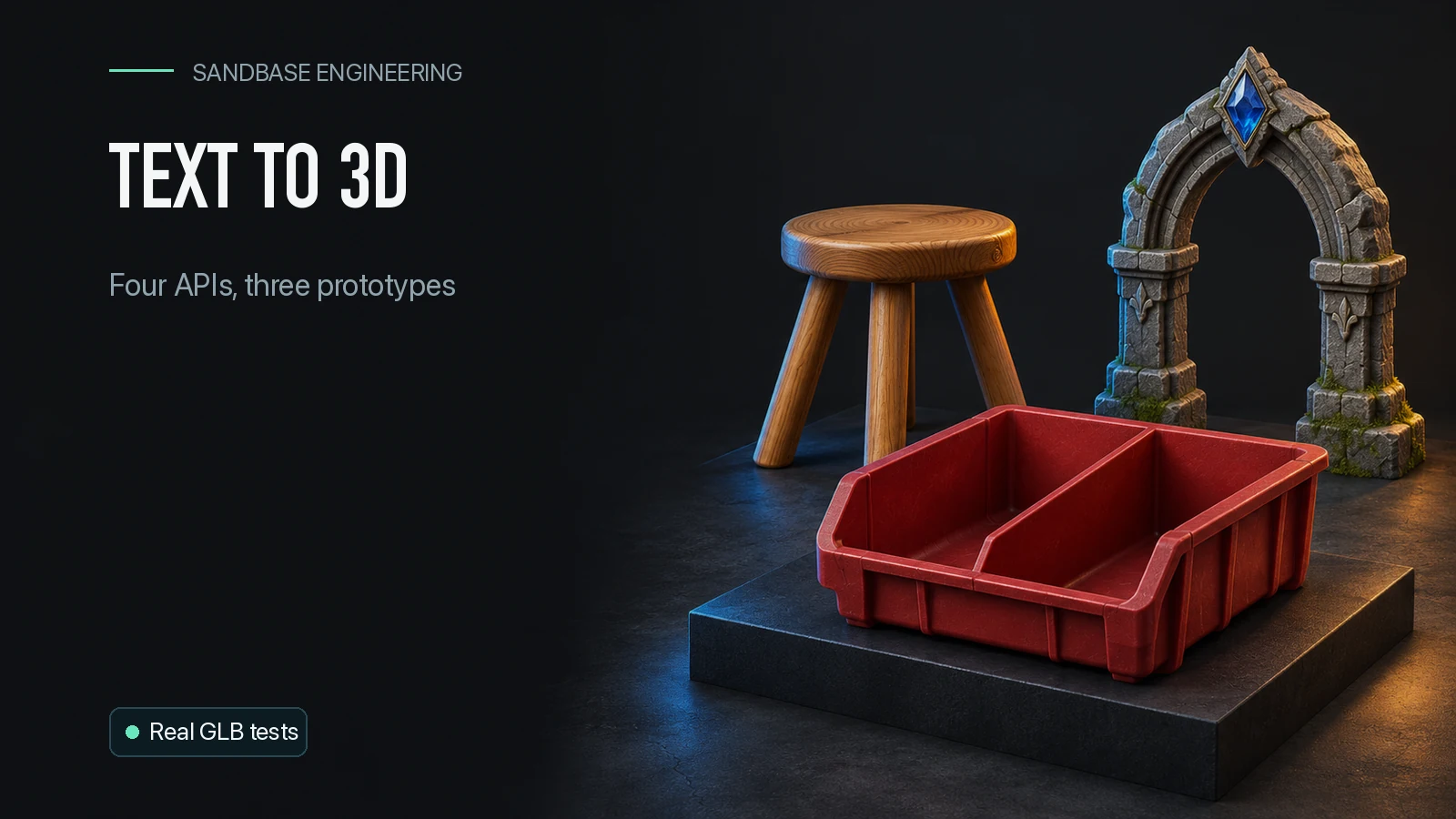
The experiment used Hunyuan, Tripo, Meshy and Rodin text-to-3D routes available through SandBase. Each received the same English text for a given prop. The prompts test three types of constraint that come up in prototype requests. The stool tests a precise number and prohibited bracing. The tray tests divider orientation and open compartments. The portal tests an opening and the placement of small attachments. The cover illustrates the briefs. The figures in the article come from the returned assets.
We submitted one job for each route and prop on November 14, 2026 UTC. We set each route to generate a colored GLB, with a 50,000-triangle setting available in each route’s own schema. Hunyuan used Normal mode and disabled PBR. Tripo H3.1 had texture on, PBR off and quad off. Meshy used triangle topology and PBR off. Rodin 2.5 used the High tier with Shaded material and the explicit 50K Triangle option. We sent seed 42 for Tripo, Meshy and Rodin. The inspected Hunyuan route offered no seed field. The shared number records the request settings and does not establish equivalent internal behavior.
| Route on SandBase | Mesh request | Triangles delivered | Original GLB size range | Charge per job |
|---|---|---|---|---|
| Hunyuan 3D 3.1 Pro | face_count: 50000 | 49,354–50,000 | 11,205,844–16,021,308 bytes | $0.525 |
| Tripo H3.1 | face_limit: 50000 | 45,756–48,411 | 1,686,024–2,183,900 bytes | $0.24 |
| Meshy 7.1 | target_polycount: 50000 | 44,947–49,975 | 3,757,140–6,223,900 bytes | $1.44 |
| Rodin 2.5 | quality_mesh_option: "50K Triangle" | 50,000 on all three | 3,496,312–7,158,488 bytes | $0.48 |
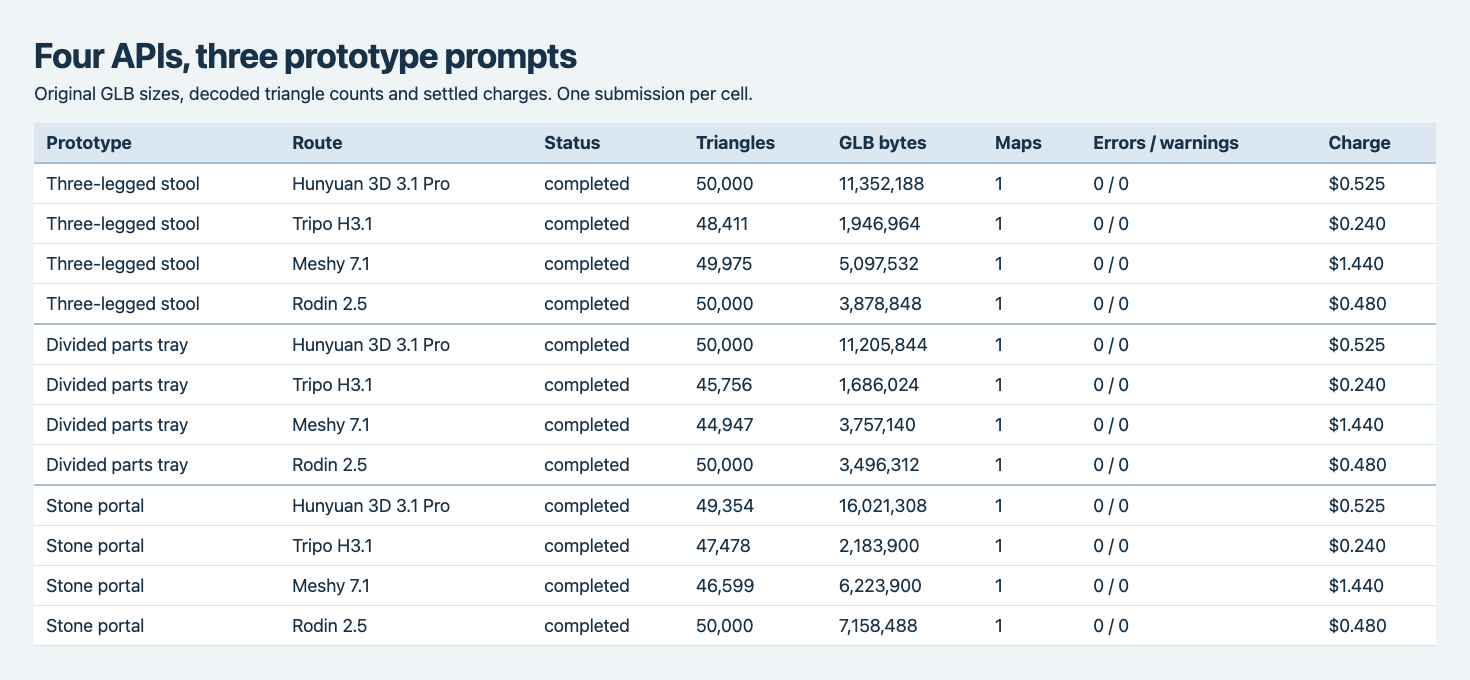
Each row is a first submission. Counts and sizes come from the downloadable original GLBs. Charges come from settled jobs. The 12 jobs totaled $8.055.
Rendered comparisons use the same longest-side display scale and orthographic framing after centering. We used quarter turns to align the tray for comparison and point the Tripo arch toward the camera. The neutral render uses a shared solid material, so its visible boundary and raised forms do not depend on the original texture. We saved decoded triangles and embedded image references separately from visual checks. There are no dimensioned references or repeated seeds in this test.
Furniture: count the feet with a low slice
The stool prompt requested a flat round honey-colored seat, three black splayed tubular legs and open space underneath, with no footrest ring or floor. All four produced the right general visual category. From a single angle, projected legs can overlap. The apparent tripod in a review screenshot is unreliable if two legs sit along the same view ray.
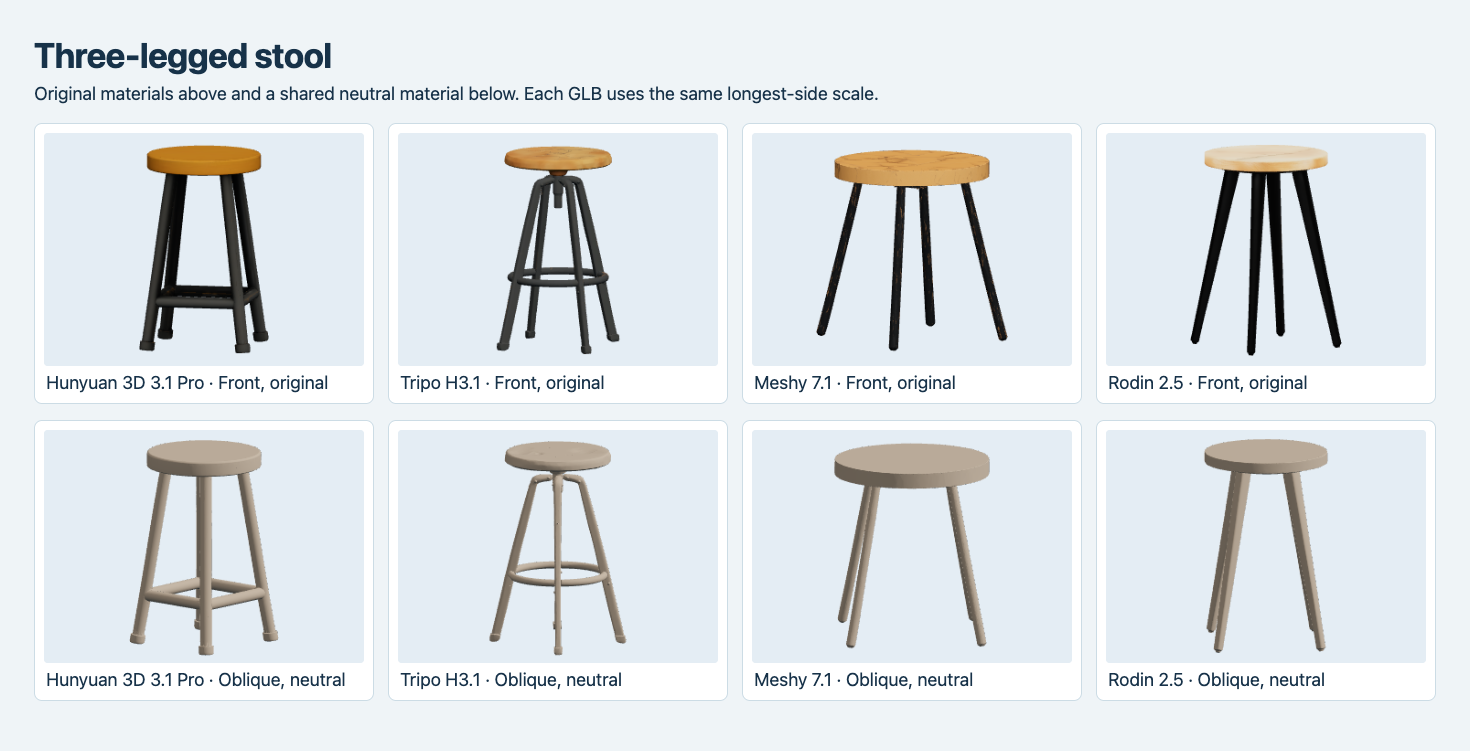
All four approaches made a round-seat workshop stool. The Hunyuan result has lower bracing between legs, while the Tripo result has a circular footrest. The Meshy and Rodin samples show open space between their supports.
We intersected the original triangle meshes with horizontal planes at 6%, 10% and 14% of each file’s height above its lowest point. We grouped joined line segments on each slice and considered outlines spanning at least 0.5% of the longest bounding dimension. All 12 slice/model combinations had four such outlines. At those levels the screenshots show those contours belong to legs. They were comparable in size within each stool and persisted across all three heights. A count at one height can catch a stray fragment or miss an angled part. A few neighboring slices let you check whether the shapes continue as supports.
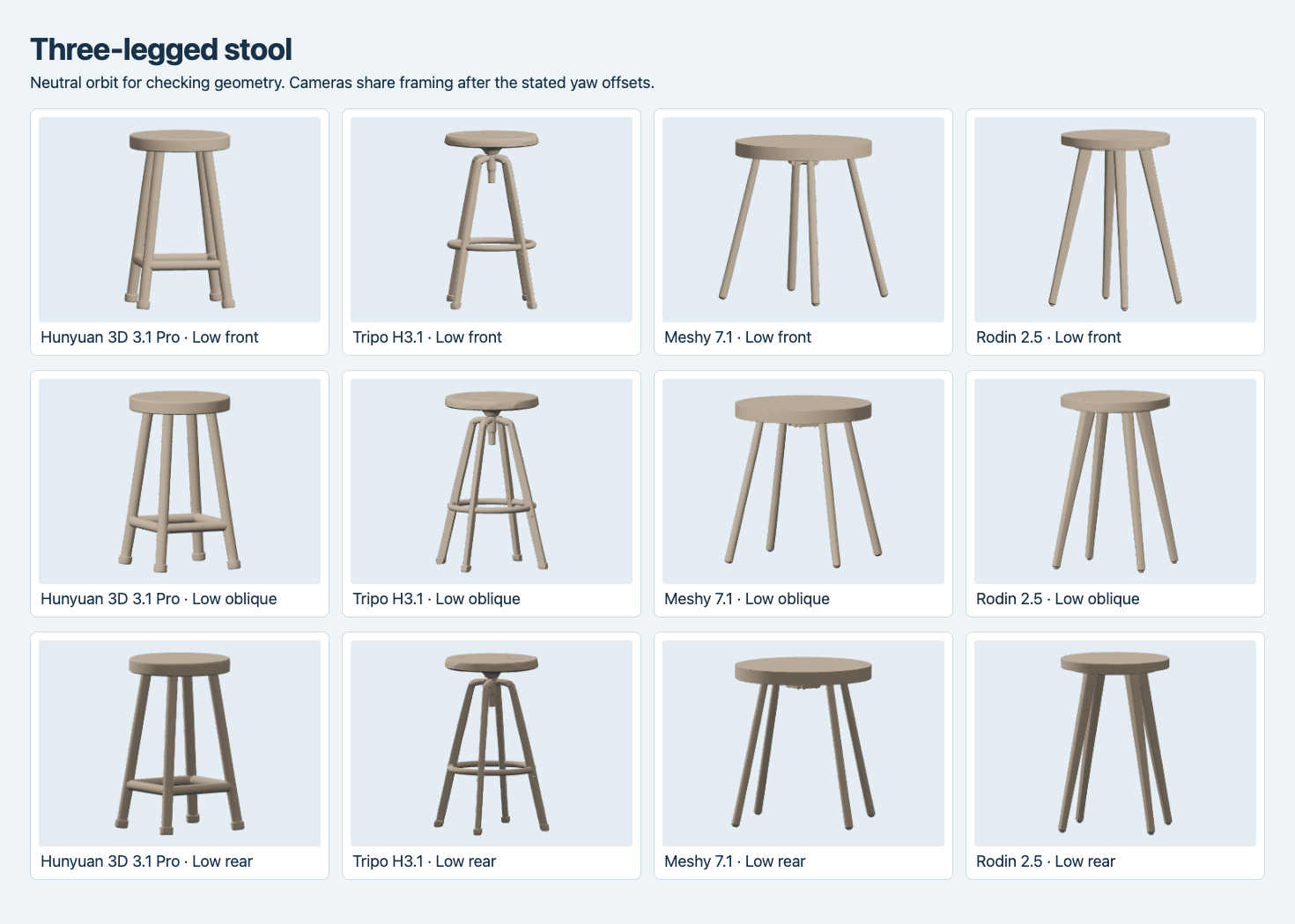
The low orbits reveal the fourth support even when two overlap at another angle. Hunyuan and Tripo also added bracing that the task did not call for.
Use the outputs for broad styling or visual references where another support is acceptable. For a tripod silhouette that has to travel downstream, use a reference showing all three positions or model the legs as separate components. The mesh alone does not establish whether a physical stool could bear a load.
Container: measure the divider across both axes
The tray request specified a red, open rectangular container with one raised divider running down the long axis to form two open bays. Hunyuan and Tripo both showed that geometry. Meshy showed faint lines on the tray floor. Rodin showed two deep bays with the wall running across the long axis, leaving bays at opposite ends. A view from above shows the compartment layout. Looking from the side shows whether the divider has height.
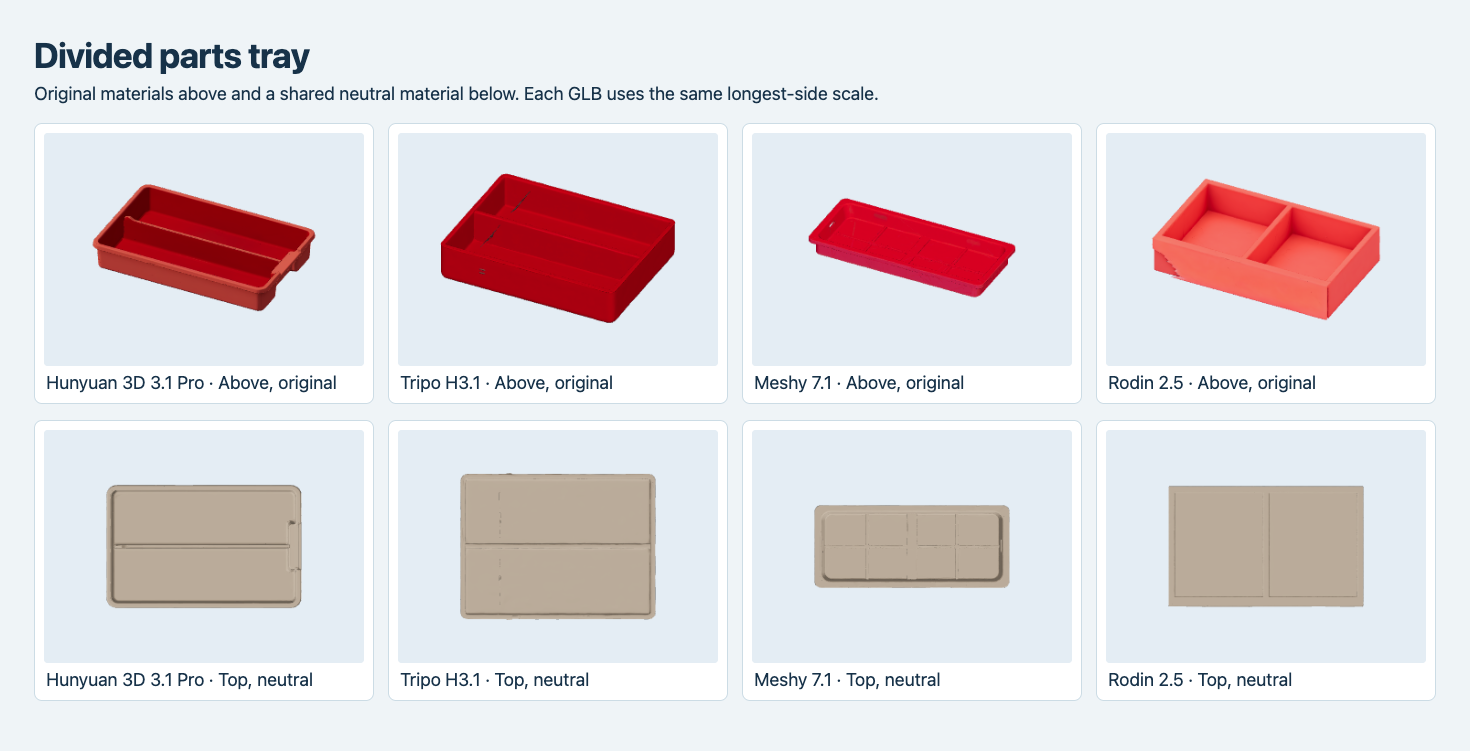
Hunyuan and Tripo show two lengthwise channels. The Rodin divider runs crosswise. Meshy shows marks where a partition might be expected.
We checked the four meshes with 15 downward rays along each of two centerlines. In each direction the samples ran from −35% to +35% of the relevant horizontal span. Height is relative to each mesh’s own bounding box, with zero at the lowest point. Hunyuan and Tripo had continuous high hits near 0.88 and 0.95 along the long-axis centerline. Across the short axis the high hit was concentrated at the center, between lower floor hits. On Rodin, the high line followed the short axis. On Meshy, both lines stayed near 0.23, with no raised center hit in this scan. The sampled orientations agree with the neutral top views. These two cross-sections do not certify wall thickness, fit, removability or every possible offset.
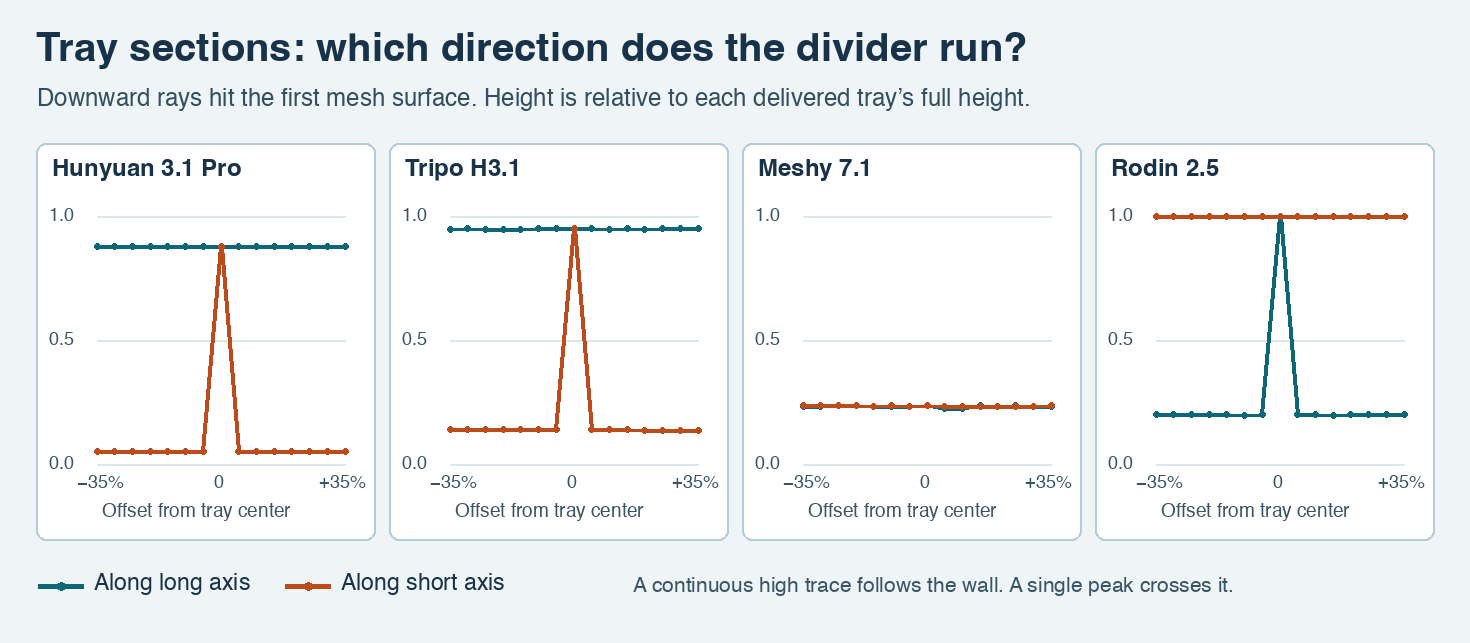
The color of the flat trace identifies the direction of the elevated divider. The x-axis is a relative offset from the center of that file, not a physical dimension.
For a concept that keeps the lengthwise division, Tripo delivered a much smaller, less expensive source than Hunyuan in this first pass. Hunyuan remains another candidate if the team prefers its rounded rim. Any need to remove the divider changes the test. Bring the GLB into the editor and check its mesh structure before telling a client the divider is a movable part.
Fantasy prop: look through the opening and inspect the rings
The arch brief required an open pointed portal on short square plinths, a blue gem at the apex and one mismatched silver ring on each outer pillar. All four generated a visibly open center and an apex colored blue or cyan in the material render. Hunyuan added steps and a third ring hanging inside the arch. Meshy’s pale pillar details lacked two plainly hanging loops in these angles and the base had a narrow span. Tripo and Rodin showed a free opening between the bases and one protruding loop at each pillar. The two loops on each looked similar, so neither visually met the asymmetry request in this pass.
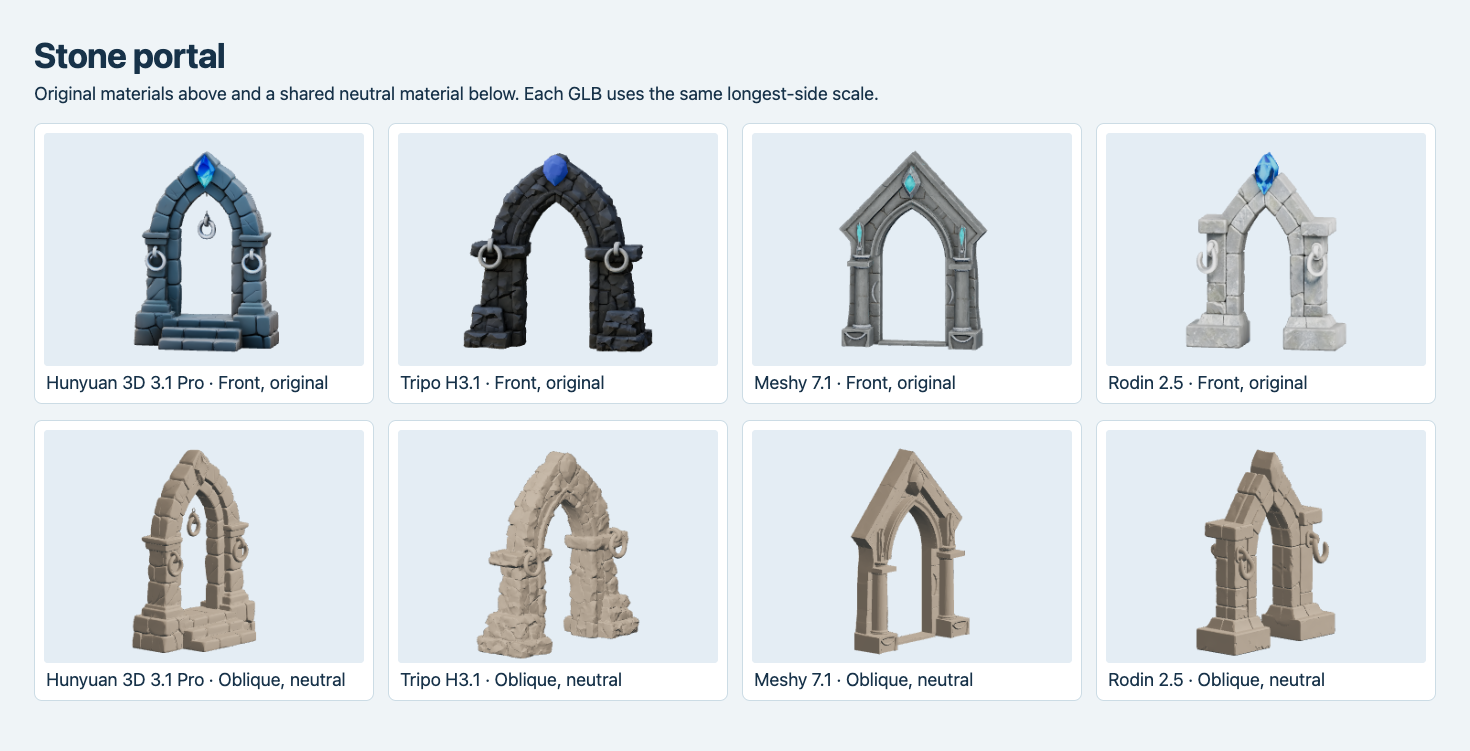
The neutral angles show the central gap and distinguish protruding rings from shallow lines and accents. The request specified no stairs.
Tripo and Rodin gave usable candidates if the immediate brief is a stone arch with a clear doorway and two side loops. For the mismatched-ring variant, use a direct edit or a second input strategy that pins down the silhouettes of the two accessories. No output supplied the center divider or the two rings as separately addressable glTF mesh nodes. If you need modular editing, inspect whether the mesh includes naturally separable geometry before committing to segmentation or manual cleanup. A single primitive can contain disjoint islands. The stored mesh structure does not settle how easy they will be to separate.
Choose an API by the first condition a prototype must satisfy
The cost of trying one brief on all four routes was $2.685 at these settings. Ten independent submissions on one route would cost $2.40 with Tripo, $4.80 with Rodin, $5.25 with Hunyuan or $14.40 with Meshy if the measured charges held and every job were submitted once. A stricter estimate includes reruns and fixing the first result. In the stool test, the cost per accepted tripod cannot be inferred because every initial output missed the requirement. The experiment did not time a designer’s cleanup or estimate first-pass success across unrelated assets.
Start with Tripo for a small textured web prototype where the first checks are generation charge and downloaded bytes. Compare a Rodin trial when a 50K triangular handoff and a clear arch profile matter. Rodin’s Shaded GLBs referenced their single embedded image through an emissive slot, while each of the other tested files used its image for base color. Inspect the material graph if the deliverable must respond to scene lighting in a particular way. Meshy and Hunyuan are worth a direct side-by-side if your brief changes to something where their shape or material choices suit the task. For a different workload, see the two-prop Hunyuan, Tripo and Meshy comparison. If unseen details need to match known reference views, the multi-view comparison tests that type of input.
Read the test prompts
These are the exact same prompts each route received, with the stated method settings.
Stool
A single ordinary three-legged workshop stool, upright. A flat round honey-colored wooden seat. Exactly three black tubular steel legs splayed outward, with visible empty space between them and under the seat. No backrest, no footrest ring, no floor, no text or other objects. Realistic unbranded product prototype.
Tray
A single open rectangular red workshop parts tray, viewed from slightly above. Thick low outer walls and a flat bottom. Exactly one straight removable-looking divider running down the center along the long axis and creating two equal open bays. No lid, no handle, no contents, no lettering, no floor or other objects.
Portal
A single freestanding fantasy stone portal prop on two short square plinths. The masonry forms a pointed arch with a fully open central doorway. Two mismatched silver rings hang separately, one on the left outer pillar and one on the right outer pillar. A blue faceted gemstone sits at the apex. No ground plane, no stairs, no people, no lettering.
To compare the two input modalities from one design brief, see the Tripo H3.1 text-versus-image prop test.
Frequently asked questions
Did 12 completed jobs mean 12 accepted prototypes?
All 12 jobs returned valid GLBs. The four-leg finding and the tray-divider direction were assessed after that. Use technical validity and brief compliance as separate checks in your asset pipeline.
Does the 50K request mean each delivery contains 50,000 triangles?
All three Rodin files and two Hunyuan files had exactly that count in this batch. All other outputs were below the request. Run the check on the file that will be delivered, including any triangulation required by your exporter.
What makes a prototype easy to adjust later?
First decide which components must move independently. A clean render can hide a single combined mesh. Inspect the file’s hierarchy, select the real geometry in the editor and test the intended change before accepting the source asset.
Found this useful? Share it