Video Clip Length in 2026: Which 1080p APIs Can Do 15 or 30 Seconds
Unscored 2026 guide to 1080p clip length: MAGI-2 4–30, Wan and Seedance auto, Kling 3–30, Veo 4/6/8, and video-extend at 720p. Not a price table.

The question is not “From $X.” It is whether the card will accept 15 seconds, or 30, at 1080p. On 27 November 2026, Asia/Shanghai, MAGI-2, Wan 3.0, Kling V4, and Seedance 2.5 all accept a 15-second integer and a 30-second integer on their 1080p-capable cards. Veo 3.1 does not. Its text and image cards accept only 4, 6, or 8 seconds. Reference-to-video on Veo accepts 8 only. video-extend adds 7 seconds at 720p, which is not a 1080p 30-second path.
This is a duration note. It is not a second price table. The already-live 1080p video API pricing post has a section, “Duration rules that change the 1080p bill,” that does the list arithmetic for 10-second and 30-second rows, auto pre-authorization, and Seedance draft settlement. This page links that arithmetic and stays on floors, ceilings, auto, and extend limits. There is no quality ranking. No generation was run.
Key takeaway
- MAGI-2: integer 4–30, default 5, no
auto. 1080p only. Official Sand.ai duration is required; SandBase uses 5 if the field is omitted. 15s and 30s are legal values on this enum.- Wan 3.0: 2–30 or
auto, default 5.autois pre-authorized at 30 seconds and settled on the actual output length. 1080p is one of three tiers, default 720p.- Kling V4: integer 3–30, default 5. Default resolution is already 1080p. No
auto.- Seedance 2.5: 4–30 or
auto, default 5, same 30-second pre-authorization wording as Wan. Default resolution 720p. Flash also accepts 4–30 orauto, but only at 480p or 720p.- Veo 3.1: 4, 6, or 8 only, default 8. R2V: 8 only. video-extend: +7 seconds at 720p only. Fast and Lite stay on 4/6/8.
- Omni Flash 1.2, a live SandBase sibling under
google/gemini-omni-flash/1.2/text-to-video, accepts integers 3–15, so 15 yes and 30 no. It is not a sixth primary row and not a Veo 3.1 id.
The question is duration, not the Offer
A 5-second Offer and an 8-second Offer tell you the default quote, not the ceiling. MAGI-2’s JSON-LD Offer of 0.4 USD is a 5-second default at the only resolution. Veo’s Offer of 3.2 USD is an 8-second default with audio. Wan’s 0.3 and Seedance’s 1.44 are 5-second 720p quotes after their badges. None of those Offers is a 15-second or 30-second authorization. If the brief says “15 seconds at 1080p,” read the duration enum first, then go back to the pricing post for the bill.
Floors and ceilings at 1080p
MAGI-2 duration is an integer, minimum 4, maximum 30, default 5, “Billed per second.” There is no auto. A 15-second request is in range. A 30-second request is in range. A 2-second or 3-second request is not. Resolution cannot leave 1080p. Open the MAGI-2 text-to-video card to see the field. The same 4–30 range is on the image and reference siblings.
Wan 3.0 duration accepts 2 through 30 and auto, default 5. The short end is 2, which MAGI-2 and Seedance do not offer. 15 and 30 are legal integers. 1080p is in the enum, default 720p; a 15-second call still has to set 1080p if that is the file you promised. Pairwise context is MAGI-2 vs Wan 3.0.
Kling V4 duration is an integer from 3 to 30, default 5. No auto. The short end is 3. Default resolution is already 1080p, so a 15-second or 30-second call stays at 1080p unless you change the field. HDR, if set, still adds $0.047 per output second at 1080p; that adder is priced in the pricing post and in MAGI-2 vs Kling V4. Official Kling duration cells were not re-fetched in this writing pass.
Seedance 2.5 duration is 4–30 or auto, default 5, the same floor as MAGI-2 and the same ceiling as MAGI-2, Wan, and Kling. Default resolution is 720p. Flash uses the same 4–30 or auto range but cannot emit 1080p.
Veo 3.1 text-to-video and image-to-video: 4, 6, or 8 only, default 8. A 15 or 30 is not a value in the enum. First-last-frame uses the same 4/6/8. Reference-to-video: “Reference-to-video only supports 8 seconds.” Fast and Lite keep 4/6/8.
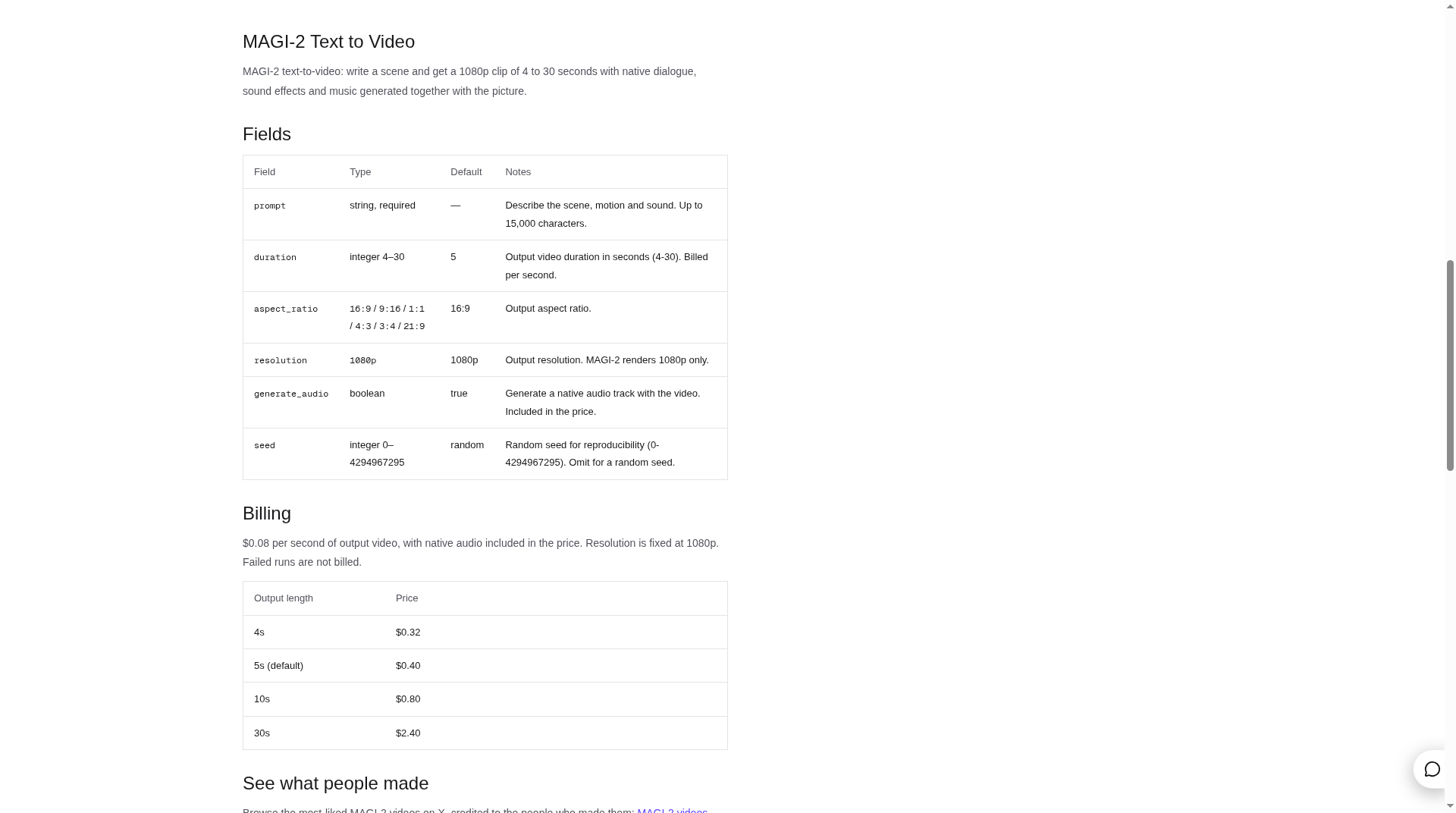
MAGI-2 Text to Video Fields and Billing, opened 27 November 2026, Asia/Shanghai. Duration is an integer from 4 to 30, default 5, billed per second. Resolution is 1080p only. There is no auto in the duration type. The billing table prints 5s (default) $0.40. This frame does not show a playground “Displayed run estimate: $0.4” and does not show a hero Facts line.
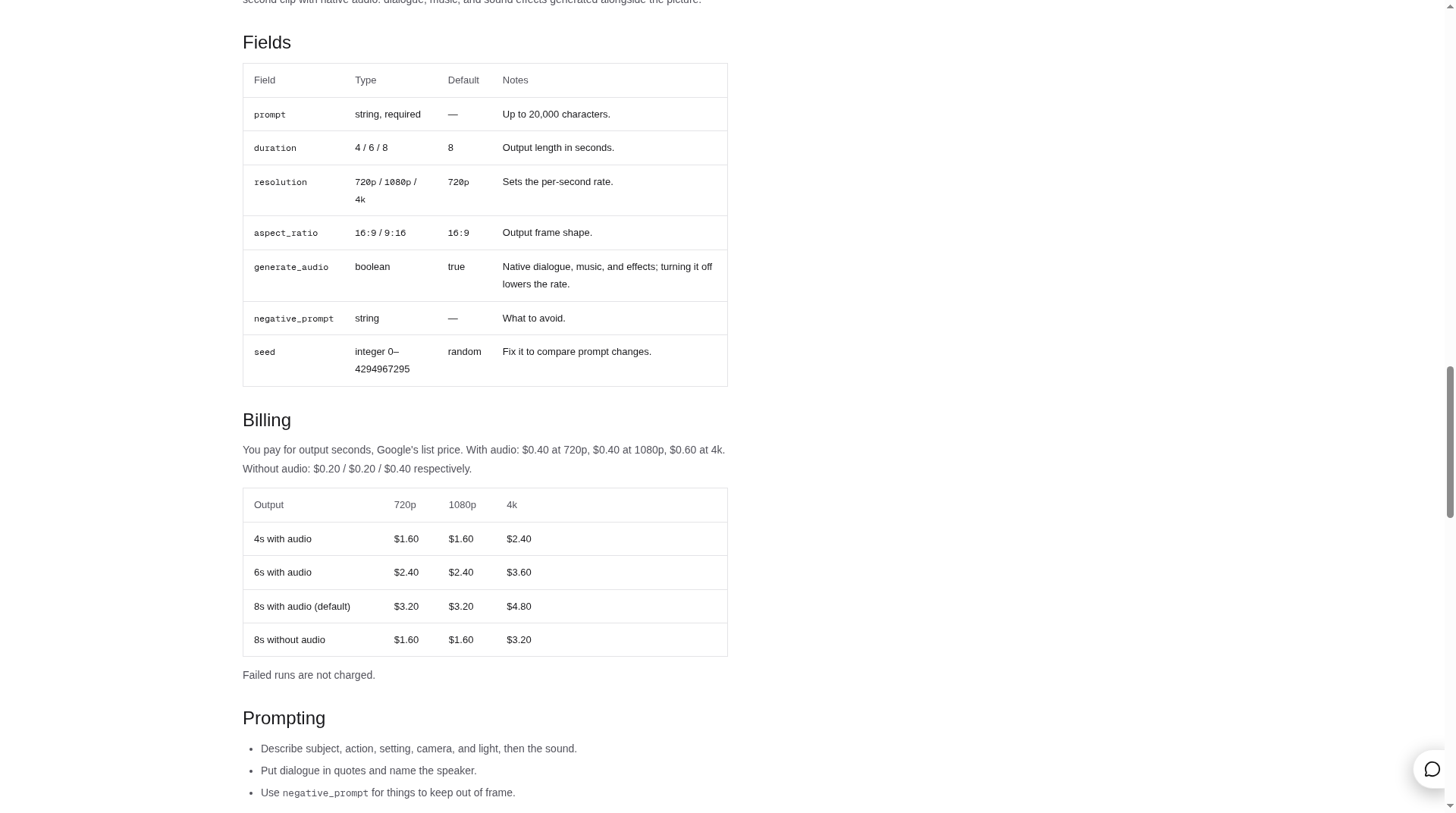
Veo 3.1 Text to Video Fields, opened 27 November 2026, Asia/Shanghai. Duration is 4 / 6 / 8, default 8. The Limits sentence about chaining video-extend is not in this crop.
| Card | 1080p on the enum? | Floor | Ceiling | auto | 15s at 1080p? | 30s at 1080p? |
|---|---|---|---|---|---|---|
| MAGI-2 T2V / I2V / R2V | yes, only value | 4 | 30 | no | yes | yes |
| Wan 3.0 T2V / I2V | yes, default is 720p | 2 | 30 | yes, pre-authorized at 30s | yes, if resolution is 1080p | yes, if resolution is 1080p |
| Kling V4 T2V / I2V | yes, default | 3 | 30 | no | yes | yes |
| Seedance 2.5 T2V / I2V | yes, default is 720p | 4 | 30 | yes, pre-authorized at 30s | yes, if resolution is 1080p | yes, if resolution is 1080p |
| Seedance 2.5 Flash | no (480p / 720p only) | 4 | 30 | yes | no | no |
| Veo 3.1 T2V / I2V / first-last | yes, default is 720p | 4 | 8 (enum 4/6/8) | no | no | no |
| Veo 3.1 R2V | yes | 8 | 8 | no | no | no |
| Veo 3.1 video-extend | no (720p only) | 7 | 7 per call | no | no | no |
| Omni Flash 1.2 T2V (sibling) | yes, default 720p | 3 | 15 | no | yes, if resolution is 1080p | no |
auto is a 30-second pre-authorization, then a settlement
Wan and Seedance are the two 1080p-capable cards in this set that accept auto. Both field descriptions say auto is pre-authorized at 30 seconds and billed on the actual output length. Seedance’s Billing sentence is more explicit: the quote assumes 30 seconds and the final charge uses the generated length. Wan’s Billing says the run is pre-authorized at 30 seconds, then settled on the length that was actually generated.
A 1080p auto call can therefore pre-authorize a 30-second list row — 30 times 0.20 on Wan, 30 times 0.90 on Seedance — and later settle lower. Those products, and how they sit next to badges, are already worked in the pricing post’s duration section. This page does not reprint every coefficient. MAGI-2, Kling, and Veo have no auto to settle. Official Sand.ai duration is required, so an omitted MAGI-2 duration is a SandBase default of 5, not a vendor-API default.
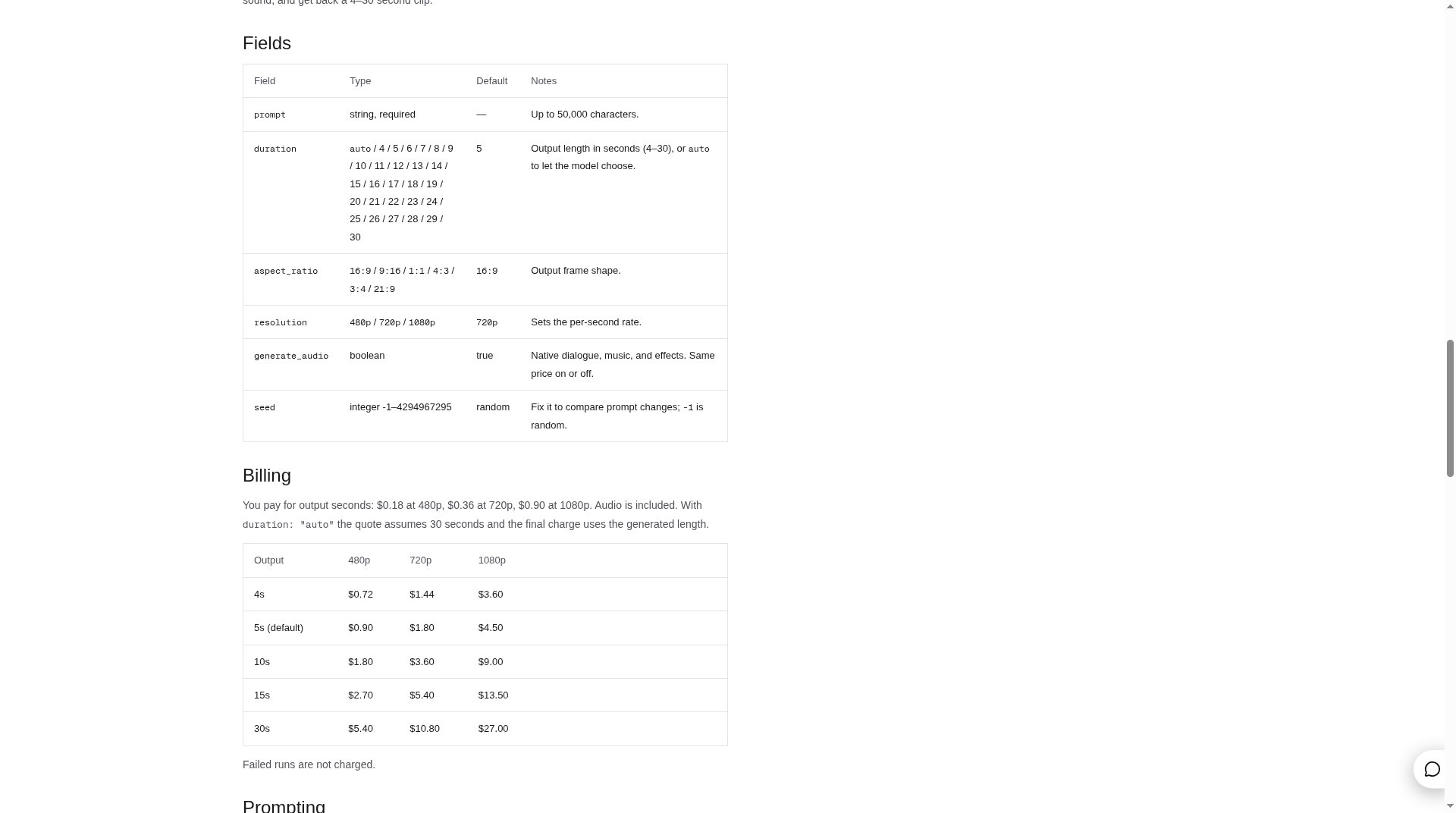
Seedance 2.5 Text to Video Fields and Billing, opened 27 November 2026, Asia/Shanghai. Duration is auto or the integers 4 through 30, default 5. The Billing sentence says that with duration “auto” the quote assumes 30 seconds and the final charge uses the generated length. This crop is the Seedance card. The playground sentence that auto is pre-authorized at 30 seconds is not in this frame.
video-extend is not a 1080p 30-second path
Veo 3.1 video-extend Limits say: “Each call adds 7 seconds at 720p; call again on the result to keep extending.” Duration is 7 only. Resolution is 720p only; the help says extensions are generated at 720p. Billing is $0.40/s with audio at 720p, $2.80 for the 7-second default, Offer 2.8. You can chain calls on the previous result. That chain is 720p, in 7-second increments, and it is a different id from google/veo3.1/text-to-video. It does not add a 15 or 30 to the 1080p enum. Official Gemini Preview ids are shut down; treat extend, Fast, and Lite as SandBase siblings, not as those preview strings. The pairwise note is MAGI-2 vs Veo 3.1.
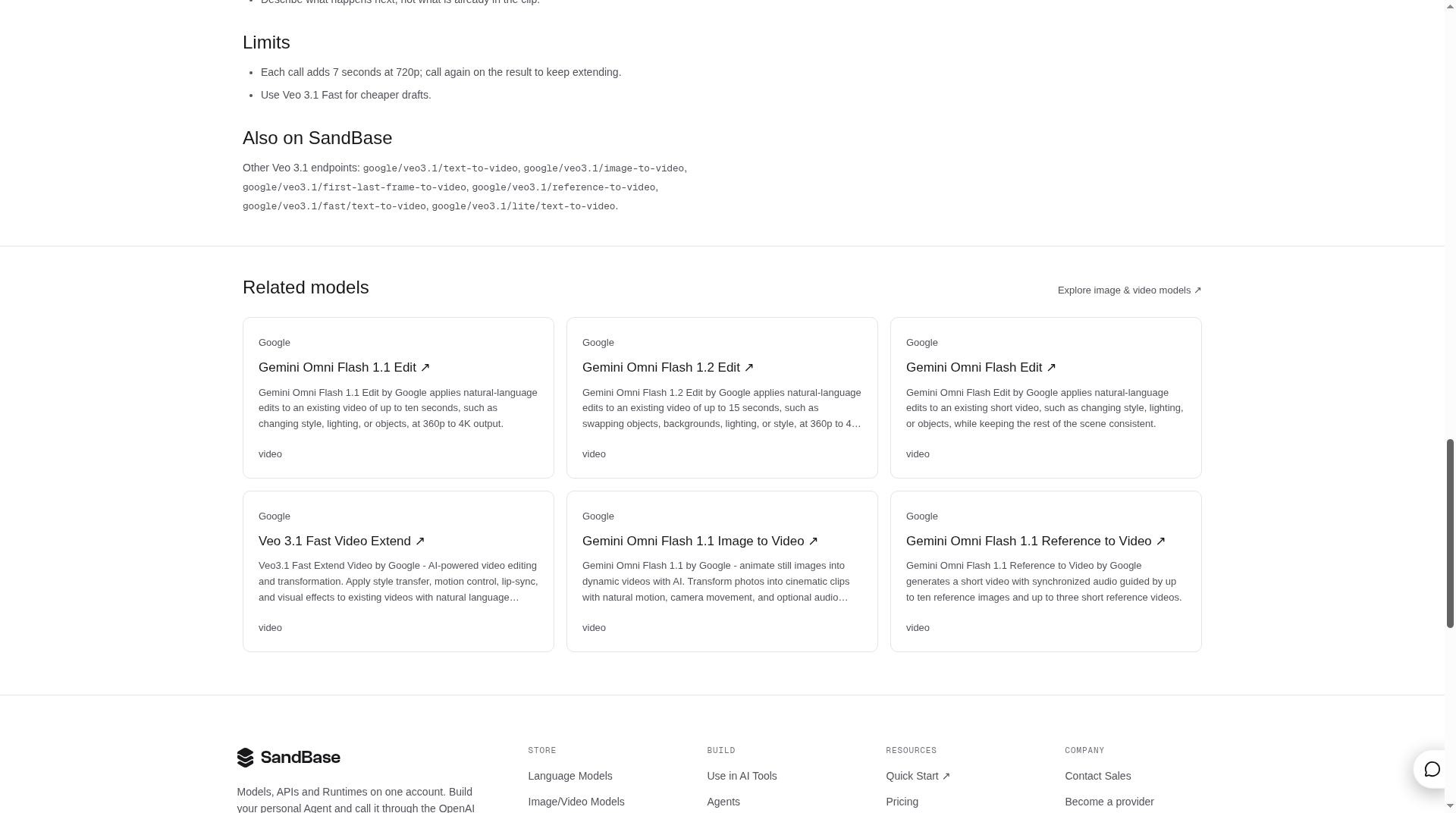
Veo 3.1 video-extend Limits, opened 27 November 2026, Asia/Shanghai. The sentence says each call adds 7 seconds at 720p, and that you can call again on the result to keep extending. This Limits line is not a 1080p row and not a 30-second request.
Official required duration, and a 15-second sibling
On Sand.ai’s API, duration is required. On SandBase MAGI-2, omitting duration uses 5. Do not send the official model id magi-2 to POST https://api.sandbase.ai/v1/run, and do not assume an omitted SandBase field is valid on the official route.
Omni Flash 1.2, id google/gemini-omni-flash/1.2/text-to-video, is a live public card this run (the memo URL gemini-omni-1.2-flash is still 404). Duration is an integer from 3 to 15, default 8. A 15-second 1080p request is in range; a 30-second request is not. Image-to-video on that family caps duration at 10 seconds when an end image is provided. That sibling belongs in a 15-second shortlist and not in a 30-second shortlist. It is not a Veo 3.1 id.
Worked length examples live on the pricing post
A 15-second or 30-second 1080p list row is already arithmetic on 1080p video API pricing: MAGI-2 is seconds times 0.08, badge 0 (15s $1.20, 30s $2.40). Wan is seconds times 0.20, badge 40. Kling is seconds times 0.235, badge 15, plus HDR if set. Seedance is seconds times 0.90, badge 20, or a 30-second pre-authorization when auto is sent. Veo has no 15-second or 30-second list cell. This page does not reprint those products. Reference length, when it joins the bill, is reference-to-video APIs. Image first and last frames do not change these duration enums, except Veo’s split cards and Omni Flash 1.2’s 10-second cap with an end image; that shape is image-to-video APIs.
Choose MAGI-2 when 15 or 30 seconds must be a native 1080p integer and you do not want auto. Open the text-to-video card. Choose Wan or Seedance when auto is acceptable and you will budget the 30-second pre-authorization at the resolution you actually set. Choose Kling when 3–30 at a default 1080p is the range you need. Do not choose Veo 3.1 when the brief is 15 or 30 seconds at 1080p. Do not choose video-extend as a stand-in for that brief. Do not choose Flash for 1080p at any length.
The cost model explainer is the vocabulary. It does not extend an enum. A scored roundup is best AI video generation APIs, and its scores are not reused here.
FAQ
If I stitch three 8-second Veo clips, is that a 24-second 1080p request?
No. That is three accepted 8-second requests, plus whatever edit you do after. It is not a native 24-second or 30-second value on the Veo enum. video-extend is a 720p append of 7 seconds, also not a 1080p 30-second request.
Does auto mean I will be billed 30 seconds?
It means the quote is pre-authorized at 30 seconds and the final charge uses the generated length, on the Wan and Seedance field text checked today. This page did not watch a hold and a capture. Budget the 30-second row until settlement.
Can Seedance Flash do 30 seconds at 1080p?
It can do 30 seconds, or auto, at 480p or 720p. Limits send 1080p — and draft mode — back to bytedance/seedance/2.5/text-to-video. Official 1080p for Flash is “Not supported.”
If I omit duration on MAGI-2, is that 5 seconds everywhere?
On SandBase, the formula uses 5. On official Sand.ai, duration is required. Copy the field rule from the route you are calling.
Were any clips generated?
No. Actual output length under auto, extend chaining, and settled charges were not measured. MAGI-2 Billing now says failed runs are not billed. Wan, Kling, Seedance, and Veo READMEs say failed runs are not charged.
What to open
If the brief is a native 15-second or 30-second 1080p clip, start on a card whose ceiling includes that integer: the MAGI-2 text-to-video card is the 1080p-only path with a zero badge. Then price the seconds on the duration section of the 1080p pricing post. The MAGI-2 request shape is the launch note.
SandBase duration fields and Limits checked 27 November 2026, Asia/Shanghai. No generation was run. No model is ranked.
Related reading
Found this useful? Share it