1080p Video API Pricing in 2026: MAGI-2, Wan, Kling, Seedance, Veo
Unscored 1080p price guide for MAGI-2, Wan 3.0, Kling V4, Seedance 2.5, and Veo 3.1. List rates, badges, and vendor units stay in separate columns.

Five cards can all print 1080p and still not share a unit. On 26 November 2026, Asia/Shanghai, MAGI-2’s only coefficient is $0.08 per output second and the badge is 0. Wan’s 1080p list coefficient is $0.20 per second, with a 40% badge that the hero applies to a 720p default. Kling’s 1080p list coefficient is $0.235 per second, with a 15% badge on a card whose default really is 1080p. Seedance 2.5’s SandBase list coefficient at 1080p is $0.90 per output second before any reference video, with a 20% badge on a hero that is a 720p quote. BytePlus prices that model in USD per million tokens. This guide does not convert those tokens into a per-second rate. Veo 3.1’s SandBase card still lists $0.40 per second at 1080p with audio, badge 0, while Google’s Gemini API docs say the Veo 3.1 Preview ids were shut down on 22 October 2026.
Nothing here is a ranking. There is no quality score and no latency number. The MAGI-2 listing itself is MAGI-2 on SandBase. Pairwise billing against Wan and Kling is MAGI-2 vs Wan 3.0 and MAGI-2 vs Kling V4.
Key takeaway
- MAGI-2:
sandai/magi-2/text-to-videoand the two sibling ids. 1080p only. Duration 4–30, default 5. Formula(params.duration ?? 5) * 0.08. Badge 0. Hero From $0.40. Sand.ai: 0.08 USD/s. Top-up on Sand.ai is not supported for the time being.- Wan 3.0:
alibaba/wan/3.0/text-to-video. 1080p list coefficient 0.20. Default resolution 720p. Badge 40. Hero From $0.30, which is the 5-second 720p quote after the badge, not the 1080p row. International Model Studio cell forwan3.0-videoat 1080P: Original $0.2/s, with a separate 30% off note. Other regions differ.- Kling V4:
kwaivgi/kling-video/v4/text-to-video. 1080p list coefficient 0.235. Default resolution 1080p. Badge 15. Hero From $1. README list cell for 5 seconds at 1080p: $1.175. Official Kling markdown: ($0.235)/s with no input video.- Seedance 2.5:
bytedance/seedance/2.5/text-to-video. SandBase list 0.90 per output second at 1080p without input video. Badge 20. Hero From $1.44, the 5-second 720p quote after the badge. Official online token rate fordreamina-seedance-2-5-260628at 1080p: $11.7 per million tokens without video input, $7.0 per million tokens with video input. Not converted.- Veo 3.1: SandBase
google/veo3.1/text-to-videois enabled, badge 0, 1080p with audio 0.40 per second, same coefficient as 720p. Duration enum 4, 6, or 8, default 8, default resolution 720p. Hero From $3.20. Gemini API docs: preview ids shut down 22 October 2026. Whether a SandBase call still completes was not tested.
How to read a cell without merging it
Every row below keeps four ideas apart. The SandBase list coefficient is the number inside price_formula for 1080p. The badge is publicDiscountPercent, also printed on the facts line when it is not zero. The hero is the facts-line “From” price, which follows the card’s default duration and default resolution, not necessarily 1080p. The official column is whatever unit the vendor page actually prints. A blank-looking official cell would have been written as Unknown. Seedance is not Unknown. It is a token rate. Veo’s Gemini preview price is not restated as a live vendor rate, because the preview shutdown page is what that site shows now.
A 10-second MAGI-2 clip is 10 times 0.08, which is $0.80, badge 0. A 10-second Wan clip at 1080p is 10 times 0.20, which is $2.00 list, badge 40, hero still From $0.30. A 10-second Kling clip at 1080p with no reference video is 10 times 0.235, which is $2.35 list, badge 15, hero From $1. Those three products are comparable only after you say which column you are in. This page never prints a single “effective $/s” that multiplies a coefficient by (1 - badge).
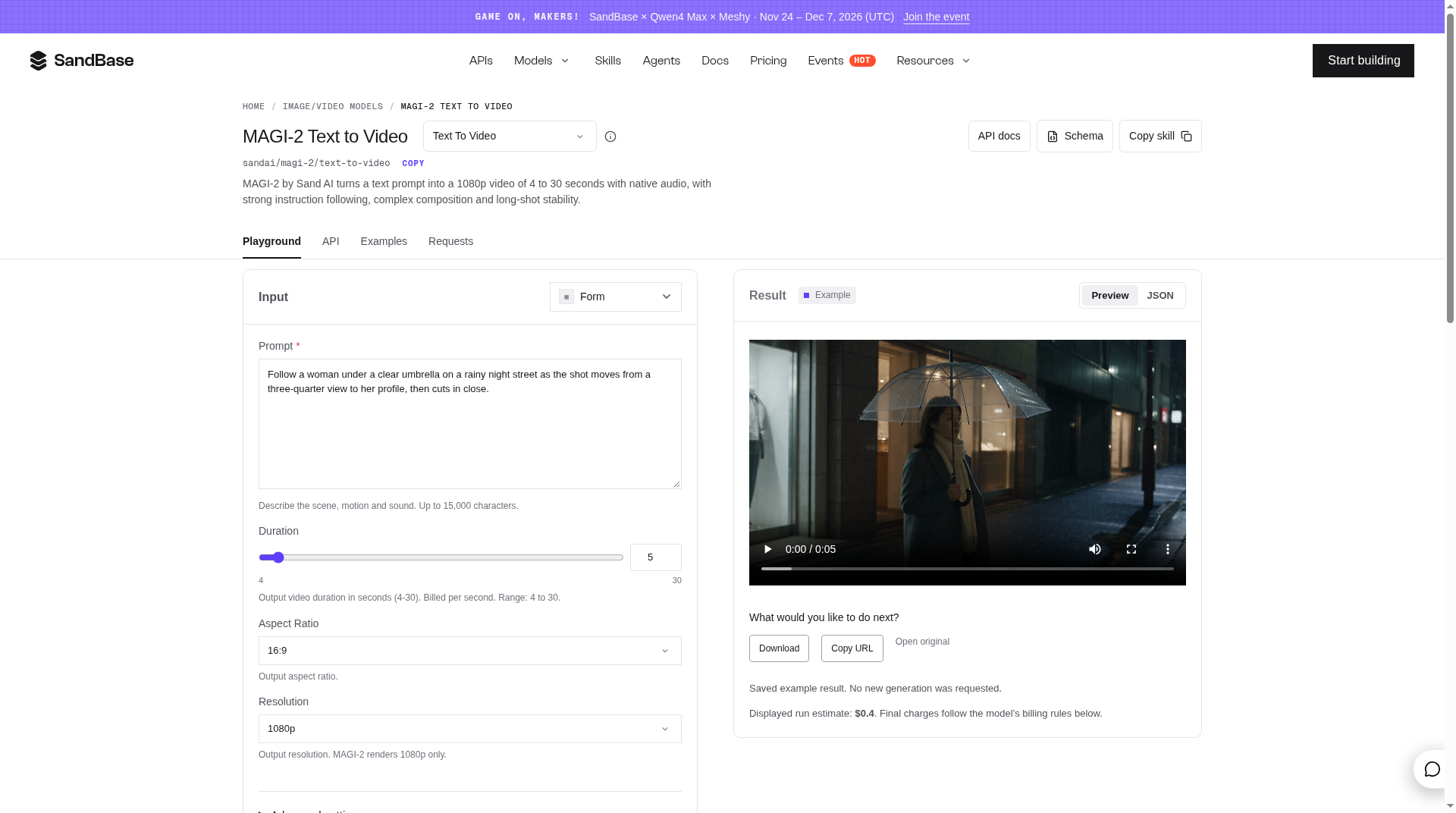
SandBase playground for sandai/magi-2/text-to-video, opened 26 November 2026, Asia/Shanghai. Duration is set to 5. The help text says billed per second, range 4 to 30. Resolution is 1080p, and the help says MAGI-2 renders 1080p only. The result note says “Saved example result. No new generation was requested.” and “Displayed run estimate: $0.4.”
| Card | SandBase id | 1080p list coefficient | Badge | Hero, and what it actually quotes | Official public price, own unit |
|---|---|---|---|---|---|
| MAGI-2 text to video | sandai/magi-2/text-to-video | $0.08 per output second, only tier | 0 | From $0.40, 5 seconds at 1080p | Sand.ai: 0.08 USD/s, model magi-2, 1080p |
| Wan 3.0 text to video | alibaba/wan/3.0/text-to-video | $0.20 per output second | 40 | From $0.30 (40% off list), 5 seconds at 720p | Model Studio International, wan3.0-video 1080P Original $0.2/s, plus a 30% off note. Other regions differ |
| Kling V4 text to video | kwaivgi/kling-video/v4/text-to-video | $0.235 per output second, no reference video | 15 | From $1 (15% off list). Default is 5 seconds at 1080p. README list cell $1.175 | Kling docs: 1.5 Units ($0.235)/s at 1080p, no input video |
| Seedance 2.5 text to video | bytedance/seedance/2.5/text-to-video | $0.90 per output second, no input video | 20 | From $1.44 (20% off list), 5 seconds at 720p. README 5-second 1080p list cell $4.50 | BytePlus: $11.7 / million tokens at 1080p without video input. $7.0 / million tokens at 1080p with video input. Model dreamina-seedance-2-5-260628 |
| Veo 3.1 text to video | google/veo3.1/text-to-video | $0.40 per output second with audio, $0.20 without. Same pair at 720p | 0 | From $3.20, 8 seconds at 720p with audio. An 8-second 1080p with-audio list row is also $3.20 | Gemini API preview ids shut down 22 Oct 2026. No live Gemini preview $/s is quoted. SandBase card still lists the formula |
Open the Wan 3.0 text-to-video card before you treat From $0.30 as a 1080p budget. The sample body on that card sends 720p. The 1080p branch is the 0.20 coefficient, and the README’s 5-second 1080p list cell is $1.00. The 40% badge is real. The post-badge 1080p total is not printed as a per-second rate on the card, so it is not printed here.
Duration rules that change the 1080p bill
MAGI-2 bills an integer from 4 to 30. There is no auto. Omit duration and the formula uses 5. Wan bills 2 to 30 or auto. auto is pre-authorized at 30 seconds and settled on the generated length, at whichever resolution coefficient you set. A 1080p auto call can pre-authorize 30 times 0.20, list $6.00, then settle lower. Kling bills an integer from 3 to 30. Seedance bills 4 to 30 or auto, and the text-card formula uses 30 when duration is auto and usage.duration is missing. Veo’s enum is only 4, 6, or 8, default 8. A 10-second 1080p Veo clip is not a value in that enum.
Seedance draft mode is a second bill, not a discount badge. The SandBase README says a draft is 480p at the 480p rate, and the final call with draft_id is billed at the 1080p output rate for the actual output length. The formula’s final branch is Math.round(usage.duration ?? 30.0) * 0.90. That 0.90 is the list coefficient. The 20% badge is still separate. Official BytePlus docs say Dreamina Seedance 2.5 draft videos are fixed at 480p and use the 480p token rate. This guide does not turn that token rate into dollars per second.
Kling HDR is easy to miss on a 1080p sheet. At 1080p the list adder is $0.047 per output second, on top of $0.235, and only when dynamic_range is hdr. MAGI-2, Wan’s text card, and Seedance’s text card do not have that field. Veo’s audio flag does change the coefficient: 1080p is $0.40 with audio and $0.20 without, default true. MAGI-2 and Wan say audio is included with no rate change. Seedance’s SandBase field says the same price on or off.
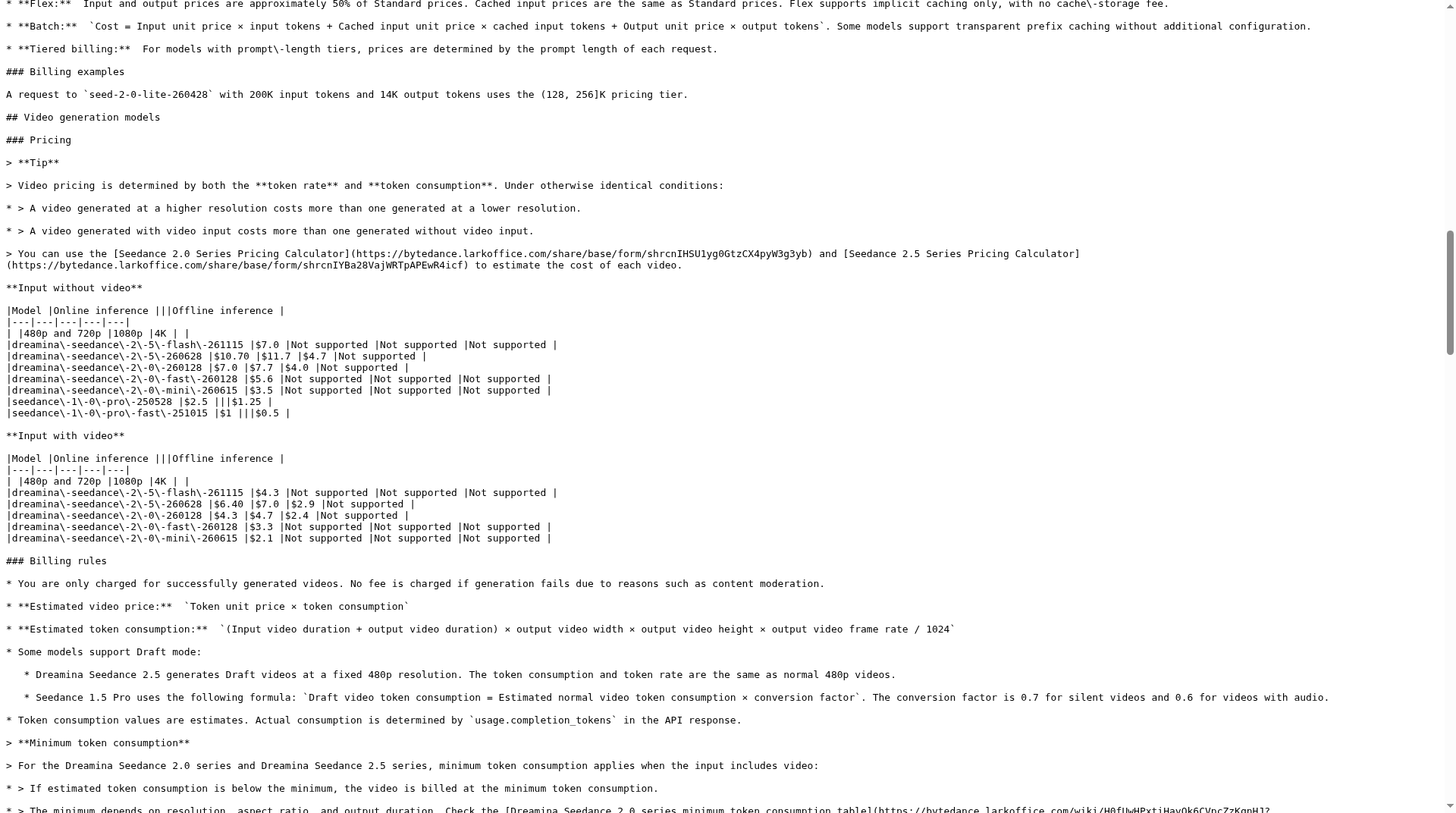
BytePlus ModelArk pricing markdown, Video generation models, opened 26 November 2026, Asia/Shanghai. The page prices video in USD per million tokens. dreamina-seedance-2-5-260628 online 1080p is $11.7 without video input and $7.0 with video input. 4K on that row is marked not supported. This crop is not a per-second rate.
Seedance stays in tokens on the vendor side
BytePlus states that video price is token rate times token consumption, and that token prices in the table are USD per million tokens. For online inference, dreamina-seedance-2-5-260628 is listed at $10.70 for 480p and 720p, $11.7 for 1080p, and $4.7 for 4K when the input has no video. With video input the same row is $6.40, $7.0, and $2.9. The 4K token rate is lower than the 1080p token rate on that table. Token consumption still depends on resolution, so a lower rate is not a lower bill. This page does not multiply the rate by the published consumption formula to invent a per-second price. The page also prints worked examples that include per-video totals. Those examples are the vendor’s illustrations. They are not copied here as a $/s column, because the instruction for this guide is to leave the official price in token units.
SandBase does not use that token formula on the card. The card’s own formula is in dollars per second: 0.18 at 480p, 0.36 at 720p, 0.90 at 1080p, for output seconds when there is no input video. base_price is 1.8, which is 5 times 0.36. The hero From $1.44 is 20% off that $1.80 list default. A 5-second 1080p list cell in the README is $4.50. The SandBase resolution enum is 480p, 720p, and 1080p. It does not include the 4K the vendor table lists. If you need official 4K, the SandBase text card checked today is the wrong control.
Reference video on the SandBase Seedance card changes the coefficient and adds input seconds. Without videos, 1080p stays 0.90 per output second. With videos, the added seconds are at least 2 and at most 30, and the 1080p coefficient becomes 0.55. That is a SandBase formula fact. It is not a conversion of the $7.0 token rate. The cap and billing note is reference-to-video APIs.
Veo 3.1: a SandBase card, and a vendor preview that the docs say is off
The SandBase text-to-video card returned HTTP 200. enabled is true. publicDiscountPercent is 0. base_price is 3.2. The formula is duration times 0.40 at 720p or 1080p when audio is on, and 0.20 when audio is off. At 4K the coefficients are 0.60 and 0.40. Default duration is 8, default resolution is 720p, so the hero From $3.20 is 8 times 0.40. The README table shows the same $3.20 for 8 seconds at 1080p with audio. The README calls these “Google’s list price.” The schema duration values are 4, 6, and 8. This check did not find a schema sentence that forces 1080p to be 8 seconds only. Older Gemini Veo documentation had that constraint. It is not restated here as a SandBase rule.
Google’s video page and deprecations page, fetched the same day, say Veo 3.1 Preview (veo-3.1-generate-preview, veo-3.1-fast-generate-preview, and veo-3.1-lite-generate-preview) in the Gemini API was shut down on 22 October 2026. The video page’s current recommendation is Gemini Omni Flash (gemini-omni-1.2-flash) or GA models on the Gemini Enterprise Agent Platform. The Enterprise Veo 3.1 page that notice links returned HTTP 200 and its visible text includes “Launch stage: Preview.” This guide did not extract a public per-second price from that Enterprise page, so the official price cell stays “preview shutdown on the Gemini API; Enterprise page still labeled Preview; no $/s copied.” The SandBase card can still be opened. This page did not submit a run, so a listed formula is not a claim that a call completes.
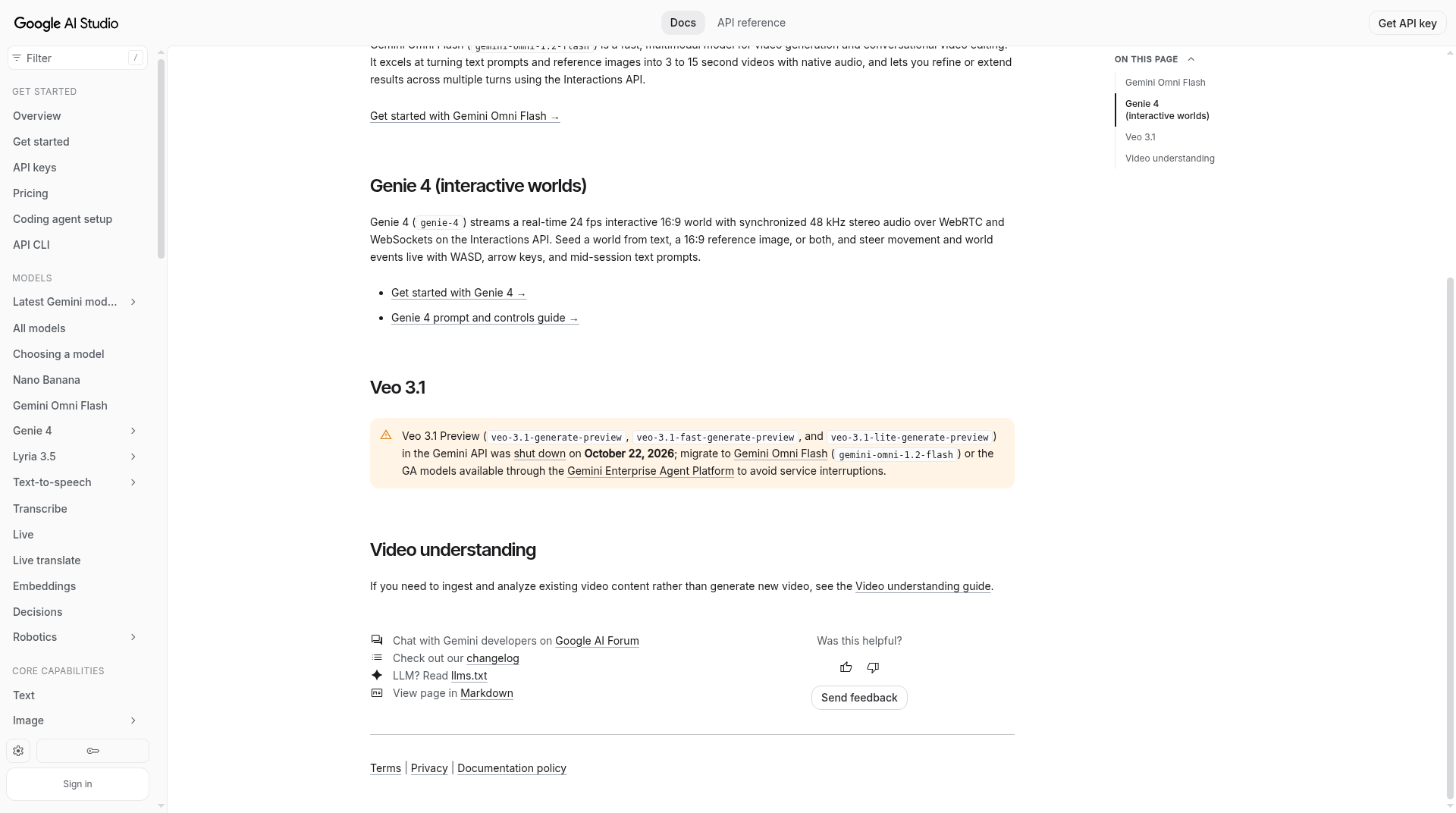
Google AI Studio video docs, opened 26 November 2026, Asia/Shanghai. The ai.google.dev video URL redirected here. The warning says Veo 3.1 Preview (veo-3.1-generate-preview, veo-3.1-fast-generate-preview, and veo-3.1-lite-generate-preview) was shut down on October 22, 2026, and names Gemini Omni Flash (gemini-omni-1.2-flash) as a migration target. This frame is not a price table and not a SandBase card.
Do not send a client to the shut-down preview ids and describe that as the SandBase card. The SandBase id is google/veo3.1/text-to-video on POST https://api.sandbase.ai/v1/run. The Gemini preview id is a different string on a different host, and the docs say that host’s preview endpoint is off. If the job is a 1080p clip you are willing to call today without a vendor-preview bet, the cards this guide can point at without that caveat are MAGI-2, Wan 3.0, Kling V4, and Seedance 2.5. Veo stays in the table because the SandBase card exists and the shutdown is the fact a buyer would miss.
What to use the table for
Use MAGI-2 when you want 1080p as the only enum, a 4 to 30 second integer, and a formula that matches the vendor’s 0.08 USD/s with a zero badge. Start on the MAGI-2 text-to-video card. A 30-second clip is $2.40 on that expression.
Use Wan when 1080p is one of three tiers and you will keep $0.20 list and the 40% badge side by side. Use Kling when the default really is 1080p and you will keep $0.235 list and the 15% badge side by side, including the HDR adder if you set it. Open the Kling V4 text-to-video card so the 4K and 720p branches stay visible. Use Seedance on SandBase when you accept a $0.90 list coefficient at 1080p and a 20% badge, and you quote BytePlus only in dollars per million tokens. Use the Veo SandBase card only with the shutdown sentence in the same paragraph.
The cost model explainer is the vocabulary for per-second bills. It does not override these five formulas. A feature roundup that scored clips is a different article, best AI video generation APIs, and its scores are not reused here.
FAQ
Which hero is a 1080p price?
MAGI-2’s From $0.40 is, because 1080p is the only resolution and 5 seconds is the default. Kling’s From $1 is the discounted wording on a card whose default is 5 seconds at 1080p, while the list cell next to it is $1.175. Wan’s From $0.30 and Seedance’s From $1.44 are 720p defaults. Veo’s From $3.20 is 8 seconds at 720p with audio, and the 1080p with-audio list row for 8 seconds happens to be the same $3.20.
Can I convert Seedance’s $11.7 per million tokens into a per-second rate?
Not in this guide. The vendor page tells you to multiply the token rate by token consumption, and consumption depends on width, height, frame rate, and duration. Doing that multiplication here would be a conversion. Quote $11.7 and $7.0 per million tokens, or quote the SandBase per-second formula, and label which document you are in.
Is Veo 3.1 gone?
The Gemini API preview ids are shut down as of the docs checked 26 November 2026, with shutdown date 22 October 2026. The SandBase card google/veo3.1/text-to-video still returns HTTP 200 and still shows a formula. This page did not buy a generation, so completion is unverified. The Enterprise page linked from the shutdown notice still says Preview.
Does a 40% or 15% badge change the coefficient in the table?
The coefficients in the list column are the formula numbers. The badges are the percents. Heroes already show the default quote the site prints after mentioning the badge. Non-default durations are left as list arithmetic plus the badge, not as a new coefficient.
Were these prices measured by running jobs?
No. They are card payloads, README tables, and vendor pages. Failed-run rules: Wan, Kling, Seedance, and Veo READMEs say failed runs are not charged. MAGI-2’s cards do not say.
What to open
Price the clip on the card whose default matches the file you will actually request. For a 1080p-only path with a zero badge, that is the MAGI-2 text-to-video card. Re-open the vendor page in the official column before you paste a number into a contract. The field list for MAGI-2 is the launch note.
Catalog cards and vendor docs checked 26 November 2026, Asia/Shanghai. No generation was run. No model is ranked.
Related reading
Found this useful? Share it