MAGI-2 vs Wan 3.0: 1080p Price, Duration, and Reference Billing
MAGI-2 vs Wan 3.0 on 26 Nov 2026: 1080p list rates, duration, reference-video billing, and separate discount badges. Not a quality test.
The two heroes do not describe the same 1080p second. On 26 November 2026, Asia/Shanghai, the SandBase MAGI-2 text-to-video card prints From $0.40 per run, and its payload formula is (params.duration ?? 5) * 0.08 with publicDiscountPercent 0. The Wan 3.0 text-to-video card prints From $0.30 per run (40% off list price). Its default resolution is 720p, and the list formula prices that default 5-second row at $0.50 before the badge. Wan’s 1080p coefficient inside the same formula is 0.20. This page compares those catalog facts, the duration enums, and what happens to the bill when a reference video is attached. It does not score picture quality, and it does not time a generation.
Use MAGI-2 when the file you promised is 1080p, the clip is 4 to 30 seconds, and you want a formula that multiplies output seconds only. Use Wan 3.0 when you need 480p or 720p on the same card, or when a 40% list-price badge is part of the budget you are willing to recompute yourself. Neither choice is a quality ranking. The MAGI-2 launch note records the three SandBase ids. The wider 1080p sheet is 1080p video API pricing.
Key takeaway
- MAGI-2 on SandBase, checked 26 November 2026: ids
sandai/magi-2/text-to-video,sandai/magi-2/image-to-video, andsandai/magi-2/reference-to-video. Resolution enum is1080ponly. Duration is an integer from 4 to 30, default 5.price_formulais(params.duration ?? 5) * 0.08.publicDiscountPercentis 0. Hero: From $0.40 per run.enabledis true.published_atis2026-11-25T00:00:00Z.- Wan 3.0 text-to-video id is
alibaba/wan/3.0/text-to-video. Resolutions are480p,720p, and1080p, default720p. Duration is 2 to 30 orauto, default 5. List formula: 0.05 at 480p, 0.10 at 720p, 0.20 at 1080p, times output seconds.publicDiscountPercentis 40. Hero: From $0.30 per run (40% off list price). That hero is the default 720p, 5-second quote, not a 1080p quote.- Reference video does not appear in the MAGI-2 formula. On Wan reference-to-video, a non-empty
videosarray adds reference seconds, capped at 15 in the formula, at the same per-second list rate. Images and audio are not terms in that formula.- Sand.ai’s pricing page lists model
magi-2at 1080p and 0.08 USD/s, and says top-up is not supported for the time being. Alibaba’s English Model Studio pricing page, Last Updated 25 Nov 2026, prints an International 1080P cell forwan3.0-videoas Original $0.2/s with a limited-time 30% off note, and other regions at different originals. Those vendor figures stay in their own column.- No generation was purchased for this comparison. Failure billing on the MAGI-2 cards is not stated. Wan’s README says failed runs are not charged.
What each card is willing to call 1080p
Open the MAGI-2 text-to-video card before you budget a 1080p second. The resolution field is an enum of one value, 1080p, default 1080p, and the description says MAGI-2 renders 1080p only. There is no 720p row to fall back to, and no 4K row to step up to. The sibling image and reference cards use the same enum and the same formula. A prompt-only call, a first-frame call, and a reference call do not change the per-second coefficient.
Wan’s text-to-video resolution enum is 480p, 720p, and 1080p, default 720p. The list formula branches on that field: 0.20 when the value is 1080p, 0.05 when it is 480p, otherwise 0.10. Omit resolution and the formula takes the 720p branch. The markdown sample request sends "resolution": "720p". If a client copies that sample and then talks about “the Wan 1080p price,” it is talking about a request the sample did not send.
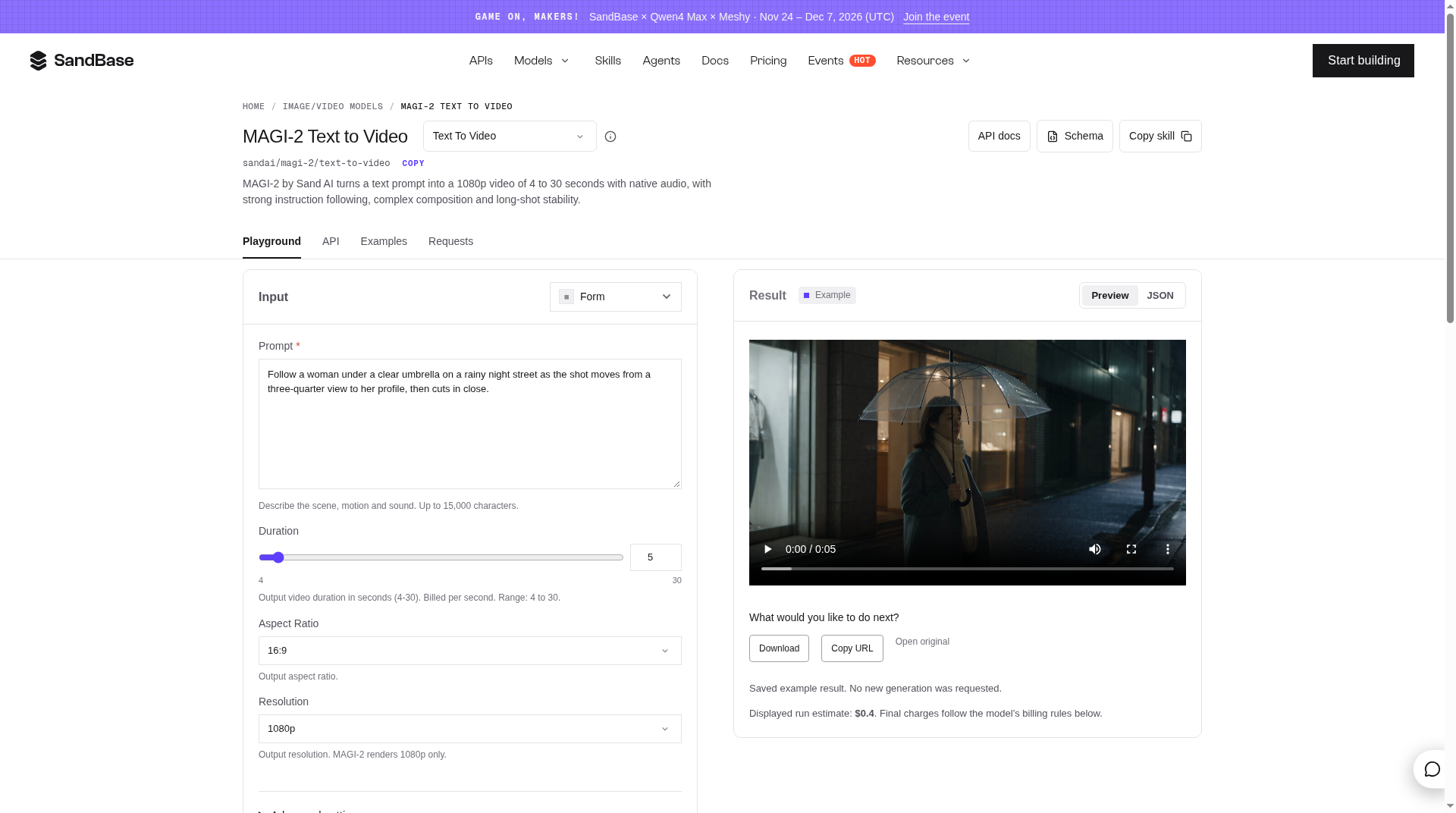
SandBase playground for sandai/magi-2/text-to-video, opened 26 November 2026, Asia/Shanghai. Duration is set to 5. The help text says billed per second, range 4 to 30. Resolution is 1080p, and the help says MAGI-2 renders 1080p only. The result note says “Saved example result. No new generation was requested.” and “Displayed run estimate: $0.4.”
The visible heroes are easy to subtract and easy to misuse. MAGI-2’s From $0.40 matches 5 times 0.08, which is the formula default. Wan’s From $0.30 matches 5 times 0.10, then the 40% badge: the list default is $0.50, and 40% off that list row is $0.30. A 5-second Wan clip at 1080p is a different list row. The README table prints it as $1.00, which is 5 times 0.20. The badge is still 40% off list. This article does not fold that badge into a new per-second number such as $0.12. The card does not print $0.12.
| MAGI-2 text to video | Wan 3.0 text to video | |
|---|---|---|
| SandBase id | sandai/magi-2/text-to-video | alibaba/wan/3.0/text-to-video |
| Resolutions on the card | 1080p only | 480p / 720p / 1080p, default 720p |
| Duration | integer 4–30, default 5 | 2–30 or auto, default 5 |
| List formula, 1080p | (params.duration ?? 5) * 0.08 | output seconds times 0.20 |
| List formula, other tiers | none on this card | 0.05 at 480p, 0.10 at 720p |
publicDiscountPercent | 0 | 40 |
| Facts-line hero | From $0.40 per run | From $0.30 per run (40% off list price) |
| What the hero prices | default 5 seconds at the only resolution | default 5 seconds at 720p, after the badge |
| Official vendor price, separate | Sand.ai: magi-2, 1080p, 0.08 USD/s | Model Studio International: wan3.0-video 1080P Original $0.2/s, plus a 30% off note. Other regions differ |
| Reference video in the price formula | no term | on the reference card, extra seconds, same list rate |
base_price on the MAGI-2 payload is 0.4. On Wan text-to-video it is 0.5. Those match the undiscounted default rows, not the badge. free_quota_eligible is false on the MAGI-2 cards. Wan’s README says output files are copied to SandBase storage and the returned URL stays valid for 7 days. The MAGI-2 markdown cards checked here do not print that retention sentence.
Duration, including the auto branch
MAGI-2 duration is an integer, minimum 4, maximum 30, default 5. The help text says the output is billed per second. There is no auto. If the caller omits duration, the formula uses 5. A 4-second clip is the short end of the enum, so the formula arithmetic is 4 times 0.08, which is $0.32. A 10-second clip is $0.80. A 30-second clip is $2.40. The discount badge is 0, so those products are the list expression and the hero math at once. They are still not an invoice. No run was submitted.
Wan duration accepts the integers 2 through 30 and the string auto, default 5. The formula treats auto as Math.round(usage.duration ?? 30.0). The field description says auto is pre-authorized at 30 seconds and billed on the actual output length. A caller who sends auto should budget the 30-second pre-authorization, then expect settlement on the generated length. That pre-authorization is a catalog sentence. This page did not watch a hold and a capture on an account.
Wan can bill a 2-second output. MAGI-2’s minimum is 4. A 2-second 720p Wan list row in the README is $0.20. MAGI-2 has no 2-second row and no 720p row. The $0.30 and $0.40 heroes are not peers.
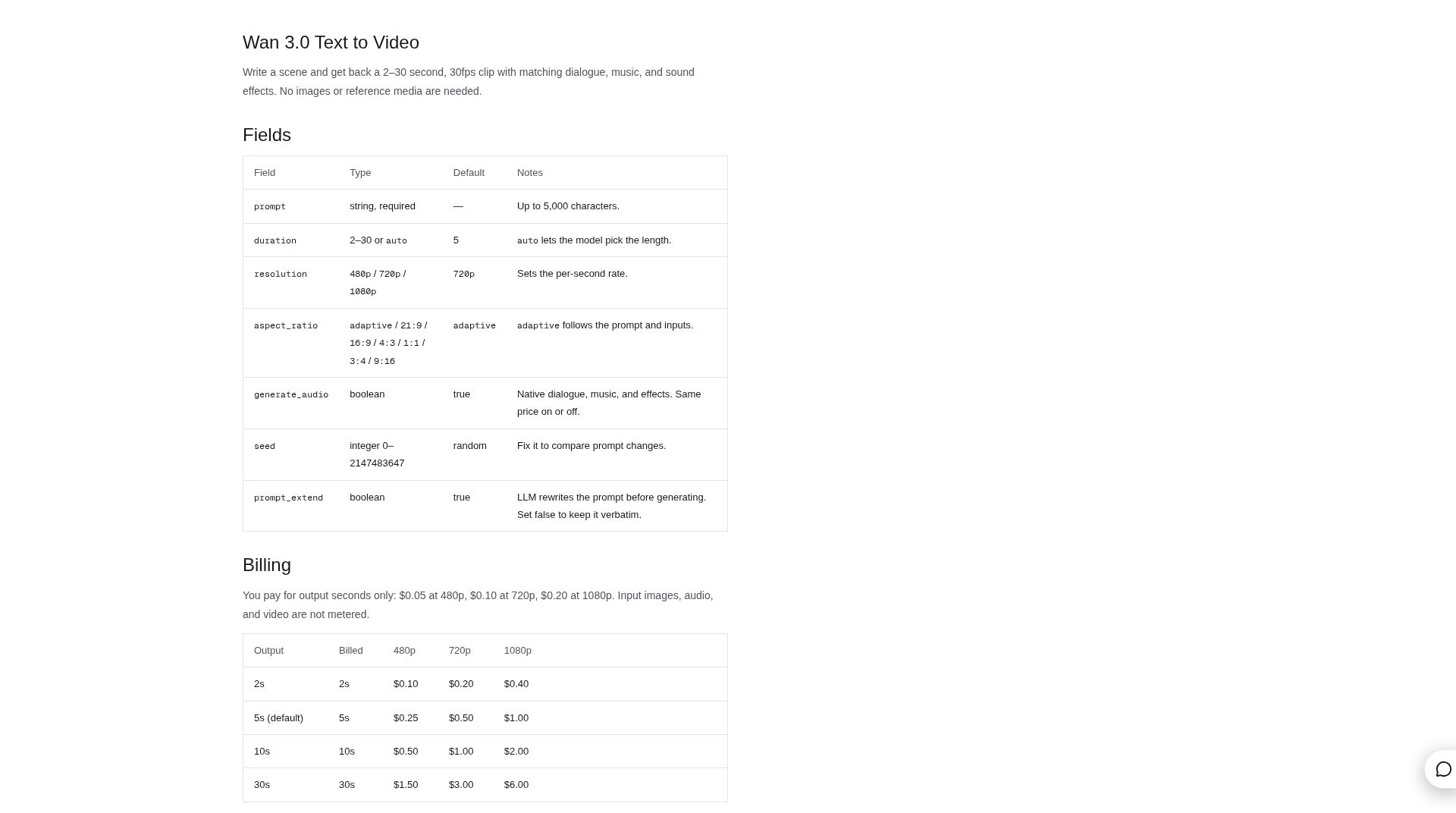
Wan 3.0 Text to Video README on the SandBase card, opened 26 November 2026, Asia/Shanghai. The billing sentence says you pay for output seconds only: $0.05 at 480p, $0.10 at 720p, $0.20 at 1080p. The 5-second default row is $1.00 at 1080p. Fields show duration 2-30 or auto, default 5, and resolution 480p/720p/1080p, default 720p. This crop does not show a discount badge.
Audio does not change either text-to-video rate. MAGI-2 generate_audio defaults to true and the description says a native audio track is included in the price. The formula has no audio term, and this check did not find a cheaper rate for false. Wan’s field says pricing is the same either way, default true. Kling’s HDR adder, which does change a rate, is a different card and is covered in MAGI-2 vs Kling V4.
Reference video is where the formulas split
The MAGI-2 reference card still uses (params.duration ?? 5) * 0.08. The schema allows up to 10 images under 30 MB, up to 5 MP4 or MOV clips of 2 to 30 seconds each and 30 seconds combined, up to 200 MB each, and up to 5 WAV or MP3 clips on the same 2 to 30 / 30-second combined rule, up to 15 MB each. None of those lengths are variables in price_formula. A 5-second output with an 8-second reference video is still the 5-second product on that expression: $0.40 list, and the badge is 0. Caps can still reject the request. They do not add a second line to this formula.
Wan reference-to-video, id alibaba/wan/3.0/reference-to-video, keeps the same 0.05 / 0.10 / 0.20 list rates and then adds time when videos is non-empty. The added term is Math.ceil(Math.min(media_duration(params.videos) ?? 15.0, 15.0)). If the length cannot be read, the formula assumes 15 seconds. The cap inside the formula is 15 seconds, not the full output length. Images and audio are not added. The README prints the consequence at list rates: 5 seconds of output plus 8 seconds of reference video bills 13 seconds, so the 1080p list cell is $2.60. Five seconds plus 15 seconds of reference video bills 20 seconds, and the 1080p list cell is $4.00. The 40% badge is a separate field on that card too. This page does not reprint those cells after the badge.
The README also says reference video length plus output length must stay within 30 seconds. The formula itself does not multiply by a “must stay within 30” flag. A rejected request and a 45-second arithmetic product are different outcomes. Read the limit before you send 30 seconds of output plus a reference clip. The field caps are tighter than MAGI-2’s in another way: Wan reference videos are 1 to 15 seconds each, 15 seconds total, under 100 MB, up to 5 clips. MAGI-2’s video cap is 2 to 30 seconds each, 30 seconds combined, up to 200 MB. The reference-to-video caps note puts Kling V4 and Seedance 2.5 on the same table.
Open the Wan 3.0 text-to-video card when the job is a prompt-only clip and you have chosen a resolution on purpose. For a reference clip, open the reference card and read the billing table before you assume the From $0.30 hero still applies. That hero is the text card’s default row. The reference card’s facts line also says From $0.30 per run (40% off list price), and its base_price is also 0.5. The moment videos is non-empty, the formula is no longer “output seconds only.”
Official prices stay in their own column
Sand.ai’s pricing page, fetched the same day, is one row: model magi-2, resolution 1080p, pricing 0.08 USD/s. Above the table it says top-up is not supported for the time being. That sentence is about the Sand.ai console. The SandBase cards say pay per use from a SandBase balance, and the markdown FAQ says a separate Sand AI account is not required. The $0.08 figures match on this check. The invoices, if you pull them, are still separate accounts. Sand.ai’s native route is POST https://api.sand.ai/v2/generations with model magi-2. SandBase’s route is POST https://api.sandbase.ai/v1/run with one of the three sandai/magi-2/* ids. Do not send magi-2 to the SandBase route.
Alibaba’s English model-pricing page showed Last Updated: Nov 25, 2026. The Wan 3.0 block says both input videos and output videos are billed by video seconds, and the billing formula is input video duration plus output video duration. Failed requests do not incur fees. The International row for wan3.0-video prints 480P Original $0.05/s, 720P Original $0.1/s, and 1080P Original $0.2/s, each with a parenthetical that a 30% discount is offered for a limited time. The page does not print the post-discount per-second figure in that cell. Other regional rows print different originals, including a 1080P original that is not $0.2/s. This guide cites the International cell and does not pick a region for you. It also does not treat Alibaba’s 30% note as SandBase’s 40% badge. They are different sentences on different sites. The earlier SandBase discount write-up is Wan 3.0 at 40% off. Use today’s card if the two dates disagree.
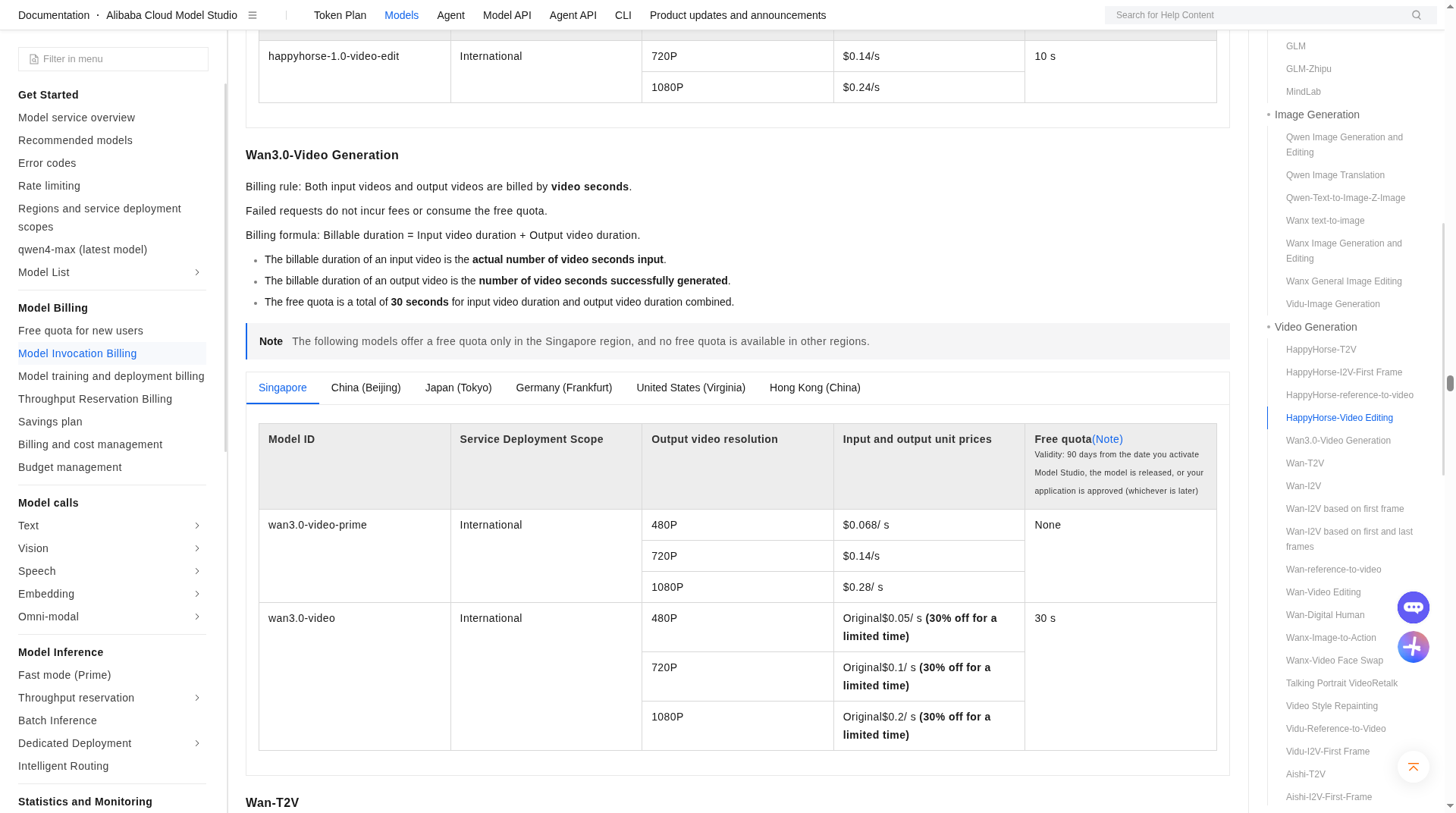
Alibaba Cloud Model Studio, Wan3.0-Video Generation, International tab, opened 26 November 2026, Asia/Shanghai. wan3.0-video at 1080P reads Original $0.2/s (30% off for a limited time). 480P is Original $0.05/s and 720P is Original $0.1/s, with the same note. The section says failed requests do not incur fees. This is not a SandBase price.
Wan’s official model id on that page and on the video generation guide is wan3.0-video (and wan3.0-video-prime beside it). The guide still describes 480P, 720P, and 1080P and a 2 to 30 second duration. It does not list a SandBase id. SandBase’s id is alibaba/wan/3.0/text-to-video. This comparison does not fold Pro, 2K, or 4K into the standard row. Official docs checked here still describe 480P, 720P, and 1080P for wan3.0-video.
When the list row is the decision
Choose the MAGI-2 card when delivery is 1080p, length is between 4 and 30 seconds, and a reference video must not change the billed seconds. If the arrays are the input, the reference-to-video card uses the same expression. The list expression is $0.08 per output second, the badge is 0, and Sand.ai’s own row prints 0.08 USD/s. A 10-second clip is $0.80 on that expression. Call sandai/magi-2/text-to-video for a prompt, sandai/magi-2/image-to-video when a first frame is required, or sandai/magi-2/reference-to-video when the arrays are the input. The image card’s schema requires image. The short markdown curl on that card omits image, so it is not a complete body.
Choose Wan 3.0 when you need a resolution below 1080p, a 2-second floor, or auto, and you are willing to keep the 40% badge next to the list rate instead of merging them. A 10-second 1080p list row in the README is $2.00. The badge still says 40% off list. The facts-line hero remains From $0.30, which does not describe that 10-second 1080p row. If the request includes reference video, add the capped reference seconds before you apply any mental discount. The cost model explainer is the general vocabulary for list, discount, and per-second billing. It is not a substitute for these two formulas.
Leave both cards when you need a published quality score, a latency budget, or a 4K master. This comparison did not run either model. run_count on the MAGI-2 payload was 0 at this fetch. A zero counter is a field at one moment. Wan text-to-video also showed run_count 0. Neither number is a reliability test.
FAQ
Which 1080p second is actually on the formula?
MAGI-2: 0.08, and it is the only resolution coefficient. Wan: 0.20 in the list formula when resolution is 1080p. Wan’s 0.10 is the 720p branch, which is also the default. Sand.ai prints 0.08 USD/s for magi-2. Alibaba’s International cell prints Original $0.2/s for wan3.0-video at 1080P, with a separate 30% off note.
Does the 40% badge change Wan’s 1080p coefficient to 0.12?
The card does not say that. publicDiscountPercent is 40. The formula coefficients are 0.05, 0.10, and 0.20. The hero applies the badge language to the default quote, From $0.30, which lines up with a $0.50 list row at 5 seconds and 720p. A 1080p total after the badge is not printed as its own per-second rate here, so this page does not invent one.
Does a reference video cost extra on both?
On MAGI-2 the formula has no reference term. On Wan reference-to-video, reference video seconds are added, rounded up, and capped at 15 inside the formula, then multiplied by the same list rate as the output. Reference images and reference audio are not metered on that Wan formula.
Can I send Wan’s id to Sand.ai, or MAGI-2’s id to DashScope?
No. SandBase ids stay on POST https://api.sandbase.ai/v1/run. Sand.ai’s id magi-2 stays on POST https://api.sand.ai/v2/generations. Alibaba’s documented id on the pages opened here is wan3.0-video. Copy the id from the card you are calling.
Were any clips generated for this page?
No. Latency, failure rate, and the settled charge on a real account were not measured. Wan’s README says failed runs are not charged. The MAGI-2 cards checked here do not say whether a failed run is billed.
What to open next
Price a 1080p MAGI-2 clip as output seconds times $0.08, badge 0, on the text-to-video card. Price a Wan 1080p clip from the 0.20 list coefficient, keep the 40% badge in its own cell, and add reference seconds only after you have opened the reference card. The launch note’s field list is still the right companion if you are about to build the request body: MAGI-2 on SandBase.
SandBase cards, Sand.ai pricing, and Alibaba Model Studio pricing checked 26 November 2026, Asia/Shanghai. No generation was run. This page has no quality score.
Related reading
Found this useful? Share it