MAGI-2 vs Seedance 2.5: 1080p List Price, Draft Mode, and Official Token Rates
MAGI-2 vs Seedance 2.5 on 27 Nov 2026: 1080p list rates, draft mode, and official BytePlus tokens in a separate column. Not a quality test.
The two public Offers do not describe the same 1080p second. On 27 November 2026, Asia/Shanghai, the MAGI-2 text-to-video card lists $0.08 per output second at its only resolution, 1080p, with publicDiscountPercent 0. Its JSON-LD Offer is 0.4 USD per run, which matches the billing table’s 5-second default row of $0.40. The Seedance 2.5 text-to-video card lists $0.90 per output second at 1080p, shows a 20 % OFF badge, and publishes a JSON-LD Offer of 1.44 USD per run. That 1.44 is 20% off the 5-second 720p list row of $1.80, not a 1080p quote. Official BytePlus prices the same Seedance model in USD per million tokens. This page does not convert those tokens into a SandBase per-second rate.
Use MAGI-2 when the file you promised is 1080p, the clip is an integer from 4 to 30 seconds, and you want a formula that multiplies output seconds only, with a zero badge. Use Seedance 2.5 when you need 480p or 720p on the same card, an auto duration, or draft mode — and you are willing to keep the 20% badge, the 720p Offer, and the official token column in separate cells. Neither choice is a quality ranking. The MAGI-2 listing itself is the launch note. The five-model 1080p sheet, which already includes a Seedance row, is 1080p video API pricing. This comparison does not remake that table, and it does not remake the Seedance 2.5 Flash posts.
Key takeaway
- MAGI-2 on SandBase, checked 27 November 2026: ids
sandai/magi-2/text-to-video,sandai/magi-2/image-to-video, andsandai/magi-2/reference-to-video. Resolution enum is1080ponly. Duration is an integer from 4 to 30, default 5.price_formulais(params.duration ?? 5) * 0.08.publicDiscountPercentis 0. JSON-LD Offer: 0.4 USD per run. Billing table: 5s (default) $0.40. The Sand AI vendor catalog prints From $0.4 per run. Billing now says failed runs are not billed.- Seedance 2.5 text-to-video id is
bytedance/seedance/2.5/text-to-video. Resolutions are480p,720p, and1080p, default720p. There is no 4K value on the SandBase enum. Duration is 4 to 30 orauto, default 5. List rates: $0.18 / $0.36 / $0.90 per output second. Audio is included; Fields say the same price on or off. Badge: 20 % OFF. JSON-LD Offer: 1.44 USD per run, which is 20% off the 5-second 720p list row of $1.80. The 4-second 720p list cell is also $1.44; that is a coincidence.- Draft mode is two calls on the same Seedance 2.5 card, not a Flash sku and not a MAGI-2 field.
"draft": truereturns a 480p preview billed at the 480p rate. A laterdraft_idrenders the shot at 1080p and is billed at the 1080p output rate for the actual output length, inside a 7-day window.- Official BytePlus, model
dreamina-seedance-2-5-260628, online inference, USD per million tokens: 1080p $11.7 without video input, $7.0 with video input. Official billing examples for a 5-second 16:9 clip without video input estimate $2.843 per video / $0.569 per second at 1080p. Those estimates are not the SandBase $0.90/s list.- Flash (
bytedance/seedance/2.5/flash/text-to-video) is 480p or 720p only. Its Limits line says to use the 2.5 text card for 1080p or draft mode. Official 1080p for Flash is “Not supported.”- No generation was purchased for this comparison.
What each card will actually call 1080p
Open the MAGI-2 text-to-video card before you budget a 1080p second. The resolution field is an enum of one value, 1080p, default 1080p, and the description says MAGI-2 renders 1080p only. There is no 720p row to fall back to, and no 4K row to step up to. The sibling image-to-video and reference-to-video cards use the same enum and the same formula. A prompt-only call, a first-frame call, and a reference call do not change the per-second coefficient.
Seedance 2.5’s resolution enum is 480p, 720p, and 1080p, default 720p. The list formula uses 0.18, 0.36, or 0.90 depending on that field. Omit resolution and the default is 720p. There is no 4k or 4K value on this SandBase enum, even though official BytePlus lists 4K token rates for dreamina-seedance-2-5-260628. A 4K official cell is not a SandBase control on these cards. If you need official 4K, the SandBase 2.5 text card checked today is the wrong switch.
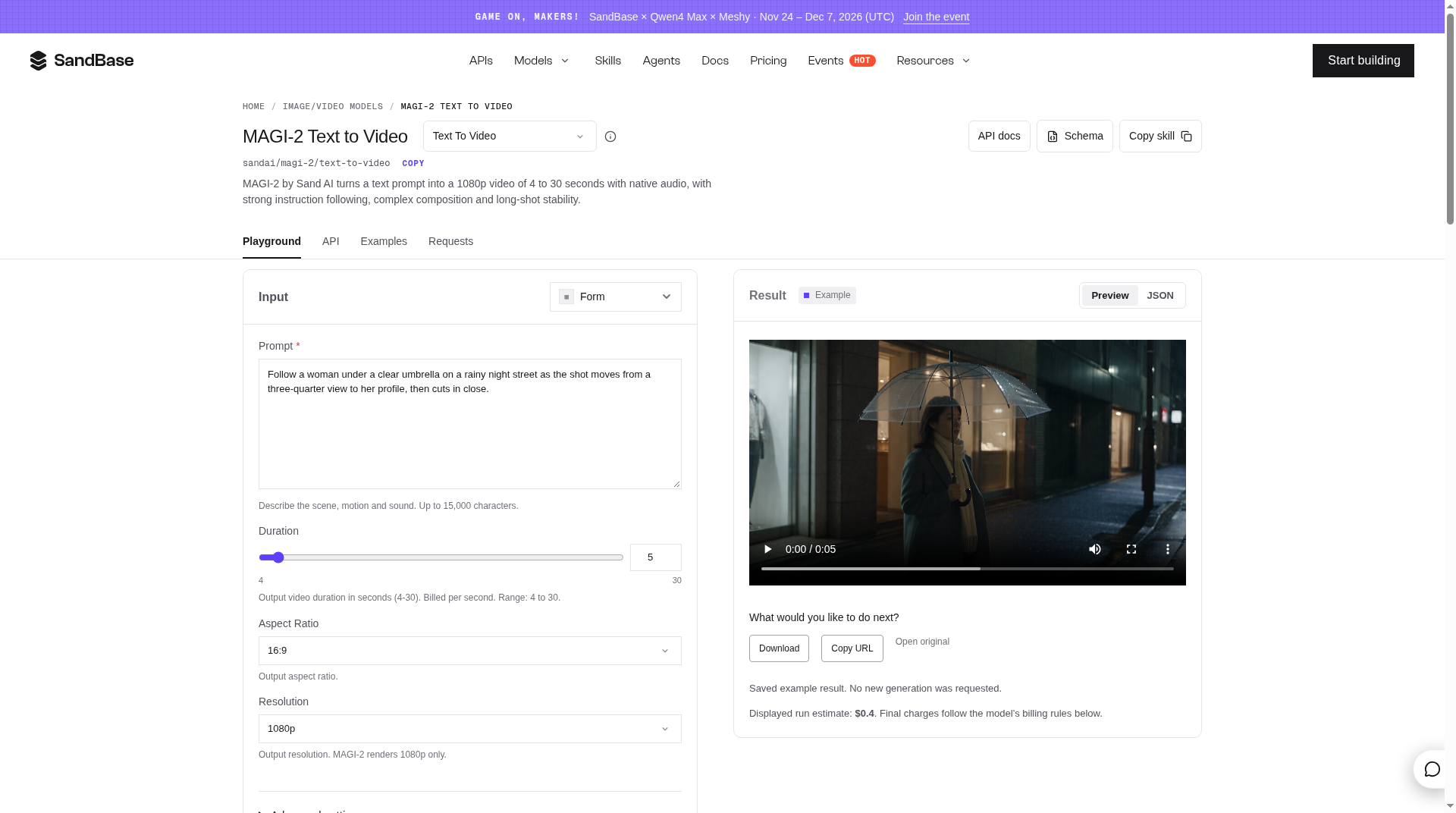
SandBase playground for sandai/magi-2/text-to-video, opened 27 November 2026, Asia/Shanghai. Duration is set to 5. The help text says billed per second, range 4 to 30. Resolution is 1080p, and the help says MAGI-2 renders 1080p only. The result note says “Saved example result. No new generation was requested.” and “Displayed run estimate: $0.4.” This frame does not show a hero Facts line.
List $0.08 versus $0.90, and why the Offers are not the same second
MAGI-2’s visible Billing sentence is short: “$0.08 per second of output video, with native audio included in the price. Resolution is fixed at 1080p. Failed runs are not billed.” The table prints 4s $0.32, 5s (default) $0.40, 10s $0.80, and 30s $2.40. The payload formula is (params.duration ?? 5) * 0.08. base_price is 0.4. The badge is 0, so those products are the list expression and the Offer math at once. They are still not an invoice. No run was submitted.
Seedance 2.5’s visible Billing, with no reference video, is: “You pay for output seconds: $0.18 at 480p, $0.36 at 720p, $0.90 at 1080p. Audio is included.” The 5-second default row is $0.90 / $1.80 / $4.50. A 30-second 1080p list cell is $27.00. Failed runs are not charged. The 20% badge is a separate field, publicDiscountPercent 20, also printed on the page as 20 % OFF. This page does not fold that badge into a new per-second number such as $0.72. The card does not print $0.72 as a 1080p rate.
The JSON-LD Offer of 1.44 is easy to drop into a spreadsheet and easy to misuse. Five seconds at the default 720p list rate is 5 times 0.36, which is $1.80 — that is base_price. Twenty percent off that default list row is $1.44. The README’s 4-second 720p list cell is also $1.44. Those two $1.44 figures are not the same row: one is a discounted 5-second 720p Offer, and one is an undiscounted 4-second 720p list cell. Neither is a 1080p quote. A 5-second 1080p list cell is $4.50.
The Sand AI vendor catalog, opened the same day, prints From $0.4 per run on the MAGI-2 text, image, and reference cards — the wording is $0.4, not $0.40. Official Sand.ai pricing is one row: model magi-2, resolution 1080p, 0.08 USD/s, with a note that top-up is not supported for the time being. The $0.08 figures match on this check. The invoices, if you pull them, are still separate accounts. Sand.ai’s native route is POST https://api.sand.ai/v2/generations with model magi-2. SandBase’s route is POST https://api.sandbase.ai/v1/run with one of the three sandai/magi-2/* ids.
| MAGI-2 text to video | Seedance 2.5 text to video | |
|---|---|---|
| SandBase id | sandai/magi-2/text-to-video | bytedance/seedance/2.5/text-to-video |
| Resolutions on the card | 1080p only | 480p / 720p / 1080p, default 720p. No 4K on this enum |
| Duration | integer 4–30, default 5. No auto | 4–30 or auto, default 5 |
| List formula, 1080p | (params.duration ?? 5) * 0.08 | output seconds times 0.90, when there is no reference video and no draft |
| List formula, other tiers | none on this card | 0.18 at 480p, 0.36 at 720p |
publicDiscountPercent | 0 | 20 |
| JSON-LD Offer | 0.4 USD per run | 1.44 USD per run |
| What the Offer prices | default 5 seconds at the only resolution ($0.40 list) | default 5 seconds at 720p, after the 20% badge (list default $1.80) |
| Official vendor price, separate | Sand.ai: magi-2, 1080p, 0.08 USD/s | BytePlus tokens: dreamina-seedance-2-5-260628, 1080p $11.7 / $7.0 per million tokens. Official 5s 16:9 example: $2.843 per video / $0.569 per second — not the SandBase list |
| Draft mode | no draft field | two calls on this same card: 480p draft, then 1080p final |
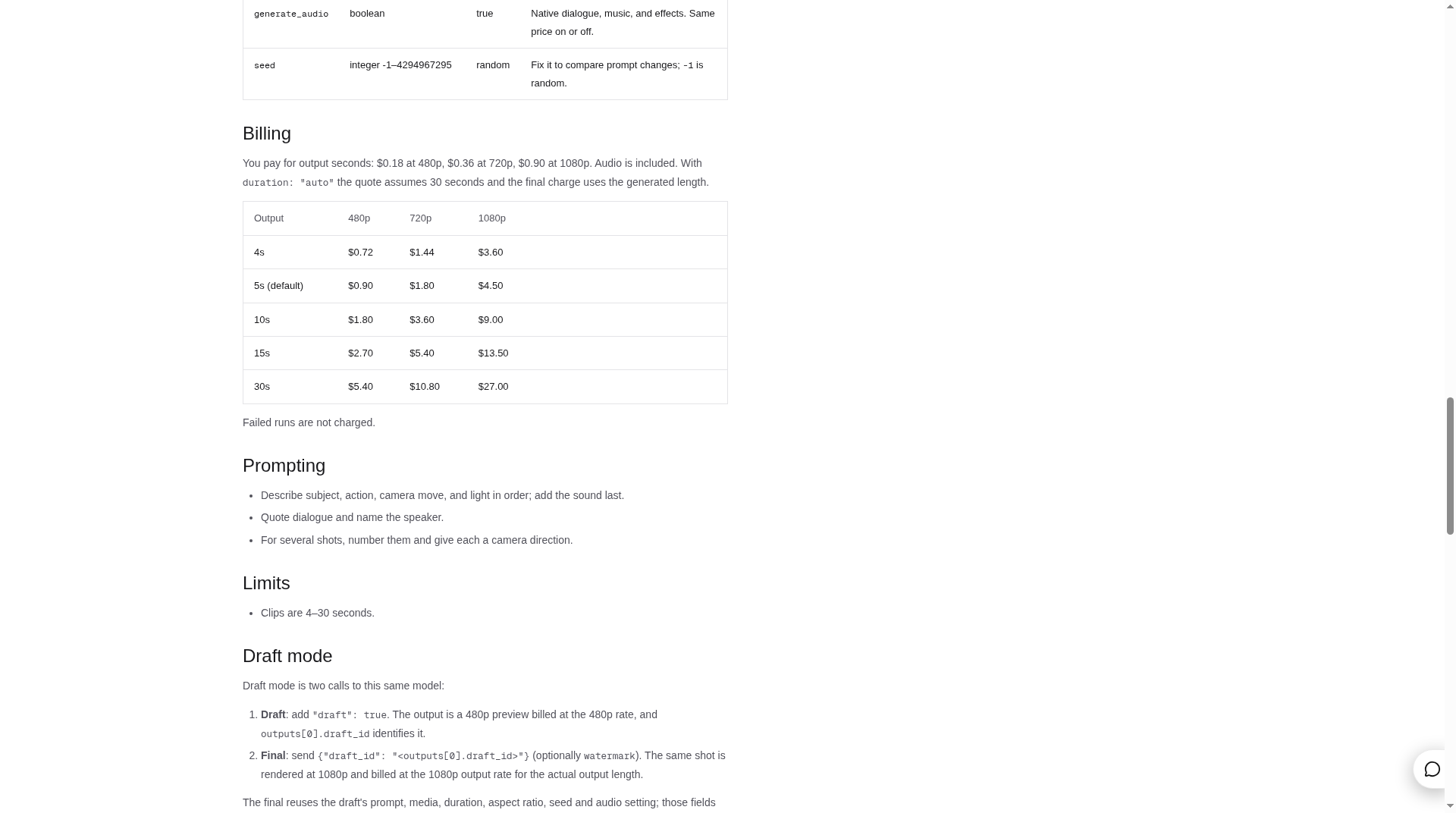
Seedance 2.5 Text to Video README Billing on the SandBase card, opened 27 November 2026, Asia/Shanghai. The billing sentence says you pay for output seconds: $0.18 at 480p, $0.36 at 720p, $0.90 at 1080p, and that audio is included. The 5-second default row is $1.80 at 720p and $4.50 at 1080p. The 4-second 720p list cell is $1.44. Failed runs are not charged. This crop does not show a 20% OFF badge.
Duration, including the auto branch
MAGI-2 duration is an integer, minimum 4, maximum 30, default 5. The help text says the output is billed per second. There is no auto. If the caller omits duration, the formula uses 5. Official Sand.ai duration is required on POST https://api.sand.ai/v2/generations. A 15-second MAGI-2 clip is 15 times 0.08, which is $1.20 on that expression. A 30-second clip is $2.40. The badge is 0.
Seedance duration accepts the integers 4 through 30 and the string auto, default 5. The field description says auto is pre-authorized at 30 seconds and billed on the actual output length. The Billing sentence says the quote assumes 30 seconds and the final charge uses the generated length. A caller who sends auto should budget the 30-second pre-authorization at the resolution they actually set, then expect settlement on the generated length. That pre-authorization is a catalog sentence. This page did not watch a hold and a capture on an account.
A 15-second Seedance clip at 1080p is a different list row from the Offer: 15 times 0.90 is $13.50 list, badge 20, Offer still 1.44. A 2-second floor is a Wan fact, not a Seedance fact; Seedance’s short end is 4, the same as MAGI-2. Pairwise duration against Wan and Kling is already MAGI-2 vs Wan 3.0 and MAGI-2 vs Kling V4. Floors and ceilings across five cards are video clip length.
Official tokens stay in their own column
BytePlus, fetched the same day from the official model-pricing markdown, states that token prices are USD per million tokens, and that video price is token rate times token consumption. Consumption, on that page, depends on input duration, output duration, width, height, and frame rate. For online inference, dreamina-seedance-2-5-260628 is listed at $10.70 for 480p and 720p, $11.7 for 1080p, and $4.7 for 4K when the input has no video. With video input the same row is $6.40, $7.0, and $2.9. The 4K token rate is lower than the 1080p token rate on that table. Token consumption still depends on resolution, so a lower rate is not a lower bill. This page does not multiply the rate by the published consumption formula to invent a per-second price.
The same official page has a “Billing examples” section. For Dreamina Seedance 2.5, 5 seconds, 16:9, input without video, the 1080p example is $2.843 per video / $0.569 per second. Those figures are official estimates. They are not the SandBase $0.90/s list, they are not 20% off $0.90, and they are not a number this guide derived. Quote $11.7 and $7.0 per million tokens, or quote the official example as an official example, or quote the SandBase per-second formula, and label which document you are in.
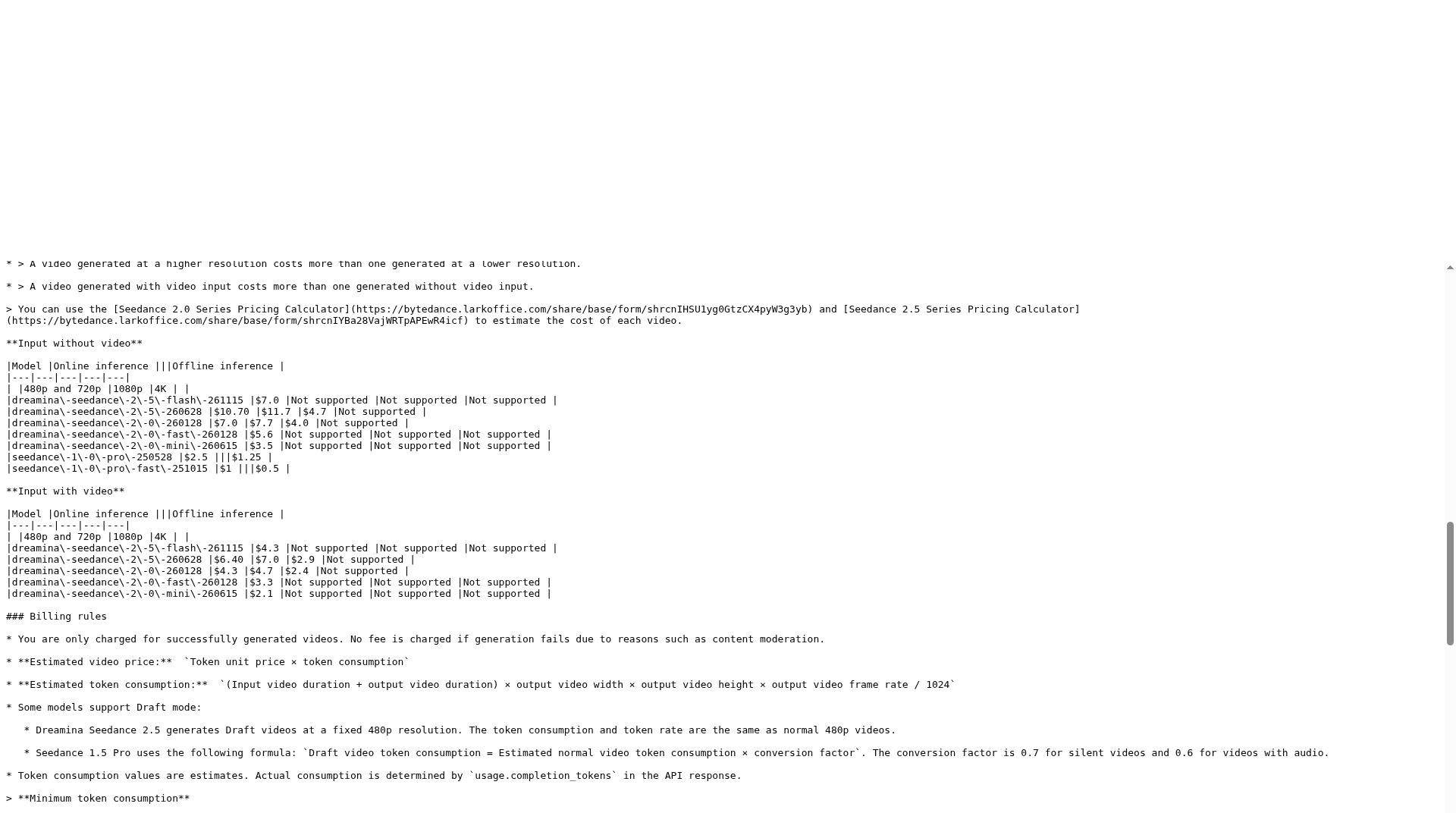
BytePlus ModelArk pricing markdown, video-generation token tables, opened 27 November 2026, Asia/Shanghai. The crop shows dreamina-seedance-2-5-260628 online 1080p cells of $11.7 without video input and $7.0 with video input. The phrase “USD per million tokens” is not in this crop. Official billing-example cells such as $2.843 / $0.569 are not in this crop. This frame is not a SandBase per-second rate.
SandBase does not use that token formula on the card. The card’s own formula is in dollars per second. Reference video on the Seedance reference card changes the coefficient and adds input seconds — without videos, 1080p stays 0.90 per output second; with videos, the 1080p list coefficient becomes 0.55 and input seconds (at least 2, at most 30) are added. That is a SandBase formula fact, not a conversion of the $7.0 token rate. The cap and billing note is reference-to-video APIs. This comparison does not reprint that table.
Draft mode is two Seedance calls
Seedance draft mode is a second bill, not a discount badge, and it lives on the 2.5 card itself. The README heading “Draft mode” says it is two calls to this same model. Step one: add "draft": true. The output is a 480p preview billed at the 480p rate, and outputs[0].draft_id identifies it. Step two: send {"draft_id": "<outputs[0].draft_id>"}. The same shot is rendered at 1080p and billed at the 1080p output rate for the actual output length. A draft can be finalized within 7 days, only with the model that created it. The final reuses the draft’s prompt, media, duration, aspect ratio, seed, and audio setting; those fields are ignored when draft_id is set.
The playground labels match that README: “Draft Mode (480p)” and “Draft ID.” The T2V/I2V formula’s final branch is Math.round(usage.duration ?? 30.0) * 0.90 once a draft_id is present. That 0.90 is the 1080p list coefficient. The 20% badge is still separate. Official BytePlus says Dreamina Seedance 2.5 draft videos are fixed at 480p and use the 480p token rate. This page does not turn that official token rate into dollars per second either.
MAGI-2 has no draft or draft_id field on the cards checked today. A MAGI-2 1080p second is the only second on that formula, badge 0. If you want a cheaper preview path on Seedance, draft mode is the 2.5 card, not Flash, for a 1080p final.
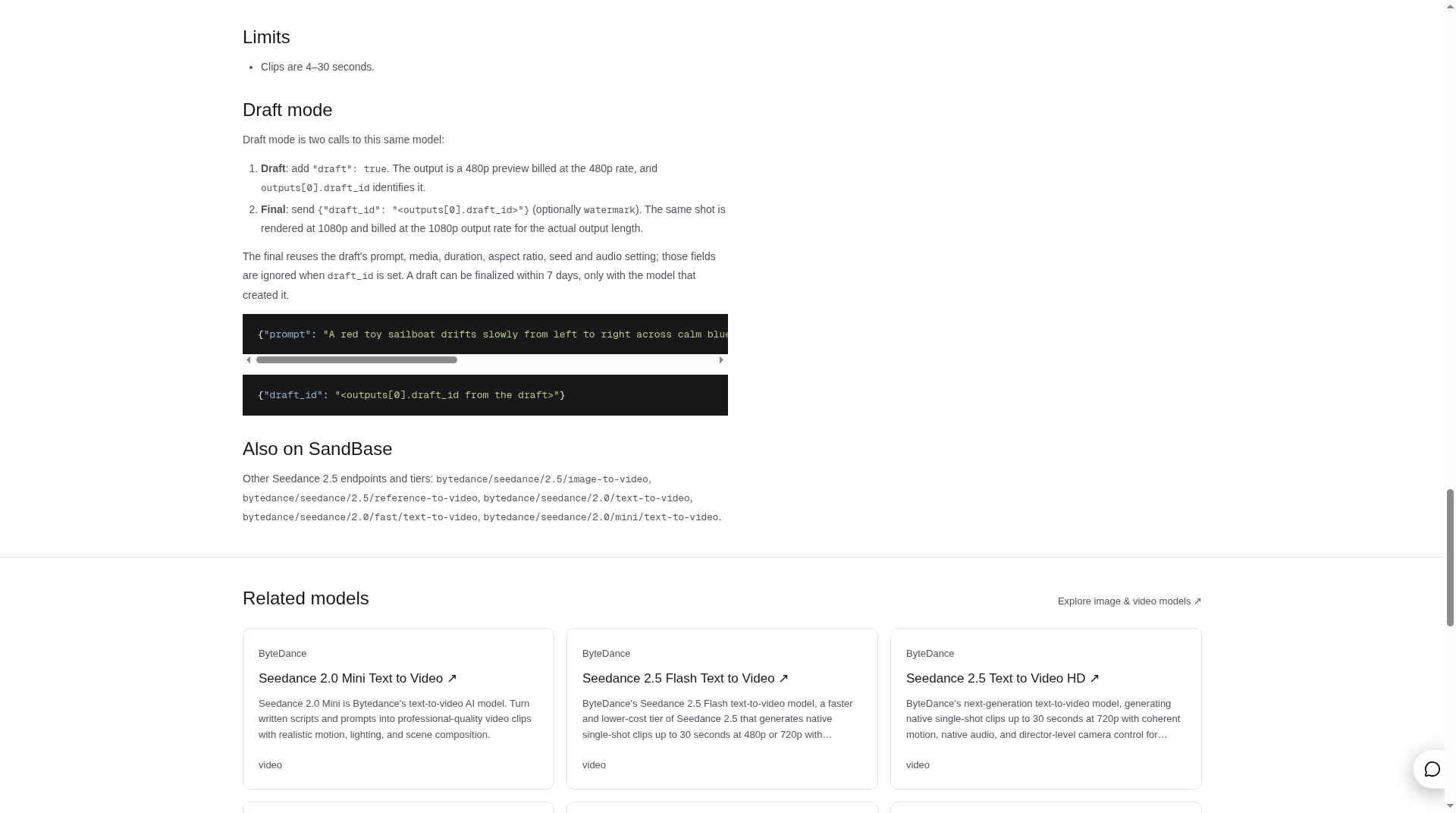
Seedance 2.5 Text to Video README, Draft mode section, opened 27 November 2026, Asia/Shanghai. The heading says draft mode is two calls to this same model. A draft with “draft”: true is a 480p preview billed at the 480p rate. The final with draft_id is rendered at 1080p and billed at the 1080p output rate for the actual output length. The visible sentence says a draft can be finalized within 7 days, only with the model that created it.
Flash is not a 1080p substitute
Seedance 2.5 Flash text-to-video is a live sibling, HTTP 200, badge 20 % OFF, Offer 0.96. Its resolution enum is 480p and 720p only. Billing is “$0.12 at 480p, $0.24 at 720p.” Limits say: “Output is 480p or 720p. For 1080p or draft mode, use bytedance/seedance/2.5/text-to-video.” Official BytePlus marks 1080p and 4K as “Not supported” for dreamina-seedance-2-5-flash-261115. Do not use Flash 720p rates as 1080p evidence. The already-published notes are Seedance 2.5 Flash on SandBase and Flash vs Seedance 2.5. This page does not remake them.
When the list row, not the brand, decides
Choose the MAGI-2 card when delivery is 1080p, length is between 4 and 30 seconds, and you do not need draft mode or a 720p default. The list expression is $0.08 per output second, the badge is 0, and Sand.ai’s own row prints 0.08 USD/s. A 10-second clip is $0.80 on that expression. Call sandai/magi-2/text-to-video for a prompt, sandai/magi-2/image-to-video when a first frame is required, or sandai/magi-2/reference-to-video when the arrays are the input. First and last frames on the image card are image-to-video APIs.
Choose Seedance 2.5 when you need 480p or 720p, auto, or a 480p draft plus a 1080p final on the same model, and you will keep $0.90 list, the 20% badge, and the official token column side by side. Open the Seedance 2.5 text-to-video card so the default 720p Offer is visible next to the 1080p list row. If the request includes reference video, read the reference card before you assume the 0.90 coefficient still applies. The cost model explainer is the vocabulary for list, discount, and per-second billing. It is not a substitute for these two formulas, and it is not a token converter.
Leave both cards when you need a published quality score, a latency budget, or a 4K master on SandBase. This comparison did not run either model. Official 4K token cells are not a SandBase 4K enum. Veo’s duration lock and audio split are a different pairwise note, MAGI-2 vs Veo 3.1.
FAQ
Is Seedance’s 1080p second $1.44, $0.90, $0.569, or $11.7?
They are four different columns. $0.90 is the SandBase list coefficient per output second at 1080p, with no reference video. $1.44 is the JSON-LD Offer for the default 5-second 720p row after the 20% badge (and, coincidentally, the 4-second 720p list cell). $11.7 is the official online token rate per million tokens at 1080p without video input. $0.569 per second is an official BytePlus billing-example estimate for a 5-second 16:9 clip, not a SandBase rate. This page does not pick one number and retire the others.
Does the 20% badge change Seedance’s 1080p coefficient to $0.72?
The card does not say that. publicDiscountPercent is 20. The list coefficients are 0.18, 0.36, and 0.90. The Offer applies the badge language to the default 720p quote. A 1080p total after the badge is not printed as its own per-second rate here, so this page does not invent one.
Can I convert $11.7 per million tokens into a SandBase $/s myself?
Not in this guide. The vendor page tells you to multiply the token rate by token consumption, and consumption depends on width, height, frame rate, and duration. Doing that multiplication here would be a conversion. Quote the token rate, or quote the official example as an official example, or quote the SandBase formula, and label the document.
Is draft mode the same thing as Flash?
No. Draft mode is two calls on bytedance/seedance/2.5/text-to-video (or the image/reference siblings that expose the same fields). Flash is a different id, 480p or 720p only, and its Limits line sends 1080p and draft mode back to the 2.5 text card. MAGI-2 has neither draft nor Flash.
Were any clips generated for this page?
No. Latency, failure rate, and the settled charge on a real account were not measured. MAGI-2 Billing now says failed runs are not billed. Seedance’s README says failed runs are not charged.
What to open next
Price a 1080p MAGI-2 clip as output seconds times $0.08, badge 0, on the text-to-video card. Price a Seedance 1080p clip from the 0.90 list coefficient, keep the 20% badge in its own cell, and quote BytePlus only in dollars per million tokens — or, if you cite the official $0.569 example, label it as an official estimate. The launch note’s field list is still the right companion if you are about to build the request body: MAGI-2 on SandBase.
SandBase cards, Sand.ai pricing, and BytePlus ModelArk pricing checked 27 November 2026, Asia/Shanghai. No generation was run. This page has no quality score.
Related reading
- MAGI-2 on SandBase: 1080p, $0.08 per second, three model IDs
- 1080p video API pricing, unscored
- MAGI-2 vs Wan 3.0
- MAGI-2 vs Kling V4
- MAGI-2 vs Veo 3.1
- Image-to-video first and last frames
- Which 1080p APIs can do 15 or 30 seconds
- Reference-to-video caps and billing
- How video generation cost is modeled
Found this useful? Share it