Image-to-Video APIs in 2026: First and Last Frames on MAGI-2, Wan, Kling, Seedance, Veo
Unscored 2026 image-to-video request shapes: first and last frames on MAGI-2, Wan 3.0, Kling V4, Seedance 2.5, and Veo 3.1. Not a price table.
The surprise on an image-to-video card is often not the 1080p coefficient. It is which image is required, whether a last frame is allowed on the same id, and whether last-frame control is a different card altogether. On 27 November 2026, Asia/Shanghai, MAGI-2, Wan 3.0, Kling V4, and Seedance 2.5 all put an optional last frame on the same image-to-video card as the required first frame. Veo 3.1 does not. Its image-to-video card accepts one image. First and last frames are a separate, required-both card at the same 1080p rates.
This is a request-shape note. It is not a remake of the 1080p price sheet, which is built around list coefficients, and it is not a remake of reference-to-video caps, which is about reference videos and audio refs. List rates on these image cards match each family’s text-to-video list rates. The five-model arithmetic stays on the pricing post. There is no quality ranking and no generation was run.
Key takeaway
- MAGI-2
sandai/magi-2/image-to-video: requiredimage(First Frame, under 30 MB). Optionalend_image(Last Frame) on the same card. Prompt is optional. 1080p only, duration 4–30, default 5, $0.08 per output second, audio included, badge 0. JSON-LD Offer 0.4 USD per run.- Wan 3.0
alibaba/wan/3.0/image-to-video: required prompt and first-frameimage.end_imageis the last frame and “needsimage.” “The frame images are free.” 1080p list $0.20/s, badge 40 % OFF, Offer 0.3 (a 5-second 720p quote after the badge). Duration 2–30 orauto.- Kling V4
kwaivgi/kling-video/v4/image-to-video: required prompt and startimage. Optionalend_image. Duration 3–30, default resolution 1080p, 1080p list $0.235/s, 4K available, HDR adder $0.047/s at 1080p. Badge 15 % OFF. Offer 0.99875. README 5s 1080p list cell $1.175.- Seedance 2.5
bytedance/seedance/2.5/image-to-video: required prompt and startingimage. Optional last frame. Duration 4–30 orauto. 1080p list $0.90/s, badge 20 % OFF, Offer 1.44 (5-second 720p after the badge). Draft mode is on this same card. Flash is not a 1080p I2V peer.- Veo 3.1
google/veo3.1/image-to-video: one required first-frame image; no last-frame field. Limits: “One input image; use first-last-frame-to-video to control the ending.” The siblinggoogle/veo3.1/first-last-frame-to-videorequires both frames. Both cards: duration 4/6/8, 1080p $0.40/s with audio, $0.20 without, Offer 3.2.- MiniMax H3 is in the catalog but has no 1080p (768P / 2K only) and is omitted here. Omni Flash 1.2 I2V is a live sibling with an optional end image and a 10-second cap when that end image is set; it is not a sixth row in the table below.
Same list rates as text-to-video, different required inputs
Each image-to-video card below uses the same 1080p list coefficient as that family’s text-to-video card. MAGI-2 is still $0.08 per output second. Wan is still $0.20. Kling is still $0.235, plus the HDR adder if you set it. Seedance is still $0.90 when there is no reference video. Veo is still $0.40 with audio and $0.20 without. Badges and Offers stay in their own cells, exactly as in the pricing post. What changes is the payload: a required image, and whether a last frame belongs on this id.
Open the MAGI-2 image-to-video card when the first frame is the input you actually have. The schema required array is ["image"], not prompt. The short sample on a text card will not satisfy this one.
MAGI-2: required first frame, optional last frame, same card
Fields on MAGI-2 image-to-video: image is required, titled First Frame, “upload or public HTTPS URL,” JPEG, PNG, WebP, BMP, TIFF, GIF or HEIC, under 30 MB. end_image is titled Last Frame and described as “Optional last frame (upload or public HTTPS URL).” prompt is optional: “Optional. Describe the motion and sound.” Duration is an integer from 4 to 30, default 5, billed per second. Resolution is 1080p only. generate_audio defaults to true and is included in the price. The formula is still (params.duration ?? 5) * 0.08. Badge 0. JSON-LD Offer 0.4. Billing now says failed runs are not billed.
A last frame on MAGI-2 is a field on this id, not a second product. Leaving end_image empty is allowed. Putting a last frame on the text-to-video id is the wrong card. Putting reference videos here is also the wrong card; that payload belongs on reference-to-video.
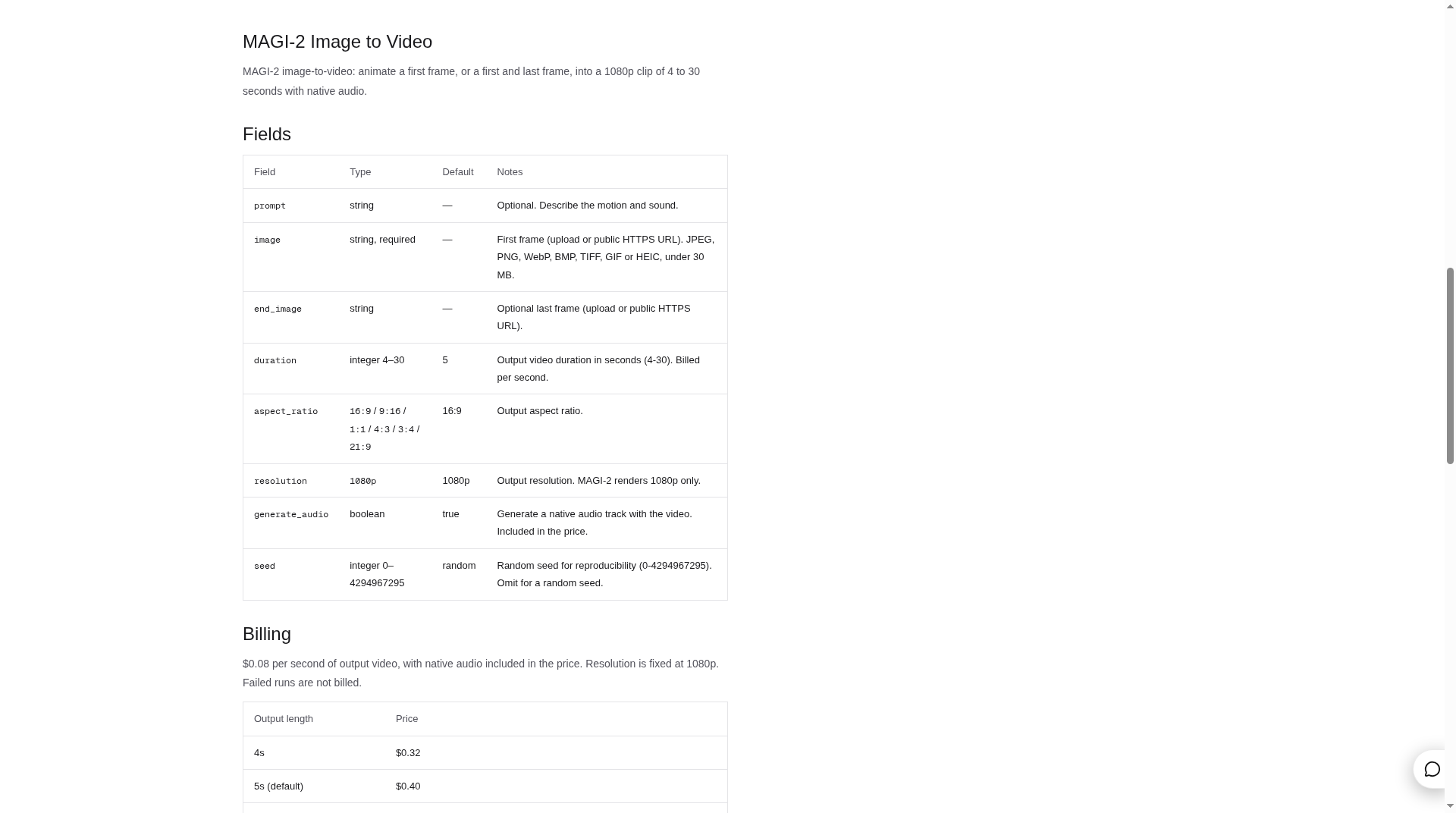
MAGI-2 Image to Video Fields on the SandBase card, opened 27 November 2026, Asia/Shanghai. The image row is required; the notes say first frame, under 30 MB. The end_image notes say optional last frame. prompt is optional. Duration is an integer 4–30, default 5, billed per second. Resolution is 1080p only. generate_audio is included in the price.
Wan 3.0: first frame required, last frame needs the first, frames are free
Wan’s id is alibaba/wan/3.0/image-to-video. Prompt is required, up to 5,000 characters. image is required, “First frame,” JPEG/PNG/BMP/WebP, with a side-length and 20 MB note on the Fields table. end_image is “Last frame; needs image.” It is not a required field. Duration is 2–30 or auto, default 5. Resolution is 480p / 720p / 1080p, default 720p. Badge 40 % OFF. JSON-LD Offer 0.3, the default 5-second 720p quote after the badge, not a 1080p quote. Billing: “You pay for output seconds only: $0.05 at 480p, $0.10 at 720p, $0.20 at 1080p. Input images, audio, and video are not metered. The frame images are free.” auto is pre-authorized at 30 seconds. Failed runs are not charged. Limits: “Reference images, videos, and audio are not accepted here; use reference-to-video instead.”
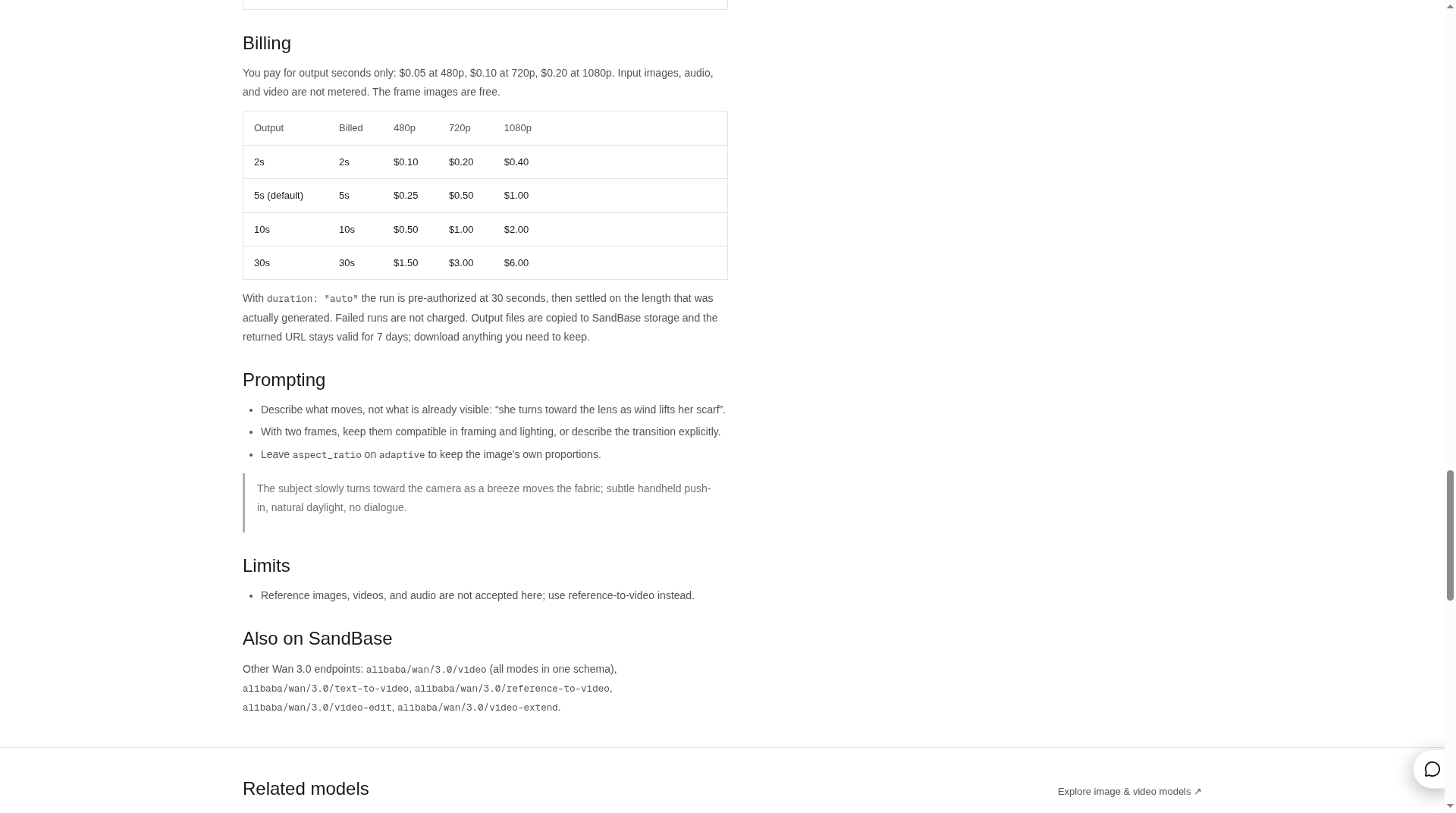
Wan 3.0 Image to Video Billing, opened 27 November 2026, Asia/Shanghai. The sentence says you pay for output seconds only at $0.05, $0.10, and $0.20, that input images are not metered, and that the frame images are free. The 5-second default 1080p list cell is $1.00. This crop does not show a 40% OFF badge.
Open the Wan 3.0 image-to-video card when the job is a first frame, optionally a last frame, and you have chosen 1080p on purpose. The sample default is still 720p.
Kling V4: required start, optional end, default is already 1080p
Kling’s id is kwaivgi/kling-video/v4/image-to-video. Prompt is required, up to 2,500 characters. image is required, titled Start Image / “First frame,” minimum 300×300, aspect ratio 0.4–2.5, up to 30 MB. end_image is “Optional last frame.” Duration is 3–30, default 5. Resolution is 720p / 1080p / 4k, default 1080p. HDR is a separate field, 1080p and 4k only, adding $0.047 per output second at 1080p. Billing matches the text card: $0.157 / $0.235 / $0.549, 5s 1080p default list $1.175, badge 15 % OFF, Offer 0.99875. Failed runs are not charged.
A last frame does not move you onto the reference card. Reference videos do; that meter is the R2V post. Pairwise 1080p context is MAGI-2 vs Kling V4. Official Kling markdown was not re-fetched in this writing pass; the official ($0.235)/s cell stays on the live pricing and vs Kling posts.
Seedance 2.5: optional last frame, plus draft mode on the same I2V card
Seedance’s id is bytedance/seedance/2.5/image-to-video. Prompt is required. image is required, “First frame. JPEG, PNG, or WebP URL.” end_image is “Optional last frame.” Duration is 4–30 or auto, default 5. Resolution is 480p / 720p / 1080p, default 720p, no 4K on the SandBase enum. 1080p list is $0.90 per output second, audio included, “same price on or off.” Badge 20 % OFF. Offer 1.44, the 5-second 720p quote after the badge. The 5-second 1080p list cell is $4.50.
Draft mode is on this image card, not only on text-to-video: "draft": true is a 480p preview billed at the 480p rate; a later draft_id renders at 1080p and is billed at the 1080p output rate for the actual output length, inside 7 days. MAGI-2 I2V has no draft field. Flash remains 480p/720p only; official 1080p for Flash is “Not supported,” so Flash is omitted from 1080p I2V claims. Details sit in MAGI-2 vs Seedance 2.5 and the existing Flash posts.
Veo 3.1: one image on this card, both frames on another
Veo’s image-to-video id is google/veo3.1/image-to-video. Prompt is required. image is required, “First frame. JPEG, PNG, or WebP URL.” There is no end_image field on this card. Limits say, exactly: “One input image; use first-last-frame-to-video to control the ending.” Duration is 4, 6, or 8, default 8. 1080p list is $0.40/s with audio and $0.20 without, badge 0, Offer 3.2. Failed runs are not charged. Official Gemini API Preview ids were shut down on 22 October 2026; the SandBase card still returns HTTP 200. Completion was not tested. That official context is MAGI-2 vs Veo 3.1.
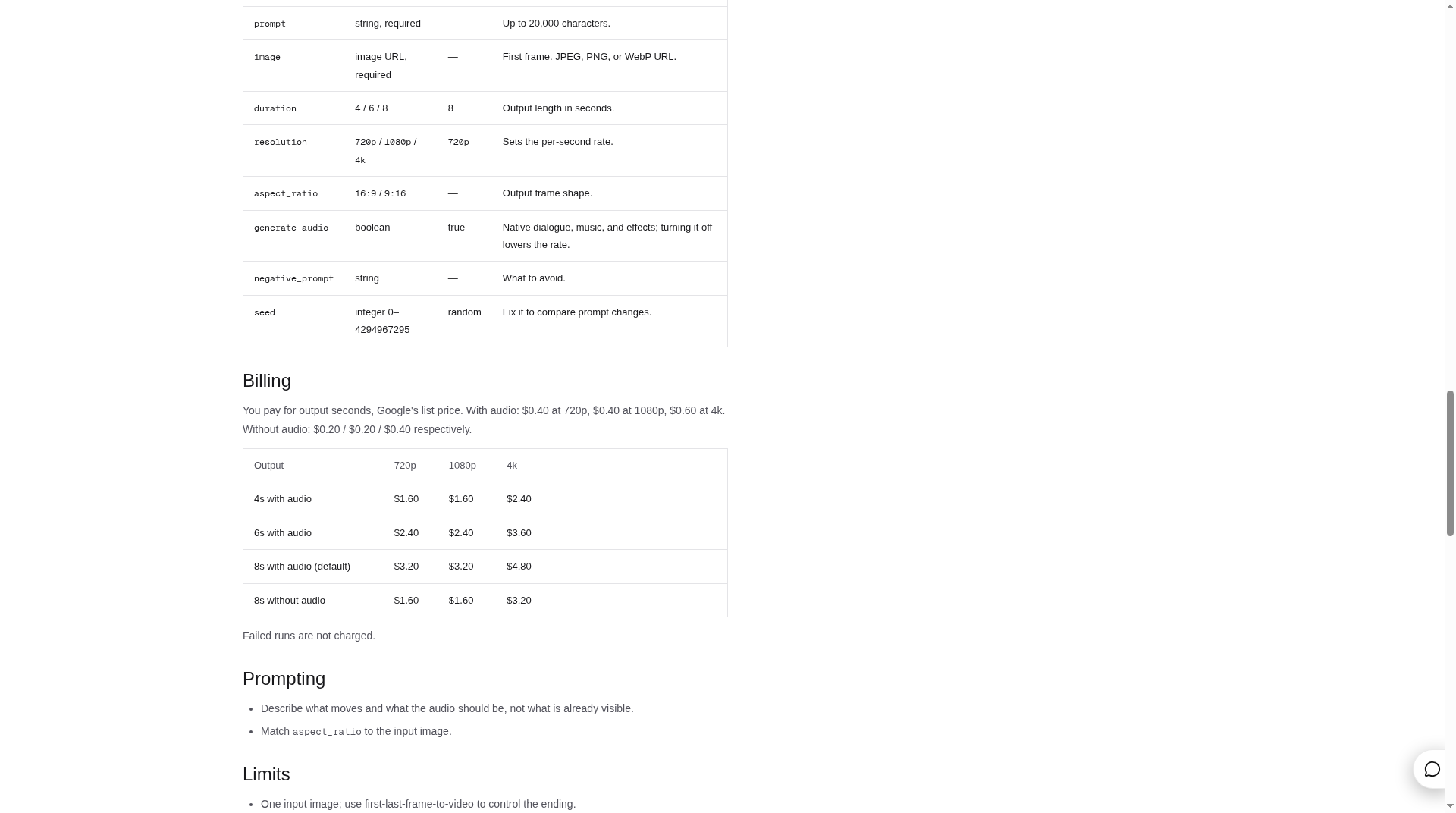
Veo 3.1 Image to Video field rows and Limits, opened 27 November 2026, Asia/Shanghai. image is required and described as the first frame. There is no end_image row in this table. Limits say: “One input image; use first-last-frame-to-video to control the ending.” Duration is 4 / 6 / 8, default 8.
The sibling id is google/veo3.1/first-last-frame-to-video. Fields: image required, first frame; end_image required, last frame. Limits: “Both frames are required.” Duration is still 4, 6, or 8. Rates and Offer match the image-to-video card. Do not collapse these two ids. An optional last frame on MAGI-2, Wan, Kling, or Seedance is not the same shape as Veo’s required-both card.
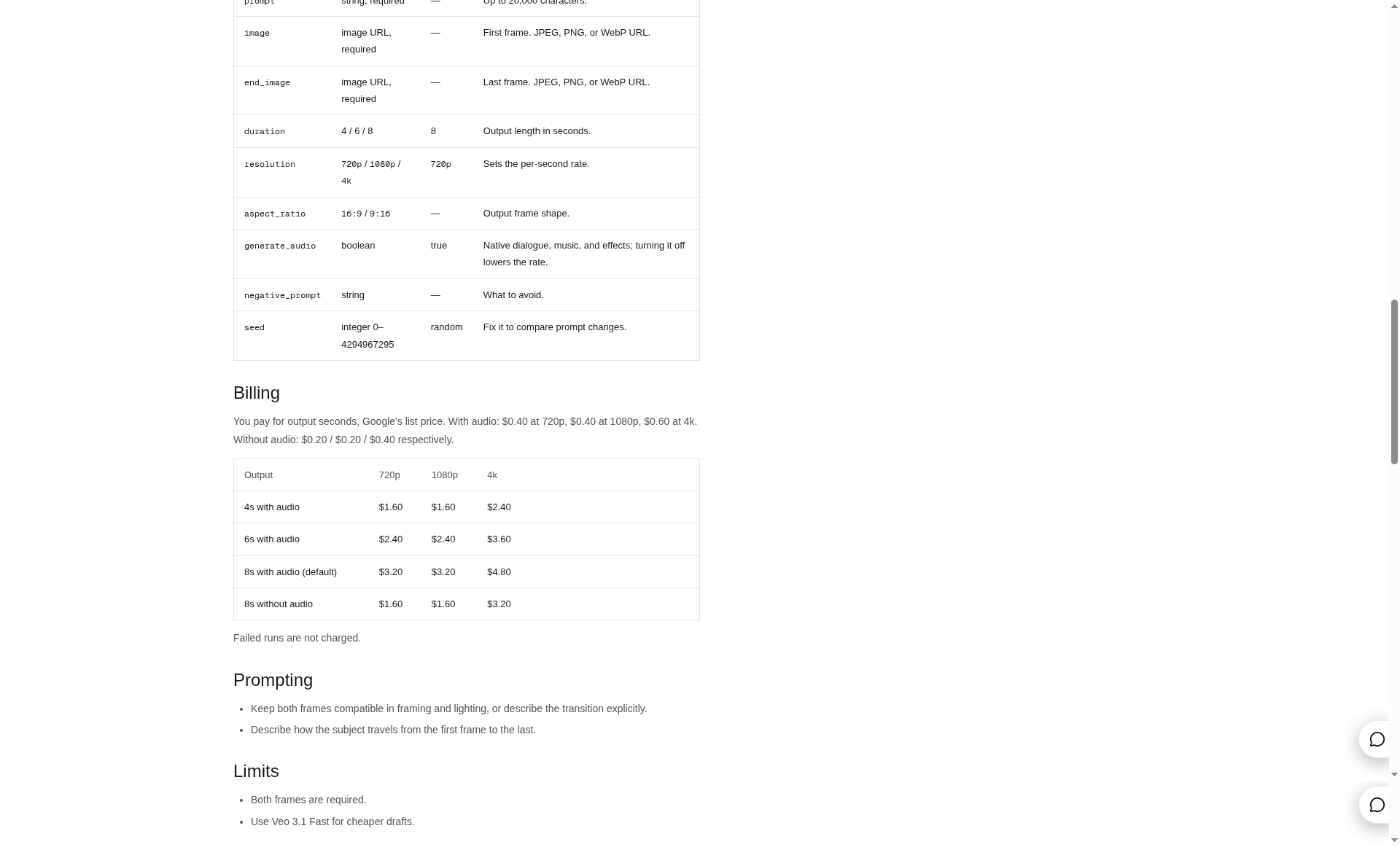
Veo 3.1 first-last-frame-to-video Fields and Limits, opened 27 November 2026, Asia/Shanghai. image is required as the first frame. end_image is required as the last frame. Limits say both frames are required. Duration is 4 / 6 / 8, default 8. This is a different SandBase id from image-to-video.
What this page is not, and one live sibling
This page is not a five-model T2V price matrix. Link 1080p video API pricing for coefficients, badges, and official units. It is not a reference-video caps essay; link reference-to-video APIs. It is not a quality ranking; best AI video generation APIs is a different article, and its scores are not reused here.
MiniMax H3 is in the catalog at HTTP 200, but its resolution enum is 768P / 2K only. It is omitted from 1080p I2V claims.
Gemini Omni Flash 1.2 image-to-video, id google/gemini-omni-flash/1.2/image-to-video, is a live public card this run (the older memo URL gemini-omni-1.2-flash is still 404). It requires a prompt and a first-frame image, allows an optional end image, and caps duration at 10 seconds when that end image is provided. List at 1080p is $0.105/s, duration otherwise 3–15. It is a sibling, not a sixth primary row, and not a MAGI-2 launch comparison. Length ceilings, including 15 versus 30, are video clip length.
| MAGI-2 | Wan 3.0 | Kling V4 | Seedance 2.5 | Veo 3.1 I2V | Veo 3.1 first-last | |
|---|---|---|---|---|---|---|
| Id | sandai/magi-2/image-to-video | alibaba/wan/3.0/image-to-video | kwaivgi/kling-video/v4/image-to-video | bytedance/seedance/2.5/image-to-video | google/veo3.1/image-to-video | google/veo3.1/first-last-frame-to-video |
| First frame | required image | required image | required image | required image | required image | required image |
| Last frame | optional end_image on this card | end_image, “needs image” | optional end_image | optional end_image | not on this card | required end_image |
| Prompt | optional | required | required | required | required | required |
| 1080p list | $0.08/s, audio included | $0.20/s, frames free | $0.235/s, plus HDR if set | $0.90/s | $0.40/s with audio, $0.20 without | same rates |
| Duration | 4–30 | 2–30 or auto | 3–30 | 4–30 or auto | 4 / 6 / 8 | 4 / 6 / 8 |
| Badge / Offer | 0 / 0.4 | 40 / 0.3 (720p default) | 15 / 0.99875 | 20 / 1.44 (720p default) | 0 / 3.2 | 0 / 3.2 |
Choose MAGI-2 I2V when the first frame is required, a last frame should stay optional on the same id, and the output is 1080p for 4 to 30 seconds at $0.08 list. Choose Wan when frames must be unmetered and you will keep the 40% badge beside the $0.20 list. Choose Kling when the default is already 1080p and an optional end image is enough. Choose Seedance when you also want draft mode on the I2V card, and you will not treat the $1.44 Offer as a 1080p quote. Choose Veo I2V for a single starting image at 4, 6, or 8 seconds; choose the first-last card when both frames are the point of the request.
FAQ
Is a last frame the same thing as a reference image?
No. A last frame (end_image) is an ending still on an image-to-video (or Veo first-last) card. Reference images belong on the reference-to-video ids, with different caps and, on Wan, Kling, and Seedance, different meters. MAGI-2’s reference formula still does not bill reference length.
If I turn MAGI-2 audio off, does the I2V bill change?
The field says a native audio track is included in the price. The formula has no audio term. This check did not find a cheaper false rate. Veo’s I2V and first-last cards do lower the rate when audio is off.
Can I send Veo a last frame on google/veo3.1/image-to-video?
The Limits line says no: one input image, and first-last-frame-to-video is the card that controls the ending. Both frames are required on that second id.
Is Seedance 2.5 Flash a 1080p image-to-video option?
Not on the cards and official table checked today. Flash output is 480p or 720p, and official 1080p is “Not supported.” Use the 2.5 image card for 1080p I2V, including draft mode.
Were any clips generated?
No. Acceptance of a URL, latency, and the settled charge after a badge were not measured.
What to open
Start with the first frame you actually have, then pick the card whose last-frame rule matches the request. For a required start image, an optional last frame, and a 1080p-only 4–30 second output, that is the MAGI-2 image-to-video card, id sandai/magi-2/image-to-video. The field list for the MAGI-2 family remains the launch note.
SandBase image-to-video and first-last-frame cards checked 27 November 2026, Asia/Shanghai. No generation was run. No model is ranked.
Related reading
Found this useful? Share it