MAGI-2 vs Kling V4: 1080p Rates, Clip Length, and Reference Rules
MAGI-2 vs Kling V4 on 26 Nov 2026: 1080p list rates, 4-30 vs 3-30 seconds, reference-video rules, and a 15% badge kept separate.
Kling’s default is already 1080p, and the hero still does not equal the README row under that default. On 26 November 2026, Asia/Shanghai, the SandBase Kling V4 text-to-video card prints From $1 per run (15% off list price). The README’s default row is 5 seconds at 1080p for $1.175. The payload formula uses 0.235 per output second at 1080p, and 5 times 0.235 is 1.175. publicDiscountPercent is 15. base_price is 1.175. MAGI-2, checked the same morning, has no second resolution and no badge: formula (params.duration ?? 5) * 0.08, hero From $0.40, publicDiscountPercent 0.
This comparison is those rates, the clip-length enums, and the reference-video rules. It is not a quality or latency bake-off. The MAGI-2 ids and request shape are in the launch note. Wan’s 1080p coefficient, which is a third list rate, is in MAGI-2 vs Wan 3.0.
Key takeaway
- MAGI-2 text, image, and reference cards: 1080p only, duration integer 4 to 30, default 5. List formula $0.08 per output second. Badge 0. Hero From $0.40. Reference assets are not in the formula. Sand.ai’s pricing page:
magi-2, 1080p, 0.08 USD/s.- Kling V4 text-to-video id
kwaivgi/kling-video/v4/text-to-video: resolutions720p,1080p, and4k, default1080p. Duration integer 3 to 30, default 5. List formula $0.157 at 720p, $0.235 at 1080p, $0.549 at 4K, per output second. HDR adds $0.047 per output second at 1080p and $0.078 at 4K. Badge 15. Hero From $1 per run (15% off list price).- With reference videos, Kling’s formula switches to $0.141 per second at 1080p of output plus input, and the input side counts at least as long as the output. If the reference length cannot be read, the quote assumes 30 seconds. MAGI-2 does not switch.
- Kling’s official pricing markdown, fetched the same day, prints 1.5 Units ($0.235)/s at 1080p with no input video. That vendor cell matches the SandBase list coefficient. It does not include SandBase’s 15% badge.
- No generation was run. Both READMEs that state a failure rule are quoted below. MAGI-2’s cards do not state one.
1080p is the default on one card and the only choice on the other
Open the MAGI-2 text-to-video card if the delivery file is 1080p and you do not want a resolution branch. The enum is 1080p. Duration help says 4 to 30 seconds, billed per second. A 5-second default is $0.40. A 10-second clip is $0.80. A 30-second clip is $2.40. A 4-second clip, the short end, is $0.32. The badge is 0, so the formula products are the list figures. They are not a captured invoice.
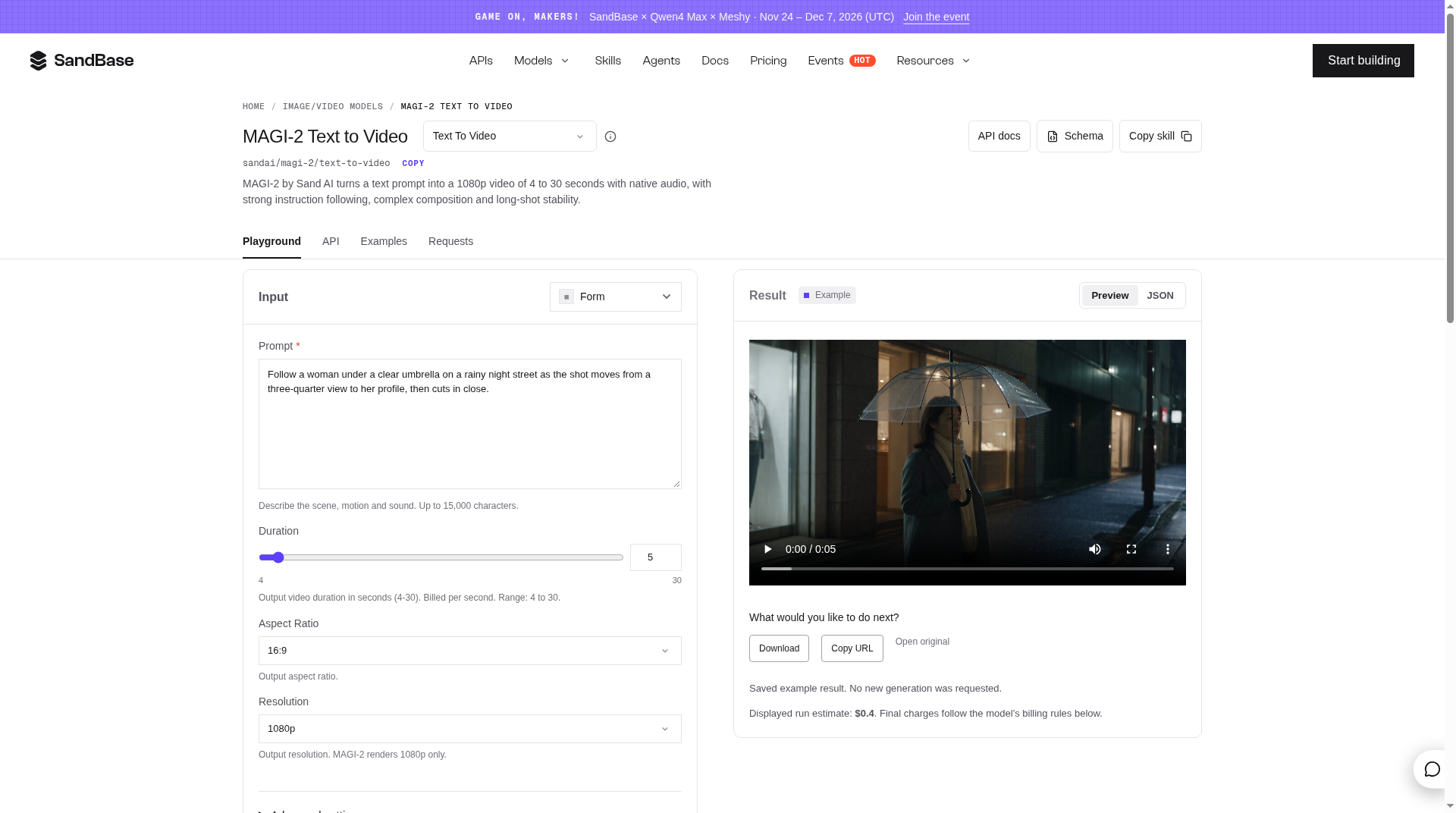
SandBase playground for sandai/magi-2/text-to-video, opened 26 November 2026, Asia/Shanghai. Duration is set to 5. The help text says billed per second, range 4 to 30. Resolution is 1080p, and the help says MAGI-2 renders 1080p only. The result note says “Saved example result. No new generation was requested.” and “Displayed run estimate: $0.4.”
Kling’s text card defaults resolution to 1080p and duration to 5. The list row for that pair is $1.175 in the README. Ten seconds at 1080p is $2.35 list. Thirty seconds at 1080p is $7.05 list. The 720p list rate is $0.157, so 5 seconds is $0.785. The 4K list rate is $0.549, so 5 seconds is $2.745. HDR is a separate adder on output seconds only, and the schema says HDR is for 1080p and 4K. MAGI-2’s schema has no dynamic_range field. Do not send hdr to a MAGI-2 id and expect a documented surcharge or a documented discount. The field is not there.
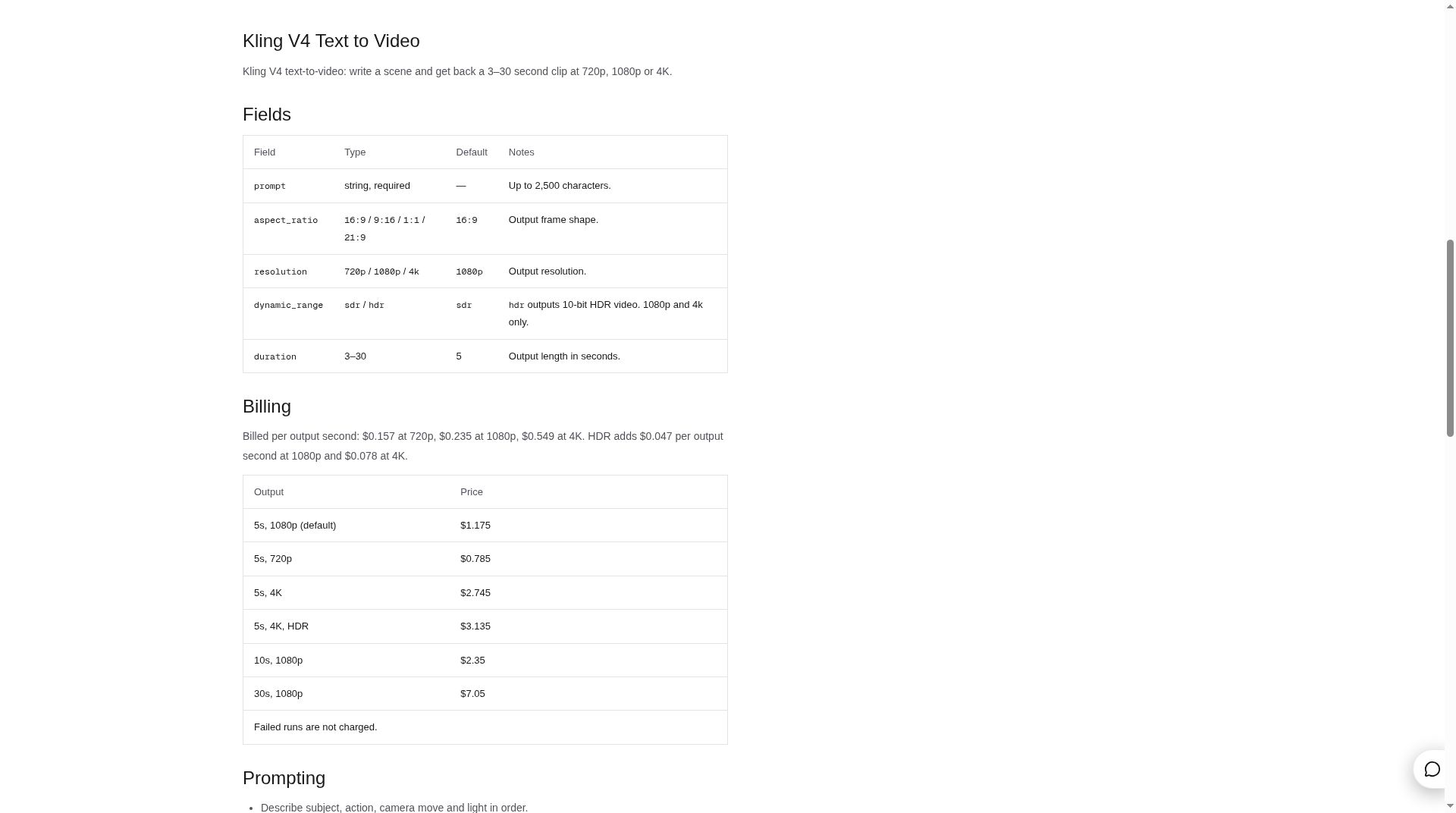
Kling V4 Text to Video README on the SandBase card, opened 26 November 2026, Asia/Shanghai. Billing text: $0.157 at 720p, $0.235 at 1080p, $0.549 at 4K. HDR adds $0.047 per output second at 1080p and $0.078 at 4K. The default row is 5s, 1080p, $1.175. Duration is 3-30, default 5. The crop says failed runs are not charged. No discount badge is in the frame.
The hero “From $1” lines up with the badge applied to the $1.175 default, in the sense that 15% off $1.175 is $0.99875, and the facts line prints $1. This page does not invent a discounted per-second rate of $0.19975. The formula coefficient stays 0.235. The badge stays 15. A 10-second 1080p list row is $2.35. The card does not print that row after the badge, so this comparison does not either.
| MAGI-2 | Kling V4 text to video | |
|---|---|---|
| SandBase id | sandai/magi-2/text-to-video | kwaivgi/kling-video/v4/text-to-video |
| 1080p list coefficient | 0.08, only tier | 0.235 per output second |
| Other list tiers | none | 0.157 at 720p, 0.549 at 4K |
| HDR | no field | plus 0.047/s at 1080p, plus 0.078/s at 4K |
| Duration | 4–30, default 5, no auto | 3–30, default 5 |
| Badge | 0 | 15 |
| Hero | From $0.40 per run | From $1 per run (15% off list price) |
| What the hero is | 5 times 0.08 | facts line for the default 5-second 1080p row, badge stated separately from the $1.175 list cell |
| Official vendor 1080p | Sand.ai 0.08 USD/s for magi-2 | Kling docs: 1.5 Units ($0.235)/s, no input video |
| Reference video | not in the MAGI-2 formula | switches rate and duration basis |
Kling’s README says failed runs are not charged. MAGI-2’s cards do not say. Leave MAGI-2 failure billing unknown. Aspect ratios differ too, and they do not change the formula on either card: MAGI-2 has six ratios including 4:3 and 3:4. Kling text-to-video has 16:9, 9:16, 1:1, and 21:9. Prompt caps are 15,000 characters on MAGI-2 text-to-video and 2,500 on Kling text-to-video. Those caps are schema text, not a quality claim.
Clip length is a one-second disagreement at the floor
MAGI-2 will not accept 3 seconds. The minimum is 4. Kling will not accept 2, and it will accept 3. Both accept 30. Neither card has auto on these two text endpoints. Wan does, which is why a three-way duration table belongs in the 1080p pricing guide rather than being repeated as if it changed the Kling math.
A 3-second Kling clip at 1080p is 3 times 0.235, list $0.705, before the 15% badge. There is no MAGI-2 cell next to it. A 4-second MAGI-2 clip is $0.32 on the formula. A 4-second Kling clip at 1080p is 4 times 0.235, list $0.94, badge still separate. Comparing $0.32 with $0.94 is a list-to-list comparison at different products. Comparing $0.32 with the Kling hero “From $1” mixes a 4-second MAGI-2 product with a 5-second discounted Kling quote. That mix is the mistake this page is here to stop.
Audio is included on MAGI-2. generate_audio defaults to true, and the description says the track is included in the price. The formula has no audio coefficient. Kling’s text schema checked here has no generate_audio switch. The official Kling page describes duration billing and an HDR adder. It does not, on the rows opened for this comparison, offer a silent 1080p discount. Do not plan a cheaper Kling clip by setting a flag the card does not list.
Reference rules change Kling’s bill and leave MAGI-2’s formula alone
MAGI-2 reference-to-video allows up to 10 images, 5 videos, and 5 audio clips. Video clips are 2 to 30 seconds each, 30 seconds combined, up to 200 MB. The price formula is still output seconds times 0.08. An 8-second reference clip does not add 8 seconds to that expression.
Kling reference-to-video, id kwaivgi/kling-video/v4/reference-to-video, keeps the no-video rates when videos is empty: $0.235 per output second at 1080p. When videos is non-empty, the 1080p coefficient becomes 0.141, and the duration basis is output seconds plus the greater of output seconds and the reference duration. Unreadable reference length falls back to 30 seconds. The README states that assumption in a sentence, and the formula encodes media_duration(params.videos) ?? 30.0. HDR, if set, is still added on output seconds only, at $0.047 for 1080p.
The README’s list example for 5 seconds of 1080p output plus 8 seconds of reference video is $1.833. That matches 0.141 times (5 + 8), because 8 is longer than 5. A 5-second 1080p clip with images only stays on the $1.175 list row. Images do not flip the rate. voice_ids, up to 2, are documented as not combinable with videos. The create-voice path is a different card. This comparison does not price voice creation.
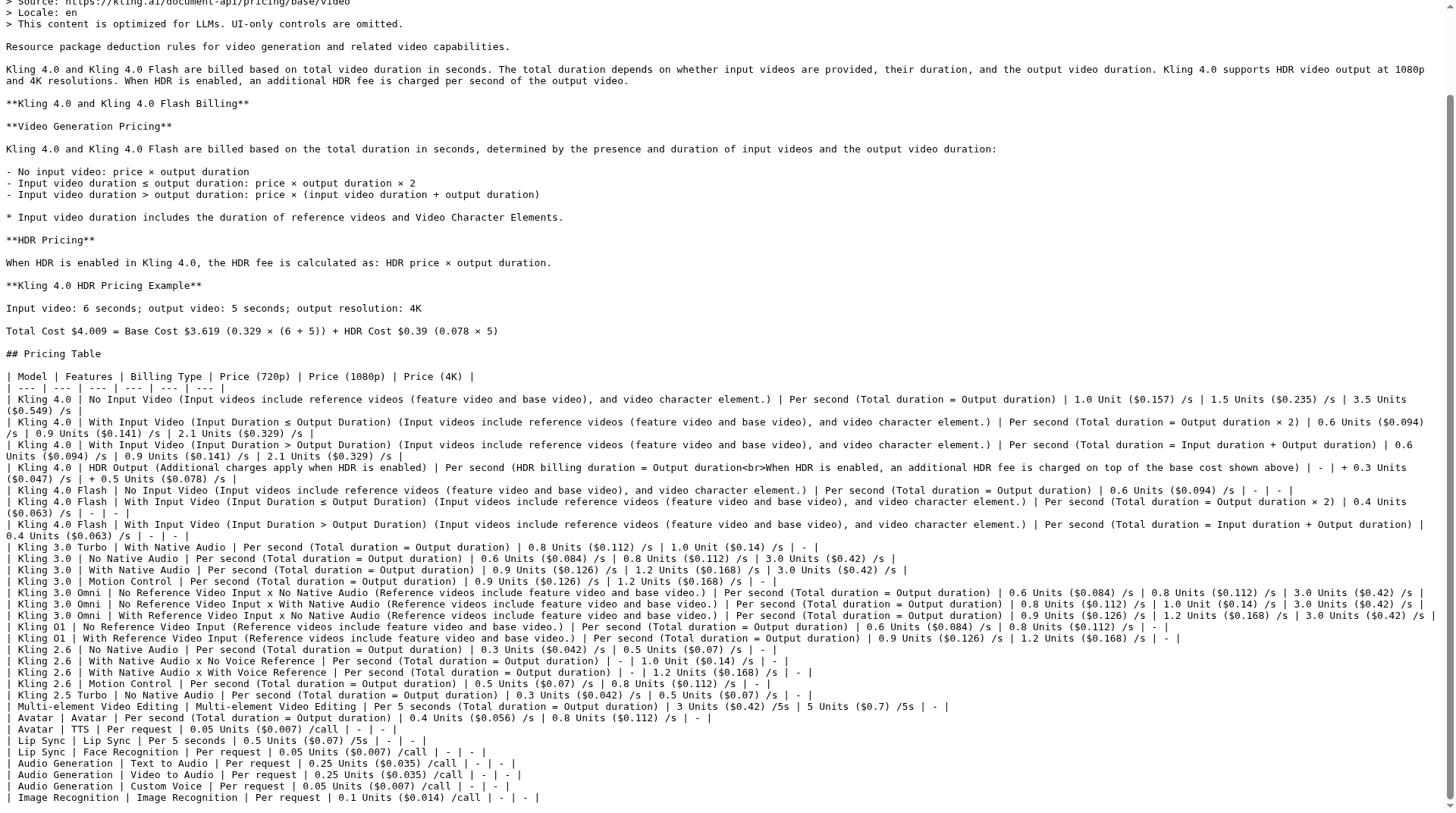
Kling API video pricing markdown, opened 26 November 2026, Asia/Shanghai. Kling 4.0 with no input video lists 1080p at 1.5 Units ($0.235)/s. With input video, 1080p is 0.9 Units ($0.141)/s. The same rows show 720p at $0.157 and $0.094, and 4K at $0.549 and $0.329.
Official Kling billing, same fetch, uses three cases. No input video: price times output duration. Input video duration less than or equal to output duration: price times output duration times 2, at the lower unit price. Input longer than output: price times (input plus output), at that same lower unit price. The 1080p no-input cell is $0.235 per second. The with-input 1080p cell is $0.141 per second. HDR adds $0.047 per output second at 1080p. Those dollar figures are in the official markdown, next to unit counts. They match the SandBase list coefficients. SandBase’s 15% badge is not on that vendor table. Keep it in the SandBase column.
The official page also counts “video character element” as input video. The SandBase reference schema’s videos field is what flips the formula this page read. This check did not confirm a separate character-element control on the SandBase card. If your bill depends on that official category, read the vendor page again before you assume the SandBase videos array is the only input the vendor would have counted.
Caps, briefly: Kling reference images up to 10, videos up to 5, each 3 to 30 seconds, 30 seconds combined. MAGI-2 videos are 2 to 30 seconds each. A 2-second reference clip fits MAGI-2’s video field and does not fit Kling’s “3 to 30 seconds” video note. The full cap table, including Wan and Seedance, is reference-to-video APIs.
When the rate, not the brand, decides
Choose MAGI-2 when the output is 1080p, the length is 4 to 30 seconds, reference media must not enter the price expression, and you want the vendor row and the SandBase formula on the same $0.08 figure with a zero badge. Open the reference card only if you need the arrays. The price expression does not change when you do.
Choose Kling V4 when you need 720p or 4K, a 3-second clip, HDR, or you have already accepted the $0.235 list coefficient and the separate 15% badge. Open the Kling V4 text-to-video card and set resolution on purpose. The default is 1080p, so a client that omits the field is already on the $0.235 branch, not the $0.157 branch. If the request includes reference video, leave the $0.235 branch. The formula will. Ten seconds at 720p with a 4-second reference video is a README list row of $1.88, which is the with-video 720p rate applied to output plus the max of output and input. Do not price that request with the no-video 1080p coefficient.
Choose neither from this page if you need a measured latency or a quality score. None were collected. Kling’s run_count on the text payload was 0 at this fetch, same as MAGI-2. A zero is not a verdict.
FAQ
Why does Kling show both $1 and $1.175?
From $1 is the facts line, with the words “15% off list price.” $1.175 is the README’s 5-second 1080p list cell, and it matches 5 times the 0.235 coefficient. base_price is 1.175. This page does not merge the badge into a new per-second price.
Is $0.235 a SandBase markup on top of a cheaper official rate?
Not on the pages opened 26 November 2026. Kling’s official markdown prints ($0.235)/s for 1080p with no input video. SandBase’s list coefficient is 0.235. The SandBase-only piece in this pair is the 15% badge, which the official table does not show.
Does reference video cost extra on MAGI-2 the way it does on Kling?
No. MAGI-2’s formula has no videos term. Kling’s formula changes both the rate and the seconds it multiplies once videos is non-empty.
Does HDR exist on MAGI-2?
Not as a field in the three schemas checked here. Kling documents dynamic_range of sdr or hdr, with an added per-second fee at 1080p and 4K.
Can I send kwaivgi/kling-video/v4/text-to-video to Sand.ai?
No. Kling ids stay on the Kling card and on POST https://api.sandbase.ai/v1/run if you are calling through SandBase. Sand.ai’s id is magi-2 on POST https://api.sand.ai/v2/generations. The official Kling text route documented on Kling’s own API page is a different path again. Copy the id from the document you are calling.
What to open
Budget MAGI-2 from the text-to-video card as output seconds times $0.08. Budget Kling’s no-video 1080p second from the 0.235 list coefficient, and keep the 15% badge beside it rather than inside it. If a reference video is in the request, re-read the Kling reference formula before you reuse the text-card hero. The launch note remains the MAGI-2 field list: MAGI-2 on SandBase.
SandBase cards, Sand.ai pricing, and Kling’s video pricing markdown checked 26 November 2026, Asia/Shanghai. No generation was run. This page has no quality score.
Related reading
Found this useful? Share it