Reference-to-Video APIs in 2026: Caps and Billing for MAGI-2, Wan, Kling, Seedance
Unscored reference-to-video caps and billing for MAGI-2, Wan 3.0, Kling V4, and Seedance 2.5. MAGI-2 does not bill reference length. Wan and Kling do.

The surprise is not the output second. It is whether the reference clip joins the bill. On 26 November 2026, Asia/Shanghai, MAGI-2 reference-to-video still uses (params.duration ?? 5) * 0.08. The schema accepts up to 10 images, 5 videos, and 5 audio clips, and none of those lengths are variables in the formula. Wan 3.0 adds reference-video seconds, capped at 15 inside the formula, at the same list rate as the output. Kling V4 changes both the rate and the duration basis once videos is non-empty. Seedance 2.5 on SandBase drops the 1080p coefficient from 0.90 to 0.55 and adds input-video seconds. BytePlus prices the official model in tokens per million, not in a per-second rate this guide is willing to derive.
This is a cap and billing note. It does not rank likeness, identity lock, or latency. The plain 1080p sheet, without the reference term, is 1080p video API pricing. The MAGI-2 field list is the launch note.
Key takeaway
- MAGI-2
sandai/magi-2/reference-to-video: up to 10 images under 30 MB, up to 5 videos (2–30 s each, 30 s combined, 200 MB each), up to 5 audio clips (2–30 s each, 30 s combined, 15 MB each). Formula has no reference term. Badge 0. Hero From $0.40. 1080p only. Duration 4–30.- Wan
alibaba/wan/3.0/reference-to-video: up to 10 images, 5 videos (1–15 s each, 15 s total, 100 MB), 5 audio clips (1–15 s each, 15 s total, 15 MB). Non-emptyvideosadds ceil of reference seconds, capped at 15, at $0.05 / $0.10 / $0.20 list. Badge 40. Hero From $0.30, the no-extra-seconds default.- Kling
kwaivgi/kling-video/v4/reference-to-video: up to 10 images, 5 videos (3–30 s each, 30 s combined). No videos: $0.235/s at 1080p list. With videos: $0.141/s at 1080p of output plus at least the output length of input. Unreadable length assumes 30 s. Badge 15.voice_idscannot combine withvideos.- Seedance
bytedance/seedance/2.5/reference-to-video: SandBasevideosmax 10. Without videos, 1080p list is $0.90 per output second. With videos, input seconds (at least 2, at most 30) are added and the 1080p list coefficient is $0.55. Badge 20. Official token rates stay per million tokens.- No generation was run. Caps are schema and README text. A cap is not a promise that every accepted URL returns a clip.
MAGI-2 bills the output and stops
Open the MAGI-2 reference-to-video card when the question is whether the reference file changes the price. On this card it does not. price_formula is (params.duration ?? 5) * 0.08. publicDiscountPercent is 0. base_price is 0.4. A 5-second output is $0.40 on that expression whether you attach one image or five videos, as long as the request is accepted. A 10-second output is $0.80. The reference arrays are constraints, not meter terms.
The prompt is required. The description says to describe how to use the references, the scene, motion, and sound. Images are public HTTPS URLs or uploads, up to 10, each under 30 MB. Videos are MP4 or MOV, up to 5, 2 to 30 seconds each and 30 seconds combined, up to 200 MB each. Audio is WAV or MP3, up to 5, the same 2 to 30 and 30-second combined rule, up to 15 MB each. Resolution is 1080p only. Duration is an integer from 4 to 30, default 5. generate_audio defaults to true and is described as included in the price. There is still no audio coefficient.
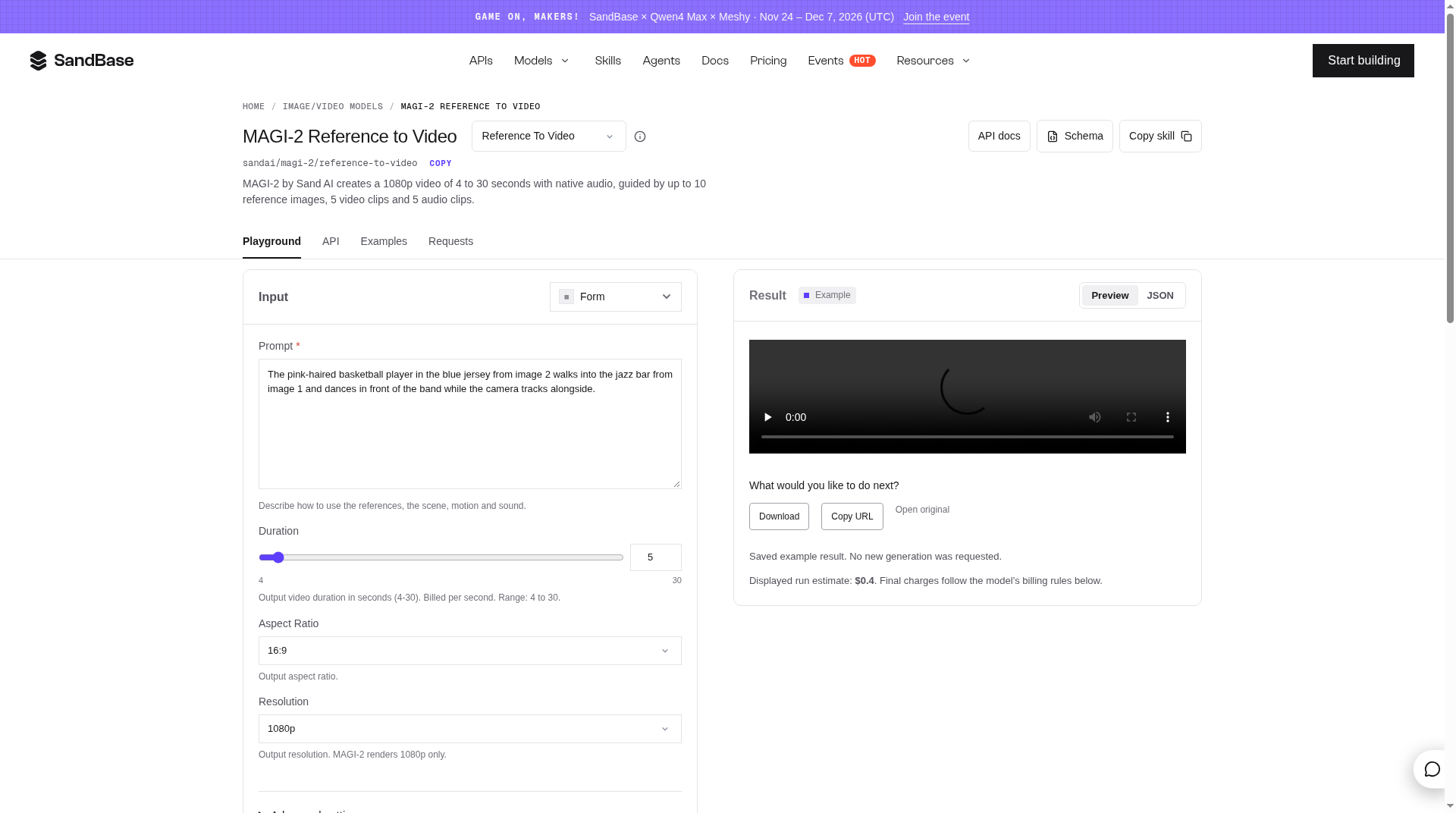
SandBase playground for sandai/magi-2/reference-to-video, opened 26 November 2026, Asia/Shanghai. The intro says a 1080p clip of 4 to 30 seconds, guided by up to 10 reference images, 5 video clips, and 5 audio clips. Duration is 5, billed per second, range 4 to 30. Resolution help says 1080p only. The panel says “Saved example result. No new generation was requested.” and “Displayed run estimate: $0.4.”
Sand.ai’s native API, the vendor route rather than the SandBase id, allows the same 10 / 5 / 5 counts: videos 2 to 30 seconds each and 30 seconds combined, audio 30 seconds combined. The pricing page is still 0.08 USD/s for model magi-2 at 1080p, with no reference adder printed on that one-row table. Top-up is not supported for the time being. The research post dated 24 November 2026 describes omni-reference and editing. The SandBase reference schema does not add an edit task field. Editing language stays on the research post. The checkpoint-versus-card split is MAGI-2 vs MAGI-2 Preview.
The card’s markdown sample omits the arrays and sends duration 5. That sample is a legal price example. It is not a demonstration that an empty reference body satisfies a product that needs references. prompt is the required field. Send the arrays your shot actually uses, then expect the formula to ignore their lengths.
Wan adds seconds at the same list rate
Wan’s reference id is alibaba/wan/3.0/reference-to-video. The facts line matches the text card: From $0.30 per run (40% off list price). base_price is 0.5. publicDiscountPercent is 40. The list rates stay 0.05 at 480p, 0.10 at 720p, and 0.20 at 1080p. The formula adds time only when len(params.videos) is greater than 0. The added amount is the ceil of the reference duration, and both the fallback and the cap are 15 seconds: if the duration cannot be read, 15 is assumed, and the value is also clamped at 15. Images and audio do not add seconds.
The README list table is the readable form. Five seconds of output and no reference video is the ordinary output row: $1.00 at 1080p list. Five seconds of output plus 8 seconds of reference video bills 13 seconds, $2.60 at 1080p list. Five seconds plus 15 seconds of reference video bills 20 seconds, $4.00 at 1080p list. The 40% badge is not folded into those cells here. The hero From $0.30 does not describe the 13-second row.
Field caps are tighter than the MAGI-2 video cap. Wan videos are 1 to 15 seconds each, 15 seconds total, under 100 MB, up to 5. A 20-second reference clip that MAGI-2’s field text allows, inside the 30-second combined cap, does not fit Wan’s 15-second total. The README also says reference video length plus output length must stay within 30 seconds. The formula will still add up to 15 reference seconds onto a long output if the request is accepted. Read the limit as a rejection rule, and the formula as the bill if the request is not rejected. Official Model Studio text says billable duration is input video seconds plus output video seconds, without the 15-second clamp this SandBase formula uses. The International 1080P original on that pricing page is $0.2/s, with a 30% off note that is not SandBase’s 40% badge. Pairwise context is MAGI-2 vs Wan 3.0.
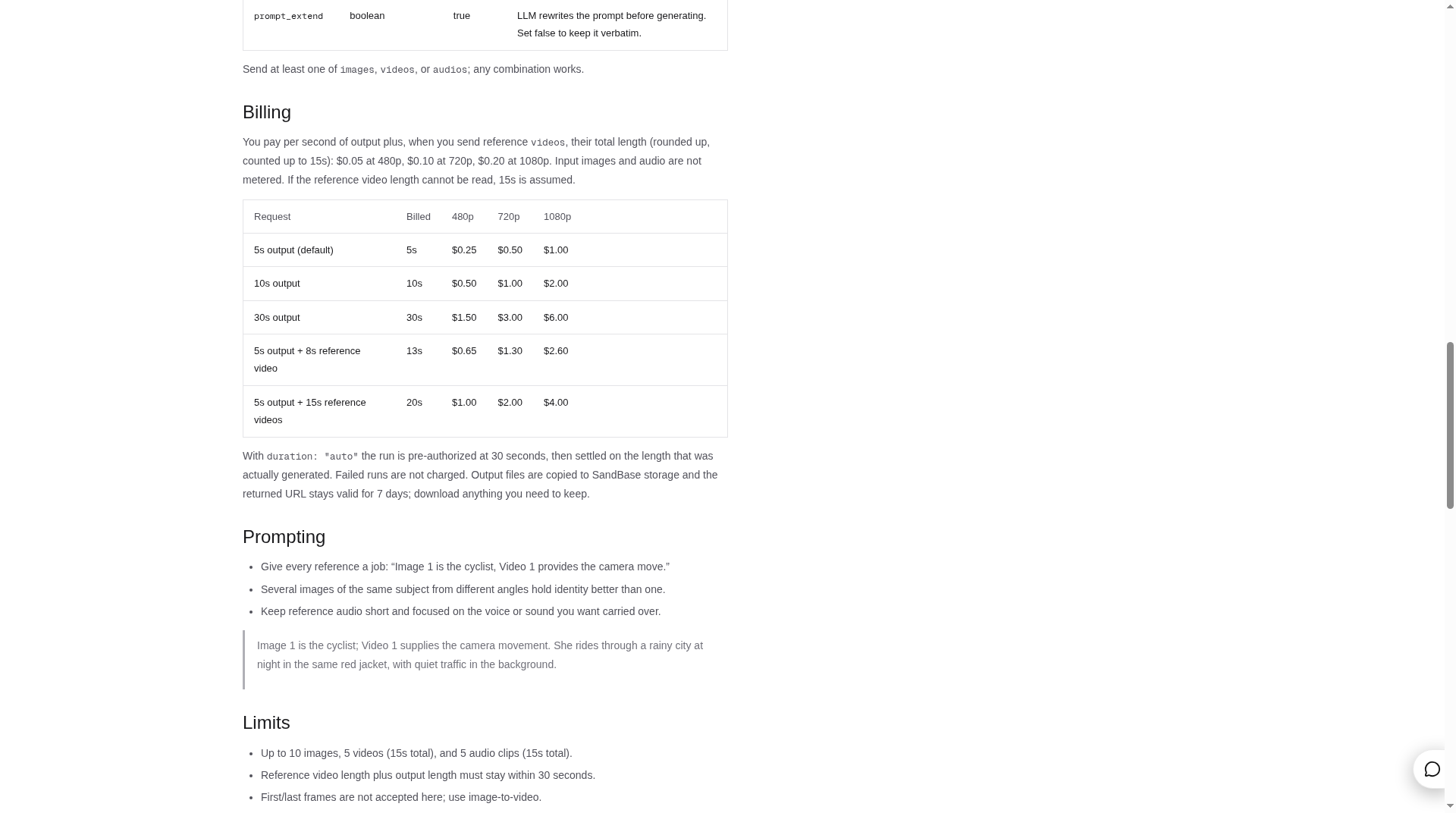
Wan 3.0 Reference to Video README, opened 26 November 2026, Asia/Shanghai. Billing adds reference-video seconds, rounded up and counted up to 15s, at $0.05, $0.10, and $0.20. The table shows 5s of output plus 8s of reference video billed as 13s, 1080p $2.60, and 5s plus 15s of reference video billed as 20s, 1080p $4.00. Limits say up to 10 images, 5 videos (15s total), and 5 audio clips (15s total), and reference length plus output length must stay within 30 seconds.
Send at least one of images, videos, or audios. The text endpoint accepts no media. Putting reference URLs on alibaba/wan/3.0/text-to-video is the wrong card, and that card’s formula has no reference term because the field is absent, not because references are free.
Kling changes the rate, not only the seconds
Kling’s reference id is kwaivgi/kling-video/v4/reference-to-video. Images, up to 10, do not flip the price. The no-video branch is the text-card list: $0.157 at 720p, $0.235 at 1080p, $0.549 at 4K, per output second, plus the HDR adder if you set it ($0.047 per output second at 1080p). The facts line is From $1 per run (15% off list price). The 5-second 1080p images-only list cell is $1.175. Badge and list stay apart, as in MAGI-2 vs Kling V4.
A non-empty videos array leaves that branch. At 1080p the coefficient becomes 0.141. The multiplied duration is output seconds plus the greater of output seconds and the reference duration. If the length cannot be read, 30 seconds is assumed. The README example of 5 seconds at 1080p plus an 8-second reference video is $1.833 list, which is 0.141 times 13. Ten seconds at 720p plus a 4-second reference video is $1.88 list, because the input side counts at least as long as the output, so 10 plus 10, times the with-video 720p rate 0.094. Official Kling markdown prints the same dollar figures: ($0.235)/s at 1080p with no input video, and ($0.141)/s at 1080p with input video, under the cases “output times 2” when input is shorter or equal, and “input plus output” when input is longer. The official table does not show SandBase’s 15% badge.
voice_ids accepts up to 2 custom voice ids and the schema says they cannot be combined with reference videos. A request that needs both a cloned voice and a reference clip is two operations on this card, or a different product. This page did not price the create-voice call.
Video items are 3 to 30 seconds each, 30 seconds combined, up to 5. MAGI-2’s floor is 2 seconds. A 2-second reference clip is inside MAGI-2’s video text and outside Kling’s. Duration of the output is 3 to 30, default 5, against MAGI-2’s 4 to 30.
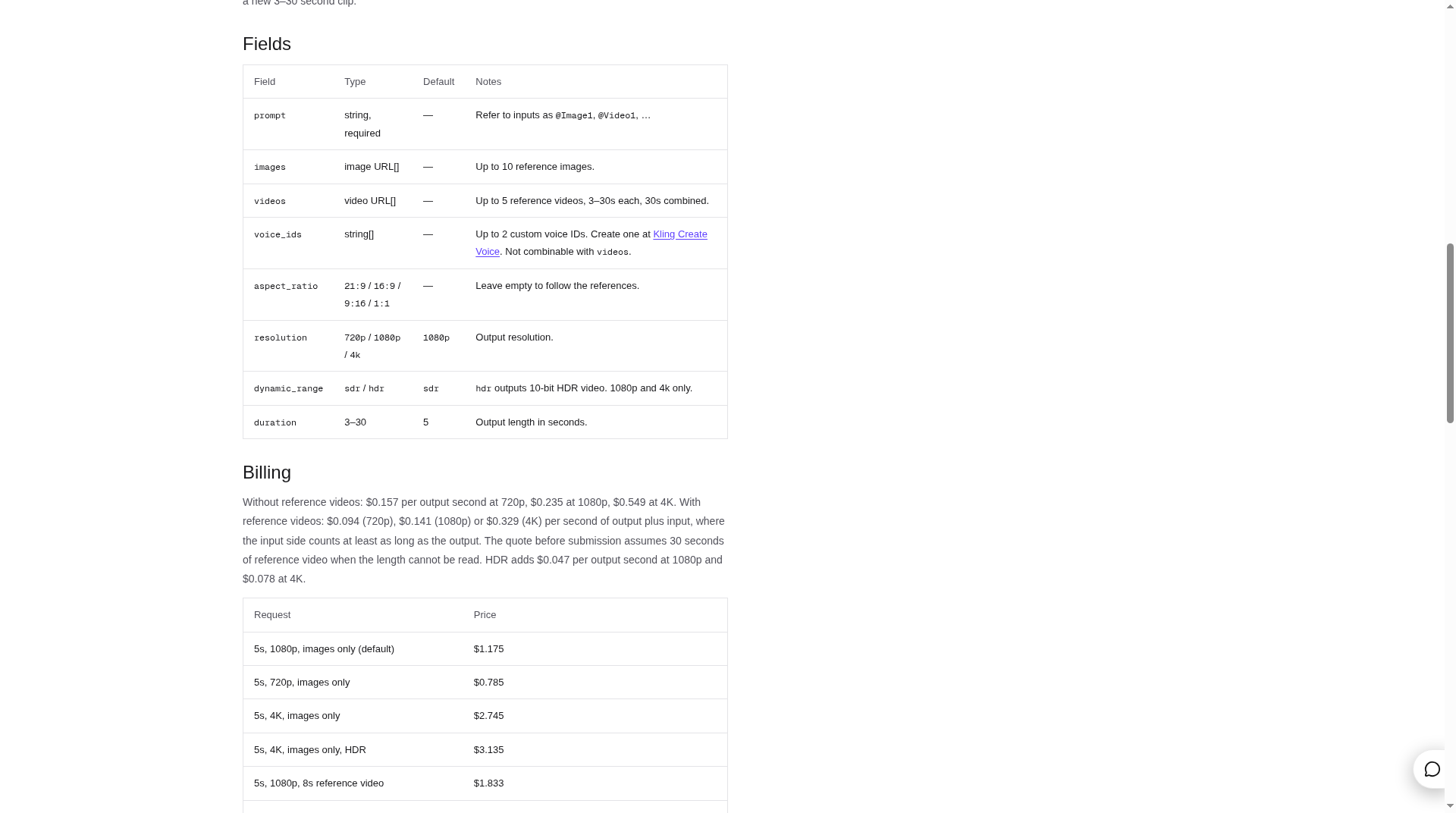
Kling V4 Reference to Video README, opened 26 November 2026, Asia/Shanghai. Fields allow up to 10 images and up to 5 videos, 3-30s each, 30s combined. Without reference videos the rates are $0.157, $0.235, and $0.549. With reference videos they are $0.094, $0.141, and $0.329 per second of output plus input. The table lists 5s at 1080p, images only, at $1.175, and 5s at 1080p plus 8s of reference video at $1.833.
Seedance adds seconds and also changes the coefficient
The SandBase id is bytedance/seedance/2.5/reference-to-video. The facts line is From $1.44 per run (20% off list price). base_price is 1.8. publicDiscountPercent is 20. That hero matches the images-only default: 5 seconds at 720p list is 5 times 0.36, which is $1.80, and the badge language sits on the facts line. It is not a 1080p quote and it is not a with-video quote.
Without reference videos the list coefficients match the text card: 0.18 at 480p, 0.36 at 720p, 0.90 at 1080p, times output seconds. With reference videos the formula adds input seconds and uses a lower coefficient: 0.11, 0.22, or 0.55. Input seconds are Math.max(2, min(ceil(usage.input_video_seconds), 30)). The README’s list rows: 5 seconds plus 5 seconds of reference video is $5.50 at 1080p, which is 10 times 0.55. Ten plus ten is $11.00 at 1080p list. The 20% badge is not merged into 0.55.
videos is up to 10. The schema text for images that this check read does not print a numeric cap. Official BytePlus Seedance 2.5 documentation says the reference ceiling is 50 assets: 30 images, 10 videos, and 10 audios, and that reference audio or video can total 30 seconds. The SandBase card’s video max of 10 matches the video half of that official ceiling. This page does not upgrade the SandBase image field to 30, because the schema excerpt did not say 30. task_type can be reference, edit, extend, or auto. Edit and extend need a video. Edit follows the source clip’s length and is billed on the actual output length. If the prompt contradicts an explicit task_type, the task fails. Draft mode is a separate 480p preview at the 480p rate, then a final at the 1080p list rate. Those are SandBase sentences.
Official price stays in tokens. For dreamina-seedance-2-5-260628, online inference is $11.7 per million tokens at 1080p without video input and $7.0 per million tokens at 1080p with video input. Token consumption, on that same page, uses input duration plus output duration. This guide does not divide either rate by a duration to produce a $/s figure. Quote the token rate as the vendor price, and quote 0.90 or 0.55 as the SandBase list coefficient, with the 20% badge in its own column.
Which cap and which meter
| MAGI-2 | Wan 3.0 | Kling V4 | Seedance 2.5 on SandBase | |
|---|---|---|---|---|
| Id | sandai/magi-2/reference-to-video | alibaba/wan/3.0/reference-to-video | kwaivgi/kling-video/v4/reference-to-video | bytedance/seedance/2.5/reference-to-video |
| Images | up to 10, under 30 MB | up to 10 | up to 10 | schema text read here does not print a max |
| Videos | up to 5, 2–30 s each, 30 s combined, 200 MB | up to 5, 1–15 s each, 15 s total, 100 MB | up to 5, 3–30 s each, 30 s combined | up to 10. Input seconds billed from 2 to 30 |
| Audio | up to 5, 2–30 s, 30 s combined, 15 MB | up to 5, 1–15 s, 15 s total, 15 MB | voice_ids up to 2, not with videos | audios array. No numeric cap in the schema text read here |
| 1080p list, no reference video | $0.08/s output | $0.20/s output | $0.235/s output | $0.90/s output |
| When a reference video is present | formula unchanged | add up to 15 s at the same list rate | $0.141/s at 1080p of output plus input, input at least as long as output | add input seconds at $0.55/s list at 1080p |
| Badge | 0 | 40 | 15 | 20 |
| Official unit | 0.08 USD/s, no reference adder on the pricing row | input seconds plus output seconds. International 1080P original $0.2/s, 30% note separate | ($0.235)/s no input video, ($0.141)/s with input video, 1080p | $11.7 or $7.0 per million tokens at 1080p. Not converted |
Choose MAGI-2 when the reference set fits 10 / 5 / 5 and you do not want reference length on the bill. A long reference clip still has to pass the 30-second combined cap. It does not have to be paid as extra seconds on this formula. Choose Wan when the reference video is inside 15 seconds total and you have priced the added seconds at the list rate, badge aside. Choose Kling when you accept the rate switch, the doubled-or-summed duration rule, and the 3-second floor on reference clips. Choose Seedance when you want up to 10 reference videos on the SandBase card and you will quote 0.55 and 0.90 as list coefficients, not as a token conversion.
Open the Wan reference card if the 13-second example is the one your budget resembles. Open the Kling reference card if the request contains a video URL, because the text-card hero will not describe that bill. For the vocabulary that keeps list and badge apart on any of these, the cost model explainer still applies. It does not replace the four formulas.
FAQ
Does “reference” always mean “more seconds”?
On MAGI-2, no. On Wan, only videos add seconds, and images or audio do not. On Kling, only a non-empty videos array switches the branch. Images alone stay on the output-only rate. On Seedance, has_input_videos is what selects the lower coefficient and the added seconds.
Are the with-video examples already discounted?
No. The $2.60, $1.833, and $5.50 figures above are list cells from the READMEs or from the formulas. Badges are 40, 15, and 20 on those three cards. MAGI-2’s badge is 0, so its $0.40 default is both list and hero.
Can I put Kling voice ids on a MAGI-2 reference call?
No. voice_ids is a Kling field, and that schema says it cannot be combined with Kling reference videos either. MAGI-2 takes audios as URL clips, up to 5, and does not meter them.
Is Seedance’s official price $0.55 per second once a video is attached?
That 0.55 is the SandBase list coefficient at 1080p in the with-video branch. The official page prices dreamina-seedance-2-5-260628 at $7.0 per million tokens for 1080p online inference with video input. This guide does not convert one into the other.
Did anyone generate a reference clip for this page?
No. Acceptance of a URL, failure billing on MAGI-2, and the settled charge after a badge were not measured. Wan, Kling, and Seedance READMEs say failed runs are not charged. MAGI-2’s reference card does not say.
What to open
Count the files first, then read the formula that matches the array you will actually send. For a reference set that must not change the SandBase price expression, use the MAGI-2 reference card and the id sandai/magi-2/reference-to-video. The output is still 1080p, 4 to 30 seconds, $0.08 list per output second. The launch note’s request shape is MAGI-2 on SandBase.
SandBase reference cards and the vendor pricing pages checked 26 November 2026, Asia/Shanghai. No generation was run. No model is ranked.
Related reading
Found this useful? Share it