Best AI Video Generation APIs 2026: Price & Comparison
Best AI video generation APIs in 2026: compare MiniMax H3, Kling 3.0, and Gemini Omni Flash on quality, speed, API price, features, and developer use cases.
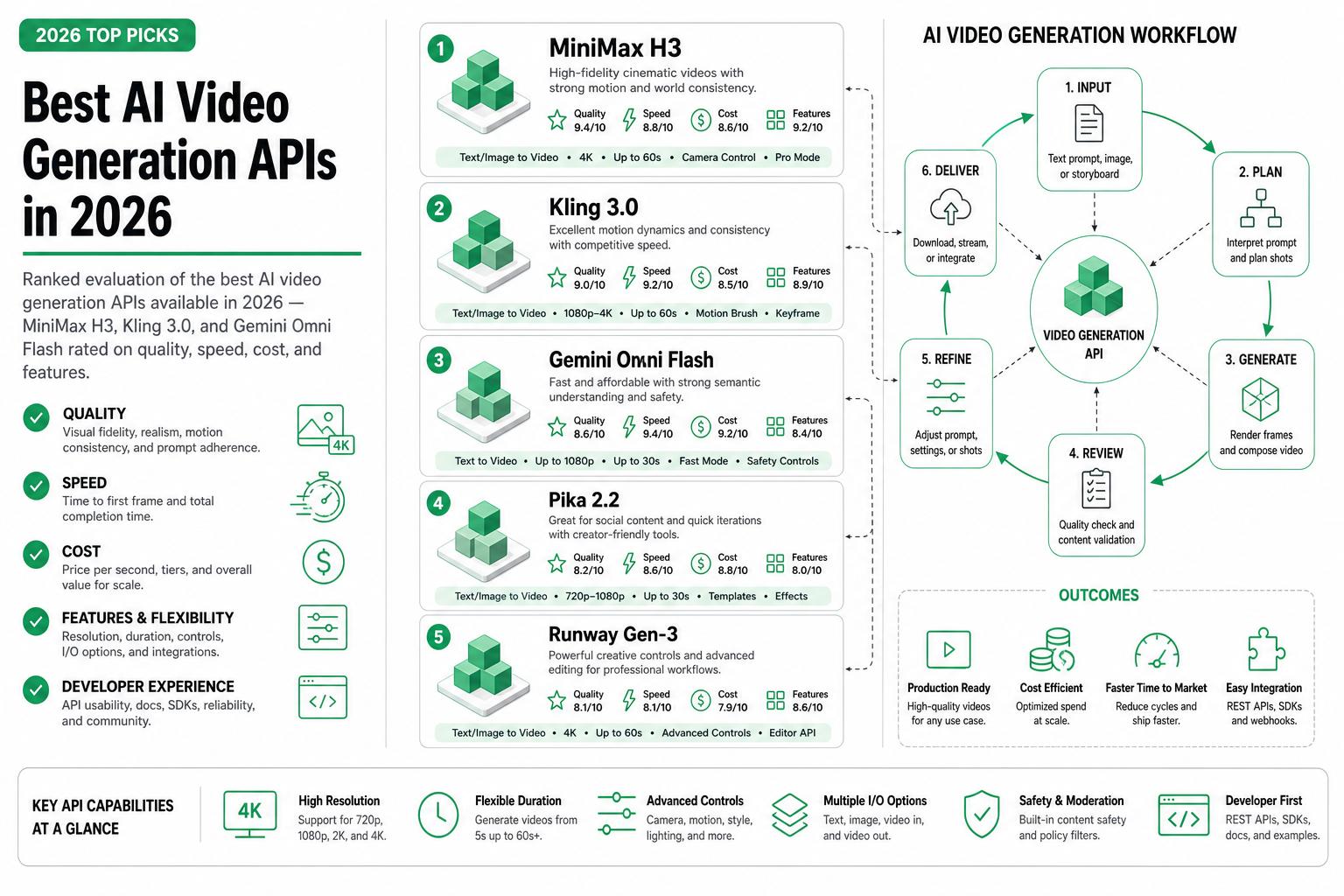
TL;DR — The three best video generation APIs accessible via SandBase in 2026 are: Kling Video 3.0 (best overall value with tiered pricing), MiniMax H3 (best for audio-integrated content), and Gemini Omni Flash (best for speed-critical workflows). Runway and Pika exist in the market but are not available through SandBase’s unified API.
The AI video generation API landscape in 2026 has matured from “demo impressive, production impractical” to genuinely useful for agent workflows. Three models are available today through the SandBase ecosystem, each filling a different niche. Here’s how they rank.
Evaluation criteria
Each model is rated on five dimensions (1–5 scale):
- Visual quality — Resolution, motion physics, temporal coherence, detail rendering
- Speed — Time from API call to delivered video
- Cost efficiency — Dollar per second of usable output
- Feature breadth — Generation modes, editing, multi-shot, audio
- Agent-friendliness — Predictable billing, simple API, reliable output
Rankings
#1: Kling Video 3.0 — Best overall value
| Dimension | Score | Notes |
|---|---|---|
| Visual quality | 4.5/5 | Omni Pro tier rivals film quality; Turbo is solid |
| Speed | 4/5 | Turbo tiers are fast (15–30s); Omni is moderate |
| Cost efficiency | 5/5 | $0.02/sec minimum, linear scaling, predictable |
| Feature breadth | 4/5 | T2V, I2V, V2V edit, multi-shot; no audio, no Ref2V |
| Agent-friendliness | 5/5 | Per-second = perfect for budget agents |
Why #1: Kling 3.0 offers the widest tier range, covering everything from $0.02/sec batch processing to $0.10/sec premium output. The per-second pricing model is the most predictable for agents — you know exactly what a 7-second video will cost before you generate it. Multi-shot generation simplifies agent architecture for multi-scene content. The only gaps: no native audio and no reference-to-video mode.
Available tiers on SandBase:
kwaivgi/kling-video/3.0/turbo-standard— 720p, $0.02/seckwaivgi/kling-video/3.0/turbo-pro— 1080p, $0.04/seckwaivgi/kling-video/3.0/omni-pro— 1080p–4K, $0.07–$0.10/sec
Best for: Production teams needing predictable costs, scalable volume, and quality options.
#2: MiniMax H3 — Best for audio-integrated content
| Dimension | Score | Notes |
|---|---|---|
| Visual quality | 4/5 | 2K native, strong motion, good textures |
| Speed | 2.5/5 | 60–180 seconds is slow |
| Cost efficiency | 3.5/5 | $0.30–$0.80/video, but includes audio |
| Feature breadth | 4.5/5 | T2V, I2V, Ref2V + native stereo audio |
| Agent-friendliness | 4/5 | Per-call pricing is clear; slow generation needs async handling |
Why #2: H3’s native audio-video generation is unique in the market. No other API produces synchronized stereo audio in the same generation pass. For content that needs sound — ads with voiceover, product videos with ambient audio, social clips with music — H3 eliminates an entire integration layer (separate TTS + audio sync). The trade-off is speed: at 60–180 seconds per generation, it’s a background task, not a real-time tool.
Available operations on SandBase:
minimax/h3/text-to-video— Text prompt → video with audiominimax/h3/image-to-video— Image → animated video with audiominimax/h3/reference-to-video— Reference clip → new video with audio
Best for: Content teams producing ads, tutorials, social media posts where audio is expected.
#3: Gemini Omni Flash — Best for speed-critical workflows
| Dimension | Score | Notes |
|---|---|---|
| Visual quality | 3.5/5 | Mid-tier, adequate for most uses, max 1080p |
| Speed | 5/5 | 10–30 seconds, fastest available |
| Cost efficiency | 3/5 | Token-based = unpredictable at scale |
| Feature breadth | 4/5 | T2V, I2V, Ref2V, video edit; no audio |
| Agent-friendliness | 3.5/5 | Speed is great; cost unpredictability hurts |
Why #3: Gemini Omni Flash is 3–6× faster than any competitor. For interactive applications — chatbots with video responses, design iteration tools, live content pipelines — it’s the only model where users won’t abandon the process while waiting. The drawback is token-based pricing: complex scenes cost more than simple ones, making budget forecasting difficult at scale.
Available on SandBase:
google/gemini-omni-flash— Supports all four modes (T2V, I2V, Ref2V, edit)
Best for: User-facing products where wait time determines UX quality.
Comparison matrix
| Metric | Kling 3.0 | MiniMax H3 | Gemini Omni Flash |
|---|---|---|---|
| Cheapest 5s video | $0.10 | $0.30 | ~$0.15 |
| Cheapest 10s video | $0.20 | $0.80 | ~$0.25 |
| Best quality 10s video | $0.70–$1.00 | $0.80 | ~$0.55 |
| Fastest generation (5s) | 14s | 55s | 8s |
| Max resolution | 4K | 2K | 1080p |
| Native audio | ❌ | ✅ | ❌ |
| Multi-shot | ✅ | ❌ | ❌ |
| Reference-to-video | ❌ | ✅ | ✅ |
| Video editing | ✅ | ❌ | ✅ |
| Pricing model | Per-second | Per-call | Per-token |
Market context: what’s not on SandBase
For completeness, other video generation APIs exist in the market but are not currently available through SandBase’s unified endpoint:
- Runway Gen-4 — Premium quality, higher pricing ($0.50+ per 5s clip), proprietary API
- Pika 2.5 — Good for character animation, limited API access
- Sora (OpenAI) — High quality but restricted API availability and high cost
These are mentioned for context. If you’re building through SandBase, the three ranked models above are your options — and they cover the full quality/speed/cost spectrum.
Cost projection: 500 videos/month (mixed 7s average)
| Strategy | Model(s) | Monthly cost | Trade-off |
|---|---|---|---|
| Budget maximum | Kling Turbo Standard | $70 | 720p, no audio |
| Balanced production | Kling Turbo Pro | $140 | 1080p, no audio |
| Premium quality | Kling Omni Pro | $245–$350 | 4K capable, no audio |
| Audio-inclusive | MiniMax H3 | $250 | 2K + stereo audio |
| Speed-optimized | Gemini Omni Flash | $105–$193 | Variable cost, fastest |
| Smart routing | Mixed | $110–$150 | Best of each model |
The smart routing approach — using Turbo Standard for A/B tests, Turbo Pro for standard posts, H3 for audio-needed content, Gemini for speed-critical items — typically lands at $110–$150/month for 500 videos.
For the detailed head-to-head analysis, see H3 vs Kling 3.0 vs Gemini Omni Flash. For cost model explanations, see Video Generation Cost Model Explained.
Recommendation by team type
| Team type | Primary model | Secondary | Why |
|---|---|---|---|
| Solo creator | Kling Turbo Pro | H3 for audio pieces | Best value per video |
| Marketing team | Kling (mixed tiers) | H3 for ads | Tiered quality matches content tiers |
| Product team (UX) | Gemini Omni Flash | Kling for quality pieces | Speed for user-facing features |
| Agency | Kling Omni Pro | H3 for premium audio | Client work needs top quality |
| E-commerce (bulk) | Kling Turbo Standard/Pro | — | Volume + predictability |
| Content studio | H3 | Kling Omni Pro | Audio-first content needs |
If your starting point is a free image-to-video generator, compare the advertised free tier with API limits, queue time, watermark rules, and automation support. A free web demo is not automatically a production API; the image-to-video model guide covers that distinction before you choose a paid route.
Related Reading
- Unified AI API for LLM, Image & Video (2026)
- Best Image to Video AI Models for Agents (2026)
- Text to Video vs Image to Video AI: When to Use Each
- H3 vs Kling 3.0 vs Gemini Omni Flash (2026)
- Kling Video 3.0: Unified Multi-Shot Generation
- Video Generation Costs: Per-Second vs Per-Call
- Build an Ad-Creative Video Agent (Tutorial)
Key takeaways
- Kling 3.0 is the best all-rounder — widest tier range, most predictable pricing, good-to-excellent quality
- MiniMax H3 owns the audio niche — no substitute if you need synchronized sound
- Gemini Omni Flash owns the speed niche — no substitute if you need sub-30s generation
- All three are available through SandBase through its unified model generation API
- Smart routing between models produces the best cost/quality outcome for diverse workloads
- Per-second pricing (Kling) is most agent-friendly for budget control
- The market is not a monopoly — different models for different jobs, pick based on your constraints