Top 5 Social Media Data APIs for AI Agents (2026)
A practical guide to social media data APIs that AI agents can use in 2026, covering Chinese and Western platforms, pricing, and agent-readiness.
TL;DR — Five approaches to social media data for AI agents in 2026. Dedicated data APIs win for Chinese platforms (300+ endpoints per platform, sync, $0.001/call). Apify wins for Instagram/YouTube/Twitter. The real question is not “which API” but “what does your agent’s decision loop actually need” — and the answer shapes everything from architecture to budget.
Your agent needs social media data. Not a dashboard, not a CSV export, not a weekly report — it needs JSON at the moment it is making a decision.
This sounds simple until you actually build it. Then you discover: most social platforms have no public API worth using. The ones that do require OAuth flows that assume a human is present. And the third-party options range from “$0.001 per call, sync JSON” to “spin up a headless browser, wait 30 seconds, parse whatever comes back.”
The difference between these approaches is not a detail. It determines whether your agent can make 100 decisions per hour or 3.
Four scenarios that expose the real differences
Before comparing approaches, let’s define what “agent-ready” actually means through concrete scenarios.
Scenario 1: Competitor monitoring (daily loop)
An agent tracks 10 competitor Douyin accounts. Every morning it checks: new videos posted, engagement changes, content themes shifting.
What it needs per cycle:
- 10× user profile (follower count, bio changes)
- 10× latest videos (last 20 videos with view/like/comment counts)
- 10× video detail (for any video that crossed a threshold)
Total: ~30 API calls per day. At $0.001/call = $0.03/day.
The critical requirement: all 30 calls must complete in one agent turn (typically under 60 seconds). If any call is async with a 30-second polling loop, the agent’s decision window blows up from 1 minute to 15 minutes. That’s the difference between a morning briefing and a morning wasted.
Scenario 2: KOL screening (batch + judgment)
A brand agent evaluates 200 Xiaohongshu influencers for a campaign. For each KOL, it needs: follower count, engagement rate on recent posts, content category distribution, audience quality signals.
What it needs:
- 200× user profile
- 200× recent notes (10 each = 2,000 note fetches)
- Optionally: 200× fan growth history (if available)
Total: ~2,400 calls. At $0.001/call = $2.40 for the entire screening.
The critical requirement: structured response schemas. The agent feeds each KOL’s data into a scoring function. If 10% of responses have different field names or missing keys, the scoring function throws errors 240 times and the entire batch needs error-handling that costs more engineering time than the data.
Scenario 3: Real-time trend detection (continuous)
An agent monitors Weibo hot search every 15 minutes, detects brand mentions or industry-relevant trends, and fires a Slack alert.
What it needs per cycle:
- 1× hot search list
- 3-5× topic detail (for flagged items)
- Optionally: sentiment sampling from top comments
Total: ~5 calls every 15 minutes = 480/day. At $0.001/call = $0.48/day.
The critical requirement: low latency and predictability. If the API takes 2 seconds one call and 45 seconds the next (common with scraping approaches), the agent cannot maintain a reliable 15-minute cadence. It either misses windows or backs up.
Scenario 4: Cross-platform content analysis (research)
A strategy agent collects the top 50 posts from Douyin, Weibo, and Xiaohongshu for a specific topic, analyzes content patterns across platforms.
What it needs:
- 3× search endpoint (one per platform, 50 results each)
- 150× post/video detail
- 150× engagement metrics
Total: ~303 calls across 3 platforms. The challenge: three different APIs with three different auth flows, three different response schemas, and three different error codes.
This is where contract normalization matters most. If calling Douyin search and Xiaohongshu search requires different code paths, the agent’s implementation complexity triples.
The five approaches, evaluated against these scenarios
| Approach | Scenario 1 (monitor) | Scenario 2 (batch) | Scenario 3 (real-time) | Scenario 4 (cross-platform) |
|---|---|---|---|---|
| Dedicated data APIs | ✅ 30 calls in <10s, $0.03 | ✅ 2,400 calls, predictable schema | ✅ 5 calls/15min, <2s latency | ✅ if all 3 platforms covered |
| Apify | ⚠️ async polling adds 30-60s | ⚠️ schema inconsistency across actors | ❌ latency too variable | ⚠️ 3 different actors, 3 schemas |
| Bright Data | ❌ batch-only, no real-time | ✅ bulk datasets work here | ❌ not designed for 15-min loops | ⚠️ pre-collected only |
| RapidAPI | ⚠️ reliability varies by provider | ❌ schema differences kill batching | ⚠️ uptime unpredictable | ❌ no cross-platform consistency |
| Official APIs | ❌ OAuth per account, rate limited | ❌ limited endpoints, review needed | ⚠️ if approved, works | ❌ different auth per platform |
1. Dedicated data APIs — the sync-first approach
These services offer hundreds of structured endpoints per platform. Typical coverage for a major Chinese platform:
| Platform | Operations | Methods | Price range | Response time |
|---|---|---|---|---|
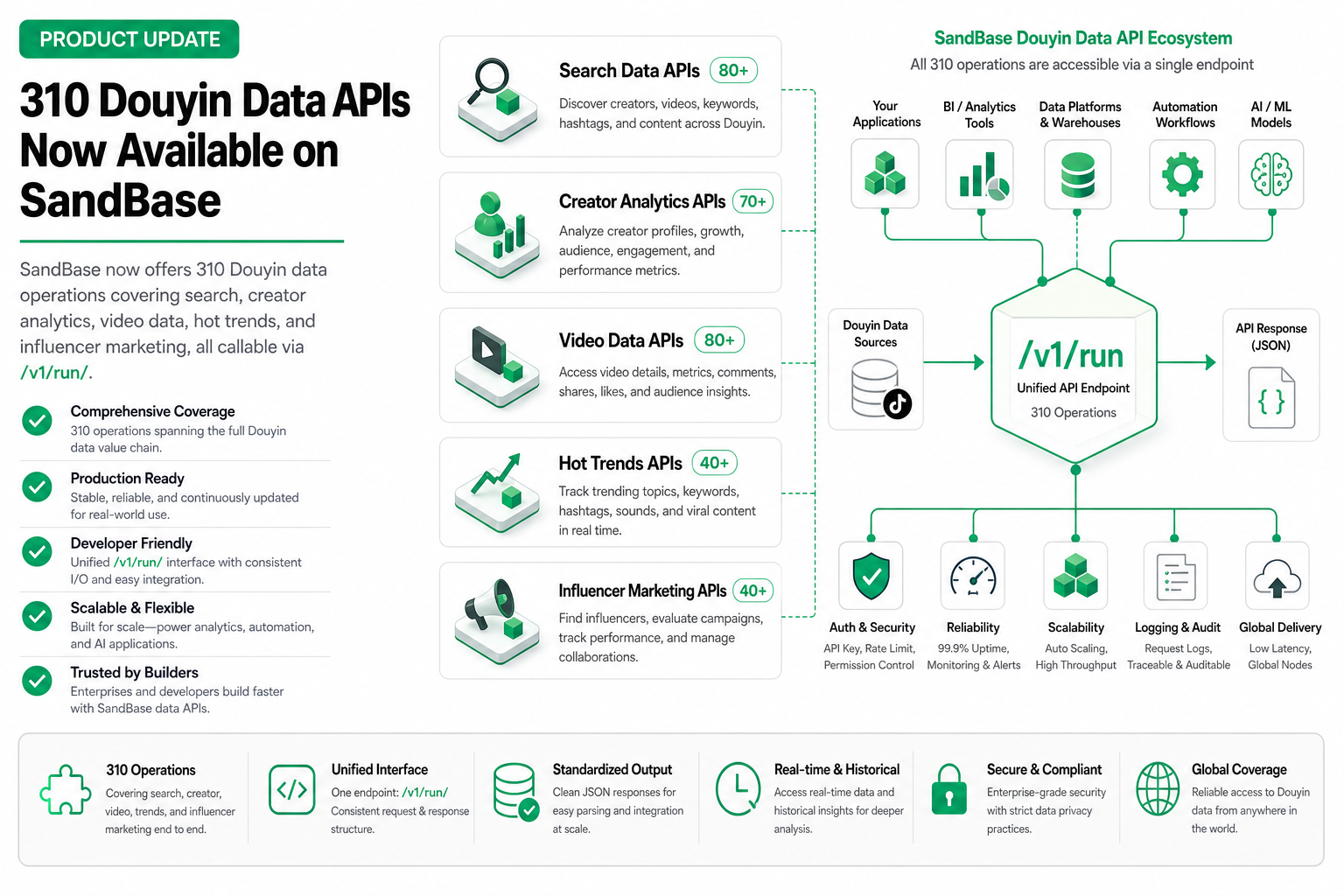
| Douyin | 310 | GET + POST | $0-$0.25/call | 1-5 seconds |
| TikTok | 161 | GET + POST | $0-$0.25/call | 1-5 seconds |
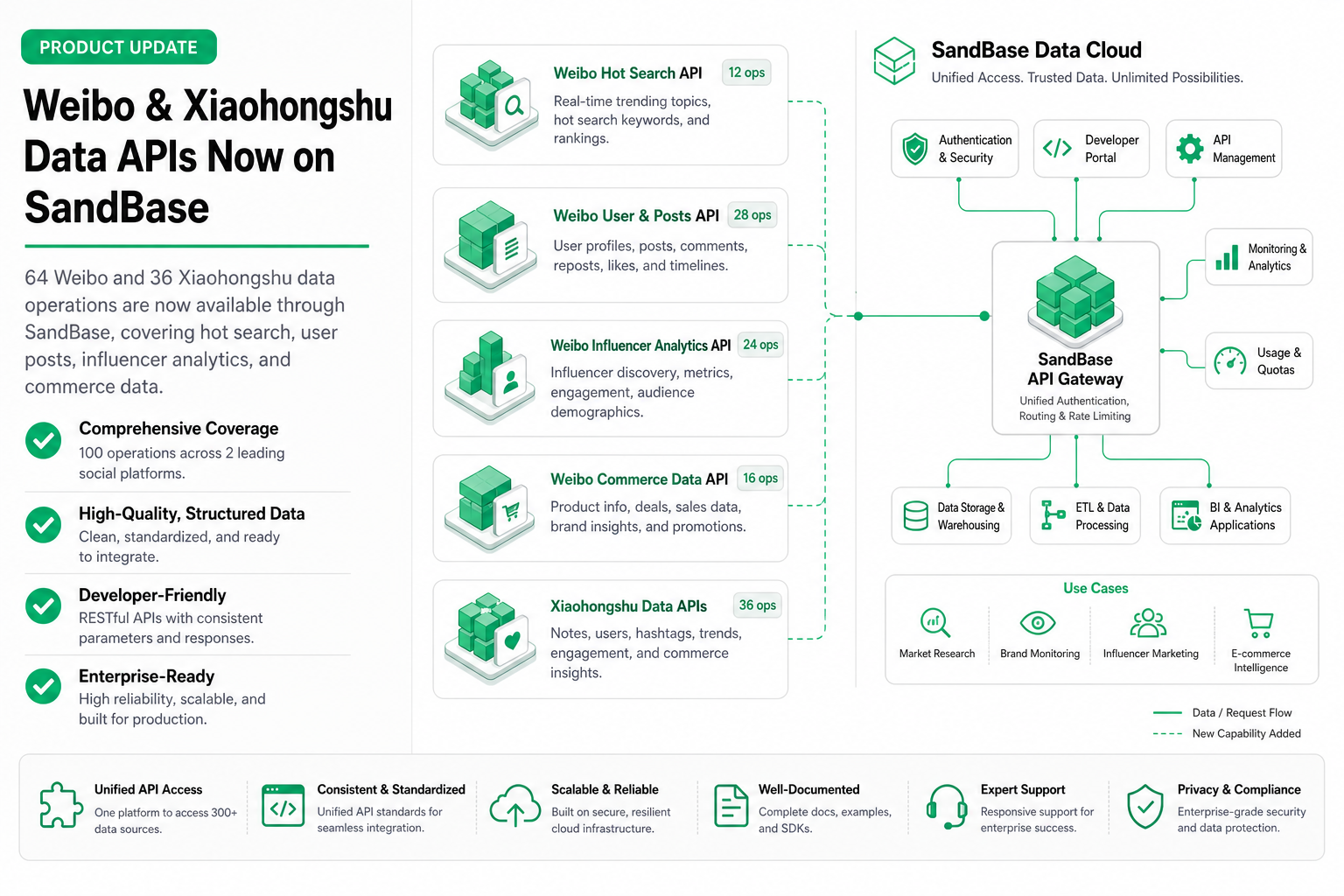
| 64 | Mostly GET | $0-$0.1/call | 1-3 seconds | |
| Xiaohongshu | 36 | Mixed | $0-$0.1/call | 1-4 seconds |
What you actually get back (example: Douyin video detail):
{
  "aweme_id": "7234567890123456789",
  "desc": "Video description text...",
  "statistics": {
    "digg_count": 45200,
    "comment_count": 1893,
    "share_count": 567,
    "play_count": 1230000
  },
  "author": {
    "uid": "1234567890",
    "nickname": "Creator Name",
    "follower_count": 890000
  },
  "create_time": 1722412800
}
Predictable schema. Every call. Every time. This is what makes batching (Scenario 2) reliable and real-time monitoring (Scenario 3) feasible.
The $0.001 per call math in practice:
| Scenario | Calls/day | Daily cost | Monthly cost |
|---|---|---|---|
| 10-account competitor monitor | 30 | $0.03 | $0.90 |
| Weekly 200-KOL screen | 343/day avg | $0.34 | $10.29 |
| 15-min trend detection | 480 | $0.48 | $14.40 |
| Cross-platform research (weekly) | 43/day avg | $0.04 | $1.30 |
Limitation that matters: Only Chinese platforms + TikTok. If your agent needs Instagram Reels engagement data or YouTube Shorts metrics, you are looking at Apify.
2. Apify — when you need platforms no API covers
Apify’s model is fundamentally different. You are not calling a data endpoint — you are renting compute to execute a headless browser script (“actor”).
The same Douyin video detail request via an Apify actor:
- Start the actor (1-3 seconds spin-up)
- Actor navigates to the page (3-10 seconds)
- Actor waits for dynamic content to load (2-5 seconds)
- Actor extracts data and returns (1-2 seconds)
- You poll for the result (variable, often 15-45 seconds total)
Total: 15-45 seconds vs 1-5 seconds for a dedicated API. For one call this is fine. For Scenario 2’s 2,400 calls, you’re looking at 10-30 hours of wall-clock time vs 40 minutes.
Where Apify genuinely excels:
- Instagram: No structured API exists outside Meta’s official Business API (which requires business account verification). Apify’s Instagram actors are the practical option.
- YouTube: YouTube Data API v3 has quota limits that make large-scale collection painful. Apify actors bypass this.
- Twitter/X: After the API pricing changes, Apify is the most accessible path for bulk collection.
Apify cost structure (approximate, varies by actor):
| Platform | Actor compute cost | Equivalent per-item |
|---|---|---|
| Instagram profile | ~$0.005-$0.02 | $0.005-0.02/profile |
| YouTube video detail | ~$0.003-$0.01 | $0.003-0.01/video |
| TikTok video | ~$0.002-$0.008 | $0.002-0.008/video |
These costs include compute + proxy. But the real cost is time: async results mean your agent architecture needs a queue, a polling mechanism, and timeout handling.
3. Bright Data — when “real-time” is not the requirement
Bright Data sells three things: residential proxy pools (72M+ IPs), a Web Scraper IDE, and pre-collected datasets.
For AI agents, the datasets are the most interesting — but they are batch products:
- Social media datasets updated daily or weekly
- Sold per record ($0.001-$0.01/record depending on platform)
- Structured JSON, but you get what they collected, not what you query
Best fit: Scenario 4 (research) when you don’t need real-time data. “Give me the top 10,000 TikTok videos about cooking from last month” is a Bright Data query. “Give me this creator’s latest video right now” is not.
The proxy approach is different — you run your own scraping code through their network. This gives maximum control but puts all parsing, anti-detection, and maintenance on you. Pricing: $8-15/GB of residential proxy traffic.
4. RapidAPI aggregators — quick prototype, painful production
RapidAPI hosts 50+ social media data providers. I tested three TikTok video detail APIs from different providers on the same video:
| Provider | Response time | Fields returned | Price | Schema matches docs? |
|---|---|---|---|---|
| Provider A | 2.1s | 23 fields | $0.003 | Yes |
| Provider B | 8.4s | 18 fields | $0.001 | Partially (3 renamed) |
| Provider C | Timeout | — | $0.005 | — |
This was a single test on a single day. The problem is not that any one provider is bad — it’s that you cannot predict which will work tomorrow. For a prototype that needs to prove a concept, this is fine. For a production agent running Scenario 3 every 15 minutes, it’s a reliability nightmare.
5. Official platform APIs — the compliance choice
| Platform | Public data available | Auth requirement | Review time | Rate limit |
|---|---|---|---|---|
| Douyin Open Platform | Video search (limited), user info (authorized) | OAuth 2.0 + app review | 2-8 weeks | 100-500 req/hour |
| TikTok for Developers | Research API (limited), display API | OAuth + review | 4-12 weeks | Varies by tier |
| Weibo Open Platform | Public timeline, user profile | OAuth 2.0 | 1-4 weeks | 150 req/hour |
| Xiaohongshu (commercial) | Limited partner API | Business agreement | Negotiation | Custom |
The fundamental mismatch: these APIs assume a human authorized access to their own data. An agent monitoring a competitor’s public posts does not have that competitor’s OAuth token. Official APIs serve a different use case.
Architecture implications
The choice of data approach directly shapes your agent architecture:
Sync approach (dedicated APIs):
Agent turn starts → call data API → get JSON → reason → decide → act
Total: 5-15 seconds per turn
Async approach (Apify/scrapers):
Agent turn starts → submit scraping job → wait/poll → get data → reason → decide → act
Total: 30-120 seconds per turn (or split into two turns with a queue)
The async path forces either: (a) much longer agent turns (bad for user-facing agents), or (b) a two-phase architecture where data collection is decoupled from reasoning (adds complexity).
For agents that make frequent decisions on fresh data (Scenarios 1, 3), sync APIs eliminate an entire layer of infrastructure.
Making raw APIs orchestrable
Getting data is step one. Making it useful inside an agent workflow is step two. Individual API calls become more powerful when they are:
- Normalized into a single contract — the agent calls Douyin user profiles and Weibo hot search the same way
- Composable — search results feed directly into a scoring function without manual parsing
- Exposed via MCP — agents using Model Context Protocol can discover and invoke data APIs as tools without custom integration code
- Observable — you can trace which calls the agent made, what it paid, and what it decided
- Reusable — a “screen 200 KOLs” workflow is packaged once, used by any agent
The MCP angle
Many agent frameworks now support Model Context Protocol (MCP) for tool discovery. Social data APIs that expose themselves as MCP tools become instantly usable by any MCP-compatible agent — Claude Desktop, Cursor, OpenHands, and others — without writing integration code.
The pattern: instead of hardcoding API calls, you declare the data endpoint as an MCP tool with its schema. The agent discovers it at runtime, calls it with the right parameters, and processes the result. This is particularly powerful for social data because the same “fetch user profile” tool works regardless of which agent framework orchestrates it.
This is what agent platforms provide. They sit above individual APIs and add the orchestration layer: session management, multi-step composition, cost tracking, MCP tool exposure, and skill packaging.
SandBase, for example, integrates 571 social media data operations into its agent ecosystem — normalized into one /v1/run contract regardless of whether the underlying call is a Douyin GET query or a Xiaohongshu POST. But the value is not the endpoint count; it’s that your agent can compose a “cross-platform competitor analysis” as a single reusable skill rather than gluing together three different API clients.
Have an API that would work well for AI agents? Reach out — we integrate quality capabilities into the ecosystem.
FAQ
How much does a complete competitor monitoring setup cost?
For 10 Douyin accounts monitored daily with dedicated APIs: ~$0.90/month for data + ~$0.30/month for LLM analysis = $1.20/month total. Add Weibo and Xiaohongshu monitoring for the same accounts: roughly $2.50/month. These are real numbers at $0.001/call with 30-60 calls/day.
My agent needs Instagram data. What’s the most reliable option?
Apify with a well-maintained Instagram actor. Expect $0.005-$0.02 per profile/post, async results with 15-45 second latency, and occasional breakage when Instagram changes their frontend. There is no structured sync API equivalent for Instagram. Budget 2-3x your expected call volume for retries and actor failures.
Can I use official Douyin APIs for competitive intelligence?
Not practically. Douyin’s official OAuth flow requires the monitored user to authorize your app. Your competitor will not authorize your competitive intelligence tool. Official APIs are designed for apps where the user is the account owner — analytics dashboards, content management, commerce integrations.
What’s the latency difference between sync APIs and scraping for trend detection?
Sync dedicated APIs: 1-5 seconds per call, deterministic. Scraping (Apify/Bright Data proxy): 15-60 seconds per call, variable. For a 15-minute trend monitoring loop that makes 5 calls per cycle, this is the difference between completing in 25 seconds and completing in 5 minutes. The sync approach leaves 14 minutes of headroom; the scraping approach barely fits.
How do I handle cross-platform analysis without maintaining three different integrations?
Use a platform layer that normalizes the contract. When calling Douyin search and Xiaohongshu search uses the same request format and auth, your agent’s cross-platform logic is one code path, not three. This is exactly what agent platforms like SandBase solve with contract normalization.
For more on search APIs in agent workflows, see our AI search API comparison and top search APIs roundup.
Related Reading
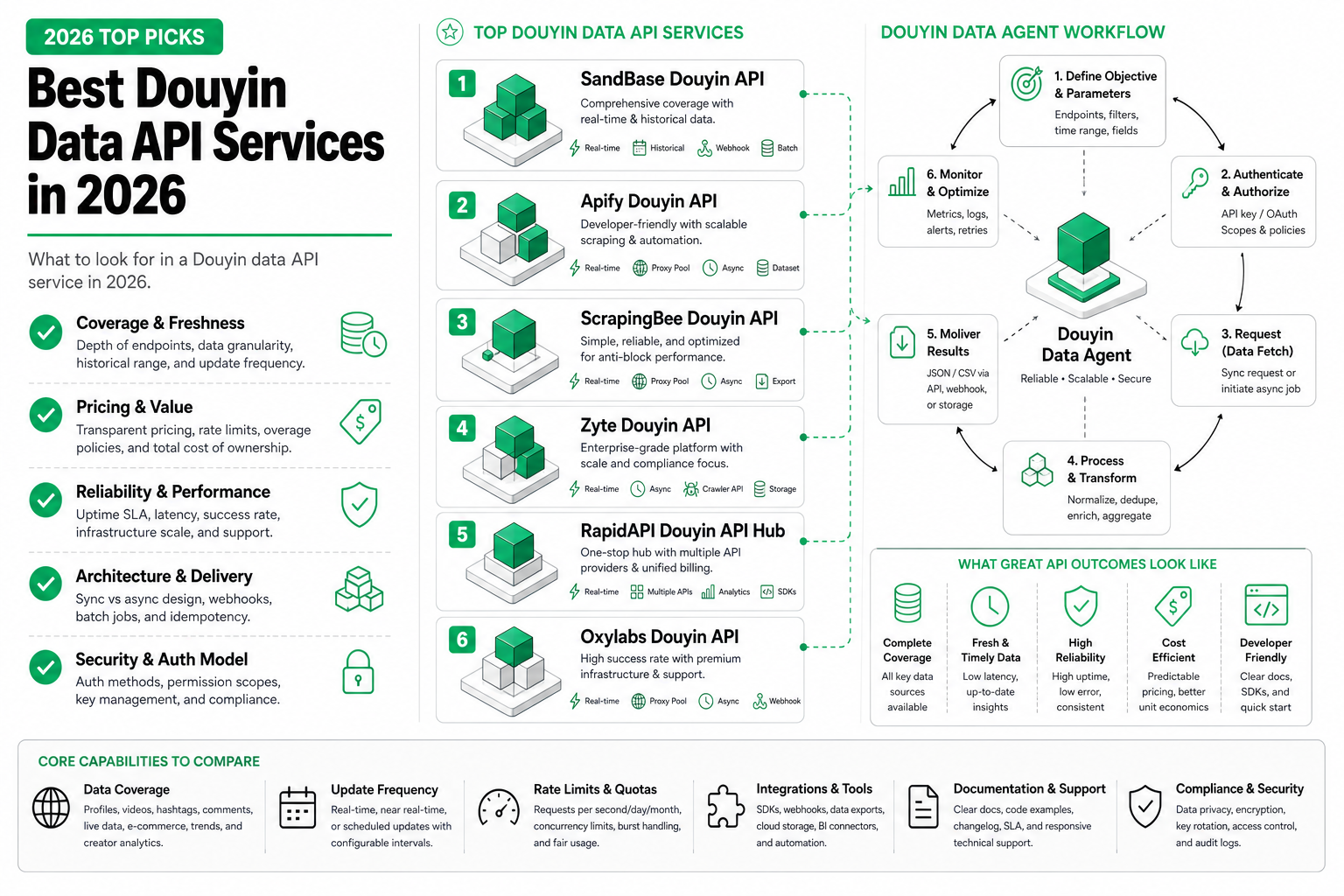
- Best Douyin Data API Services in 2026
- Social Data API vs Web Scraping for Agents (2026)
- Build a Social Listening Agent: Weibo + Douyin
- China Social Commerce Data: The Agent Opportunity
- Build a Social Monitor Agent (OpenAI SDK)
- Weibo & Xiaohongshu Data APIs Now on SandBase
Key takeaways
- The choice between data approaches is primarily an architecture decision, not a vendor comparison — sync vs async shapes your entire agent design
- Dedicated data APIs (300+ ops, $0.001/call, sync) are the only viable option for agents that make frequent decisions on Chinese platform data
- Apify is the practical choice for Instagram, YouTube, and Twitter — but plan for async architecture and 3x cost buffer for retries
- Real production cost for a daily social monitoring agent: $1-$15/month depending on scope — data is cheap, the architecture to use it well is the real investment
- The multiplier comes from the platform layer: contract normalization, skill composition, and observability turn raw API calls into reusable agent capabilities