Best Douyin Data APIs 2026: Services, Price & Comparison
Best Douyin data APIs in 2026: compare services on coverage, price, reliability, sync vs async design, auth, and AI-agent developer fit.
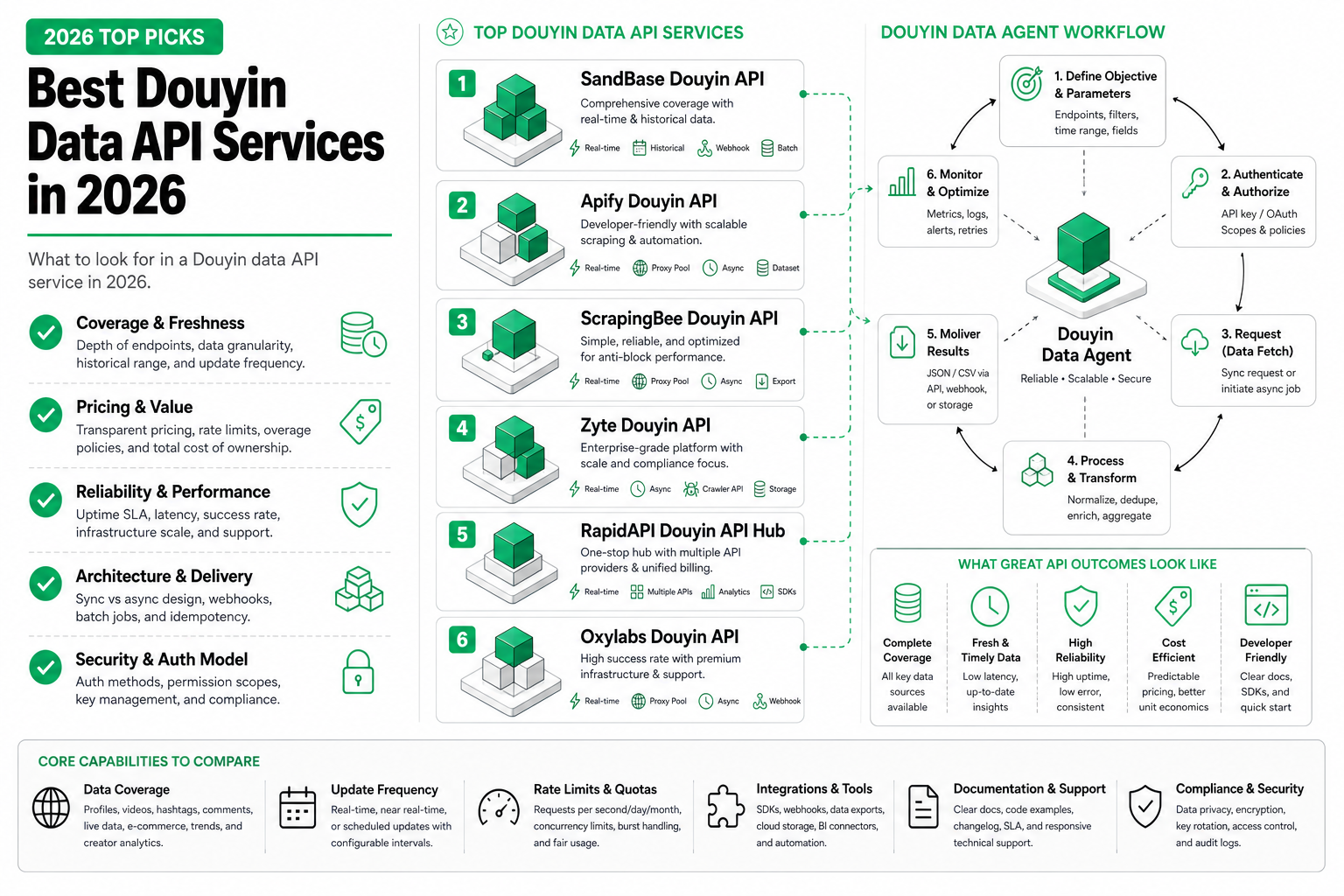
TL;DR — Douyin has no public API for third-party data access. The ecosystem of providers filling this gap varies enormously in coverage (from 20 to 310+ operations), pricing models, reliability, and architecture. This guide evaluates what matters when choosing a Douyin data API — not which provider is “best,” but which criteria matter for your specific use case.
Douyin (抖音) is the largest short-video platform in China with over 700 million daily active users. For AI agents, market researchers, and data-driven applications, accessing Douyin data programmatically is essential — yet ByteDance offers no public REST API for third-party developers.
This creates a market of data API providers, each with different trade-offs. Choosing between them requires understanding what actually matters for your agent architecture, not just comparing feature lists.
Why Douyin data access is hard
Before evaluating services, understand the landscape:
- No official third-party API. ByteDance provides APIs for advertisers (Ocean Engine) and content creators (Douyin Open Platform), but not for general data consumption.
- Aggressive anti-bot measures. Douyin employs sophisticated fingerprinting, rate limiting, and behavioral analysis.
- Multiple data surfaces. Web, mobile app, creator studio, advertising platform, Xingtu (influencer marketplace) — each exposes different data.
- Rapid iteration. ByteDance ships frontend changes weekly, breaking scrapers and unofficial integrations constantly.
- Legal framework. China’s data protection laws require authorized access — providers must navigate PIPL compliance.
The result: building your own Douyin data pipeline is prohibitively expensive and legally risky. Third-party APIs exist because the problem is hard enough to justify specialized services.
Evaluation criteria
Here’s what actually differentiates Douyin data API services:
1. Operation coverage
The most visible differentiator. “Operations” means distinct API endpoints with specific data retrieval capabilities.
| Coverage tier | Operations | Typical data surfaces | Use case fit |
|---|---|---|---|
| Basic | 20–50 | User profiles, basic video info | Simple monitoring |
| Mid-range | 50–150 | + Comments, search, trending | Market research |
| Comprehensive | 150–250 | + Creator data, ads, analytics | Competitive intelligence |
| Full-spectrum | 250–310+ | + Xingtu, DOU+, all channels | Full agent integration |
What to look for: Not just total count, but coverage across specific channels. Douyin’s data is segmented across surfaces:
- Index/Feed — Trending content, recommendations, hashtag pages
- Web — Public profiles, video pages, search results
- App (v3) — Mobile-specific data, engagement metrics
- Billboard — Official rankings, hot topics
- Xingtu — Influencer marketplace data (pricing, audience demographics)
- Creator — Creator-side analytics, content performance
- DOU+ — Advertising metrics, promotion data
- Search — Keyword-based content and user discovery
A service with 100 operations all focused on the web surface may be less useful than one with 80 operations spanning web, app, Xingtu, and creator channels.
2. Pricing model
Three common models exist in the market:
Per-call pricing:
$0.001–0.005 per API call
Pros: Pay only for what you use, predictable unit economics
Cons: High-volume gets expensive
Best for: Agents with variable/unpredictable usage patterns
Subscription tiers:
$99–499/month for X calls included
Pros: Predictable monthly cost, often cheaper at volume
Cons: Waste if usage is variable, cliff pricing at tier boundaries
Best for: Steady-state applications with predictable volume
Credit-based:
Buy credits, spend per operation (different ops cost differently)
Pros: Flexible allocation across expensive/cheap operations
Cons: Complex cost prediction, credits may expire
Best for: Teams using many different operation types
Cost comparison at scale:
| Monthly volume | Per-call ($0.001) | Per-call ($0.003) | Subscription ($299/100K) |
|---|---|---|---|
| 10,000 calls | $10 | $30 | $299 (overpay) |
| 50,000 calls | $50 | $150 | $299 (fair) |
| 100,000 calls | $100 | $300 | $299 (break-even) |
| 500,000 calls | $500 | $1,500 | $999 tier needed |
For AI agents, per-call pricing at $0.001 is generally optimal because agent workloads are bursty and unpredictable. You don’t want to commit to a tier when your agent might need 5,000 calls one week and 50,000 the next.
3. Sync vs async design
This matters enormously for agent architectures.
Synchronous APIs:
- Request → wait → response (200ms–2s)
- Fits directly into agent tool-call patterns
- No webhook infrastructure needed
- Simpler error handling (HTTP status codes)
- Constraint: operations must complete quickly
Asynchronous APIs:
- Request → task ID → poll/webhook → result
- Supports long-running operations (bulk exports, deep crawls)
- Requires callback infrastructure
- More complex agent integration (state machines, polling loops)
- Better for batch workloads
What agents need: Sync for real-time decision loops. If your agent is reasoning about a competitor’s latest video performance, it needs data in the same tool-call round — not in a callback that arrives 30 seconds later.
Most Douyin data operations (user profiles, video stats, comments, search) return in under 2 seconds and are naturally sync. The async model only makes sense for bulk operations like “export all videos from this account” or “crawl all comments on this post with 50,000 replies.”
4. Authentication and access model
How you authenticate shapes your integration architecture:
API key (simple):
Header: Authorization: Bearer sk-xxxxx- Easiest to integrate
- Single credential per team
- Rate limits tied to key
OAuth/Token refresh:
Get token → use until expiry → refresh- More secure for long-running agents
- Adds complexity (token lifecycle management)
- Some providers require this for premium operations
SDK-based:
client = DouyinDataClient(api_key="...", region="cn")
response = client.user.get_profile(user_id="...")- Convenience wrapper
- May abstract away important details
- Lock-in concern if SDK is proprietary
For agent integration, simple API key + REST endpoints is the gold standard. Your agent’s tool-calling mechanism already handles HTTP requests. Adding OAuth token management or SDK dependencies creates unnecessary complexity.
5. Reliability and SLA
Questions to ask any provider:
- What’s the documented uptime SLA? Look for 99.5%+ with credits for downtime.
- How do they handle Douyin-side changes? Platform updates can break data access. Recovery time matters.
- What’s their error rate? Even with 99.9% uptime, individual operations may fail at higher rates.
- Do they have status pages? Transparency about issues indicates maturity.
- What’s the average latency? P50 and P99 matter more than averages.
Red flags:
- No uptime commitment
- “Best effort” language
- No status page or incident history
- Claims of “unlimited” rate limits (nothing is unlimited on Douyin)
6. Data freshness and caching
Not all “real-time” claims are equal:
| Freshness level | Meaning | Typical use |
|---|---|---|
| Real-time | Fresh fetch on each request | Trending detection, live monitoring |
| Near-real-time | Cached 1–5 minutes | Most agent workflows |
| Cached | Cached 15–60 minutes | Batch analytics, reporting |
| Snapshot | Daily/weekly refresh | Historical analysis |
For most agent use cases, near-real-time (1–5 minute cache) is sufficient and significantly cheaper to serve. Only pay for true real-time when your agent genuinely needs to detect changes within seconds.
The market landscape in 2026
Without naming specific providers (the landscape shifts quarterly), here’s how the market segments:
Segment 1: Full-spectrum platforms
- 200–310+ operations
- Multi-platform (Douyin + Weibo + Xiaohongshu + TikTok)
- Unified authentication and billing
- Per-call pricing ($0.001 for most operations)
- Sync-first design
- Target audience: Agent developers, enterprise data teams
SandBase falls in this segment with 310 Douyin operations across 10 channels — including index (72 ops), web (45 ops), app-v3 (40 ops), billboard (32 ops), xingtu-v2 (30 ops), xingtu (28 ops), creator (23 ops), DOU+ (16 ops), creator-v2 (14 ops), and search (10 ops). 79% of operations priced at $0.001/call.
Segment 2: Specialized providers
- 50–150 operations
- Douyin-only or limited platform coverage
- Often subscription-based pricing
- Mix of sync and async
- Target audience: Marketing teams, research firms
Segment 3: Scraping-as-a-service
- Variable coverage (depends on what they can scrape)
- Often async (headless browser behind the API)
- Higher latency (3–10 seconds)
- Lower reliability (85–95% success rate)
- Cheaper at extreme volume
- Target audience: One-off research, price-sensitive users
Segment 4: Official adjacent
- Ocean Engine API (advertising data only)
- Douyin Open Platform (creator tools only)
- Limited to specific use cases
- Requires business verification
- High reliability but narrow scope
Choosing by use case
For AI agent development
Priority order: Sync design → Coverage → Per-call pricing → Reliability
Agents need sync responses that fit tool-call patterns. Breadth of operations determines what decisions your agent can make. Per-call pricing matches bursty agent workloads. Reliability must be high enough that your agent can trust the data.
For competitive intelligence
Priority order: Coverage (creator + Xingtu) → Data freshness → Historical data → Pricing
You need creator-side data that competitors can’t see publicly. Freshness determines how quickly you spot trends. Historical data enables trajectory analysis.
For influencer marketing
Priority order: Xingtu coverage → Audience data → Pricing → Bulk capability
The Xingtu marketplace has the data influencer platforms need. Audience demographics are the differentiator. You’ll make many calls evaluating candidates.
For trend detection
Priority order: Billboard + Search coverage → Latency → Real-time freshness → Cost
Speed matters more than breadth. You need trending data fast, and you need search to validate signals.
Integration patterns
Basic: Direct REST calls
import httpx

async def get_douyin_user(user_id: str) -> dict:
    async with httpx.AsyncClient() as client:
        response = await client.get(
            "https://api.example.com/douyin/user/profile",
            params={"user_id": user_id},
            headers={"Authorization": f"Bearer {API_KEY}"}
        )
        response.raise_for_status()
        return response.json()
Agent tool pattern
from openai import OpenAI

tools = [{
    "type": "function",
    "function": {
        "name": "get_douyin_video_stats",
        "description": "Get engagement stats for a Douyin video",
        "parameters": {
            "type": "object",
            "properties": {
                "video_id": {"type": "string", "description": "Douyin video ID"}
            },
            "required": ["video_id"]
        }
    }
}]

# Agent calls this as part of its reasoning loop
# Response comes back sync, agent continues deciding
Batch pattern (for providers supporting it)
async def batch_get_profiles(user_ids: list[str]) -> list[dict]:
    tasks = [get_douyin_user(uid) for uid in user_ids]
    results = await asyncio.gather(*tasks, return_exceptions=True)
    return [r for r in results if not isinstance(r, Exception)]
What to test before committing
- Latency test. Make 100 calls to the most common operation you’ll use. Check P50 and P99.
- Error rate test. Run 1,000 requests. What percentage fail? Are failures retryable?
- Schema stability. Call the same endpoint daily for a week. Does the response structure change?
- Rate limit behavior. What happens when you exceed limits? Graceful 429 or silent drops?
- Edge cases. Try deleted users, private accounts, videos with no comments. How does the API handle them?
- Cost projection. Estimate your monthly volume, multiply by unit price, add 20% buffer for retries.
The ecosystem view
Douyin data APIs don’t exist in isolation. For AI agents working across Chinese social platforms, you likely also need Weibo, Xiaohongshu, and possibly TikTok data. Choosing a provider that covers multiple platforms with consistent interfaces reduces your integration burden and simplifies your agent’s tool definitions.
A unified platform approach means:
- One authentication mechanism for all platforms
- Consistent error handling patterns
- Single billing relationship
- Cross-platform data correlation without schema mapping
This is the advantage of ecosystem platforms over specialized single-platform providers — not that any individual endpoint is better, but that the integration overhead is amortized across your entire data surface.
Related Reading
- Build a Douyin Competitor Monitor Agent
- 310 Douyin Data APIs Now Available on SandBase
- Top 5 Social Media Data APIs for AI Agents (2026)
- Social Data API vs Web Scraping for Agents (2026)
- China Social Commerce Data: The Agent Opportunity
- Build a Social Listening Agent: Weibo + Douyin
Conclusion
The “best” Douyin data API depends entirely on what you’re building. For agent developers: prioritize sync design, per-call pricing, and operation breadth across channels. For researchers: prioritize data freshness and historical depth. For marketers: prioritize Xingtu coverage and audience data.
The market is maturing. In 2024, options were limited and unreliable. In 2026, you can find services with 300+ operations, sub-second latency, 99.5% uptime, and $0.001/call pricing. The hard part is no longer “can I get Douyin data programmatically?” — it’s “which service matches my architecture and use case?”
Evaluate against the six criteria above, run the tests described, and choose the provider whose strengths align with your highest-priority needs.