Social Data API vs Web Scraping for Agents (2026)
A deep architectural comparison of structured API access vs web scraping for AI agents consuming social media data in 2026. When each wins, what breaks, and how to choose.
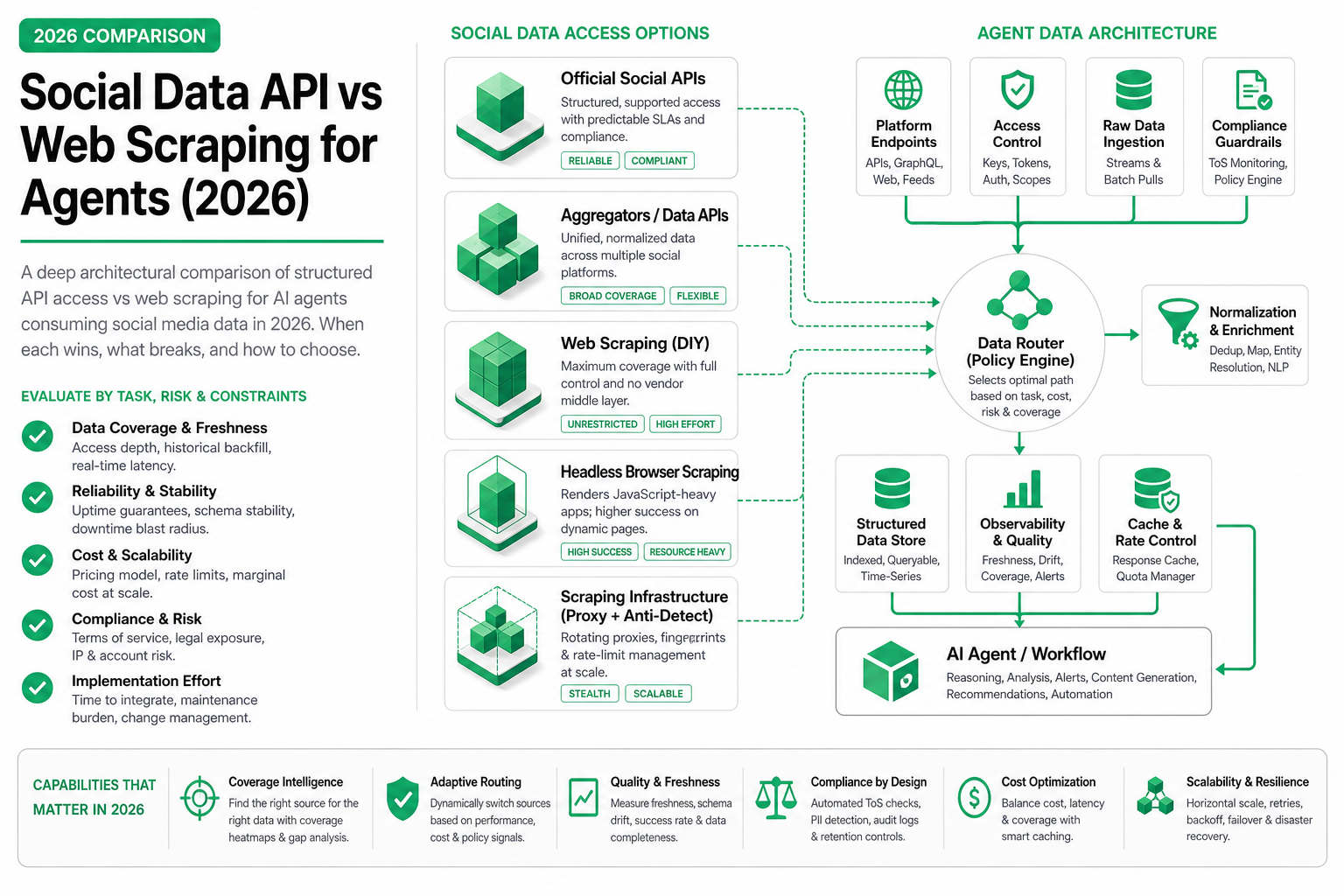
TL;DR — Two fundamentally different architectures for getting social data into your agent: structured APIs (predictable, fast, rate-governed) vs web scraping (flexible, fragile, legally murky). The choice is not philosophical — it determines your agent’s reliability ceiling, cost floor, and legal exposure. This guide evaluates both paths across five dimensions with real numbers.
Your agent needs social media data. The question is not whether to get it — it’s how. And the two dominant architectural paths (structured data APIs vs web scraping) produce such different reliability and cost profiles that choosing wrong can make an otherwise excellent agent unusable in production.
This is not a product comparison. It’s an architecture decision. Like choosing between a managed database and flat files — both can store data, but the operational characteristics diverge so sharply that the choice shapes everything downstream.
The two paths, precisely defined
Path A: Structured Data APIs. A third-party service maintains authenticated access to platform data and exposes it through documented REST endpoints. You send a request with parameters, receive JSON back. The service handles authentication, rate limiting, and schema maintenance.
Path B: Web Scraping. Your agent (or a scraping service) renders platform pages in a headless browser, extracts data from the DOM or intercepts network requests, and parses the results into a usable format. You handle anti-bot evasion, session management, and schema changes.
Both paths ultimately deliver JSON to your agent’s decision loop. The difference is everything between “agent needs data” and “agent has data.”
Dimension 1: Reliability and uptime
This is where the paths diverge most dramatically for agent architectures.
| Metric | Structured API | Web Scraping |
|---|---|---|
| Typical uptime | 99.5–99.9% | 85–95% |
| Response consistency | Fixed JSON schema | Schema drift weekly |
| Failure mode | HTTP error codes, retryable | Silent data corruption |
| Recovery time | Provider fixes, minutes to hours | You fix selectors, hours to days |
| Agent impact of failure | Graceful degradation possible | Cascading parse errors |
The critical difference for agents: API failures are explicit. You get a 429 or 503, your retry logic handles it, your agent waits and continues. Scraping failures are often silent — the page structure changes, your parser returns wrong data, and your agent makes decisions on garbage inputs without knowing it.
For an agent making 1,000 decisions per day based on social data, even 95% scraper reliability means 50 decisions made on potentially corrupted data every day. A structured API at 99.5% uptime means 5 failed requests that your agent can identify and handle.
Real scenario: Douyin competitor monitoring
An agent monitoring 50 competitor accounts needs fresh engagement metrics daily. With a structured API, this is 50 synchronous calls, each returning a fixed schema. Total time: ~10 seconds. With scraping, it’s 50 browser sessions, each requiring login state, page render wait, and DOM parsing. Total time: 3–8 minutes — and any platform UI change breaks all 50.
Dimension 2: Legal and compliance risk
This dimension matters more in 2026 than it did in 2023, because enforcement has caught up.
Structured APIs:
- Operate under the data provider’s terms of service and legal agreements
- Provider assumes responsibility for data access legality
- Clear data licensing terms
- GDPR/PIPL compliance handled by provider
- Audit trail: you have invoices proving authorized access
Web Scraping:
- Legal status varies by jurisdiction (US: hiQ v. LinkedIn precedent allows some public data scraping; EU: GDPR complicates personal data; China: PIPL and anti-unfair competition law create significant risk)
- No contractual relationship with the platform
- Terms of service violations are common
- Personal data handling obligations fall entirely on you
- No audit trail beyond your own logs
For agents deployed in enterprise settings, the legal dimension often makes the decision alone. A legal team that approves “we use a licensed data API” will not approve “we scrape social media platforms in apparent violation of their ToS.”
China-specific considerations
China’s Personal Information Protection Law (PIPL) and the Anti-Unfair Competition Law create a particularly hostile environment for scraping Chinese social platforms. Court cases in 2024-2025 established that scraping Douyin and WeChat data without authorization can result in significant liability. Structured APIs from authorized providers are not just technically simpler — they’re a legal necessity for serious deployments.
Dimension 3: Cost structure
The cost comparison is more nuanced than “APIs cost money, scraping is free.”
Structured API cost model
Cost per data point = API call price
Example (Douyin user profile): $0.001 per call
1,000 profiles/day = $1.00/day = $30/month
10,000 profiles/day = $10/day = $300/month
Predictable. Linear. No infrastructure cost.
Web scraping cost model
Infrastructure:
  - Proxy pool: $200–500/month (residential proxies for anti-bot evasion)
  - Browser farm: $100–300/month (headless Chrome instances)
  - IP rotation service: $50–150/month

Engineering:
  - Initial development: 40–80 hours
  - Ongoing maintenance (selector fixes): 8–16 hours/month
  - Anti-bot adaptation: 4–8 hours/month

Operational:
  - Monitoring and alerting: $50/month
  - Failed request waste: 10–20% of compute

Total for 10,000 profiles/day:
  Infrastructure: ~$500/month
  Engineering: ~$3,000/month (at $150/hr contractor rate)
  Total: ~$3,500/month
At scale, scraping is often more expensive than structured APIs when you account for engineering time. The crossover point varies, but for Chinese social platforms where APIs are priced at $0.001/call, scraping almost never wins on cost.
Break-even analysis
| Daily volume | API cost/month | Scraping cost/month | Winner |
|---|---|---|---|
| 100 calls | $3 | $800+ | API |
| 1,000 calls | $30 | $1,200+ | API |
| 10,000 calls | $300 | $3,500+ | API |
| 100,000 calls | $3,000 | $5,000+ | API |
| 1,000,000 calls | $30,000 | $12,000+ | Scraping* |
*Only if you have dedicated engineering staff already on payroll and the platform doesn’t actively fight your scrapers.
Dimension 4: Speed and latency
Agent architectures are latency-sensitive. An agent in a decision loop cannot wait 30 seconds for data.
| Metric | Structured API | Web Scraping |
|---|---|---|
| P50 latency | 200–500ms | 3–8 seconds |
| P99 latency | 1–3 seconds | 15–45 seconds |
| Parallelism | Limited by rate limits | Limited by proxy pool |
| Burst capacity | Rate limit headers tell you | Trial and error |
| Timeout strategy | Standard HTTP timeouts | Complex (page load + render + parse) |
For an agent that needs to make real-time decisions — like responding to a trending topic within minutes — the latency difference is decisive. A structured API can fetch 100 data points in parallel in under 2 seconds. A scraper needs 100 browser sessions, proxy rotation, and page renders, taking 30–120 seconds for the same data.
Sync vs async implications
Structured APIs (especially at the sync-only design pattern) integrate directly into agent tool-call flows. The agent calls a function, gets JSON, continues reasoning. No polling, no callbacks, no state management.
Scraping requires async patterns: launch browser, wait for page, extract data, close browser. This means your agent either blocks (slow) or manages concurrent state (complex). Both are worse than a synchronous API call.
Dimension 5: Data coverage and flexibility
This is where scraping has a genuine advantage — in theory.
Structured API strengths:
- Curated data points with documented semantics
- Consistent schema across time
- Aggregated metrics (engagement rates, growth trends)
- Historical data where available
- Cross-platform normalization (see how 431 heterogeneous APIs get normalized into one contract)
Web scraping strengths:
- Access to any visible data on the page
- UI-level detail (layout, visual context)
- Data not exposed through any API
- No dependency on a third party’s endpoint roadmap
- Custom extraction logic for niche data
In practice, the flexibility advantage of scraping is smaller than it appears. Most agent use cases need structured, repeated access to the same data types — exactly what APIs optimize for. The “I need one weird data point” scenario exists but rarely justifies building scraping infrastructure.
When scraping wins
To be fair, there are legitimate scenarios where scraping is the right choice:
-
No API exists. Some platforms have no third-party data APIs. If you need Instagram Story view counts and no API provides them, scraping is the only path.
-
One-time research. If you need a dataset once for training or analysis, the ongoing maintenance cost of scraping doesn’t apply.
-
Visual/layout data. If your agent needs to understand how content is displayed (ad placements, UI patterns), APIs can’t provide this.
-
Extremely high volume with simple data. At millions of requests per day for simple public data points, scraping can be cheaper — if you have the engineering team.
When APIs win
For most agent architectures, structured APIs are the better path:
-
Production agents with SLAs. If your agent must work reliably, an API’s uptime guarantee beats scraping’s fragility.
-
Real-time decision loops. Sub-second latency requirements eliminate scraping entirely.
-
Chinese platforms. Legal risk, anti-bot sophistication, and $0.001/call pricing make scraping economically irrational.
-
Teams without scraping expertise. Building and maintaining scraping infrastructure is a specialized skill. APIs are commoditized.
-
Compliance-sensitive deployments. Enterprises, regulated industries, anything that needs an audit trail.
Architecture implications for agent developers
The choice between APIs and scraping ripples through your entire agent architecture:
With structured APIs:
# Agent tool definition — simple, synchronous
async def get_douyin_user_metrics(user_id: str) -> dict:
    response = await client.get(f"/douyin/user/profile", params={"user_id": user_id})
    return response.json()  # Fixed schema, always works
With scraping:
# Agent tool definition — complex, fragile
async def get_douyin_user_metrics(user_id: str) -> dict:
    browser = await launch_browser(proxy=get_rotating_proxy())
    try:
        page = await browser.new_page()
        await page.goto(f"https://www.douyin.com/user/{user_id}")
        await page.wait_for_selector(".user-stats", timeout=10000)
        # Parse DOM — breaks when Douyin changes their frontend
        followers = await page.query_selector(".follower-count")
        likes = await page.query_selector(".like-count")
        # ... 20 more lines of fragile DOM parsing
    except TimeoutError:
        # Anti-bot triggered? Proxy banned? Page redesigned?
        return None  # Agent now has to handle missing data
    finally:
        await browser.close()
The API path gives you a simple function that fits cleanly into any agent framework’s tool-calling pattern. The scraping path gives you a brittle, slow, complex function that requires error handling at every step.
The orchestration layer
Platforms like SandBase make the API path even more attractive by providing a unified contract across hundreds of APIs. Instead of integrating with each data provider separately, you get consistent authentication, pricing, and response formats across 571 social data operations spanning Douyin, Weibo, Xiaohongshu, and TikTok.
This matters for agent developers because it means your tool definitions stay simple regardless of how many data sources your agent uses. One authentication method, one error format, one billing model — and the platform handles the upstream complexity.
Decision framework
Use this flowchart for your architecture decision:
- Does a structured API exist for your data need? If no → scraping is your only option.
- Is your use case production/recurring? If yes → API (maintenance cost of scraping is prohibitive).
- Do you need sub-second latency? If yes → API (scraping cannot meet this requirement).
- Are you accessing Chinese platforms? If yes → API (legal risk + $0.001/call makes scraping irrational).
- Is your volume > 1M calls/day with dedicated engineering? If yes → scraping may be cheaper (do the math).
- Do you need visual/layout data? If yes → scraping (APIs don’t capture presentation).
For the vast majority of agent developers building production systems that consume social media data, structured APIs are the correct architectural choice. The reliability, speed, legal clarity, and simplicity advantages compound over time, while scraping’s flexibility advantage rarely justifies its operational burden.
Related Reading
- Top 5 Social Media Data APIs for AI Agents (2026)
- Best Douyin Data API Services in 2026
- Why Sync-Only is the Right Default for Data APIs
- Normalizing 571 APIs into One Agent Contract
- China Social Commerce Data: The Agent Opportunity
- Build a Social Listening Agent: Weibo + Douyin
Conclusion
This is not a close call for most production agent architectures. Structured APIs win on reliability (99.5% vs 85-95%), latency (200ms vs 5s), legal clarity (licensed vs gray area), and usually cost (when engineering time is included). Scraping wins on flexibility and — at extreme scale with existing teams — raw unit economics.
The agent ecosystem is moving toward API-first data access because agents need predictable, fast, structured inputs. The scraping era was appropriate when humans could review and correct extracted data. Agents can’t. They need data they can trust at the speed they operate. That means APIs.