China Social Commerce Data: The Agent Opportunity
China's $700B+ social commerce market represents the largest untapped opportunity for AI agents — but structured data access is the bottleneck. An industry analysis of the data landscape and agent opportunity.
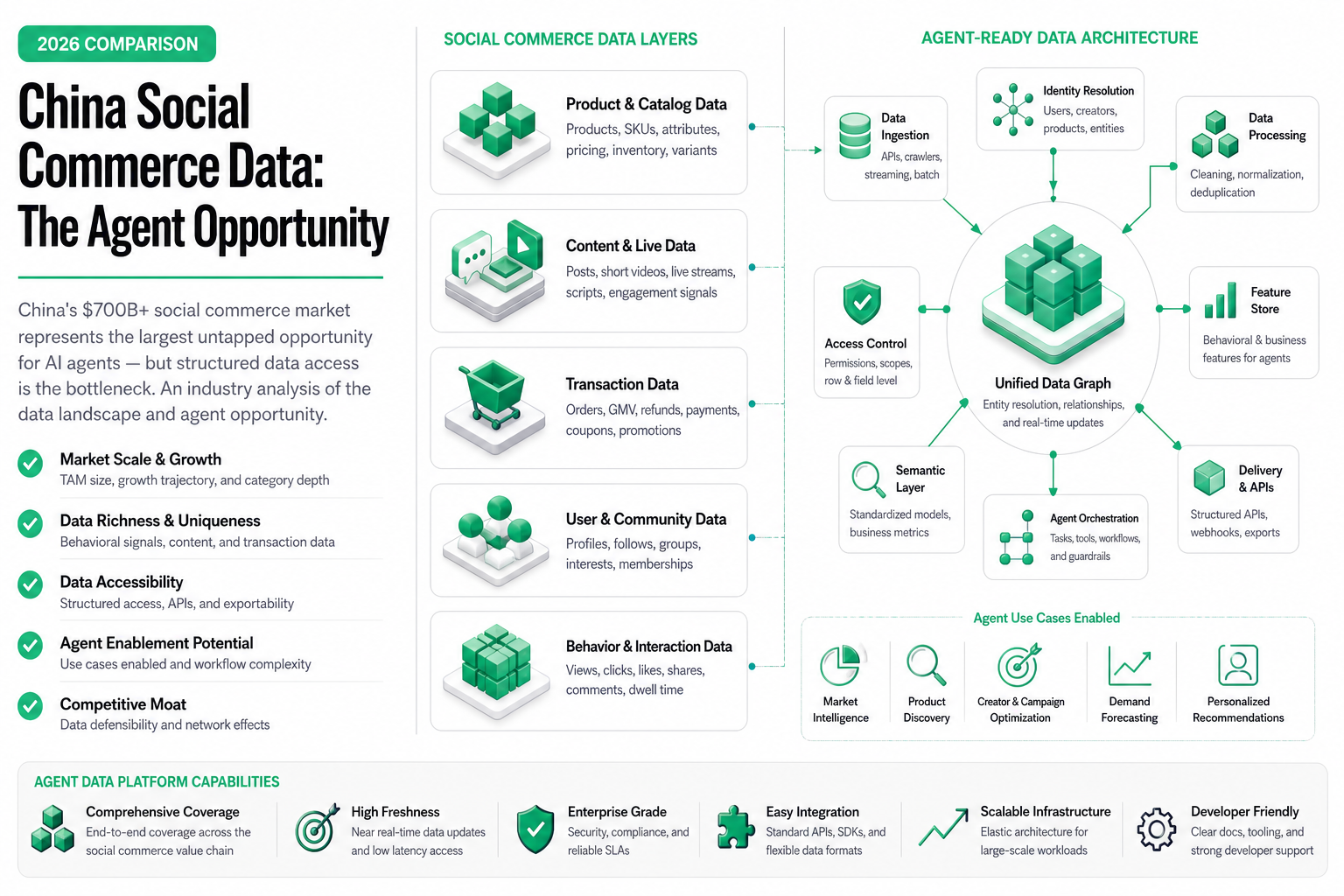
TL;DR — China’s social commerce market exceeds $700 billion annually. AI agents could transform how brands, creators, and platforms operate within it — but only if they can access structured data from Douyin, Xiaohongshu, and Weibo at machine speed. The data is there. The bottleneck is access architecture. This is the opportunity.
The market: $700B and growing
China’s social commerce market — where discovery, content, and purchase happen within the same platform — hit approximately $720 billion in GMV in 2025 and is projected to exceed $850 billion by end of 2026. For context, that’s larger than the entire US e-commerce market was in 2022.
The key platforms:
| Platform | Est. Commerce GMV 2025 | Primary model | Monthly active users |
|---|---|---|---|
| Douyin (抖音) | $300B+ | Live commerce + short video | 700M+ |
| Xiaohongshu (小红书) | $50B+ | Content-driven discovery | 300M+ |
| Kuaishou (快手) | $150B+ | Live commerce | 600M+ |
| Weibo (微博) | $15B+ | Celebrity/brand endorsement | 580M+ |
| WeChat (微信) | $200B+ | Mini-programs, private traffic | 1.3B+ |
These aren’t just social platforms with a “buy” button. They are fully integrated commerce ecosystems where:
- Content is the storefront
- Engagement metrics are purchase signals
- Creator influence is distribution
- Algorithmic recommendation is merchandising
Why agents need this data
Traditional analytics tools for Chinese social commerce have a fundamental limitation: they assume a human will review dashboards, interpret trends, and make decisions. This creates a bottleneck that scales linearly with team size.
AI agents break this constraint. An agent can:
- Monitor 10,000 SKUs across Douyin shops — detecting price changes, review sentiment shifts, and stock signals in real-time
- Evaluate 500 KOLs per hour for campaign fit based on audience overlap, content style, engagement authenticity, and historical conversion rates
- Detect trending products before they peak by cross-referencing Xiaohongshu mentions, Douyin video engagement velocity, and Weibo sentiment
- Optimize live commerce schedules by analyzing historical viewership patterns, competing streams, and audience availability
Each of these requires structured, programmatic, real-time access to platform data. Not screenshots. Not CSV exports. Not weekly reports. JSON at agent speed.
The data landscape: What’s available
Douyin commerce data
Douyin’s commerce ecosystem is the largest and most data-rich:
Creator/influencer data:
- Follower demographics (age, gender, city tier)
- Content performance metrics (views, engagement rate, completion rate)
- Commerce conversion signals (product link clicks, cart additions)
- Star Atlas (Xingtu) pricing and collaboration history
- Live stream performance (peak viewers, duration, sales volume estimates)
Product/shop data:
- Shop ratings and review counts
- Product listing details (price, category, variants)
- Sales velocity estimates
- Review sentiment distribution
- Return rate signals
Trend/discovery data:
- Billboard rankings (multiple categories, updated hourly)
- Hashtag volume and growth velocity
- Search trends and related keywords
- Content recommendation signals
Available via structured APIs: Approximately 310 operations across Douyin’s data surfaces, covering index, web, app, billboard, Xingtu, creator, DOU+, and search channels. Most accessible at $0.001/call through ecosystem platforms.
Xiaohongshu commerce data
Xiaohongshu is the “discovery engine” of Chinese social commerce. Users research products here before buying anywhere:
Content data:
- Note performance (likes, saves, comments — saves are the strongest purchase signal)
- Product tags and mentions within content
- User-generated review content and sentiment
- Trending topics and seasonal patterns
Creator data:
- Engagement authenticity scores
- Audience quality metrics
- Content category distribution
- Brand collaboration history
Commerce signals:
- Product mention frequency and growth
- Price sensitivity indicators from comments
- Purchase intent language in discussions
- Cross-platform purchase journey signals
Available via structured APIs: ~36 operations across app and web surfaces, priced at $0.001–$0.02/call.
Weibo commerce data
Weibo serves as the sentiment layer — where public opinion forms and brand crises emerge:
Sentiment data:
- Real-time discussion volume per topic/brand
- Sentiment polarity distribution
- Key opinion leader amplification patterns
- Crisis detection signals (sudden negative volume spikes)
Celebrity/brand data:
- Endorsement performance metrics
- Fan engagement patterns
- Campaign reach and resonance
- Cross-brand competitor share of voice
Available via structured APIs: ~64 operations across web and app surfaces, all at $0.001/call.
The bottleneck: Data access architecture
Here’s the fundamental problem: the data exists, but it’s trapped in platform silos with no native programmatic access for third-party agents.
What doesn’t work
Manual export: Teams of analysts copying data from platform dashboards. Scales at O(n) with team size. Introduces hours/days of latency. Agents can’t use it.
Browser automation: Headless browsers scraping platform UIs. Fragile (breaks weekly), slow (seconds per request), legally questionable (PIPL violations), and impossible to maintain across platform updates.
Official APIs (limited scope): ByteDance’s Ocean Engine API gives advertisers their own campaign data. Douyin Open Platform gives creators their own analytics. Neither provides the competitive intelligence, market-level, or cross-account data that agents need for strategic decisions.
What works
Structured third-party data APIs — services that maintain authorized, reliable access to platform data and expose it through documented REST endpoints. This is the architectural approach that enables agent-speed data access:
# Agent gets competitive intelligence in milliseconds
competitor_data = await api.get("/douyin/user/videos", params={
    "user_id": competitor_id,
    "count": 20
})
# Parse, reason, decide — all in one agent loop iteration
The total addressable surface: 571 operations across Douyin, TikTok, Weibo, and Xiaohongshu, accessible through platforms like SandBase that normalize heterogeneous data sources into consistent interfaces.
Five agent opportunities in China social commerce
Opportunity 1: Product trend detection agent
Problem: Brands discover trending products weeks after they peak. By the time a human analyst spots a Douyin trend, it’s already saturated.
Agent architecture:
Every 15 minutes:
  1. Scan Douyin billboard for rising products
  2. Cross-reference with Xiaohongshu mention velocity
  3. Check Weibo sentiment for early negative signals
  4. Score trend strength (volume × acceleration × sentiment)
  5. Alert if score exceeds threshold AND market isn't saturated
Data requirements:
- Douyin billboard API (32 operations)
- Xiaohongshu search/trending
- Weibo topic sentiment
- Historical baselines for scoring
Market size: Every brand selling into China needs this. Estimated market for social commerce intelligence tools: $2-5B/year.
Opportunity 2: KOL selection and vetting agent
Problem: Brands evaluate influencers manually using platform-provided metrics that don’t capture audience quality or commerce potential. Fake followers inflate perceived value.
Agent architecture:
Given: Brand brief (product, target audience, budget)
For each candidate KOL:
  1. Pull audience demographics from Xingtu
  2. Analyze content-commerce alignment
  3. Detect engagement authenticity (ratio analysis)
  4. Calculate estimated CPM and CPA from historical data
  5. Score and rank against brief requirements
Data requirements:
- Xingtu API (58 operations across v1+v2)
- Creator analytics APIs
- Video engagement detail
- Historical collaboration performance
Market size: Influencer marketing in China is a $25B+ industry. Even 1% efficiency gain from AI vetting justifies significant spend. See our KOL screening agent tutorial for implementation patterns.
Opportunity 3: Live commerce optimization agent
Problem: Live stream scheduling, product ordering, and pricing decisions are made by gut feel. Optimal timing windows are missed. Product sequencing isn’t data-driven.
Agent architecture:
Pre-stream:
  1. Analyze historical viewership patterns for similar creators
  2. Identify competitor streams in same time slots
  3. Recommend optimal start time and duration
  4. Order product catalog by predicted engagement

During stream (near-real-time):
  5. Monitor viewer count trajectory
  6. Detect engagement drops → suggest product switches
  7. Track conversion signals vs baseline
Data requirements:
- Creator performance history
- Live stream scheduling data across competitors
- Real-time engagement metrics
- Product performance data from similar streams
Opportunity 4: Cross-platform price intelligence agent
Problem: The same product appears on Douyin Shop, Xiaohongshu, Tmall, and JD at different prices. Brands lack real-time cross-platform price monitoring.
Agent architecture:
For each monitored SKU:
  1. Track Douyin shop pricing and promotional events
  2. Monitor Xiaohongshu product mentions for price references
  3. Detect unauthorized resellers or gray market
  4. Alert on price undercutting by competitors
  5. Recommend price adjustments based on platform dynamics
Data requirements:
- Douyin shop/product APIs
- Xiaohongshu product search
- Cross-platform product matching (by name, image, or barcode)
Opportunity 5: Social sentiment early warning agent
Problem: Brand crises on Chinese social media escalate from zero to national news in hours. Manual monitoring can’t keep pace.
Agent architecture:
Continuous monitoring:
  1. Track brand/product mentions across Weibo, Douyin, Xiaohongshu
  2. Sentiment analysis on new mentions
  3. Volume anomaly detection (spike = potential crisis)
  4. Escalation scoring (KOL amplification + negative sentiment + volume)
  5. Immediate alert if escalation score crosses threshold
Data requirements:
- Weibo real-time search and trending (64 operations)
- Douyin comment and video mention tracking
- Xiaohongshu note monitoring
- Cross-platform volume aggregation
The economics of agent-powered social commerce
Cost to run a competitive intelligence agent
Hourly monitoring cycle:
  - 50 Douyin profile checks: $0.05
  - 200 video stats updates: $0.20
  - 30 Xiaohongshu searches: $0.30 (at $0.01/call)
  - 20 Weibo sentiment checks: $0.02
  Total per cycle: $0.57

Daily (24 cycles): $13.68
Monthly: ~$410

LLM reasoning cost (GPT-4 class):
  - 100 reasoning calls/day × $0.01 avg: $1/day
  Monthly: ~$30

Total agent operating cost: ~$440/month
Compare this to a human analyst team:
- 1 junior analyst in China: $2,000–3,000/month
- Can cover maybe 20 competitor accounts manually
- Agent covers 50+ accounts with 24/7 monitoring
- Agent never sleeps, never misses a spike, never has bias
ROI: An agent costing $440/month replaces or augments $6,000–10,000/month in human analyst capacity while providing real-time coverage.
Market sizing for agent infrastructure
If 10,000 brands operating in China social commerce each deploy 2-3 agents at $500/month infrastructure cost:
- TAM for data API layer alone: $60-180M/year
- TAM including LLM, orchestration, and tooling: $500M-1B/year
This is conservative. The real market includes agencies, platforms, and tool builders.
What’s needed to unlock the opportunity
1. Broader operation coverage
Current state: 571 operations across 4 platforms. Needed: 1,000+ covering commerce-specific data surfaces (shop analytics, live stream metrics, product catalog data) that are currently underserved.
2. Better cross-platform identity resolution
Agents need to correlate creators and products across platforms. A KOL who’s big on Douyin may also be on Xiaohongshu. Products appear under different names. Identity resolution APIs would unlock cross-platform analytics.
3. Historical data access
Most APIs return current state. Agents making strategic decisions need historical trends — 30/60/90 day trajectories for engagement, follower growth, content output.
4. Event-driven data delivery
Beyond polling, agents benefit from push-based data: webhook notifications when monitored metrics cross thresholds, reducing unnecessary API calls and enabling faster response.
5. Compliance infrastructure
As China’s data protection framework matures, agents need clear data provenance, usage logging, and consent management. This is infrastructure, not feature.
Related Reading
- Top 5 Social Media Data APIs for AI Agents (2026)
- Best Douyin Data API Services in 2026
- Social Data API vs Web Scraping for Agents (2026)
- Xiaohongshu KOL Screening Agent (Tutorial)
- Build a Social Listening Agent: Weibo + Douyin
- Weibo & Xiaohongshu Data APIs Now on SandBase
Conclusion
China’s social commerce market is the largest commerce opportunity that AI agents haven’t yet penetrated at scale. The data exists — hundreds of millions of transactions, billions of content interactions, real-time signals on every product and creator. The bottleneck is not intelligence (LLMs are capable enough) or demand (brands desperately need automated intelligence) — it’s structured data access at agent speed.
The platforms that solve this access layer — providing reliable, fast, compliant, normalized data APIs across Chinese social commerce platforms — will enable the next generation of commerce agents. The opportunity window is now, because:
- Social commerce in China is still growing 20-30% annually
- AI agents reached production readiness in 2025-2026
- First-movers in agent-powered commerce intelligence will have compounding data advantages
- The legal framework (PIPL) is stabilizing, creating clarity for authorized data services
For developers and entrepreneurs: the agent opportunity in China social commerce is architectural, not algorithmic. The hard problem isn’t “build a smarter model” — it’s “get structured data from Douyin, Xiaohongshu, and Weibo into an agent’s decision loop at sub-second latency.” Solve that, and $700B of commerce activity becomes programmable.