Rodin 2.5 Tiers and Export Settings in 2027: 14 Real Runs
Test all nine Rodin 2.5 Fast and Standard Auto tier combinations and compare GLB, OBJ, STL, USDZ and FBX exports at the High 20K preset.
At the Standard High tier, Rodin 2.5 with Auto returned a 500,000-triangle GLB. The same tier with an explicit 20K Triangle request returned 19,588 triangles. Both runs cost $0.48. In a separate group of five format requests at that 20K preset, the OBJ came back with UVs but no material library, while the FBX embedded a texture. Tier, mesh preset and export format are three controls with different consequences for the file you get.
Key takeaway
- The three tested Fast tiers with Auto delivered 18,634 to 19,416 triangles at $0.10 each. Their GLBs ranged from 742,248 to 834,128 bytes.
- Standard Auto landed at 50,000 triangles in three tiers, 500,000 in Medium and High, and 1,000,000 in Extreme-High. The first five Standard tiers cost $0.48 each. Extreme-High cost $0.96.
- At High and explicit 20K, GLB, OBJ, STL, USDZ and FBX were separate generation requests charged $0.48 each. The returned files ranged from 19,588 to 20,000 triangles and carried different material data.
- This batch covered every tier at Auto and every export format at one Standard preset. It used one reference image, with one result per configuration. The 14 settled jobs cost $6.06 on November 14, 2026 UTC.
Choose a route before comparing tier names
Rodin 2.5 Fast on SandBase exposes Minimum, Extreme-Low and Low. Rodin 2.5 Standard also exposes Medium, High and Extreme-High. The Auto mesh budget can differ across routes with the same tier name. When a request is templated, store the route, tier, quality preset, material option and format separately.
For the first nine jobs, we sent one identical 768 × 768 front three-quarter PNG of an authored desktop label printer, seed 42, material: "Shaded", quality_mesh_option: "Auto" and geometry_file_format: "glb". Each route and tier was explicitly selected. HD texture and paid add-ons were left out, and the only variable within each route was the tier. For a previous test that held the 20K preset and PBR constant across the two routes, see Rodin Fast vs Standard. Here Auto and request format are the questions.
| Route and tier | Observed triangles | Original GLB bytes | Shaded image edge | Charge |
|---|---|---|---|---|
| Fast Minimum | 19,416 | 742,248 | 1,024 | $0.10 |
| Fast Extreme-Low | 18,634 | 777,176 | 2,048 | $0.10 |
| Fast Low | 18,918 | 834,128 | 2,048 | $0.10 |
| Standard Minimum | 50,000 | 1,896,224 | 1,024 | $0.48 |
| Standard Extreme-Low | 50,000 | 3,312,504 | 2,048 | $0.48 |
| Standard Low | 50,000 | 3,582,060 | 2,048 | $0.48 |
| Standard Medium | 500,000 | 16,882,788 | 2,048 | $0.48 |
| Standard High | 500,000 | 17,026,608 | 2,048 | $0.48 |
| Standard Extreme-High | 1,000,000 | 31,280,436 | 2,048 | $0.96 |
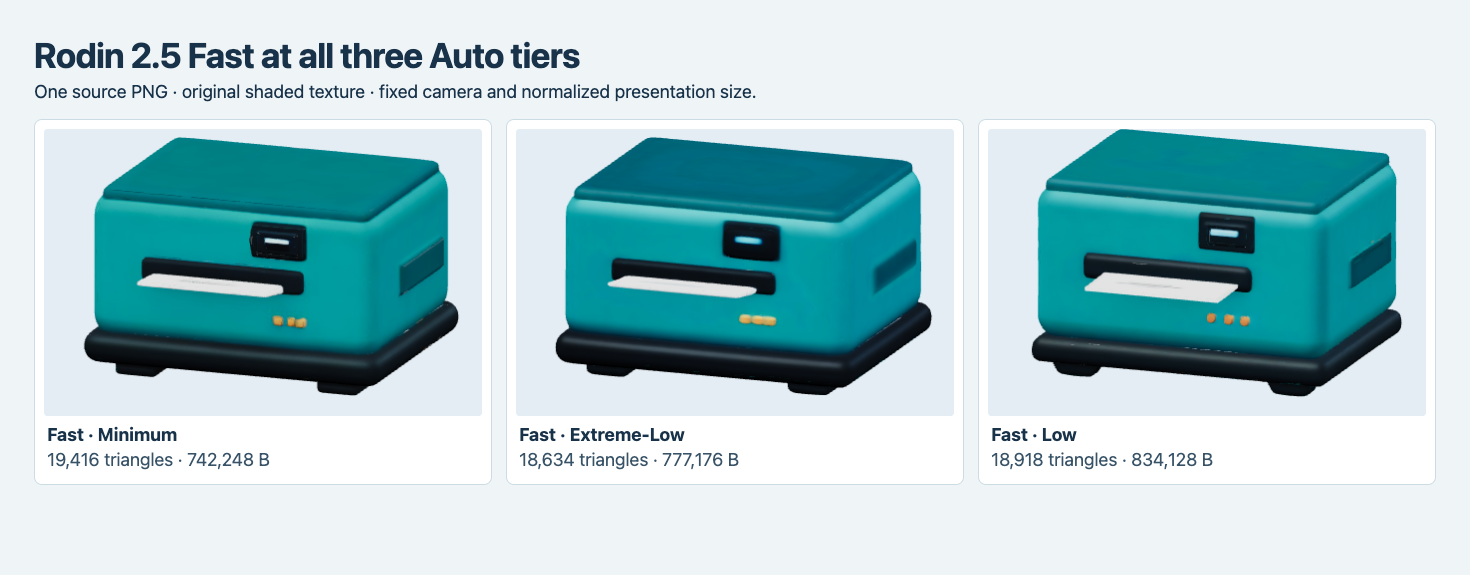
The three Fast jobs used Auto. All show the display, paper slot and color accents. The screen and button outlines vary across the three deliveries.
For the printer, Fast Minimum had the largest triangle count among the three Fast files and the smallest package. It also had the smaller texture. Fast Extreme-Low merged the orange controls into nearly continuous color at this angle. Fast Low showed three more distinct orange spots. A caller that relies on exact controls or marks should still check them on a later attempt. These results come from one shot with each configuration.
Auto can change the geometry budget by a factor of ten
Standard Low and Standard Medium both settled at $0.48. Their triangle counts were 50,000 and 500,000. The two files were 3,582,060 and 16,882,788 bytes. Moving from High to Extreme-High doubled both the observed face count and the job charge, and raised the source package from 17,026,608 to 31,280,436 bytes. Each GLB carried one image referenced through the emissive slot. The single image was 1,024 square on Minimum and 2,048 square on the other tier outputs from the same route. No PBR map suite was requested in this test.
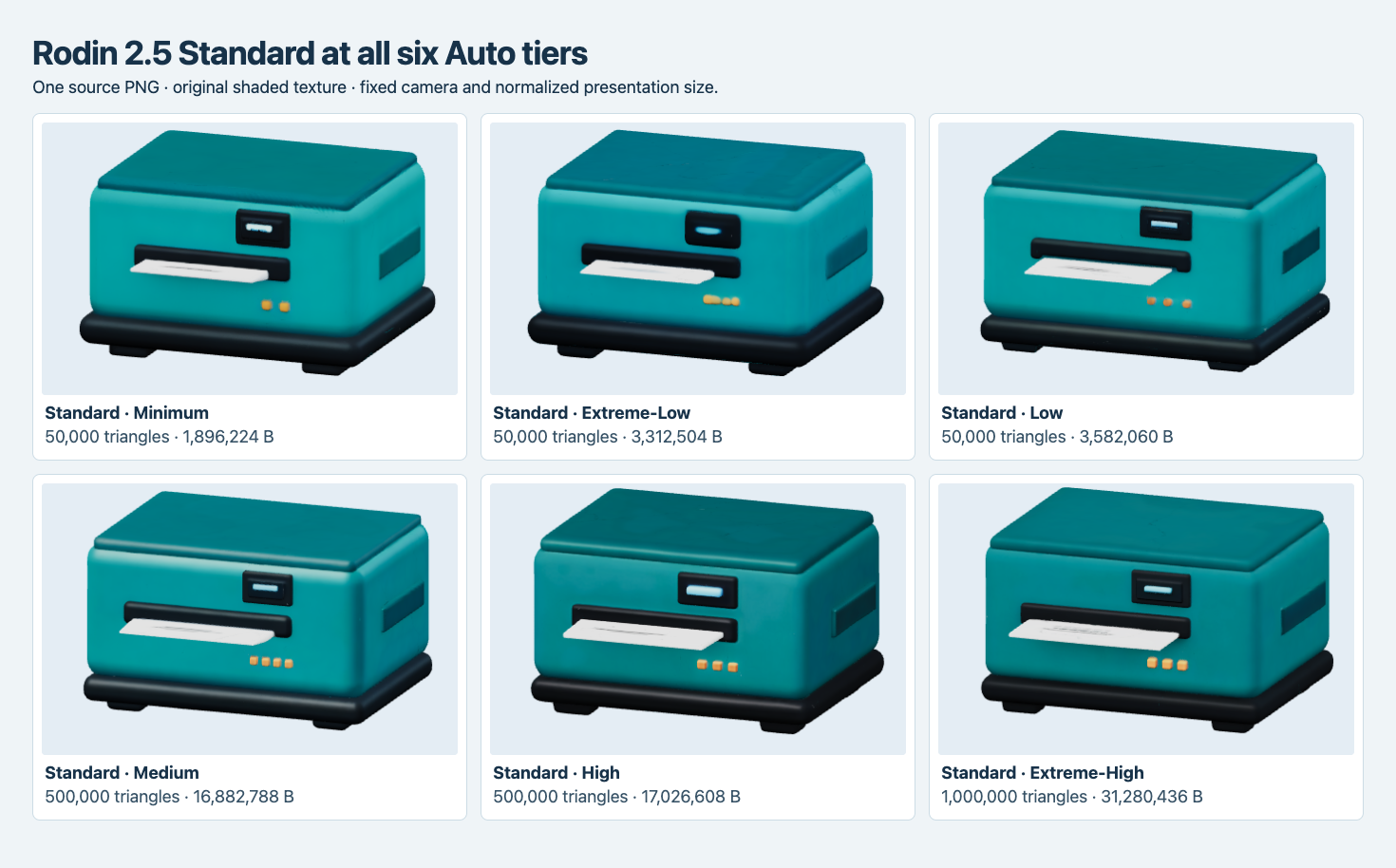
The shape and texture were rendered in the same viewer with a shared camera after centering and normalizing each model by its longest bounding dimension.
Even with the same triangle count, Low and Extreme-Low differed in file size and appearance around the controls. High showed three orange controls, matching the input, while Medium showed four. Both showed the paper slot and rounded shell. Extreme-High gives the variant with the densest geometry, with no claim here that its visual fidelity is twice as high. The screenshots are from a normalized view of an authored prop. They do not measure hidden-surface recovery or the behavior of a large file on a phone. The separate Meshy and Rodin label printer comparison walks through a sized PBR mesh and browser budget.
Pick an explicit mesh preset if a target triangle count matters. Standard High Auto consumed 17,026,608 bytes at 500,000 triangles, while explicit High 20K consumed 910,012 bytes at 19,588, both with Shaded and the same source image. These are independent jobs sharing a seed value. That comparison documents the effect on accepted package size for the observed configurations. It does not establish that 480,412 triangles were removed from the same mesh. Decode the returned asset and enforce your own actual size and triangle limits at ingest.
Export format changes the material handoff
The next five requests fixed Standard High, 20K Triangle, Shaded, seed 42 and the same image. Each requested a different geometry_file_format. We downloaded the one artifact returned by each job. Each request generated and exported its own mesh. Some counts differ below 20,000, so use the results to check what the route delivered for each format. Save one canonical mesh and convert it yourself if the geometry must remain identical across target formats.
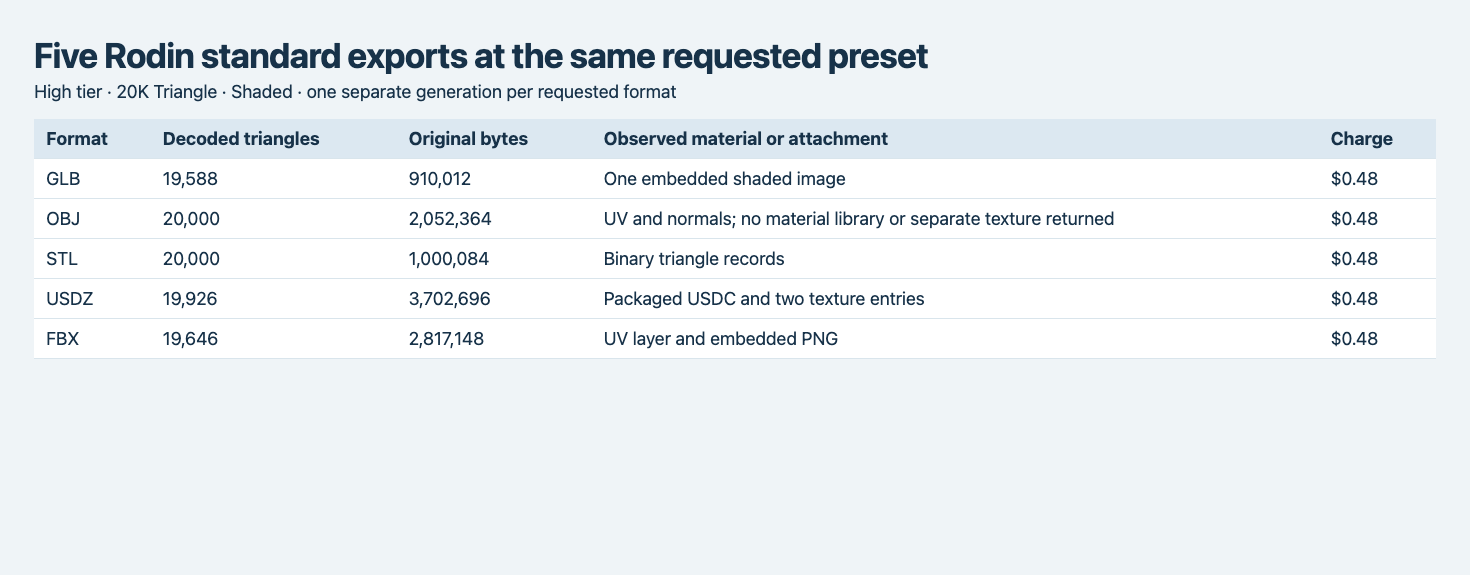
The test decoded the structures of all five files. Each request cost $0.48, or $2.40 for the five jobs. The columns show the actual artifact received.
| Format | Triangles | Original bytes | Observed material handoff |
|---|---|---|---|
| GLB | 19,588 | 910,012 | One embedded 2,048 × 2,048 JPEG attached to emissive |
| OBJ | 20,000 | 2,052,364 | UVs and normals, no material library directive or material assignment |
| STL | 20,000 | 1,000,084 | Binary triangles, all attribute words zero |
| USDZ | 19,926 | 3,702,696 | USDC stage, referenced shaded PNG and a second HDR package entry |
| FBX | 19,646 | 2,817,148 | One UV layer and one embedded media payload |
The OBJ was a readable text mesh with 9,810 vertices, 12,446 UV records and 20,108 normal records. We found no mtllib or usemtl line, and the job returned only that OBJ. Preserve the UVs if an artist will add materials later. If the brief calls for an immediately textured artifact, choose one that actually contains or references the maps.
The STL’s length matches a binary header and 20,000 50-byte triangle records. The raw file has no unit declaration. We rotated it from Z-up for the neutral browser figure. Treat orientation and intended units as two separate import checks before printing. USDZ declared metersPerUnit = 1 in its stage. This is metadata about how unit coordinates are interpreted. The test fixture itself has no certified physical dimensions.
USDZ’s uncompressed package included output_shaded.usdc, textures/shaded.png and one HDR entry. We used usdcat to read the scene and resolve the shaded image path against the package listing. The FBX was binary version 7400, with a UV layer and 2,177,113 bytes of embedded media associated with a path ending in shaded.png. That payload was checked in the file. An application’s default FBX material interpretation can still differ from the viewer’s.
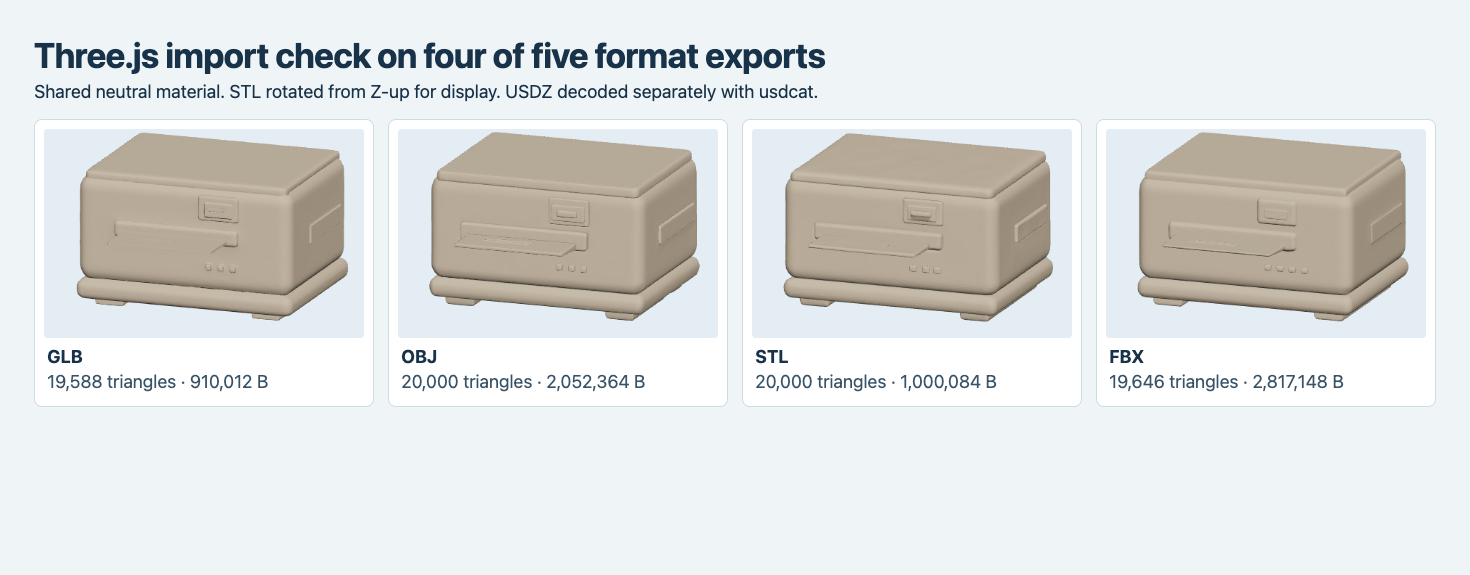
These four outputs were loaded in Three.js under one neutral material. The figure is a geometry import check. USDZ was inspected with the USD tooling.
Record the finished artifact alongside the request
Keep generation and handoff observations on the same item record. Store the reference image hash, endpoint, requested preset and settled charge first. After downloading, add the file hash, triangle count, texture inventory and importer used. When the deliverable goes through a manual materials pass, keep the original and the approved derivative separately so the next operator can tell which preview they are signing off.
For an input comparison at a fixed High tier, see the Rodin text, front-image and paired-image prototype test.
Frequently asked questions
Will every Rodin 2.5 run use the same number of triangles at the same tier?
The mesh preset also matters. On Standard High, Auto delivered 500,000 and the 20K GLB delivered 19,588. For a hard runtime cap, check the exported triangles against a limit after any asset processing.
Does a Shaded request guarantee that every format contains textures?
This run returned an untextured OBJ despite its UVs and normals, and its STL had only geometry records. GLB, USDZ and FBX carried workable texture payloads to inspect. Read the actual bundle inventory and test your target importer.
What would this cost for 100 models?
Multiplying the observed price by a single submission each gives $10 on Fast, $48 on the tested non-Extreme-High Standard tiers or $96 on Standard Extreme-High. Format reruns and post-processing are additional. No paid add-on was used here.
Found this useful? Share it