Best 3D APIs for Batch Web Assets in 2027: 12 Jobs Tested
Compare four image-to-3D APIs on a 12-job web batch. See completion intervals, actual charges, GLB sizes, texture channels and first-frame checks.
Twelve jobs completed, and all twelve browser files loaded. The bill was $2.25. For a batch of three web previews, the usable differences appeared after completion. Rodin 2.5 Fast came in at 3.13 MB for the three files, with the display color carried by an emissive map. TRELLIS cost $0.06 for three, but one equipment case lost a visible button and one robot gained a rectangular panel. Tripo H3.1 delivered 3.33 MB of base-color GLBs. All three opened side-on at our default camera, then showed their recognizable fronts when we moved the camera by a quarter turn.
Key takeaway
- Start with Rodin 2.5 Fast when the approved look is a baked catalog preview. Check the material contract if buyers will change the lighting.
- Start with TRELLIS for inexpensive draft batches. Use an explicit visual checklist on the first representative group and flag any extra geometry.
- Test Tripo H3.1 when the browser needs compact, base-color GLBs. Budget for the queue tail and set a per-asset landing angle.
- Hunyuan 3.1 Rapid delivered a textured OBJ package in all three jobs. Bundle and verify the sidecars, then measure the GLB you actually intend to ship.
Submit a matched batch and measure when it drains
On November 14, 2026 UTC, we submitted the same equipment case, robot and horn ornament to four SandBase image-to-3D routes. The case is the 768 × 768 front render from the multi-view experiment. The other two are public examples. Each request received one image. We sent twelve independent requests in a single client fan-out, with three jobs per route and no retries in the measured batch.
Hunyuan 3.1 Rapid used the textured path with enable_geometry: false and enable_pbr: false. Rodin 2.5 Fast used Gen-2.5-Extreme-Low at 20K Triangle, Shaded, seed 42 and GLB. TRELLIS used a 1024 texture and seed 42. Tripo H3.1 used a 20,000-face limit, standard geometry and texture settings, seed 42, textures enabled, PBR off and quad off. These are practical route configurations. They differ in their mesh budgets and shading models.
For each run we recorded a client submission time and the time its first completed status response arrived. This interval includes the request, queue, lookup cadence and network overhead. We began status queries about 50 seconds after submission. Rodin and TRELLIS were complete when their first responses arrived at about 52–54 seconds, so the one-second difference between their observed batch endpoints has little meaning. The Tripo case was still running at the lookup started about 324 seconds after submission and was complete by 333 seconds. The other two Tripo results were visible by about 309 seconds. The polling gaps are shown in the figure. During the last job’s completion window the other eleven were already observed complete.
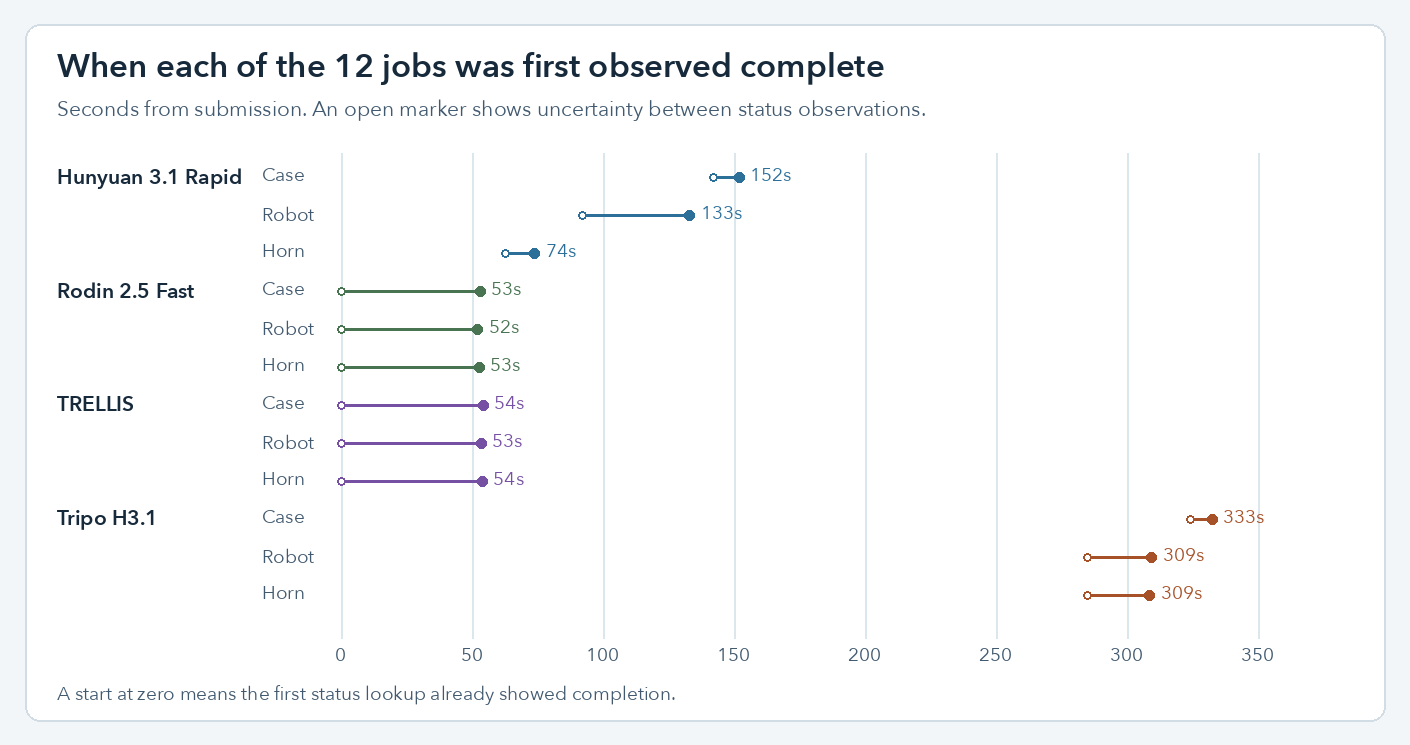
The solid dot marks the first completed response. An open mark at zero means the first lookup already returned completed. The markers bracket what the client observed.
| Route | Completed jobs | Last completion observed | Settled spend for 3 | Original files | Browser GLB total |
|---|---|---|---|---|---|
| Hunyuan 3.1 Rapid | 3/3 | 152 s | $0.81 | OBJ, MTL and PNG, 43.18 MB combined | 49.86 MB after conversion |
| Rodin 2.5 Fast | 3/3 | 53 s | $0.30 | 3 GLBs | 3.13 MB |
| TRELLIS | 3/3 | 54 s | $0.06 | 3 GLBs | 4.41 MB |
| Tripo H3.1 | 3/3 | 333 s | $1.08 | 3 GLBs | 3.33 MB |
Sizes use decimal MB. They count the delivered model files and required sidecars for Rapid, without thumbnails, or the GLB the viewer loaded. They exclude HTTP compression, the viewer bundle, and CDN metadata. These observations come from one simultaneous batch and three assets per route. An earlier set of requests was rejected for lack of account credit before creating any job IDs. Those requests are outside the generation denominator, and all twelve admitted jobs in the measured batch completed.
For a catalog team, the slowest result matters when a release waits for all variants. If a page can ship with a still and pick up its interactive viewer later, persist results as they become available. Keep one generation record per source image and recipe. Store its run ID, downloaded source hash, final asset hash, settled charge and review decision. A status timeout leaves the original outcome unknown, so query the existing run before submitting again. See the batch retry and cost ledger walkthrough.
Inspect the three files you will actually deliver
Rapid’s three OBJ imports each contained 50,000 triangles and a 4096 × 4096 PNG resolved through the MTL. Blender 4.5.9 LTS converted the three untouched packages into self-contained GLBs, preserving the triangle counts. The prior OBJ, MTL and PNG totaled 43,178,371 bytes. The first GLB copies totaled 49,860,416 bytes. Measure the whole package before conversion and the entire GLB after conversion. Comparing OBJ bytes alone to the GLB omits the images the customer needs.
We then resized the three Rapid color maps to 1024 and encoded them as WebP with quality 82. The resulting files were 5,438,824, 5,465,736 and 5,452,336 bytes, with no geometry compression applied. The three resized and re-encoded copies totaled 16.36 MB. Those derivatives are outside the primary screenshot comparison and were not accepted for production. For a separate measured example that includes a Draco decoder and a browser run, see the rotatable GLB guide.
Rodin had 19,206–19,788 triangles per file and embedded one 2048 × 2048 JPEG. The GLBs placed this image in emissiveTexture with an emissive factor of one and a black base color. It gave enough color for the comparison viewer. A material that depends on your scene’s lighting has a different contract. Inspect the mapping before moving a Shaded export to a viewer with rotating key lights or a configurator that replaces the base color. See the glTF material definition.
TRELLIS produced 8,128–23,338 triangles with one 1024 PNG in each GLB. Tripo delivered 14,308–19,832 triangles with one 2048 JPEG. The Tripo files ended up smaller despite their larger texture dimensions. Their JPEGs and TRELLIS’s PNGs account for much of the payload difference. Pixel count and triangle count help describe the asset. Container bytes also depend on image compression and geometry attributes, so record the actual file size.
All twelve browser GLBs had zero errors and warnings from the glTF validator and displayed in Chromium with Three.js. Our render records confirm decoding and framing in that local viewer. The observation intervals above are independent of loading those screenshots. For production, repeat the load test from the published CDN path and exercise the camera before promoting a generated asset.
Use the first frame, then inspect the rest of the turn
The visual screen asked three concrete questions at the native landing camera. Did the equipment case show all three orange buttons? Was the robot clear of a conspicuous separate-looking slab? Did the horn have a recognizable U with two separated prongs? Review also used the 90° and 180° frames to expose geometry outside the first view. All models used the same longest-side framing and lights. The two public example images and the case render provide a reference for the visible features.
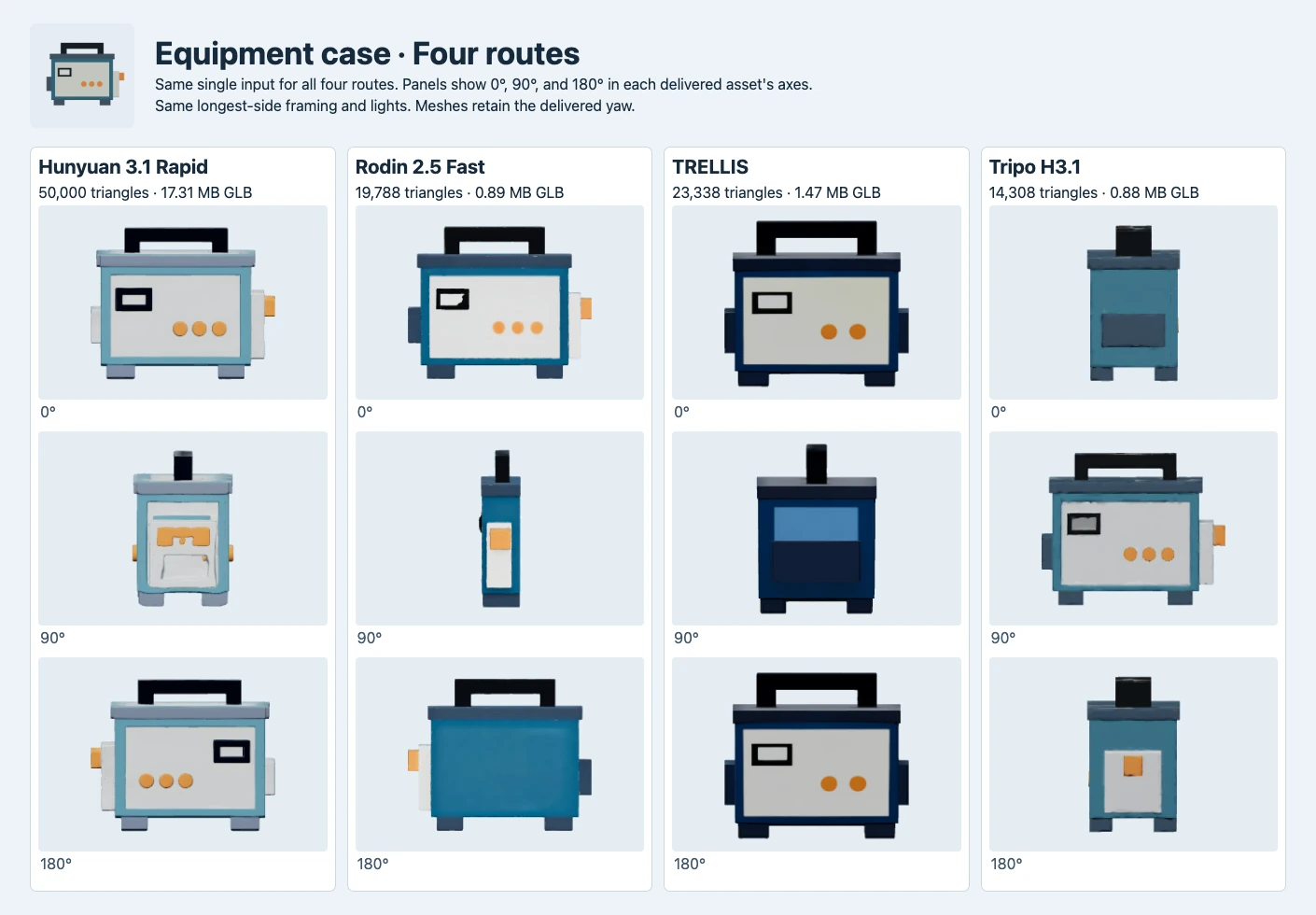
The input shows three buttons. In the native 0° frame, TRELLIS shows two and Tripo shows the side. Tripo’s three buttons are visible at 90°.
Rapid and Rodin passed all three checks at the native landing angle. Their case outputs also show why a checklist matters. In Rapid’s 180° panel, the back has a front-like screen and buttons. Rodin has a conspicuously thin side profile and little clear raised button relief in the neutral view. The brief only counted the three visible buttons. To sell a real enclosure where thickness, controls and rear vents matter, add these criteria and use reference views of those faces.
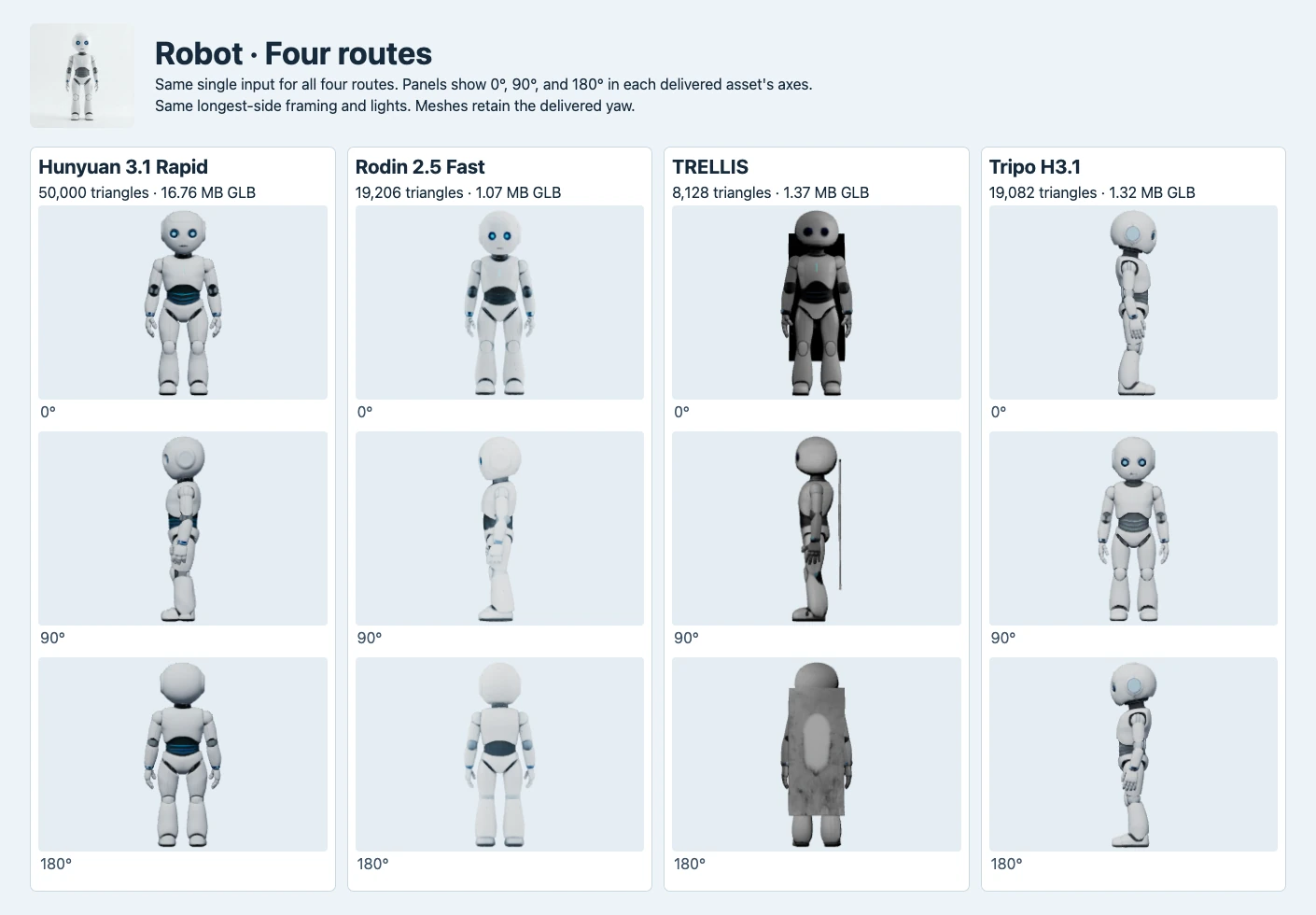
Tripo reveals the robot front at native 90°. The plate behind the TRELLIS robot shows up along the outline and from the side.
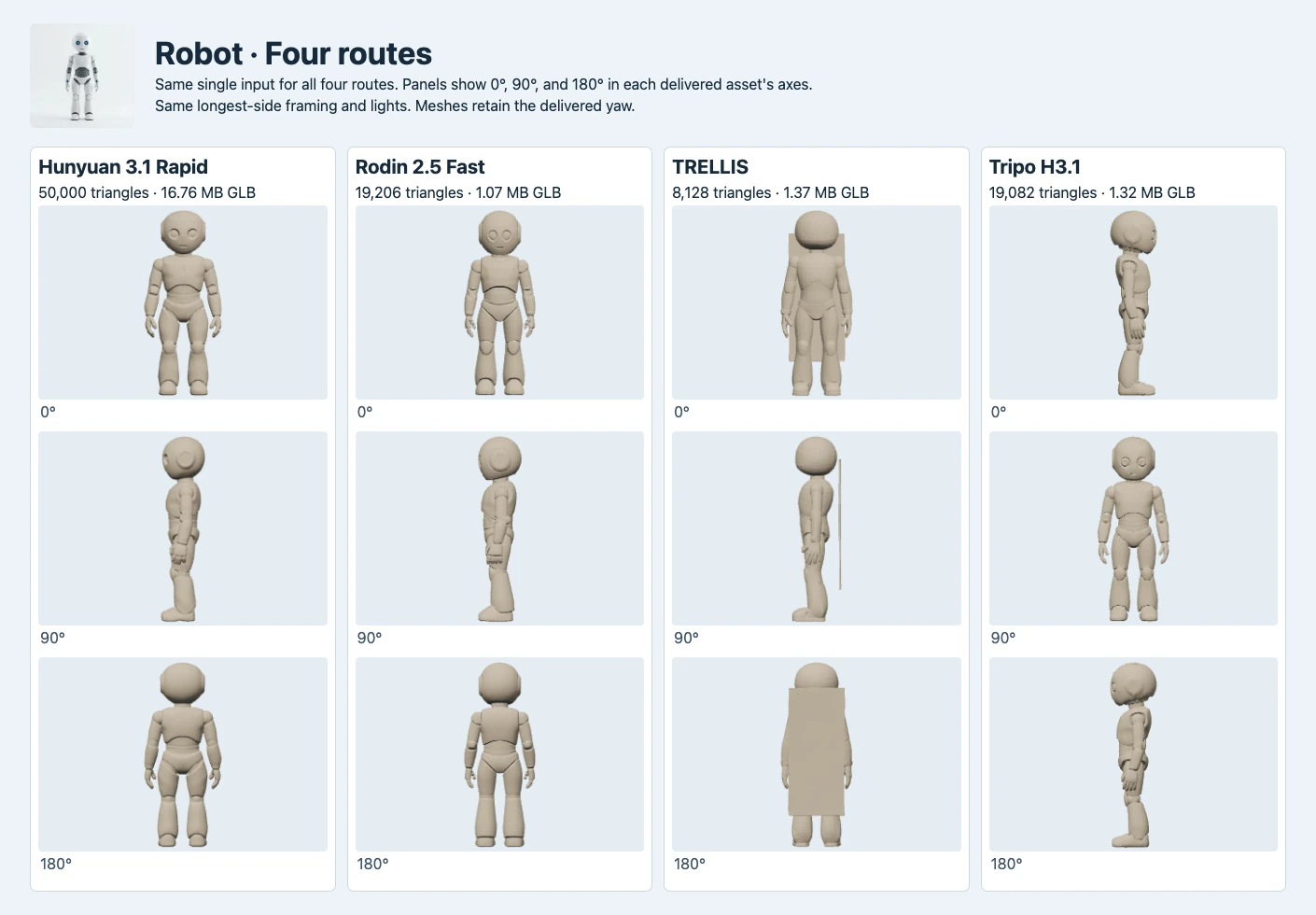
Neutral material removes the color explanation. The same panel appears edge-on at 90° and obscures the body at 180° in the TRELLIS result.
TRELLIS passed one of three native checks. Its robot’s panel remains when the materials are replaced. The horn still has two prongs, with the curved and narrower prongs appearing on opposite sides from the input at the native landing view. The count accepts the basic U silhouette. A brief with a fixed handedness requirement would make this horn fail as well.
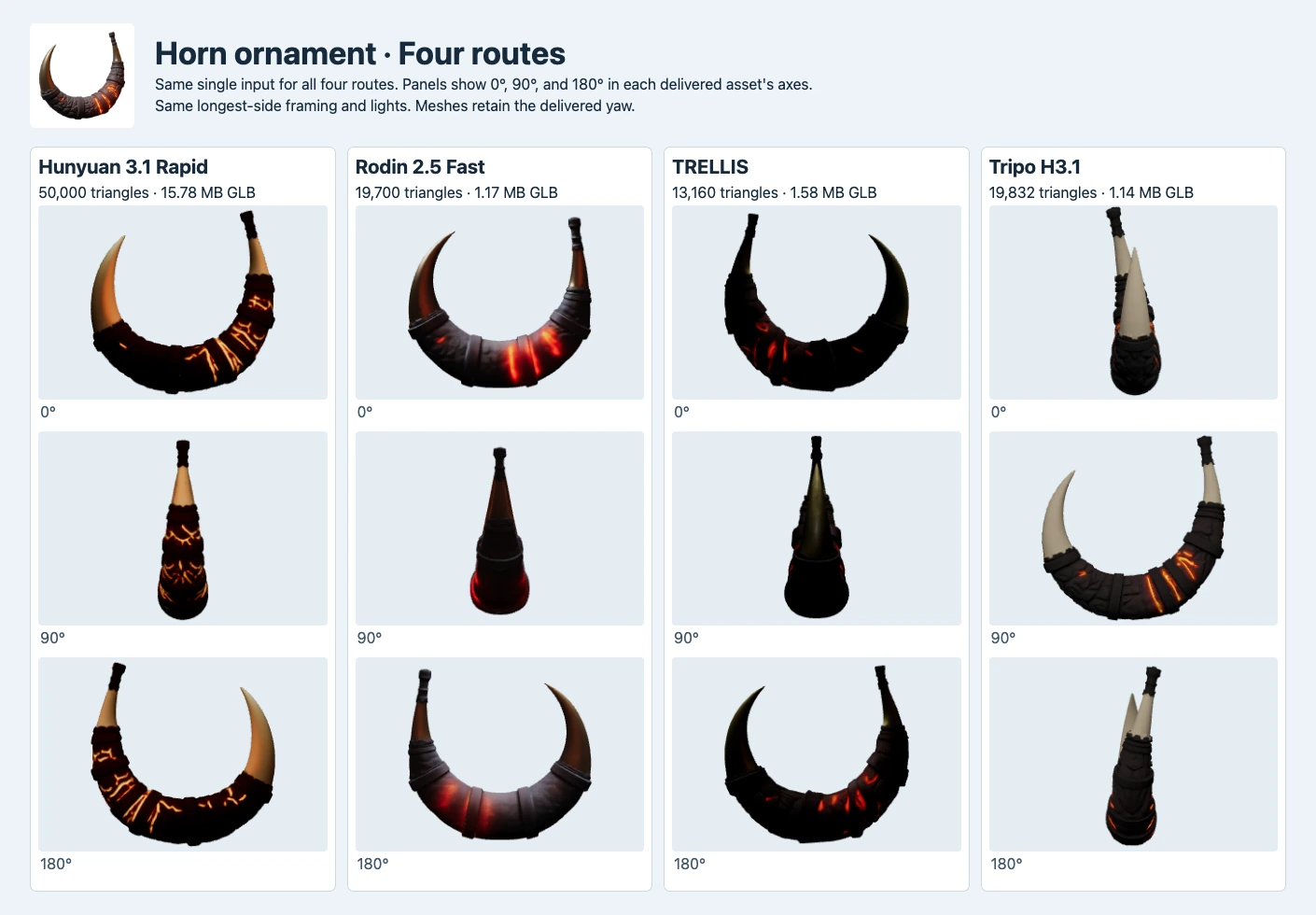
The Tripo horn looks edge-on at 0° and shows two separated prongs at 90°. Color and pattern vary across the four outputs.
Tripo passed zero of three at 0°. The case has three buttons at 90°, the robot has a recognizable unobstructed front, and the horn shows both prongs. We rendered all three again using the 90° camera as the landing view for that group. This addressed all three first-frame findings in these files. Save a camera transform per asset after review. A blanket 90° correction for future outputs would be an unsupported assumption.
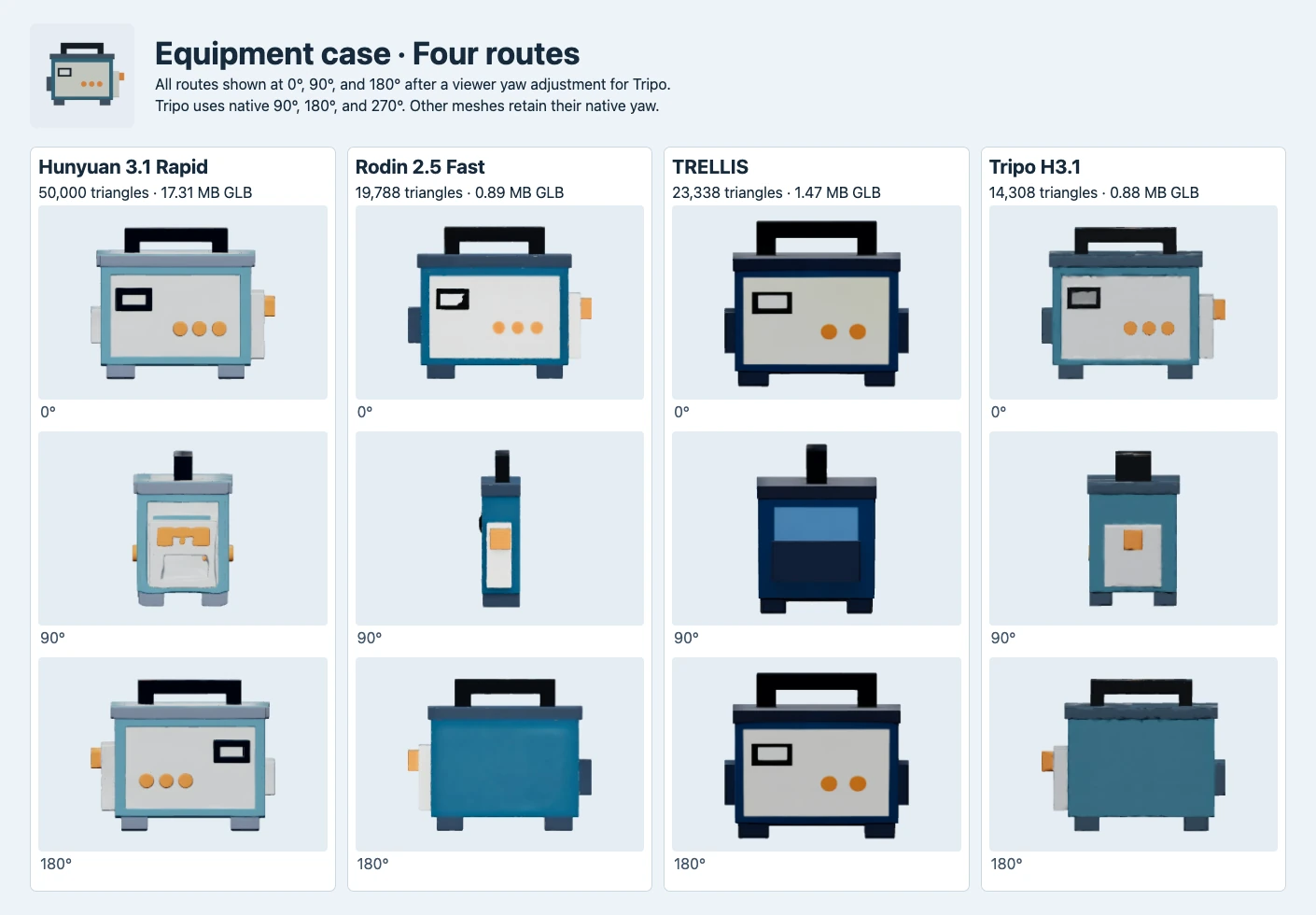
Only the Tripo view changed in this rerender. Its first frame now shows the handle, screen and three buttons. The GLB stayed byte-identical.
An independent AI-assisted screening pass took 18 seconds for the full set of review sheets. It included opening the sheets and recording decisions. It supplied neither per-route timings nor human editing estimates. If reviewer capacity is part of the purchase decision, run your own timed check. Start the clock when a reviewer opens a preloaded sheet, log any reorientation, texture handling or mesh repair separately, and finish at the saved decision.
Choose the route for the handoff you actually need
For a preview with a fixed baked appearance, Rodin’s three files opened in the early observation window and met the native landing checks. Add a base-color and lighting review if a material editor will consume them. For a first-pass queue with a small model bill, TRELLIS let us review three drafts at $0.06, with two rejected by the narrow rubric. For the smallest observed batch of direct base-color GLBs, Tripo used 3.33 MB, but its last result arrived more than five minutes after submission and all three needed a landing-camera adjustment.
Rapid met the native checks and retained three full-size textures. It also needed conversion and had the largest browser copies. It makes sense when the OBJ package has value upstream, or when a separate optimization stage already owns the preview copy. Choose on accepted files per batch, then record who owns the work between generation and acceptance. Include conversions, visual rejects and any retry charge when you calculate the actual cost per accepted asset.
Frequently asked questions
Which was the fastest API for this batch?
Rodin and TRELLIS were both done when their first status lookups came back by roughly 54 seconds. The sampling gap prevents a speed ranking between those two. In this batch, Rapid’s last observed completion was at about 152 seconds and Tripo’s at about 333 seconds.
Is an error-free GLB safe to publish automatically?
Use validation to catch malformed structure, then check the landing frame and orbit the asset. All twelve GLBs validated and loaded here. One lost a visible button, another had an extra panel, and three launched from the side.
Does a 20K setting guarantee the same number of triangles?
Measure the export. The three Rodin GLBs used the 20K preset and contained 19,206, 19,700 and 19,788 triangles. With a 20,000 face limit, the Tripo set contained 14,308, 19,082 and 19,832.
Found this useful? Share it