Fast 3D Prototyping APIs to Test in 2027
Twelve timed runs compare first observed completion, exported triangles, price and a prototype geometry gate across four image-to-3D APIs.
Hunyuan Mini Turbo showed one completed job at 8.2 seconds and another at 124.8 seconds. The two returned exactly the same GLB, and it exceeded our 100,000-triangle prototype limit. Rodin 2.5 Fast showed completion in 16.7–25.0 seconds and cleared the geometry gate on all three attempts. Four routes, three calls each and one fixed image gave separate answers for response speed, file size and whether a mesh could enter the test scene.
Key takeaway
- Twelve calls completed and returned GLBs, with $1.41 settled across the set. Nine files cleared the same acceptance rules. The three Mini Turbo files all had 272,400 triangles.
- Rodin Fast had the shortest observed median among routes that passed on all three attempts, at 16.8 seconds. Its original files were 492,216–499,040 bytes.
- TRELLIS charged $0.02 per request and embedded a 512 × 512 color texture. Hunyuan 3.1 Rapid charged $0.27 and delivered about 50,000 triangles without texture in this configuration.
- Publish both observed completion and ready-to-import counts when testing a prototype workflow. A task can be complete while its asset still requires simplification.
Hold one input and test the routes as they are used
We reused the authored signal-tool fixture, a rigid accessory with a blue housing, two front lenses, a lower grip and a raised carry bar. The 768 × 768 front image was the sole input. The louver and rear plug belong to the underlying reference and are hidden in that PNG. We used the known 3D model to evaluate the output.
Hunyuan 3D 3.1 Rapid ran in geometry-only mode. Rodin 2.5 Fast used its Extreme-Low tier, 20K Triangle, GLB and material None. TRELLIS used texture_size: 512, and Hunyuan Mini Turbo ran untextured at octree resolution 256. We sent seed 42 to the three routes that exposed a seed. Each configuration was unchanged across its three requests. The options yield different meshes and texture payloads, so the timing compares these concrete paths to a prototype.
The four routes were requested in parallel within a round. A later round started after the preceding four jobs settled. For each request we started the timer immediately before invoking the public submission tool, then read status about every seven seconds. We saved both the last preceding observation and the first response with completed status. The resulting interval includes request and queue behavior, model processing and the polling wait. Download transfer, file inspection and any fixing time were outside that clock.
Read the full set of timing observations
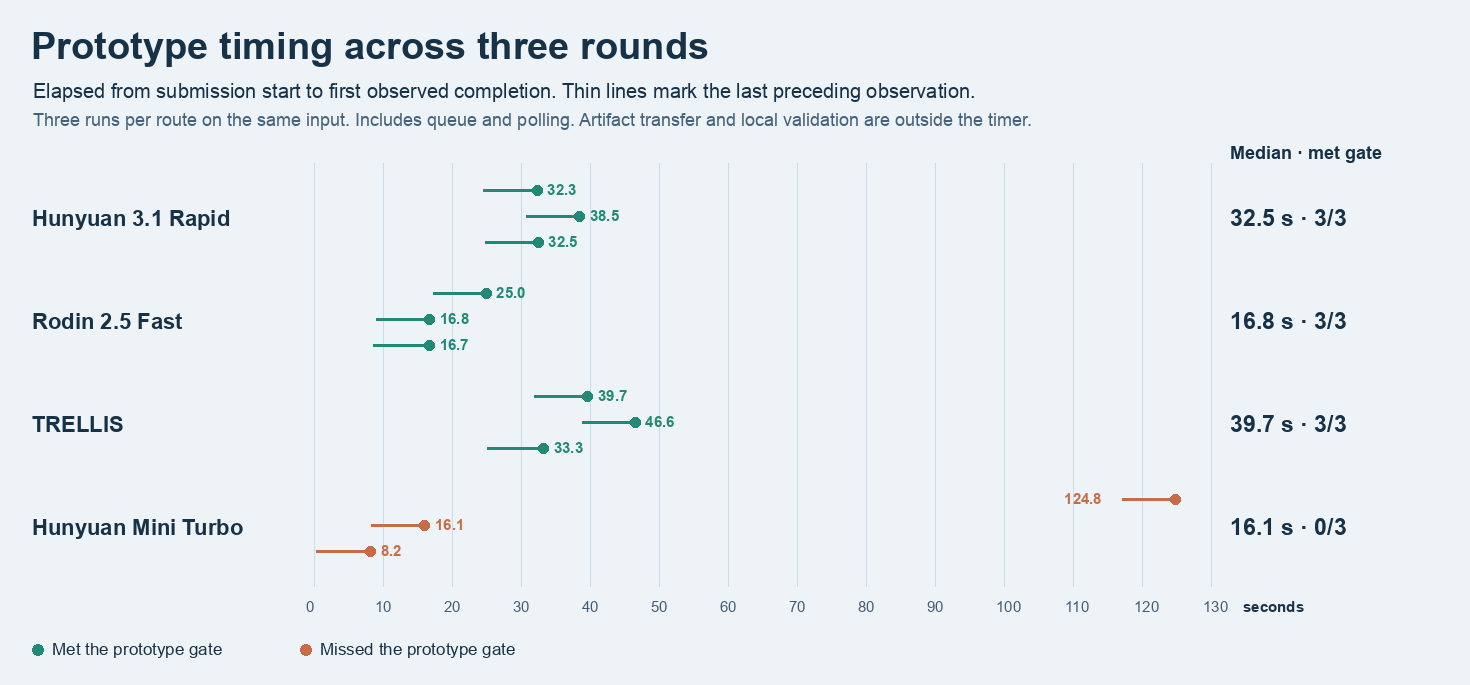
Each dot is the first observed completed status. The line starts at the preceding observation. Green deliveries met the prototype rules below.
| Route | Round 1 | Round 2 | Round 3 | Observed median | Cleared the gate |
|---|---|---|---|---|---|
| Hunyuan 3.1 Rapid | 32.34 s | 38.52 s | 32.50 s | 32.50 s | 3/3 |
| Rodin 2.5 Fast | 24.98 s | 16.78 s | 16.74 s | 16.78 s | 3/3 |
| TRELLIS | 39.69 s | 46.57 s | 33.31 s | 39.69 s | 3/3 |
| Hunyuan Mini Turbo | 124.81 s | 16.07 s | 8.25 s | 16.07 s | 0/3 |
The Mini Turbo and Rodin medians differ by about 0.71 seconds. That is much smaller than the status interval, and the relevant completion brackets overlap. Treat the reported values as observations of the calling workflow. One Mini Turbo request was still running at 117.13 seconds and completed by the next sample at 124.81 seconds. All three Mini Turbo downloads shared the same SHA-256 digest. The wait differed even when the delivered bytes matched. These observations give no basis for assigning the spread to one provider component.
Open the actual files and apply one geometry gate
The gate was specific to this prototype. An original GLB could be at most 10,000,000 bytes and 100,000 triangles, with zero validator errors. After centering and scaling by longest side, the front silhouette needed at least 88% intersection-over-union against the authored reference. We selected yaw by the front view using four quarter-turn candidates, then tested a fixed center patch of the authored carry-bar opening. At least 207 of 275 straight front rays had to pass through it.
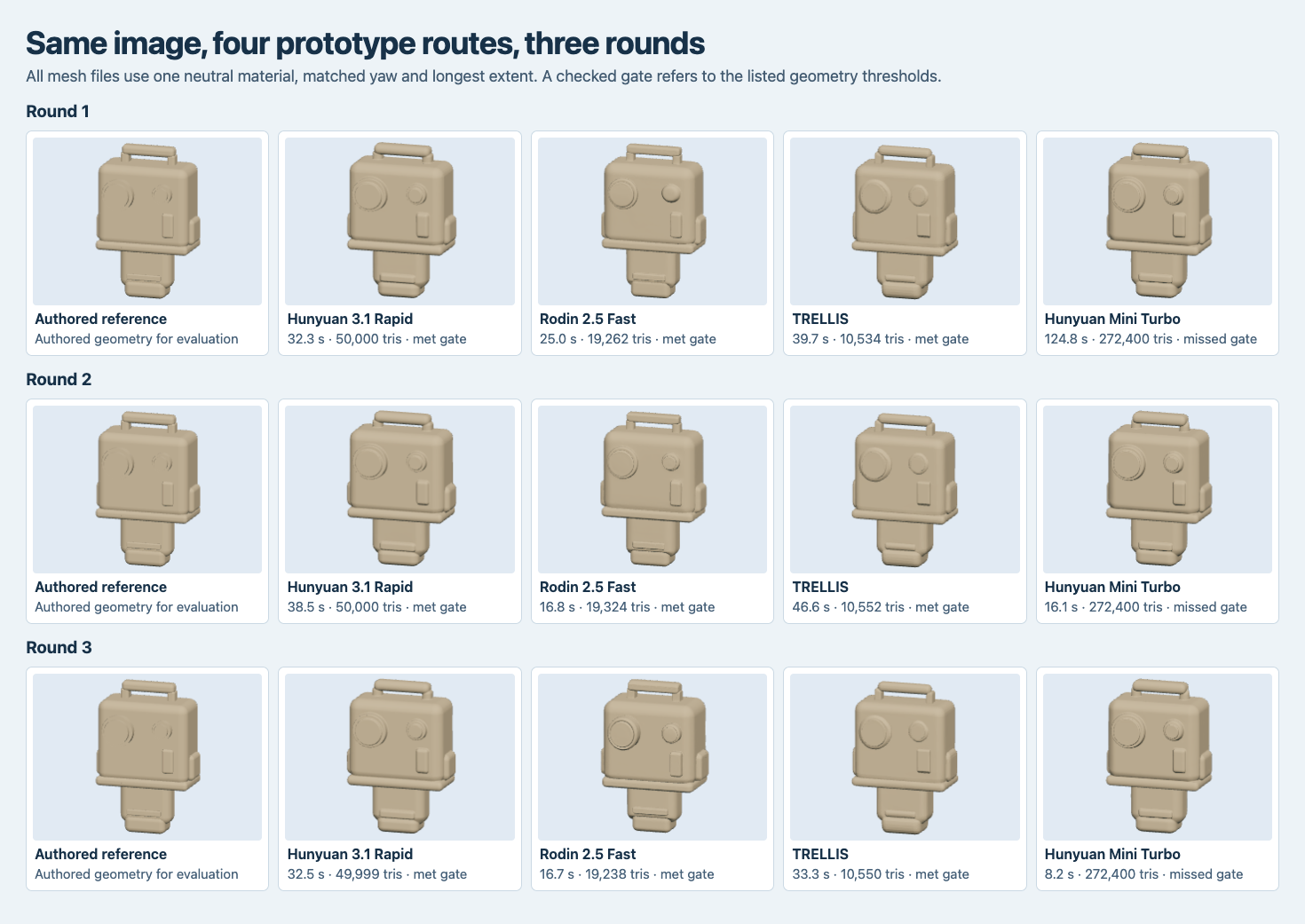
The front geometry remains readable from all four routes. The status line below each mesh records its observed time, original triangle count and gate verdict.
All twelve returned files validated with zero errors or warnings. All left the sampled central handle window open on 275/275 rays. The front silhouette scores ran from 92.56% through 97.17% across the batch. Mini Turbo failed on the triangle limit. With a requirement like this one, its first usable time would also include a remesh and review. We measured neither of those steps here.
| Route | Original GLB triangles | Original package bytes | Embedded textures | Settled price each |
|---|---|---|---|---|
| Hunyuan 3.1 Rapid | 49,999–50,000 | 901,100–901,124 | None | $0.27 |
| Rodin 2.5 Fast | 19,238–19,324 | 492,216–499,040 | None | $0.10 |
| TRELLIS | 10,534–10,552 | 540,832–555,876 | One 512 × 512 PNG | $0.02 |
| Hunyuan Mini Turbo | 272,400 | 6,538,592 | None | $0.08 |
The readiness verdict uses the GLB bytes and index counts. It can be calculated as soon as the real file arrives. Route-specific mesh targets still matter. Rodin’s 20K request fit our geometry gate and produced the smallest files in the batch. Hunyuan Rapid produced about 50K without a requested triangle count in the payload.
Record the gate result alongside the request ID, original digest and first completion observation. In the three passing configurations, each completed request yielded one acceptable file, so the observed per-accepted-file charge remained $0.27, $0.10 and $0.02 respectively. Mini Turbo’s $0.08 receipt describes a completed generation, with no file accepted under this gate. Estimating its cost per usable asset would require the measured follow-on conversion, storage and review. A second threshold illustrates the trade-off. If the receiving service raised the triangle cap and could accept a 6,538,592-byte original, the Mini Turbo files would meet the other conditions we checked. That scenario does not change their measured file delivery or timing intervals.
The GLB content can also tell you when apparent retries delivered the same object. We found one Mini Turbo SHA across all three paid calls. The other three configurations produced three distinct file hashes each. A file match can establish exact delivery identity. Hash differences can come from asset data or from packaging, so inspect the relevant geometry and texture attributes before calling it a visible change.
Inspect the hidden side before advancing the prototype
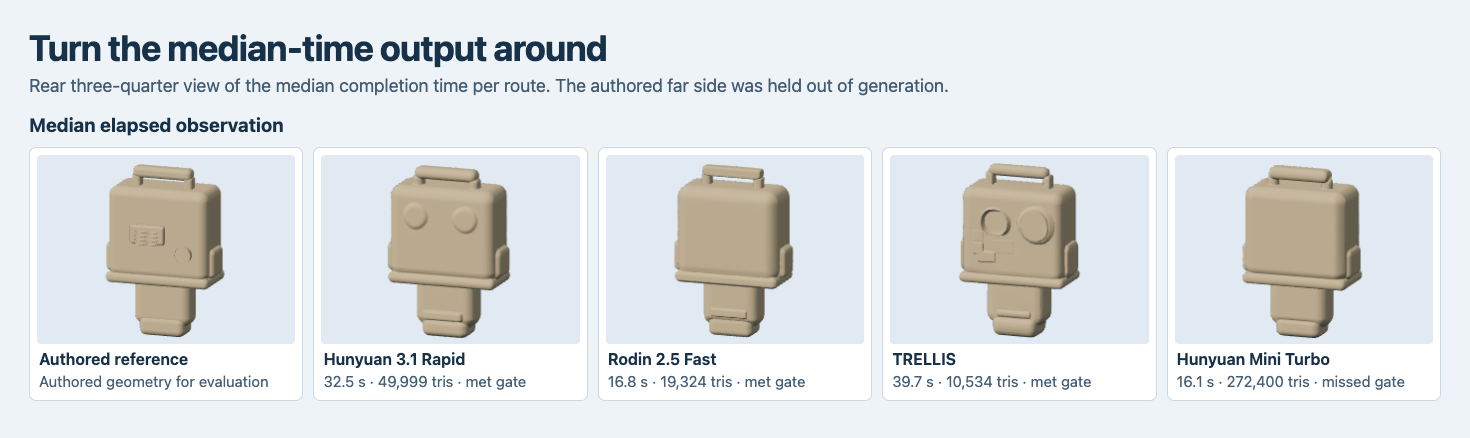
The reference has a louver and plug. Rapid and TRELLIS created circular shapes on the back. The median Rodin and Mini Turbo samples left most of the rear face plain.
A front overlap score can be high even when the back has the wrong features. We compared rear depth separately using a 96 × 96 orthographic ray grid. In Rodin’s three runs the average rear first-hit depth difference ranged from 1.14% to 5.65% of the longest normalized side. That describes overall surface agreement and is still sensitive to case proportions. None of the four median-time renders reproduced the authored louver and plug. For a prototype meant to establish where a connector sits, add a reference view or model that detail manually.
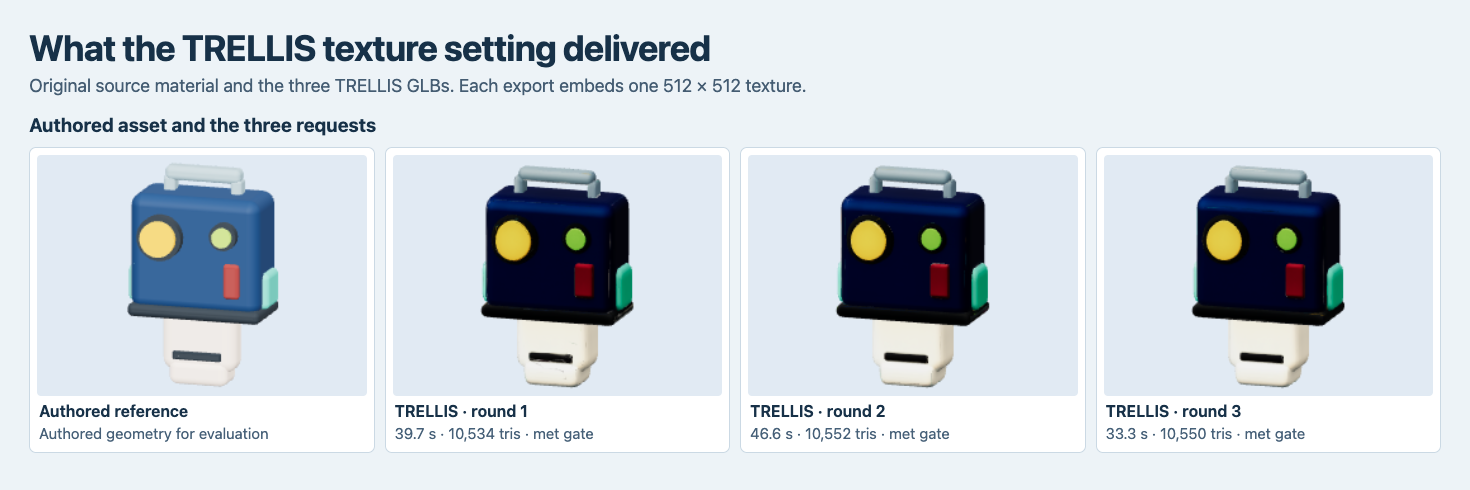
The three TRELLIS results each embed one 512 × 512 base texture. Texture support and photo fidelity still need a visual check.
TRELLIS returned lighter geometry than Rodin and was the only textured configuration in this test. Use it when a small colored mock-up is worth the observed wait. For an early scene that needs mostly neutral geometry, Rodin’s spread was 16.74–24.98 seconds while all three results entered the budget. For a pipeline that can handle dense source assets and simplify them later, Mini Turbo is an eligible generation route. Add the actual simplification and transfer interval to the timing when comparing the complete workflow.
Frequently asked questions
Which route gave the fastest ready-to-import result under these rules?
The fastest file to clear the prototype gate was Rodin Fast at a 16.74-second observed completion. The lowest observed status time in the entire test was Mini Turbo at 8.25 seconds, with 272,400 triangles against a 100,000-triangle cap.
Which of the observed requests cost the least?
TRELLIS settled at $0.02 each with one 512 × 512 texture. It passed on all three runs. These prices are for the shown configurations and the observed November 15, 2026 UTC requests.
Does the measured time include web download and cleanup?
The timer stopped on the first completed status observation. The original GLBs were then downloaded and checked. Reproduce your project’s own download, validate, simplify and import steps if time to scene placement is the metric you need. The async 3D backend guide shows how to track the job through delivery.
Found this useful? Share it