Best Multi-View 3D Reconstruction APIs in 2027: Five Routes Tested
Five APIs rebuilt the same equipment case from two and four views. Compare rear and connector geometry, side silhouettes, GLB sizes and paid costs.
Meshy 7.1 and Hi3D 3.0 got closest to the back of our equipment-case fixture when they received four views. Their mean rear depth differences were 1.16% and 1.19% of the longest side. With only the front and left images, those differences reached 4.22% and 4.31%. Hi3D had the highest side silhouette overlap, while Meshy cost $0.96 per result versus $2.16 for Hi3D. Five routes, ten GLBs and the same authored source let us compare those trade-offs directly.
Key takeaway
- In this four-view test, Hi3D had the highest side silhouette overlap at 96.13%. Meshy had 92.57% and the lowest mean rear depth difference at 1.16%. The two depth scores were only 0.03 percentage points apart after rounding.
- Four views reduced the full rear mean depth difference for all five routes on this fixture. The improvement did not extend to every region or angle. Hunyuan’s connector-region mean was lower with two views, while its overall rear mean was lower with four.
- Tripo cost $0.24 per run, the lowest charge here. Hunyuan Pro exported 100,000 triangles in 1,200,732 bytes in both conditions. These are different priorities from best side or rear shape.
- Inspect the original orientation before shipping. Meshy and Tripo needed different diagnostic yaw adjustments from Hunyuan and Hi3D in this particular test.
How the same four images reached the five APIs
The source was the equipment case from the Hunyuan Pro multiview field guide. We authored its geometry and knew where the rear connector, handle, feet and front buttons should be. Each 768 × 768 PNG shows the same case from a different orthographic camera. The two-view condition used front and left. The four-view condition added back and right. The rear connector protrudes visibly in a side view, so the two-view condition still contains an indirect cue to its depth.
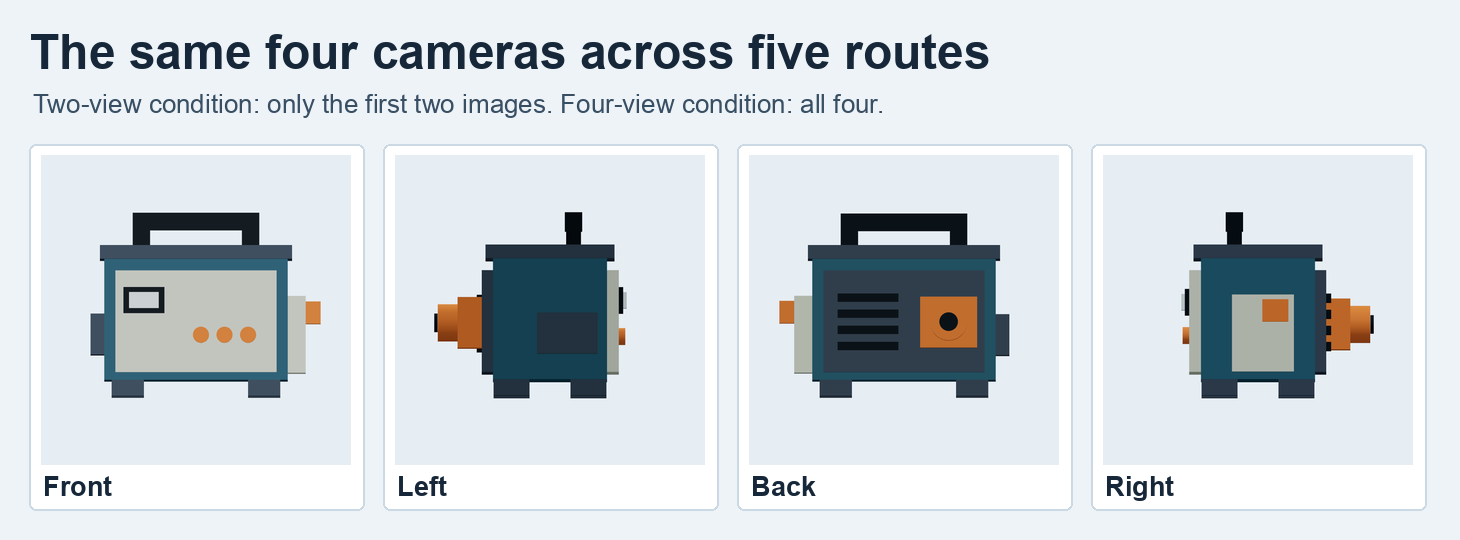
All five routes received the same original PNGs for each condition. The two-image condition uses the first two. The four-image condition uses all four.
| Route | How this test supplied the four views | Geometry setting |
|---|---|---|
| Hunyuan 3.1 Pro | Front in image, left, back and right in named fields | Geometry, 100,000-face target |
| Tripo H3.1 | Ordered images array, front, left, back, right | Standard geometry, 100,000 target, texture/PBR off, seed 42 |
| Meshy 7.1 | Same four files in images | Standard geometry, 100,000 target, symmetry off, texture/PBR off |
| Hi3D 3.0 | Front in image, left, back and right in named fields | 2048quality, 100,000 target, texture/PBR off |
| Rodin 2.5 | Same four files in images | Gen-2.5-High, 50K Triangle preset, material None, seed 42 |
We sent front first for each route. Hunyuan and Hi3D use named slots. The inspected Tripo route specifies the ordered list. The Meshy and Rodin schemas describe an image array. We used the same order for those arrays as an experiment convention. For two views we omitted the extra fields or removed the last two array entries. We did not submit placeholders. We kept each route’s other settings fixed between the two calls. The requests do not have identical geometry backends. In particular, Rodin uses discrete presets and we selected 50K Triangle. It delivered 50,000 in both conditions, so treat the cross-route numbers as outcomes at the listed settings.
Check where each route got the rear surface from
On the four-view row, Meshy and Hi3D show horizontal slats and a round, offset socket. Their side profiles also put the projecting feature on the same end as the reference. Their two-view outputs still show a round feature, but the rear panel’s layout visibly changes. In the rear connector window, Meshy’s mean depth difference was 9.17% with two views and 2.11% with four. Hi3D moved from 8.81% to 2.23%. Seeing a connector outline is one check. Putting it on the correct face and getting its projection right are separate checks.
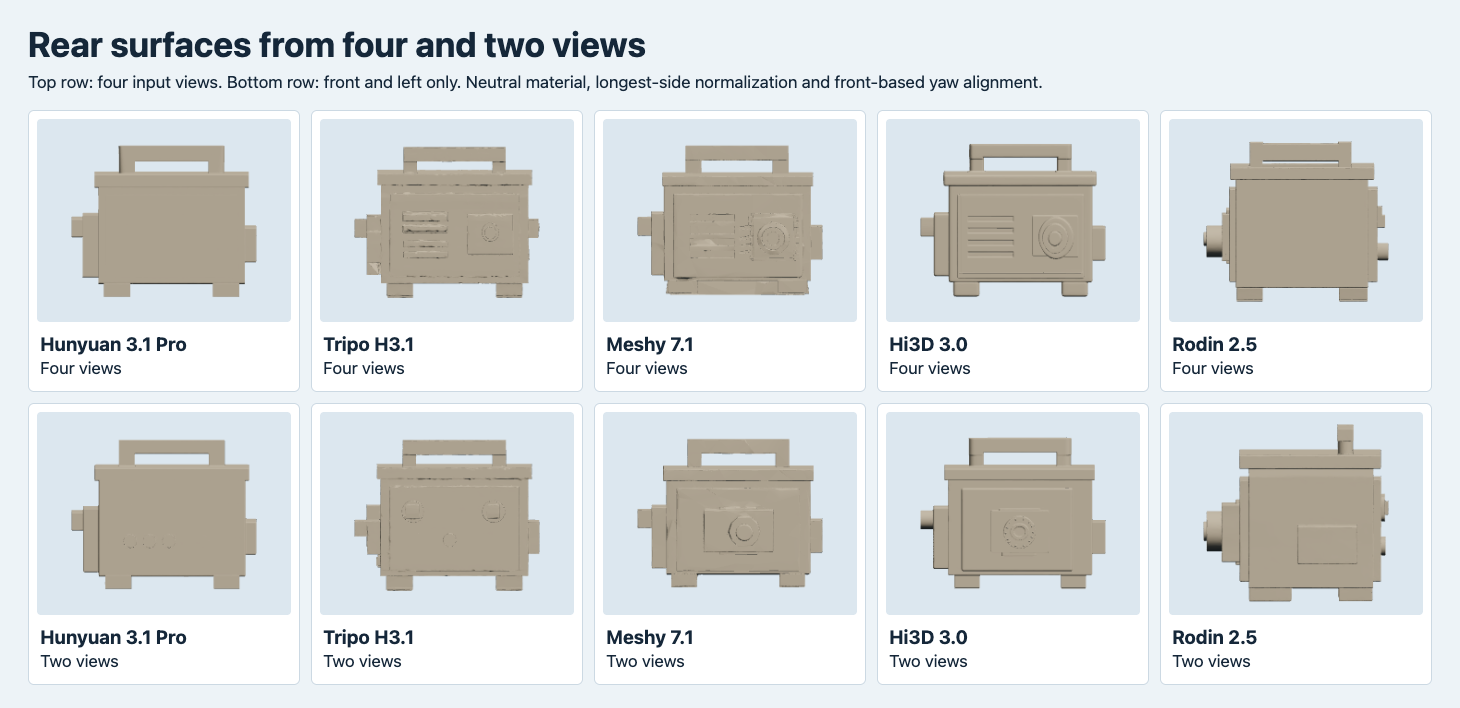
The top row received four images. The bottom row received front and left. Original exports are displayed in a common neutral material after size normalization and front-based yaw alignment.
Tripo’s four-view rear render also has identifiable slats and a circular form, yet its side projection places the main cylinder on the opposite end from the reference in the selected alignment. Its full rear mean depth difference was 18.70%, compared with 19.21% using two views. Hunyuan gives a close frontal outline, but its side panels omit the long connector. Rodin shows a cylindrical projection in a side-on native render, yet its selected front alignment and profile illustrate the difficulty of matching the overall case orientation. Part of an error score can come from how the model frame aligns as well as from the generated surface.
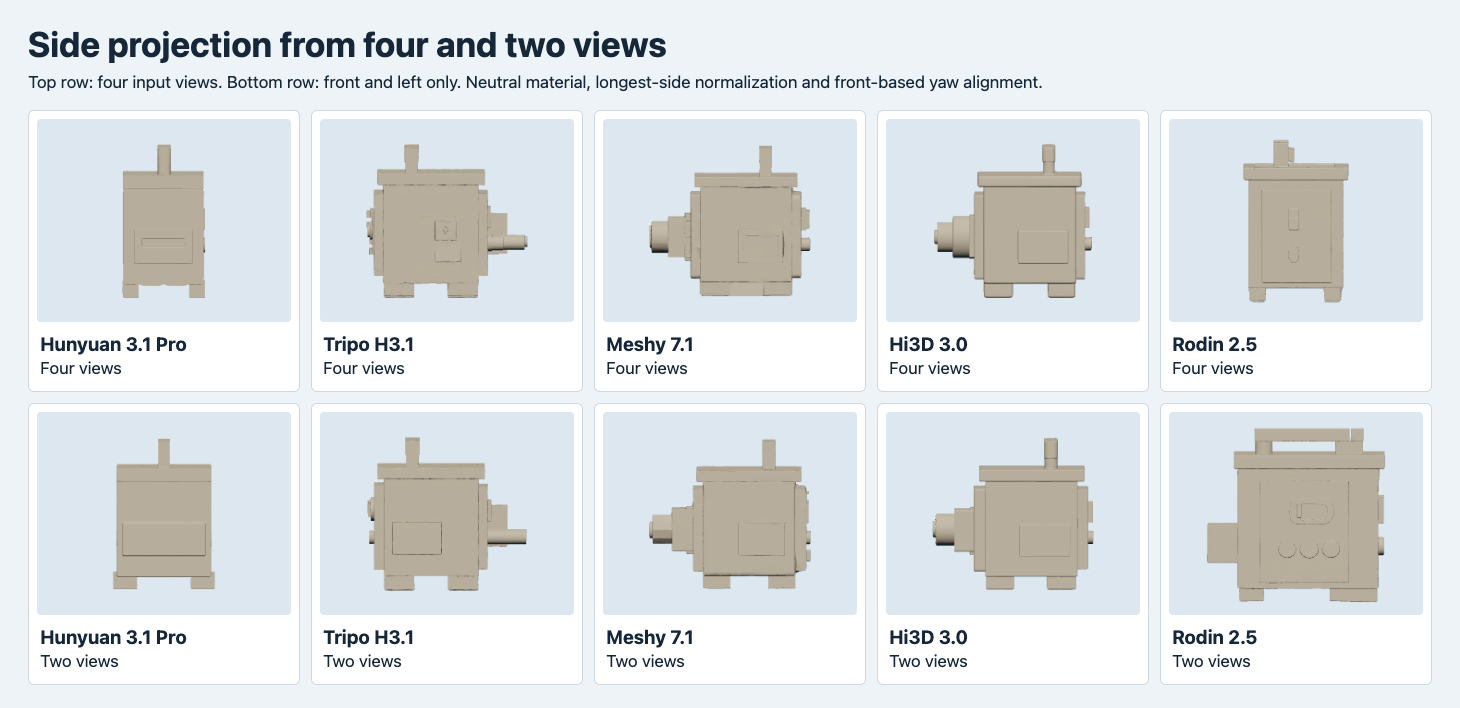
We used one side camera after selecting each mesh’s yaw from the front. The rows use the same input sets as the rear figure.
Preserve two orientation checks
In Blender 4.5.9 we translated each bounding box to the origin and scaled the longest side to one. We tested only four yaw angles around the vertical axis. We selected the angle that maximized front silhouette intersection over union (IoU) minus mean absolute front first-hit depth difference. For four views, the selected angle was 0° for Hunyuan, 270° for Tripo, 180° for Meshy, 0° for Hi3D and 90° for Rodin. These are the alignments from this one fixture and score. Check orientation per delivery and avoid turning these numbers into provider-wide rotation constants.
For Meshy’s four-view output, front IoU moved from 75.86% in the delivered orientation to 90.61% at the selected yaw. For Tripo it moved from 65.25% to 95.82%. Rodin’s two-view output had 62.77% as delivered and 71.76% after the selected rotation. Keep the numbers separate if you expect a drop-in asset. An offline alignment can help compare surfaces and still leave a transform to record for your scene.
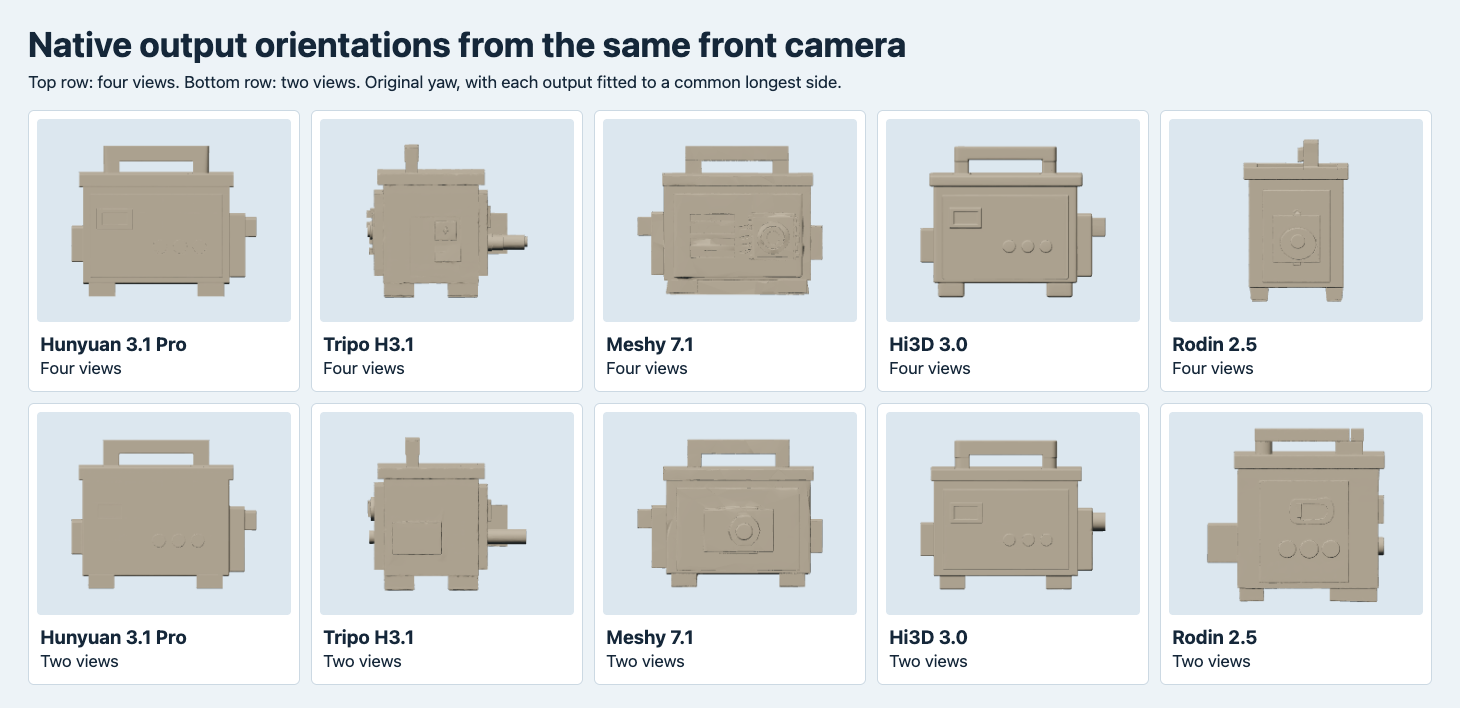
All panels use the same front camera, individual centering and longest-side normalization. The original yaw is preserved.
Measure both the whole back and the connector region
Each projected view casts 128 × 128 orthographic rays over the same square. IoU is the intersection over the union of occupied pixels. Depth difference averages the absolute difference between the two first hits only at pixels occupied by both surfaces. This metric is directional. Opposite orthographic silhouettes have the same occupancy under mirroring, but the first hit can change. We also set a fixed rectangle around the fixture’s connector in the rear view, giving a local diagnostic so the broad housing does not dominate interpretation. That rectangle had 725 shared samples for each of the ten generated files. Other products need a region defined from their own reference.
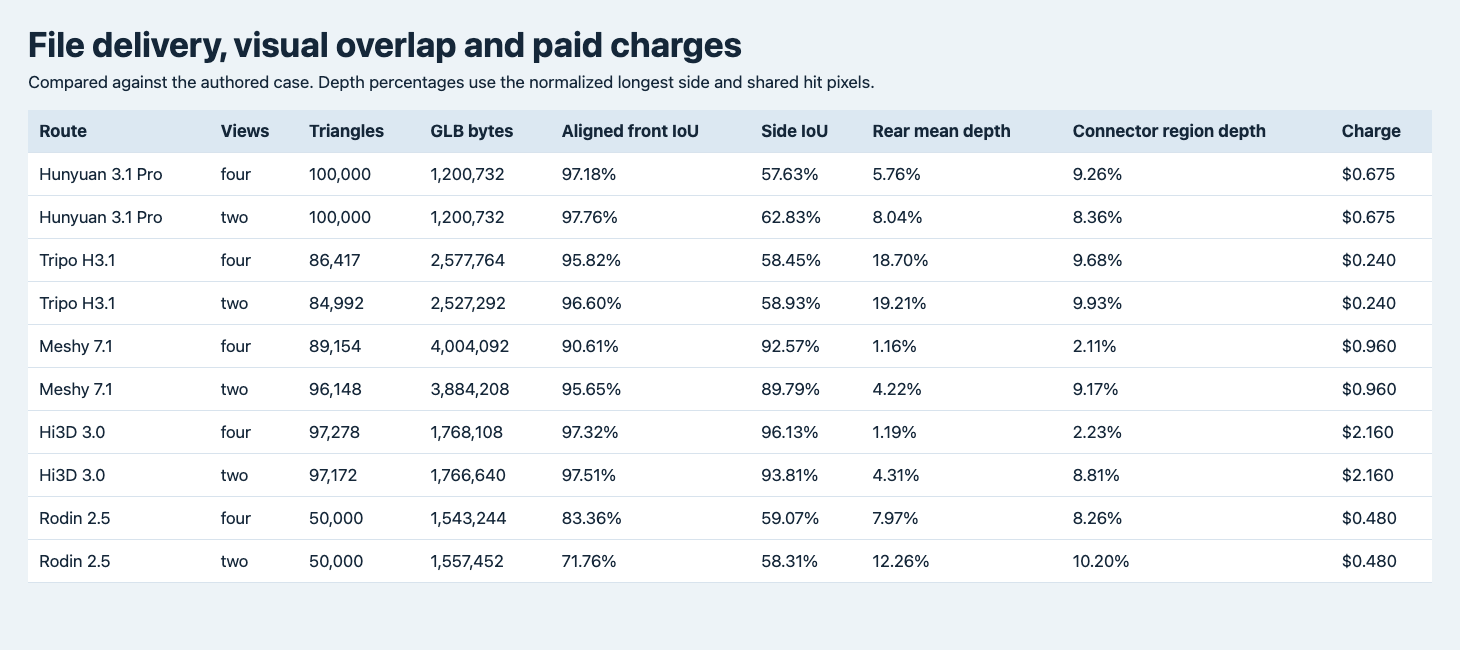
All depth percentages are fractions of the normalized longest side. They use shared hit pixels and represent this one object.
| Route | Side IoU, four / two | Rear mean depth difference, four / two | Connector mean depth difference, four / two | Charge per run |
|---|---|---|---|---|
| Hunyuan 3.1 Pro | 57.63% / 62.83% | 5.76% / 8.04% | 9.26% / 8.36% | $0.675 |
| Tripo H3.1 | 58.45% / 58.93% | 18.70% / 19.21% | 9.68% / 9.93% | $0.24 |
| Meshy 7.1 | 92.57% / 89.79% | 1.16% / 4.22% | 2.11% / 9.17% | $0.96 |
| Hi3D 3.0 | 96.13% / 93.81% | 1.19% / 4.31% | 2.23% / 8.81% | $2.16 |
| Rodin 2.5 | 59.07% / 58.31% | 7.97% / 12.26% | 8.26% / 10.20% | $0.48 |
Choose by the job and verify your own angles
Start with Meshy 7.1 Multi-Image if today’s task resembles this one and you want to check a visible back feature at the lower of the two near-leading costs. The four-view GLB was 4,004,092 bytes. Start with Hi3D 3.0 Multi-View if the side contour and a smaller original GLB are more important. Its four-view GLB was 1,768,108 bytes, and its call charged $1.20 more. Both are conclusions about this benchmark configuration and fixture, with one paid generation per condition.
For a cheaper trial, the Tripo route was $0.24 and gave a recognizable back panel with four images. Use a connector orientation check before calling the asset ready. Hunyuan’s named slots, native orientation and small file were useful here for a front-led preview, even as its back was visibly thin. Rodin’s 50K result offers a lower triangle preset for this set of routes. Its four-view rear depth average improved relative to its two-view result, with a weaker shape alignment in this scene than the Meshy and Hi3D exports.
Ten calls completed, billing $9.03. All passed the glTF validator without errors or warnings and had no embedded images. They ran on November 14, 2026 UTC (November 15 in China). The exports contain between 50,000 and 100,000 triangles. These measurements cover geometry only, with no comparison of final materials, rigging, timing or actual scale. For a different sample and a single-view baseline, see the Tripo and Meshy single-versus-multiview comparison.
The six-run Tripo H3.1 follow-up holds the route fixed while adding rear and right views to the front and left.
To see what a dim or obstructed rear image contributes while the other views stay fixed, use the Hi3D multi-view capture test.
FAQ
Is four always the right number of views?
In this experiment four improved the full rear depth average for all five routes. Front IoU and local connector error did not improve in every pair. Choose which added view reveals your feature and inspect the final GLB from that direction.
Is the best front silhouette enough for a product model?
Only if your deliverable is scoped to that one composition. Rotation reveals projection errors, the wrong face and model orientation. Before using it in a viewer, test a locked side and rear camera too.
The fixture figures depict authored input or actual outputs. The cover is illustrative.
Found this useful? Share it