Hunyuan 3D 3.1 Part vs Hi3D Split: Files, Parts and Pivots
Six split requests test two APIs on equivalent FBX and GLB sources, comparing actual delivered formats, mesh counts, triangle counts and pivots.
On the same published robot sample, Hunyuan 3D 3.1 Part delivered 19 separate GLBs. Hi3D Split delivered one GLB with 21 mesh objects. The parted models opened at almost the same overall size. All their mesh origins were still at the shared scene origin, so directly rotating a part can swing it around the floor of the scene. Two smaller FBX exports failed on the Hunyuan route while their geometry-equivalent GLB exports completed on Hi3D. These are three case histories from the routes we actually called.
Key takeaway
- The shared robot sample had 499,822 triangles. Hunyuan returned 1,138,798 triangles across 19 files for $0.45. Hi3D returned 499,822 triangles across 21 meshes in one file for $0.40.
- The original Hunyuan part files totaled 22,795,384 bytes, while the single Hi3D GLB was 29,835,416 bytes. A larger triangle count did not increase the aggregate package in this test.
- Blender placed all 40 mesh origins for those two deliveries at scene coordinate
(0, 0, 0), outside each object’s world-space bounds. A segmented object and a ready-to-rotate joint are separate deliverables. - Hunyuan reported an upstream invalid-input error for the two smaller FBX files. Hi3D returned one ZIP with one FBX for each corresponding GLB input, with 10 and 57 mesh objects. Four successful runs across the test settled for $1.65.
Pick inputs both routes can see
The two routes accept different source containers. Hunyuan 3D 3.1 Part on SandBase takes FBX. Hi3D Split accepts GLB, OBJ or STL and exposes general and character split modes. This test sends Hi3D split_mode: "general" and level: "medium" throughout, with joint: "none" in the request. Output format is GLB on the shared sample and FBX on the two smaller cases. The character template was outside this test. Each request was issued once on November 14, 2026 UTC.
The matched case is the robot FBX published as the Hunyuan route’s input example. Hunyuan received the original file. We imported it in Blender 4.5.9 and exported its mesh and material to GLB for Hi3D. The FBX was 34,519,660 bytes and the GLB was 31,866,148 bytes. Both had 499,822 triangles and one material with one image exposed in Blender. The links and recorded flags identify the specific endpoints and requests.
To verify equivalent surfaces after conversion, we normalized position and scale independently and calculated each sampled vertex’s distance to the nearest triangle on the other file. There were 10,000 stored vertex samples per direction. The largest distance was below 0.000000053 of the longest side. Vertex record counts differed, as the interchange files store attributes in different ways. The surface measurement does not prove byte, UV or material equality across the two containers.
The two other probes reused generated models from the Tripo P1 and P2 comparison. We cleared materials and exported a matched FBX and GLB for each. The carved horn had 21,011 triangles and the smaller robot had 20,898. Each imported as the same triangle count in both input encodings. Their normalized paired vertex-to-surface distances were below 0.00000013 in both directions. The matched conversion is the practical control when providers accept different input formats.
Download and inspect the actual package
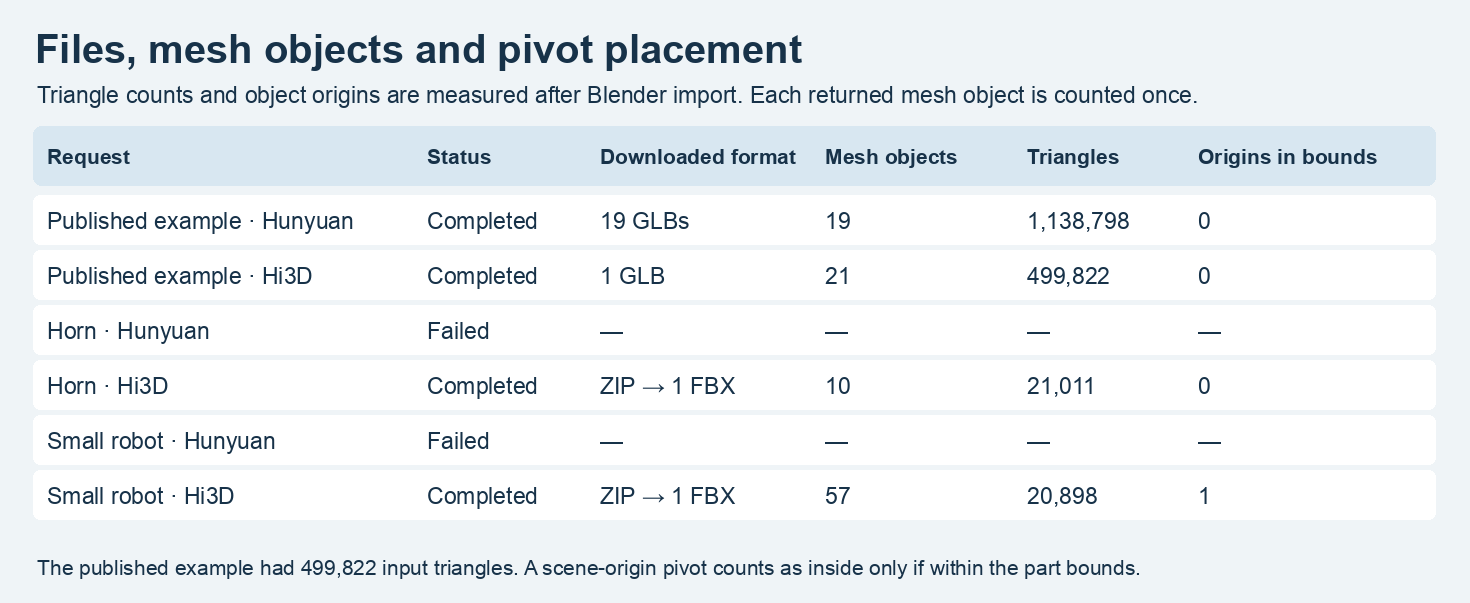
The six rows separate the response, downloaded container, imported mesh object count and number of origins inside part bounds. A failed request has no mesh object or triangle count.
The shared robot produced two quite different delivery layouts. The Hunyuan response had 19 output URLs. We downloaded all 19 and checked their first bytes and Blender imports. Each began with the GLB signature and contained one mesh object. The model listing describes FBX part outputs, but the observed response for this input was GLB. For a downloader that uses an FBX suffix merely because the request was FBX, that difference would break the next stage. Inspect the response type and the actual file signature.
Hi3D returned a single GLB for the matched robot, as requested. Blender put 21 mesh objects in the scene. All parts shared one delivery and did not require independent downloads. On the two smaller cases, requesting FBX produced one ZIP per run, with a single fbx0.fbx member carrying all objects. A ZIP is the download count at the API layer. The FBX member is the native asset count after extraction. Mesh-object count only comes from opening the asset.
The Hunyuan parts total 638,976 more triangles than the shared source, about 2.28 times its original count. The Hi3D delivery exactly matches the input’s aggregate count. The count alone does not prove how individual triangles were assigned or how surface cuts were closed. Hunyuan’s total download bytes were about 7.04 million lower than the Hi3D GLB despite those extra triangles. The containers, attributes and image payloads all affect the package. We did not treat byte count as a proxy for visible detail.
A previous Hunyuan run with the identical catalog FBX returned 17 GLBs instead of 19. Both runs used the same input URL and the downloaded FBX had the same SHA-256. Set the manifest length from each response, since the files can differ across runs on the same source.
Compare the geometry with each part colored
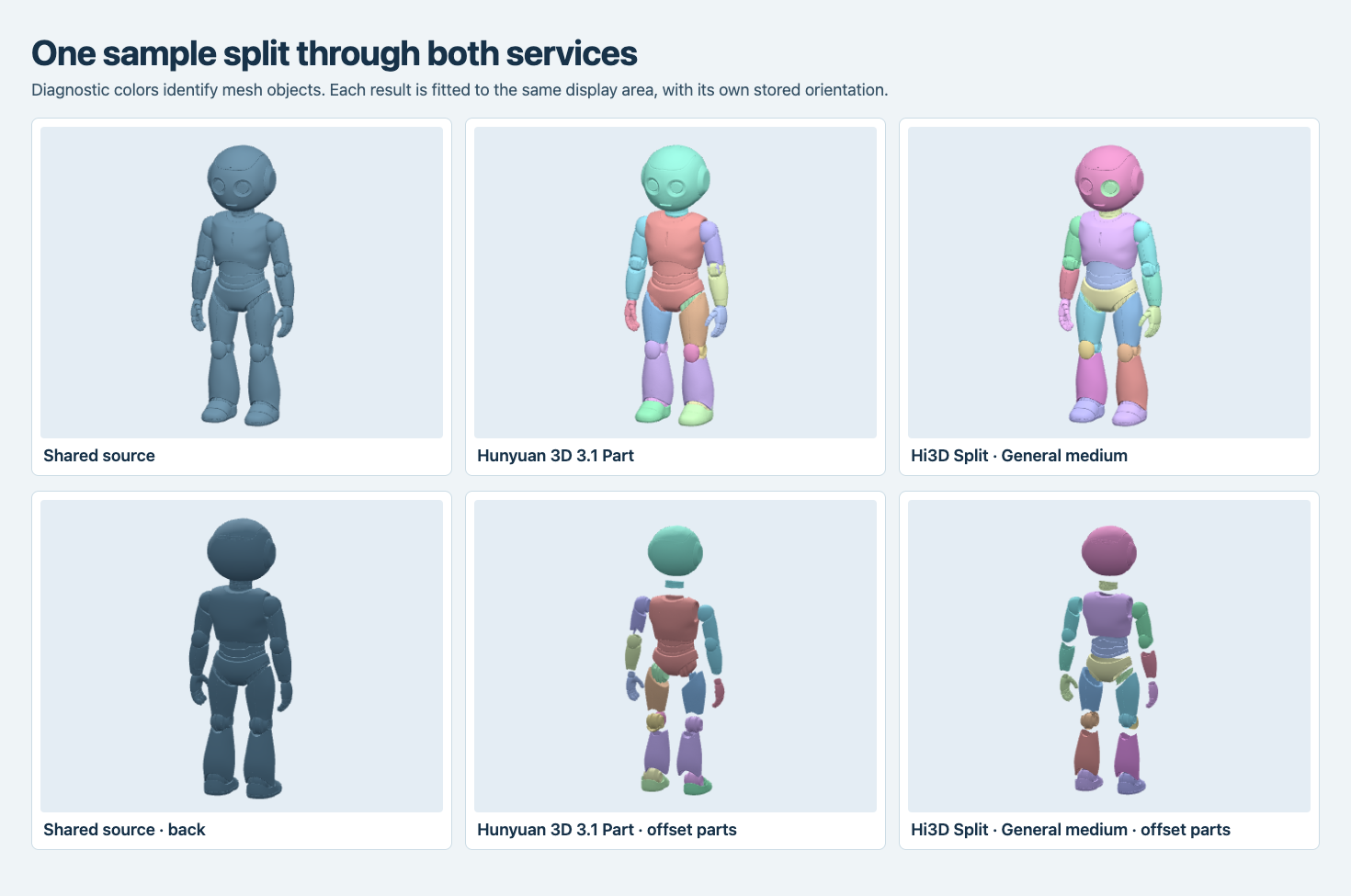
Colors mark imported mesh objects. They replace the delivered materials for diagnosis. The separate-looking pieces in the lower row are placed apart in the viewer after import. Each panel fits its own bounds to the review area.
Both output sets separate the main head and limbs enough to inspect them as parts. In the displayed front view, Hi3D gives the abdomen and a small eye region distinct object colors. The two outputs draw different boundaries around the torso. An application that needs a removable face plate or an articulated waist should open that specific feature and confirm the selected mesh moves by itself. Knowing that one route returns two more objects cannot answer that question.
Blender’s object matrix supplies the origin. We compared the world-space translation of that matrix to the world-space min and max of the part’s vertices, with a tolerance of 0.000001 in imported units. Every mesh origin in both matched deliveries was (0, 0, 0); none lay inside its own bounds. A part can be at the correct assembled location with its origin at the bottom of the scene. To rotate an upper arm around a shoulder, the motion needs a pivot at the shoulder, or a parent joint there with the intended transform. The offsets shown above were calculated from each part’s bounds, so the exploded diagram does not demonstrate a provider-assigned joint.
Read failures alongside the successful split
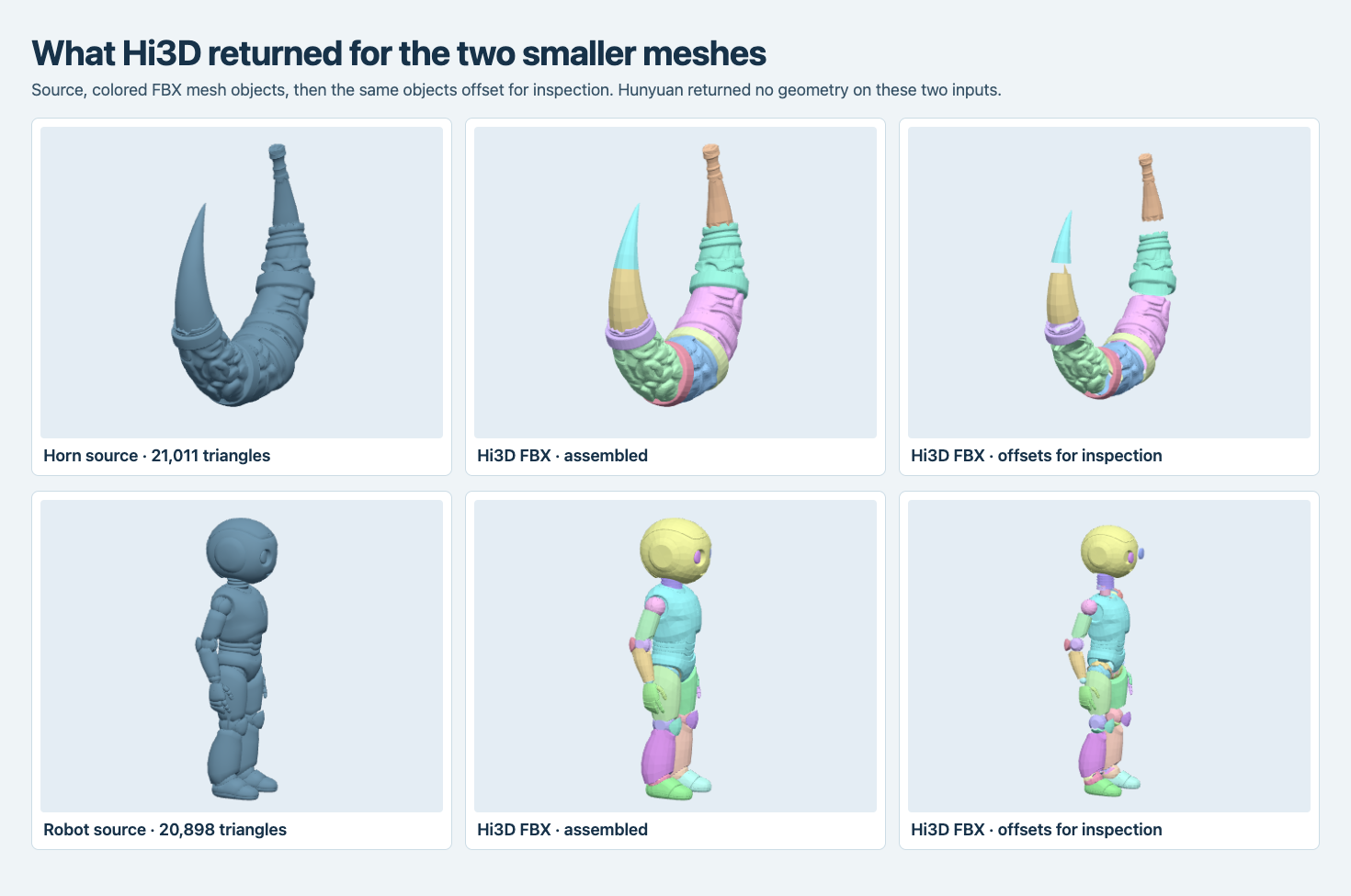
The left column shows each smaller source. The two right columns show original Hi3D segmentation, colored in place and offset for inspection. Hunyuan returned no geometry for these two inputs.
The smaller Hunyuan tests both returned an upstream invalid-input message. The exported FBXs were readable in Blender and the serving logs show HTTP 200 for the GET requests, but the failure text did not identify a mesh field or exporter choice. The input example, meanwhile, completed despite having more faces than the SandBase field description’s 30,000. That observation describes the published sample only. Input limits and acceptance behavior should be tested on the actual files that will go into a project.
Hi3D’s horn FBX member was 623,292 bytes and the small robot member was 754,556 bytes. The horn had 10 objects and the small robot had 57, 17 of those with under 100 triangles. That is a meaningful difference for a tool that creates one transform or UI control per object. A small detail might be valid, so review it in place before merging or removing it. Neither smaller row is a matched output comparison because only Hi3D returned geometry.
Budget the selected part as well as the whole scene
The largest Hunyuan part in the shared robot had 195,376 triangles. The largest Hi3D mesh had 67,553. These are different objects from different partitions, so the counts describe importer load and cannot rank the detail of a corresponding body part. If a viewer imports every Hunyuan piece before it starts, it needs a manifest for 19 files and one shared placement convention. If it loads a part on demand, it can defer the other files. The single Hi3D download lets the viewer start from one scene graph. Selecting a child mesh in that scene does not make its peers separate downloads. Decide which delivery pattern the application actually needs before picking a storage layout.
Frequently asked questions
Which result can go straight to an exploded viewer?
The matched Hi3D GLB arrives as one asset with 21 meshes. Hunyuan’s matching output can be loaded as 19 assets in one common scene. In either case use bounds and desired motion to calculate view offsets. For a live assembly pattern, see the interactive tool chest.
Does a shared scene origin mean the pieces were stacked on top of each other?
The origin and the vertices both have transforms. For these files, the mesh vertices are positioned across the whole robot even though the origins are shared. Moving or rotating one piece around its own origin can expose how far that pivot is from the feature.
Which limits should an automated downloader check?
Check the real response and inspect the bytes. In this batch Hunyuan accepted its published FBX example, returned GLBs, and rejected two smaller Blender exports. Hi3D returned a native GLB on the robot example and ZIP responses in the FBX cases.
The three-API segmentation comparison adds a rigid controller and plush toy with authored part labels, measured merges and per-part overlap.
Found this useful? Share it