Best 3D Part Segmentation APIs in 2027: Two Labeled Mesh Tests
Six measured calls compare Tripo, Hi3D and Hunyuan on rigid and soft 3D fixtures, with per-part overlap, merge errors and package sizes.
Tripo Segment gave our plush toy seven mesh objects that matched all seven authored labels in the sampled views. It also attached the small dial of our rigid controller to a patch of the housing. Hi3D and Hunyuan isolated that dial much more closely. We ran all three APIs on both fixtures and compared each file against a labeled reference, so a successful download and a useful part split could be measured separately.
Key takeaway
- On the rigid controller, mean best-part overlap was 73.79% for Tripo, 93.66% for Hi3D and 94.12% for Hunyuan. All three split the carry handle into a crossbar and supports, where the design treated it as one assembly.
- Tripo matched all seven soft fixture labels at all sampled visible points. Hi3D’s best matches averaged 99.21%, with 20 imported mesh objects for seven labels. Hunyuan merged the right ear into the head.
- Hi3D and Tripo delivered one GLB per fixture and matched the input triangle count. Hunyuan delivered seven and six GLBs, totaling 2,757,983 and 1,724,225 triangles respectively.
- The best first candidate depends on the part that must move on its own. Check that part’s coverage and what else moves with it before integrating the split.
Build two known answers before sending the file
In Blender 4.5.9 we authored a controller with a housing, slide tray, two dials and one carry-handle assembly. The second fixture is a plush toy shape with a torso, head, two ears, two arms and a tail. There are five and seven intended parts. In the submitted inputs, each fixture was joined into one mesh object with one shared neutral textured material. Geometry retains the intersecting shells of the authored components. The labels and their diagnostic colors were kept out of the submitted files.
We sent the same GLB to Tripo Segment and Hi3D Split. Hi3D ran in general mode with medium granularity, no added joint and GLB output. Hunyuan Part received the same source geometry as FBX. Both encodings imported as one object and had 1,876 controller triangles and 8,512 toy triangles. After measuring center and longest-side normalization, the largest sampled bidirectional GLB-to-FBX vertex-to-surface distance was below 0.00000013 of a longest side. The delivery containers and attributes are distinct. The tested visible geometry came from the same design.
Compare one returned object at a time
We centered each loaded assembly and used its longest dimension to normalize scale. We tried four quarter-turn yaws with a small ray grid and scored silhouette and first-hit depth against the reference without reading part labels. All six selected the original yaw. For scoring we sent a 96 × 96 orthographic ray grid from six directions. Only the first surface hit in each view can contribute to that view’s visible label.
A first-hit pair counts as a match if the depths differ by at most 2.5% of the longest side. We count overlap between an authored label and one returned object, then divide by the number of ray positions occupied by either, after subtracting the accepted overlap from the sum of their supports. This intersection-over-union score, or IoU, penalizes missing coverage and extra geometry assigned to the same object. Each authored part independently selects its highest-IoU result. The fixture mean gives the small dial or ear the same weight as the housing or torso.
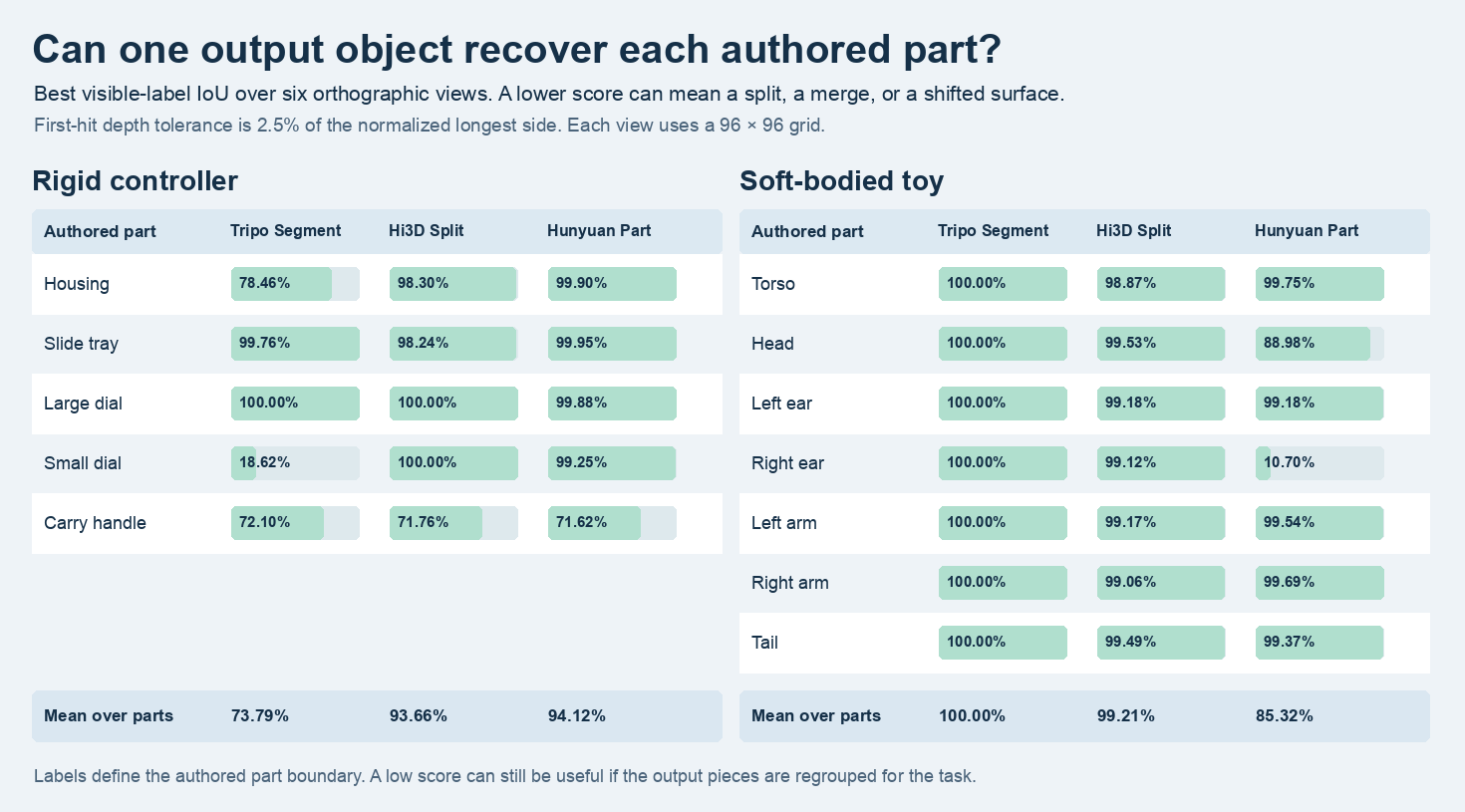
The score compares one output object with one authored label. The 18.62% small-dial and 10.70% right-ear cells illustrate different merges.
Rigid controller: check both dials independently
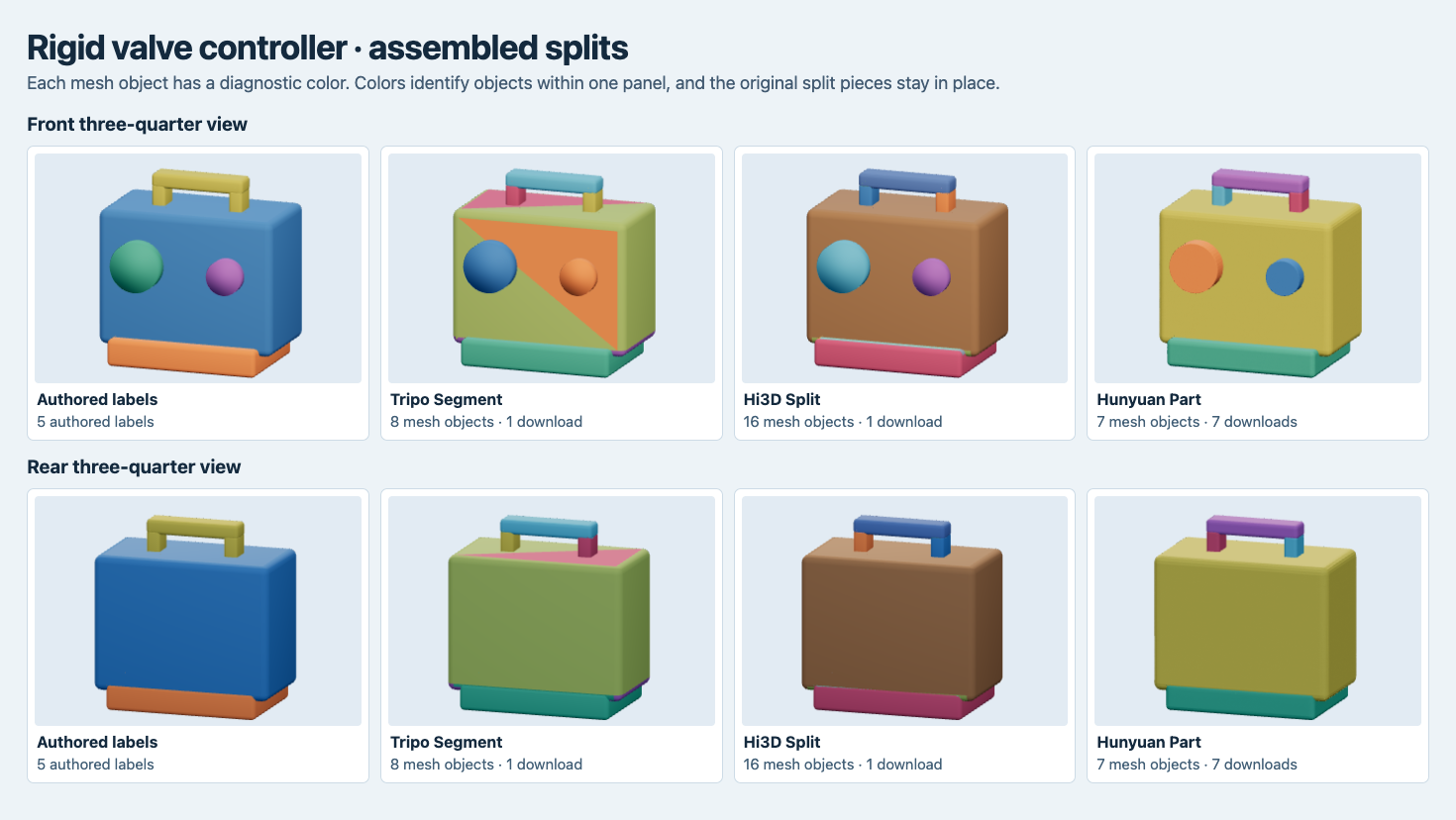
Tripo shares the smaller dial’s color with a triangle-shaped area of the housing. Hi3D and Hunyuan separate both dials. All three break the original handle assembly into pieces.
Both Tripo and Hi3D matched all sampled reference-hit rays within the depth tolerance on the controller. Hunyuan matched 99.97%. Geometry can therefore look complete without a usable semantic label. Tripo’s best small-dial object contains all 399 of the authored dial’s hit rays. It also contains 1,744 housing hit rays, making the dial only 18.62% of that output object’s visible support. Rotating the downloaded object would move a triangle-shaped patch of the housing with the control.
Hi3D’s small and large dials scored 100.00% in these views. Hunyuan reached 99.25% and 99.88%. The small difference in their rigid means comes with a much larger difference in the downloaded files. For a rigid selector where the dials must move, the Hi3D GLB was the lighter near-match of those two deliveries. It still contained 16 objects for five authored labels, so a scene graph generated directly from the file would expose extra targets.
Each route split the handle. Hi3D’s best handle object covered 1,052 of the 1,466 authored handle ray hits. The two supports came back as separate objects with 207 each. If the workflow removes the handle as one piece, group the three after import, then verify that the housing stays put when the group is moved. If the manufacturing design needs the bracket fixings independently, the same split may be a better fit.
Soft fixture: a good surface match can hide a merged ear
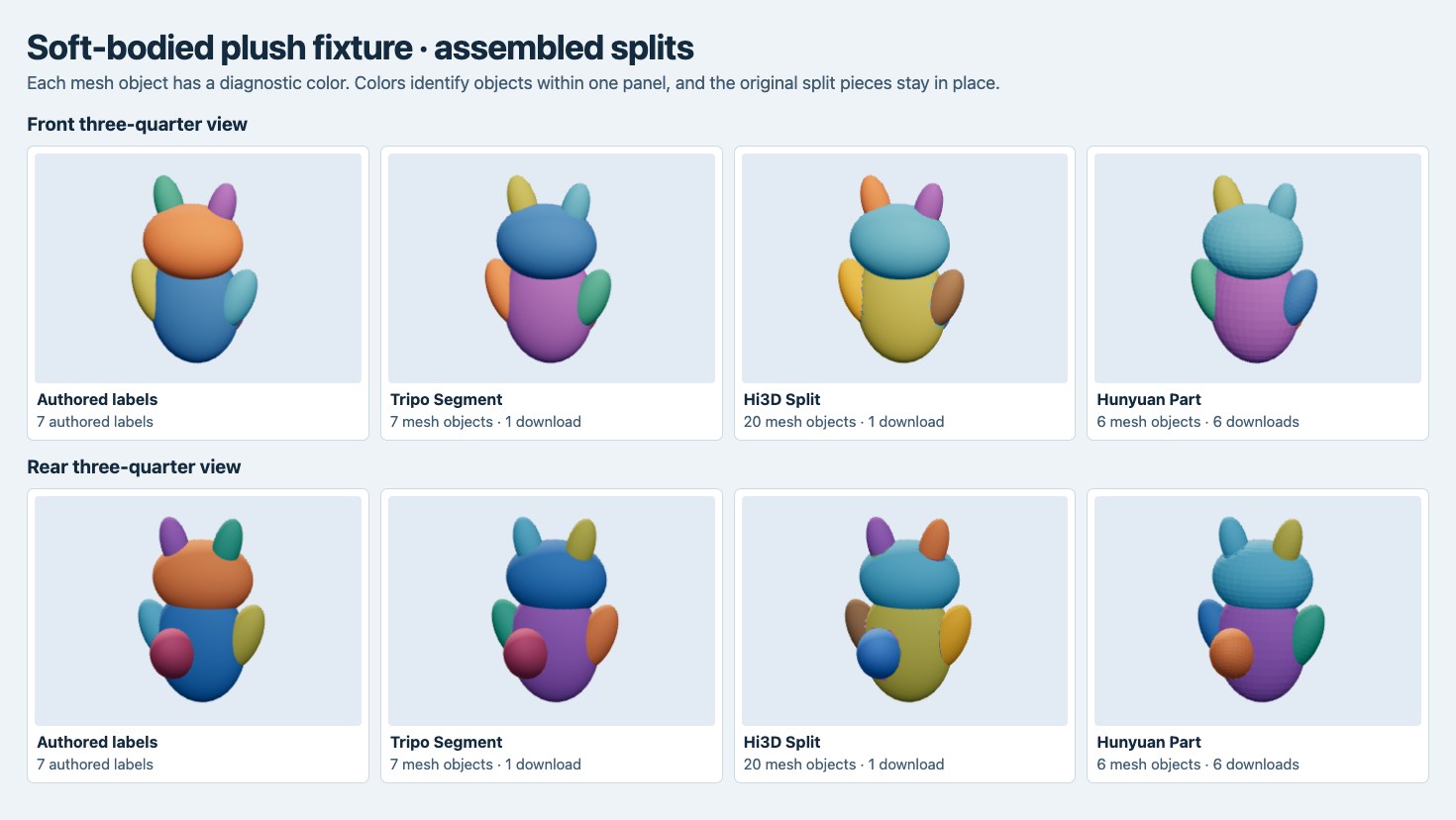
Tripo’s seven objects correspond to the seven visible design parts. One Hunyuan ear shares an output object with the head. Hi3D shows small extra boundaries along a few curved joints.
Tripo matched every sampled visible label and returned one part per label on the toy. Hi3D’s best object per label averaged 99.21%. Its 20 imported objects include small fractions beyond the seven dominant parts. For picking or animation, inspect them near the neck and limbs before deciding how to group them.
The Hunyuan toy had 99.90% same-surface coverage. Its best right-ear object overlapped 566 of 570 possible ear rays. The same object overlapped 4,707 head rays, so only 10.70% of the combined support corresponded to the ear in the IoU calculation. The ear exists geometrically. An ear-only editing action needs a separate selection. This fixture uses intersecting component shells with a neutral surface. Plush models with continuous stitched meshes, folds or accessories need their own acceptance cases.
Factor the original payload into the integration
| Input | API | Downloads | Imported mesh objects | Total triangles | Original bytes | Settled price |
|---|---|---|---|---|---|---|
| Rigid | Tripo | 1 | 8 | 1,876 | 69,656 | $0.48 |
| Rigid | Hi3D | 1 | 16 | 1,876 | 102,868 | $0.40 |
| Rigid | Hunyuan | 7 | 7 | 2,757,983 | 55,166,984 | $0.45 |
| Soft | Tripo | 1 | 7 | 8,512 | 219,460 | $0.48 |
| Soft | Hi3D | 1 | 20 | 8,512 | 324,448 | $0.40 |
| Soft | Hunyuan | 6 | 6 | 1,724,225 | 34,491,720 | $0.45 |
Six completed calls cost $2.66 on November 14, 2026 UTC. We counted each downloaded binary and opened each GLB in Blender. Tripo and Hi3D returned one package each even when Blender exposed many objects. Hunyuan returned one package per imported object in this batch. Its rigid delivery had more than 2.75 million triangles across seven GLBs. For motion or selection tests in a web viewer, count both the transfers you queue and the primitives you draw. Package layout is independent of whether the dial or ear was correctly isolated.
Pick a route for the part the application needs
Use Tripo as an early candidate for authored soft components that look like this test fixture. For a mechanical asset with small controls, try Hi3D and inspect the selected objects in place with the rest of the asset visible. Hunyuan merits the comparison when you want separate downloadable parts and can accommodate the package size or simplify them afterward. For each route, treat the screenshots as the assembled state. If the application supplies pivots or offset motions, verify those transforms on the actual output in the exploded-view workflow.
Record the name or role of the part, which surfaces are allowed to move with it, and any geometry budget before calling an API. Check the chosen output against those conditions. Grouping three correctly isolated pieces is usually a different handoff from cutting an ear away from a larger mesh. The fixture tests show which of those edits the returned files would require.
For a split that will be used in a configurator, also test the two common failure cases separately. A merged control and housing can both be rendered correctly while the control’s selection extends to the casing. A split handle can preserve its outline even though the three returns need to be parented to one pivot. In the assembly view, hide or offset only the selection under test and compare the result with the reference. A separate depth check can help catch an object that shifted during export. Our reported part IoU groups visible ray samples from multiple viewing directions. It leaves internal faces, joint clearances and actual animation to the downstream test.
Frequently asked questions
Does more output objects mean a better split?
The soft result with seven objects had exact visible-label overlap in our sampled views. Another route produced 20 and the best object per label also scored highly, with additional pieces to review. Count objects after confirming which hit rays they own.
Can I compare a single GLB with a folder of separate files?
Import all files using their original transforms. Count mesh objects and triangles across the collection, then check the same semantic part in both deliveries. The Hunyuan and Hi3D package comparison covers another example and its object origins.
Found this useful? Share it