GPT-5.6 Release: Luna, Sol, Terra Explained
OpenAI's GPT-5.6 splits into three families: Luna for creative work, Sol for deep reasoning, Terra for speed. Here's when to use each variant.
TL;DR — GPT-5.6 isn’t one model. It’s three families — Luna (creative/conversational), Sol (reasoning/analysis, 1.05M context), and Terra (efficiency/speed) — each with a base and Pro variant. Six models total. This guide breaks down what each actually excels at, so you stop guessing and start routing traffic correctly.
OpenAI’s strategy for 2026 is fragmentation by design. Instead of one model that tries to be everything, GPT-5.6 ships as three specialized families. The idea: match the model to the workload instead of paying for capabilities you don’t need.
It’s smart positioning. It’s also confusing. Luna, Sol, Terra — the names tell you nothing without context. And each has a Pro version that adds… what exactly? This piece cuts through the naming and gives you concrete decision rules.
The Three Families at a Glance
| Variant | Optimized For | Context Window | Pro Upgrade |
|---|---|---|---|
| Luna | Creative writing, dialogue, UX copy | 256K tokens | Higher coherence on 50K+ outputs |
| Sol | Reasoning, analysis, code, research | 1,050,000 tokens | Extended thinking, more accurate on complex chains |
| Terra | Speed, cost efficiency, high-volume | 128K tokens | Better instruction-following at speed |
| Variant | Input Cost (per 1M tokens) | Output Cost (per 1M tokens) |
|---|---|---|
| Luna | ~$2.5 | ~$10 |
| Luna Pro | ~$5 | ~$20 |
| Sol | ~$4 | ~$16 |
| Sol Pro | ~$8 | ~$32 |
| Terra | ~$0.8 | ~$3.5 |
| Terra Pro | ~$1.5 | ~$7 |
Luna: The Creative Engine
Luna is what happens when you optimize a frontier model for fluency, voice consistency, and creative generation. It’s not dumbed down — it still has strong reasoning — but the training emphasis tilts toward natural language quality.
Where Luna excels:
- Marketing copy that sounds human (not “AI-generated slop”)
- Long-form content with consistent voice across 10K+ word documents
- Dialogue systems (chatbots, customer support, interactive fiction)
- Summarization that preserves tone and nuance
- Translation with natural target-language idiom
Where Luna falls short:
- Multi-step mathematical reasoning (Sol is 15-20% more accurate)
- Code generation with complex logic (Sol handles this better)
- Structured data extraction (Terra Pro is faster and cheaper)
Luna Pro adds extended generation coherence. Base Luna starts to drift on voice and structure past ~20K output tokens. Luna Pro maintains consistency through 50K+ token outputs — useful for drafting full reports, books, or documentation sets in a single generation.
Agent use case for Luna
Conversational agents where user experience matters more than analytical depth. Think: AI writing assistants, customer-facing chatbots, content generation pipelines. Luna keeps responses natural even after 30+ turns of conversation — it doesn’t collapse into robotic patterns the way reasoning-optimized models sometimes do.
Sol: The Reasoning Powerhouse
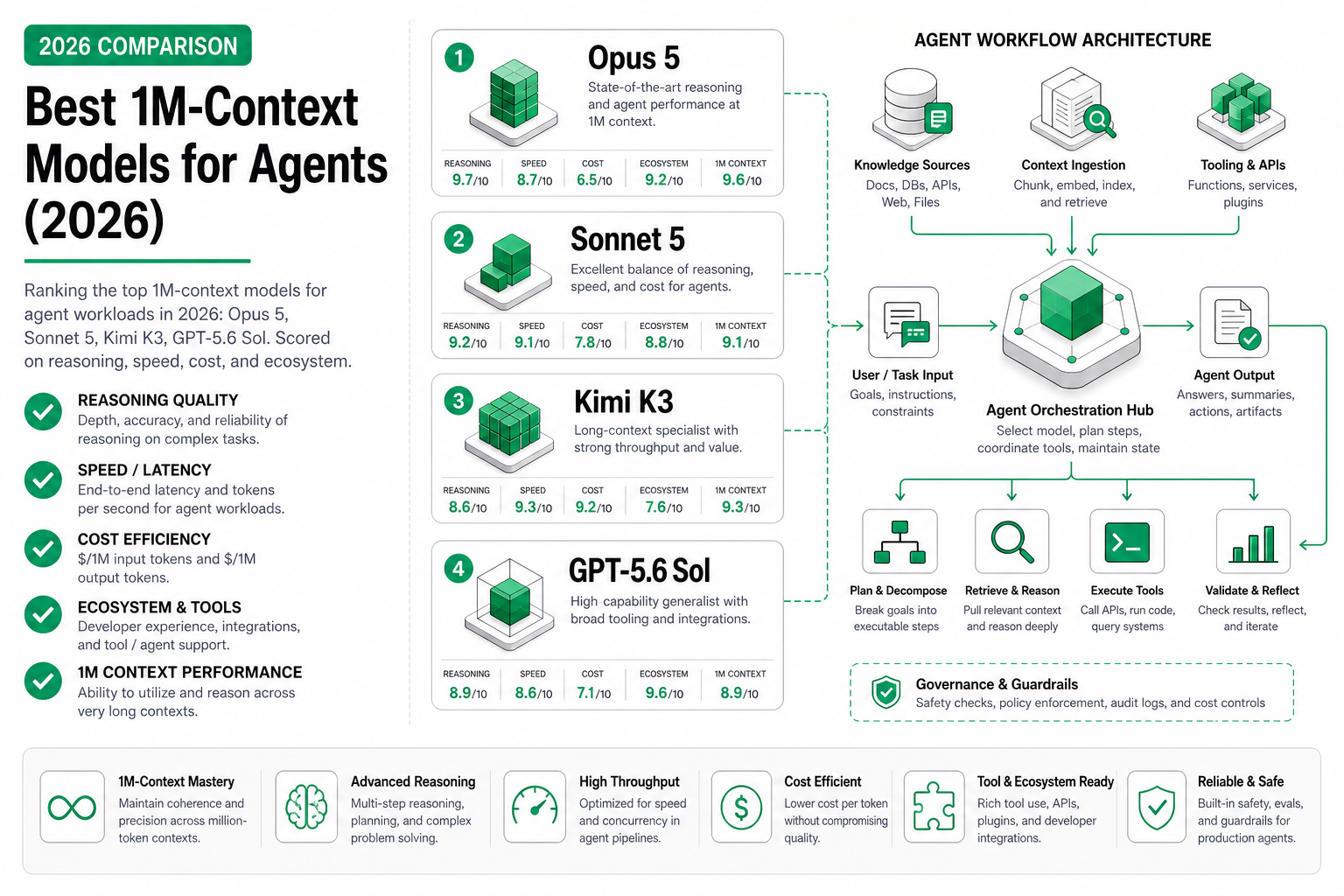
Sol is OpenAI’s answer to Claude Opus 5 in the reasoning arena. The headline feature: 1,050,000 token context window — slightly larger than Anthropic’s 1M. But the real story is structured reasoning depth.
Where Sol excels:
- Complex multi-step analysis (legal reasoning, financial modeling)
- Code generation and architectural decisions across large codebases
- Research synthesis from multiple long documents
- Data analysis with chains of transformations
- Agent orchestration requiring planning over many steps
Where Sol falls short:
- Creative writing (Luna produces more natural prose)
- Simple lookup tasks (Terra handles these 4x faster at 1/5 the cost)
- High-frequency agent loops (latency is higher due to extended thinking)
Sol Pro enables deeper chain-of-thought reasoning. Base Sol handles 10-15 step reasoning chains well. Sol Pro extends this to 25-30 step chains with maintained accuracy — the difference between solving a straightforward bug and debugging a race condition across three distributed services.
Agent use case for Sol
This is your model for complex agent workloads: code review agents, research agents processing hundreds of papers, financial analysis agents that need to reason across multiple data sources. Sol’s 1.05M context means you can load entire codebases or document collections without chunking.
Compare this with Claude Opus 5 — both target the same workloads. Opus 5 has slightly deeper reasoning on the hardest problems; Sol responds faster and offers the larger context window.
Terra: The Speed Demon
Terra is the efficiency play. It sacrifices some capability ceiling for dramatically lower latency and cost. Think of it as GPT-5.6’s answer to Claude Haiku — but more capable than previous “small” models.
Where Terra excels:
- High-volume classification and routing
- Simple extraction and formatting tasks
- Agent tool-call orchestration (fast response loops)
- Pre-processing and filtering pipelines
- Chat applications with strict latency budgets
Where Terra falls short:
- Complex reasoning (Sol is 30-40% more accurate on hard problems)
- Long-context tasks (128K window limits what you can process)
- Creative writing quality (Luna produces noticeably better prose)
Terra Pro improves instruction-following at speed. Base Terra occasionally takes shortcuts on complex instructions — it’ll give you a fast answer that misses one constraint out of five. Terra Pro maintains instruction compliance while staying 3-4x faster than Sol.
Agent use case for Terra
Router models in multi-agent systems. The agent that decides which specialized agent handles a request. Preprocessing steps that don’t need deep reasoning — extracting entities, classifying intent, formatting responses. Any loop where you’re making 100+ calls per task and each call is straightforward.
Choosing Between Variants: Decision Rules
Forget “it depends.” Here are concrete rules:
Use Luna when:
- The output will be read by humans (not parsed by code)
- Voice consistency across long outputs matters
- The task is primarily generative, not analytical
Use Sol when:
- The task requires multi-step reasoning (>5 logical steps)
- You need to reason over >128K tokens of context
- Accuracy on complex problems is more important than speed
- You’re building research, coding, or analysis agents
Use Terra when:
- Latency must be <500ms time-to-first-token
- The task is classification, extraction, or routing
- You’re optimizing for cost at scale (>1M calls/month)
- The reasoning required is straightforward (<5 steps)
Upgrade to Pro when:
- Luna Pro: you need coherent outputs >20K tokens
- Sol Pro: your reasoning chains exceed 15 steps
- Terra Pro: you need speed + reliable instruction following on complex schemas
The Cascade Pattern
The smartest teams don’t pick one variant. They cascade:
User request → Terra (classify complexity)
  → Simple → Terra (respond directly)
  → Medium → Luna or Sol (depending on creative vs analytical)
  → Complex → Sol Pro (deep reasoning)
This pattern cuts costs 60-70% compared to routing everything through Sol, while maintaining quality ceilings on hard problems. SandBase’s routing layer makes this straightforward — you define rules, and requests flow to the right model automatically.
GPT-5.6 vs Claude 5: Quick Comparison
| Dimension | GPT-5.6 (best variant) | Claude 5 (Opus) |
|---|---|---|
| Max context | 1.05M (Sol) | 1M |
| Deepest reasoning | Sol Pro | Opus 5 (slight edge) |
| Fastest variant | Terra (~100ms TTFT) | Haiku (~120ms TTFT) |
| Creative quality | Luna (strong) | Opus 5 (strong) |
| Tool calling reliability | 93% | 97% |
| Variant count | 6 | 3 (Haiku/Sonnet/Opus) |
For a detailed pricing breakdown across all LLM providers, see our LLM API pricing guide.
Accessing GPT-5.6 on SandBase
All six variants are available through SandBase’s unified API:
import openai

client = openai.OpenAI(
    base_url="https://api.sandbase.ai/v1",
    api_key="your-sandbase-key"
)

# Use any variant
response = client.chat.completions.create(
    model="openai/gpt-5.6-sol",  # or luna, terra, sol-pro, luna-pro, terra-pro
    messages=[{"role": "user", "content": "Analyze this dataset..."}],
    max_tokens=4096
)
FAQ
Which GPT-5.6 variant is best for coding agents?
Sol or Sol Pro. Coding requires multi-step reasoning (understanding the problem, planning the solution, implementing across files, verifying correctness). Sol’s 1.05M context lets you load entire repositories. Sol Pro is worth the premium when debugging complex architectural issues that require 20+ reasoning steps.
Can I use Terra as a router in front of Sol?
Yes, this is the recommended pattern. Terra classifies the request complexity in <200ms, then routes to the appropriate model. The classification call costs fractions of a cent. It pays for itself by avoiding expensive Sol calls on simple requests.
How does Luna compare to Claude Opus 5 for writing?
Different strengths. Luna produces more naturally flowing prose with better voice consistency on long outputs. Opus 5 produces writing with deeper analytical backing and more nuanced arguments. For pure marketing/creative copy, Luna edges ahead. For thought leadership or technical writing that requires depth, Opus 5 is stronger.
Is Sol Pro worth 2x the cost of base Sol?
Only for the hardest problems. Base Sol handles 80% of reasoning tasks well. Sol Pro’s advantage appears on problems requiring >15 reasoning steps or when you need near-perfect accuracy on multi-constraint problems. If your agent already has retry logic and validation, base Sol plus retries may be cheaper than Sol Pro’s higher per-call cost.
Do all variants share the same training data cutoff?
Yes. All GPT-5.6 variants share the same base training. The differentiation is in post-training optimization (RLHF focus, inference-time compute allocation, and context window engineering), not in knowledge. Any factual question gets the same answer regardless of variant.