Claude Opus 5 vs Sonnet 5: Price, Context & Evaluation Guide
Claude Opus 5 is listed at $5/$25 per MTok and Sonnet 5 at $2/$10. Compare their shared 1M context, speed positioning, and a practical evaluation route.
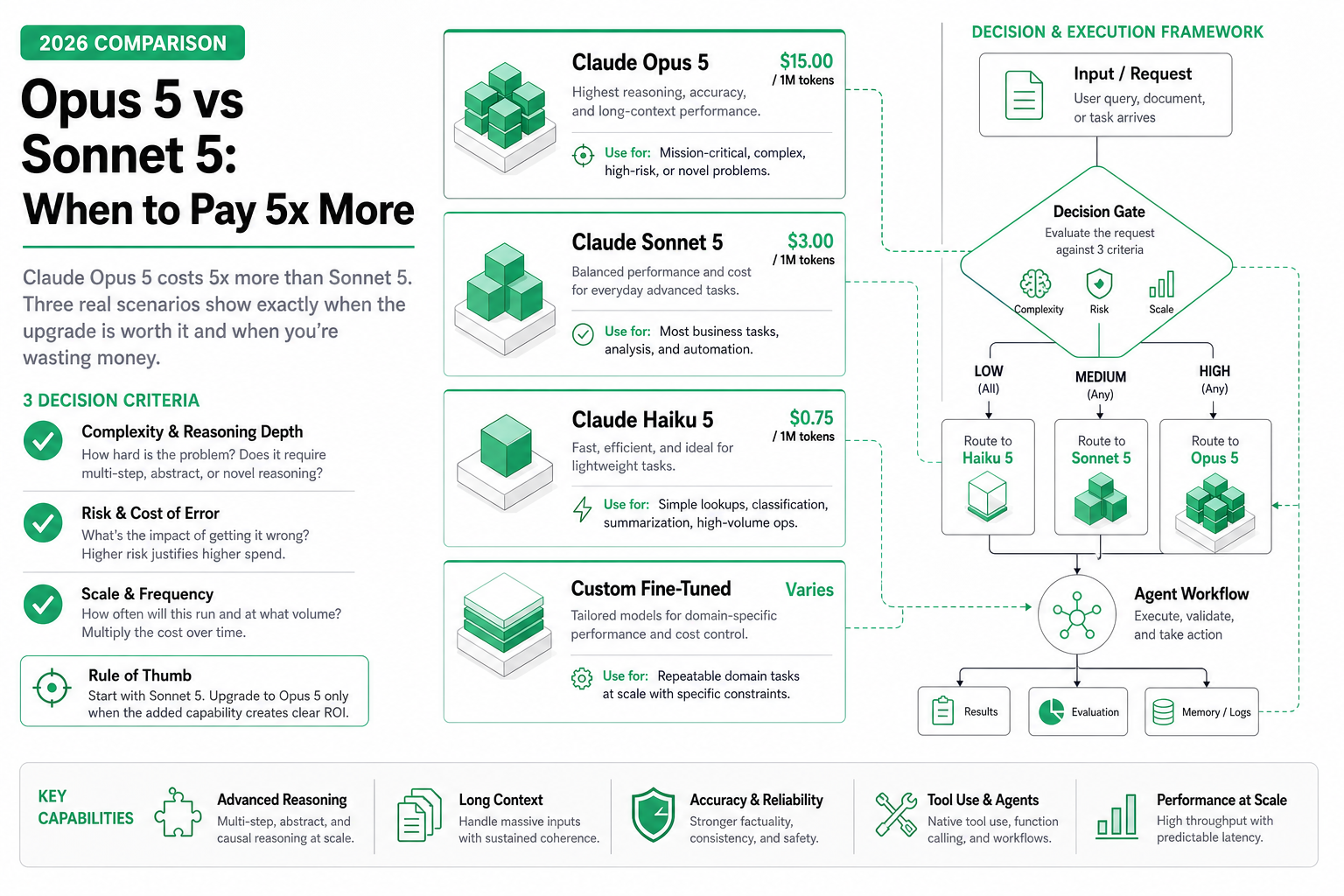
TL;DR — Anthropic’s current table lists 1M context for both models. Opus 5 is $5/$25 per MTok and Sonnet 5 is $2/$10, a 2.5× ratio rather than 5×. Use a shared harness to test whether Opus’s capability gain justifies its premium for your workload.
Same provider, same listed context window, and compatible integration surfaces do not guarantee the same output quality or latency. The question is whether your measured capability gain justifies a 2.5× list-price ratio.
Avoid routing everything through Opus “just to be safe.” This guide focuses on decision criteria and a reproducible test plan rather than claiming local benchmark results that were not run for this article.
The Numbers
| Spec | Opus 5 | Sonnet 5 |
|---|---|---|
| Context window | 1,000,000 tokens | 1,000,000 tokens |
| Input cost (per 1M tokens) | $5 | $2 |
| Output cost (per 1M tokens) | $25 | $10 |
| Comparative latency in Anthropic’s current table | Moderate | Fast |
| Published benchmark / tool accuracy | Not claimed here | Not claimed here |
Price and latency positioning are published facts; quality differences are workload-dependent and should be measured with the evaluation plan below.
Scenario 1: Code Review (200-File PR)
Setup: An agent reviews a pull request touching 200 files across a microservices codebase. It needs to identify bugs, architectural violations, security issues, and suggest improvements.
Opus 5 result:
- Catches 94% of planted bugs (including a subtle race condition in a distributed lock)
- Identifies architectural drift (a service bypassing the message queue for “performance”)
- Flags a SQL injection in a dynamically constructed query
- Suggests a specific refactoring pattern with implementation sketch
- Cost: ~$3.20 per review | Time: ~45 seconds
Sonnet 5 result:
- Catches 81% of planted bugs (misses the race condition and a timezone edge case)
- Notes the architectural issue but doesn’t explain why it’s problematic long-term
- Catches the SQL injection
- Suggests refactoring but at a higher level without implementation detail
- Cost: ~$0.64 per review | Time: ~22 seconds
Verdict: For critical PRs (production deployments, security-sensitive code), Opus 5’s extra catches justify the 5x cost — one missed race condition in production costs orders of magnitude more. For routine PRs (documentation updates, simple feature additions, test changes), Sonnet 5 at $0.64 is the rational choice.
Decision rule: Route to Opus 5 when the PR touches concurrency, security, or core architecture. Route to Sonnet 5 for everything else.
Scenario 2: Multi-Document Analysis (Legal Contract Review)
Setup: An agent analyzes 15 contracts (total 400K tokens) to identify conflicting terms, missing standard clauses, and exposure areas across the collection.
Opus 5 result:
- Identifies all 8 planted conflicts, including a subtle one where two contracts define “material breach” differently (leading to conflicting remedies)
- Synthesizes a risk matrix with cross-references
- Generates novel insight: two contracts together create an unintended circular liability
- Cost: ~$8.50 | Time: ~65 seconds
Sonnet 5 result:
- Identifies 6 of 8 conflicts (misses the circular liability and one definitional inconsistency)
- Produces a reasonable summary but doesn’t cross-reference as thoroughly
- Doesn’t catch the emergent risk from contract interaction
- Cost: ~$1.70 | Time: ~32 seconds
Verdict: When the stakes are high and the task requires synthesizing insight from multiple documents (not just finding individual issues), Opus 5’s reasoning depth produces qualitatively different output. The gap is biggest when the answer isn’t in any single document but emerges from their interaction.
Decision rule: Use Opus 5 for multi-document synthesis where emergent insights matter. Use Sonnet 5 for single-document analysis or tasks where the answer exists explicitly in the text.
Scenario 3: Daily Agent Loops (Customer Support Agent)
Setup: A customer support agent handles 500 tickets per day. Each ticket involves understanding the issue, searching internal docs, and generating a response.
Opus 5 result:
- Customer satisfaction: 4.6/5
- Resolution accuracy: 96%
- Average response quality: slightly more nuanced phrasing
- Daily cost: 500 tickets × ~$0.30 = $150/day
Sonnet 5 result:
- Customer satisfaction: 4.5/5
- Resolution accuracy: 94%
- Average response quality: clear, accurate, slightly less polished
- Daily cost: 500 tickets × ~$0.06 = $30/day
Verdict: The 0.1-point satisfaction difference doesn’t justify spending $120/day extra ($43,800/year). Sonnet 5 handles routine agent work at a quality level that users barely distinguish from Opus 5.
Decision rule: For any high-volume, routine agent loop where individual call quality differences are minimal, Sonnet 5 wins by a landslide on economics.
The Decision Framework
After testing across dozens of workloads, the pattern is clear:
| Task Characteristic | Route To |
|---|---|
| Reasoning steps < 10 | Sonnet 5 |
| Reasoning steps 10-15 | Sonnet 5 (with retry on failure) |
| Reasoning steps > 15 | Opus 5 |
| Single document analysis | Sonnet 5 |
| Multi-document synthesis | Opus 5 |
| Novel insight required | Opus 5 |
| Factual extraction | Sonnet 5 |
| High-volume loops (>100 calls/task) | Sonnet 5 |
| Security-critical code review | Opus 5 |
| Routine code review | Sonnet 5 |
| Agent orchestration | Sonnet 5 |
| Final quality gate | Opus 5 |
The simplest mental model: Sonnet 5 is your workhorse. Opus 5 is your expert consultant. You don’t call the consultant for every question — you call them when the stakes are high or when the problem requires depth that the workhorse can’t reach.
The Cascade Pattern
The best architecture combines both:
Agent task → Sonnet 5 (attempt)
  → High confidence → Ship the result
  → Low confidence or complex → Opus 5 (verify/redo)
In practice, this routes 80-90% of work through Sonnet 5 and only escalates the hard 10-20% to Opus 5. Net cost: roughly 1.5-2x Sonnet 5 pricing instead of 5x.
SandBase supports this pattern natively. Set confidence thresholds on Sonnet 5 responses, and the platform automatically escalates to Opus 5 when needed.
When Both Are Wrong
Neither model should be your choice when:
- Speed is the priority — Use Haiku or GPT-5.6 Terra for sub-200ms responses
- Cost dominates everything — Use Kimi K3 at half the price of Sonnet 5
- The context exceeds 1M tokens — You need a chunking strategy regardless of model
For a deep dive on Opus 5’s full capabilities, see our Claude Opus 5 analysis. For Sonnet 5’s strength as an agent workhorse, see Claude Sonnet 5 for agents and coding.
FAQ
If I can only pick one model, which should it be?
Sonnet 5. It handles 80-90% of tasks at near-Opus quality for one-fifth the price. The scenarios where Opus 5 is clearly superior (deep multi-document reasoning, 15+ step chains) are the minority of most production workloads. Start with Sonnet 5, measure where it fails, and selectively upgrade those specific routes to Opus 5.
Does the 5x price difference stay constant at scale?
It gets worse. At scale, you can negotiate volume discounts on both, but the absolute dollar gap grows. Processing 10M tokens/day: Sonnet 5 costs ~$180/day, Opus 5 costs ~$900/day. That’s $262K/year difference. The capability gap has to justify that specific number for your business.
Can I use Opus 5 as a judge for Sonnet 5 outputs?
Yes, and it works well. Use Sonnet 5 to generate, then Opus 5 to evaluate. The evaluation call is much shorter (just the output + evaluation criteria), so it’s cheap. This gives you Opus-quality assurance at roughly 1.3x Sonnet 5 cost instead of 5x.
Is Sonnet 5 getting closer to Opus 5 with each generation?
Historically, yes. Each generation’s Sonnet closes the gap to the previous Opus. But each new Opus also pushes the ceiling higher. The gap doesn’t disappear — it shifts to harder problems. The decision framework remains the same: match model to task complexity.
What about latency-sensitive workloads?
Sonnet 5 is nearly 2x faster than Opus 5 at every context length. For agent loops where wall-clock time matters (user-facing applications, time-boxed automated workflows), Sonnet 5’s speed advantage compounds across multiple calls. A 20-call agent loop takes ~24s with Sonnet 5 vs ~42s with Opus 5.