Best Models for Autonomous Agents (2026)
A tiered model recommendation for autonomous agents in 2026: which model for planning, execution, classification, and when to cascade across tiers.
TL;DR — No single model is best for all autonomous agent tasks. The optimal setup cascades across tiers: Claude Opus 5 / GPT-5.6 Sol for complex planning (5% of calls), Claude Sonnet 5 / GPT-4o for execution and reasoning (25%), and Haiku 3.5 / GPT-4o-mini / Gemini Flash for classification and routing (70%). This guide gives you the tiered configuration and the decision rules to route between them.
An autonomous agent does four fundamentally different things: it plans (decomposing a complex goal into steps), it reasons (analyzing information to make decisions), it executes (calling tools, writing code, generating output), and it classifies (routing inputs, filtering relevance, deciding what to do next).
Each of these jobs has a different cost-quality tradeoff. Using Opus for everything is like hiring a PhD to answer the phone. Using mini for everything is like sending an intern to negotiate a contract.
The right answer is a cascade.
The tiered model configuration
| Tier | Role | Models | % of calls | Cost range |
|---|---|---|---|---|
| T1: Deep reasoning | Complex planning, multi-step strategy, critical decisions | Claude Opus 5, GPT-5.6 Sol Pro | 5% | $15-25/M input |
| T2: Core execution | Code generation, analysis, tool use, structured output | Claude Sonnet 5, GPT-4o, Kimi K3 | 25% | $2.50-3.00/M input |
| T3: Fast & cheap | Classification, routing, extraction, simple generation | Haiku 3.5, GPT-4o-mini, Gemini Flash, DeepSeek V4 | 70% | $0.07-0.80/M input |
Why this distribution works
Most autonomous agent turns are simple: “Is this input relevant?” → classify. “Extract the name and date from this text.” → extract. “Route this to the right handler.” → route. These are T3 tasks.
When a T3 model is uncertain or the task requires multi-step reasoning, it escalates to T2. And T2 handles 95% of the remaining work — code generation, document analysis, report writing, tool orchestration.
T1 (Opus / Sol Pro) activates only for genuinely hard problems: planning a 20-step research workflow, evaluating contradictory evidence across documents, or making high-stakes decisions where a wrong answer has significant consequences.
Model recommendations by agent function
Planning (T1)
The agent receives “Research the AI infrastructure market and produce an investment thesis.”
| Model | Strength | Limitation |
|---|---|---|
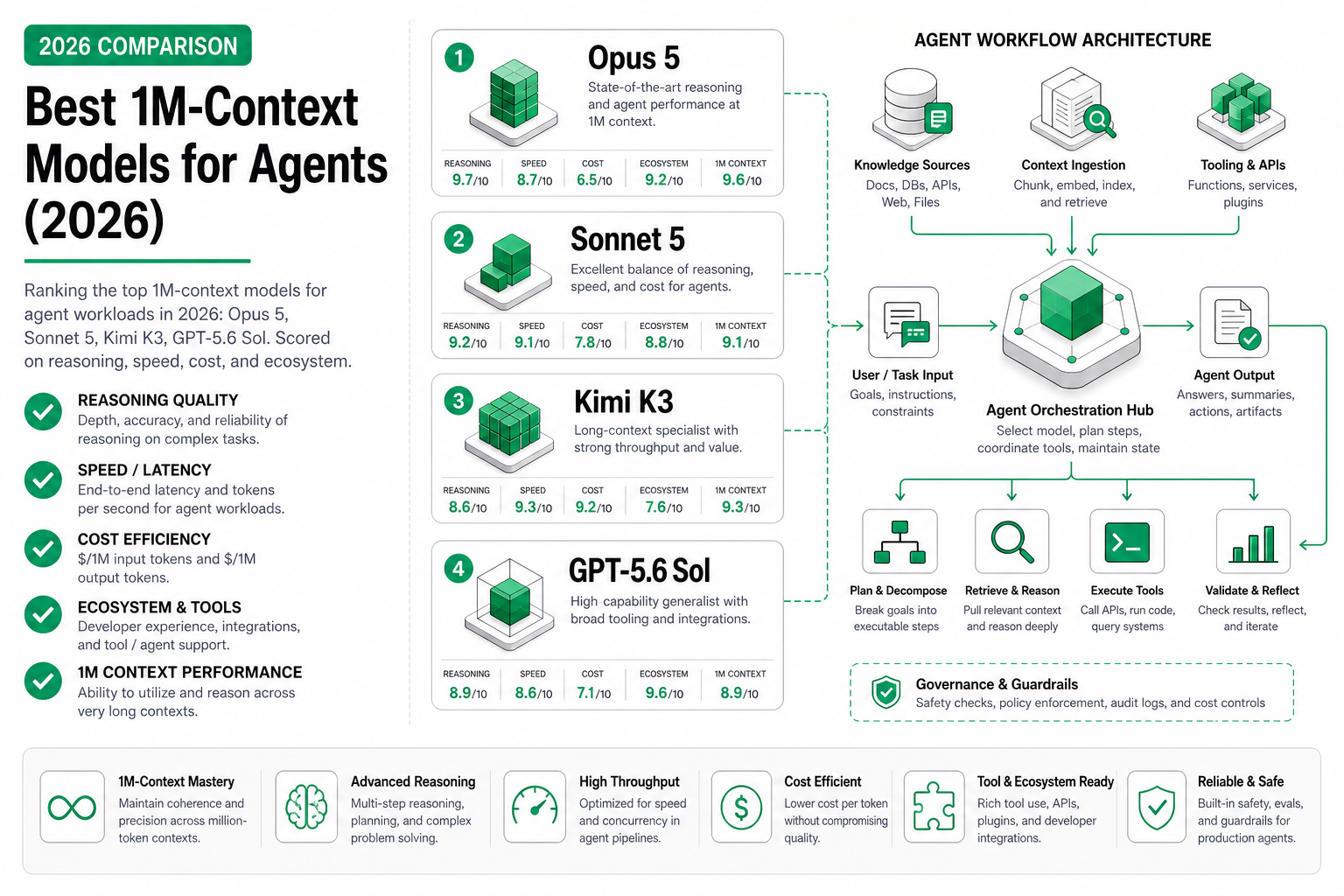
| Claude Opus 5 | Deepest reasoning, sees subtle connections in 1M context | Slowest, most expensive |
| GPT-5.6 Sol Pro | Strong analytical reasoning, 1.05M context | Newer, less battle-tested |
| Kimi K3 | Fast planning, competitive quality | Ecosystem still maturing |
Recommendation: Opus 5 for critical plans where wrong decomposition has high cost. Sol Pro as a strong alternative. Kimi K3 for budget-conscious planning where speed matters more than maximum depth.
Execution — Code (T2)
The agent writes, debugs, or refactors code.
| Model | Strength | Limitation |
|---|---|---|
| Claude Sonnet 5 | Excellent code quality, 1M context for full repos | Not cheapest |
| GPT-4o | Strong coding, fast, good tool use | 128K context limit |
| Kimi K3 | Competitive coding benchmarks | Less community tooling |
| DeepSeek V4 | Strong for coding, very competitive pricing | Smaller ecosystem |
Recommendation: Sonnet 5 for complex multi-file changes that benefit from 1M context. GPT-4o for single-file tasks where speed matters. DeepSeek V4 as a budget alternative that trades ecosystem maturity for cost.
Execution — Analysis (T2)
The agent reads documents and produces insights.
| Model | Strength | Limitation |
|---|---|---|
| Claude Sonnet 5 | 1M context, strong instruction following | Medium speed |
| GPT-4o | Good analysis, faster than Sonnet | 128K context ceiling |
| Gemini 1.5 Pro | 2M context, good for very long docs | Slightly less precise |
Recommendation: Sonnet 5 as default for documents up to 500K tokens. Gemini 1.5 Pro for documents exceeding Sonnet’s practical limit. GPT-4o for shorter documents where speed is priority.
Classification & Routing (T3)
The agent decides: is this relevant? which handler? what priority?
| Model | Strength | Limitation |
|---|---|---|
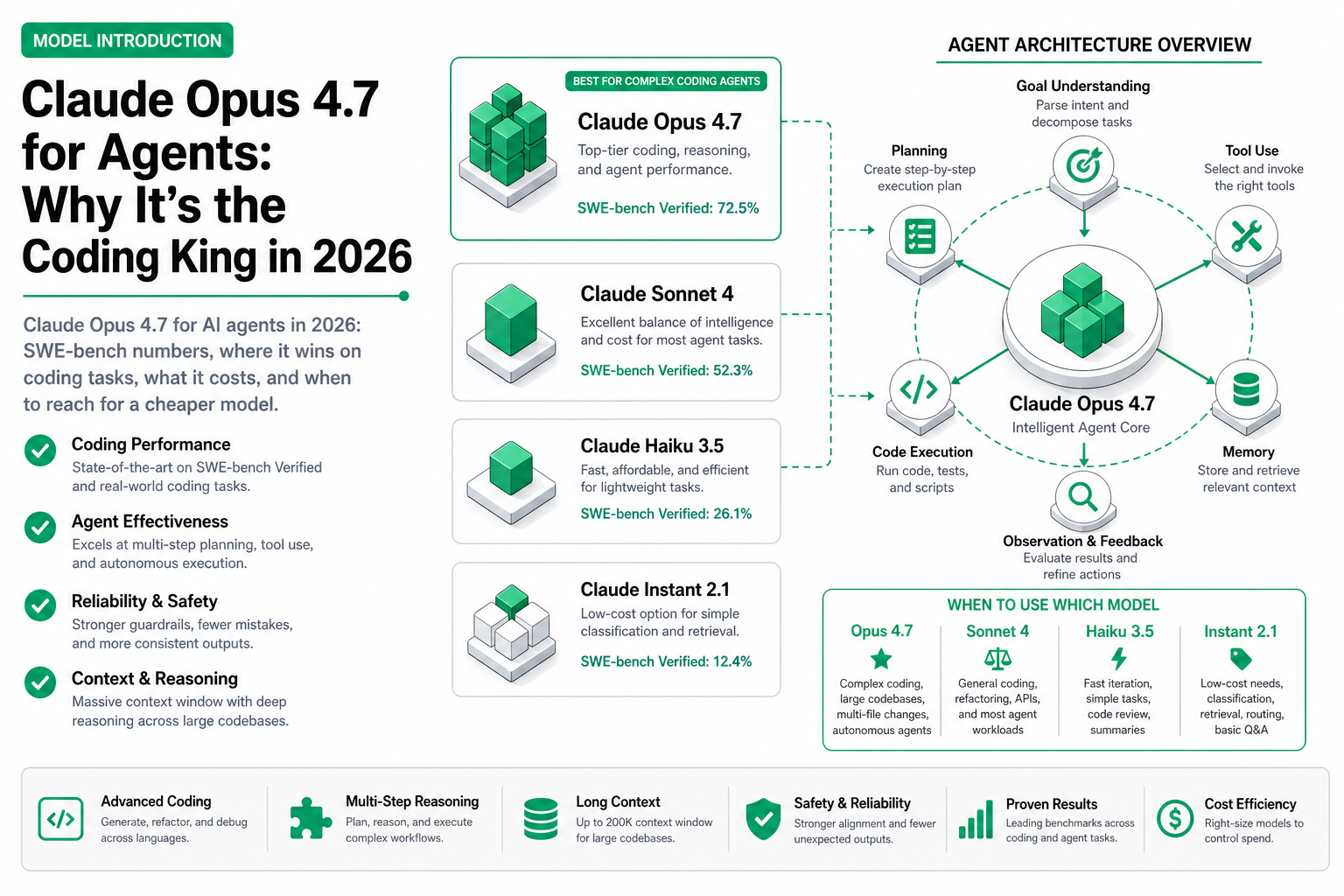
| Claude Haiku 3.5 | Fast, accurate classification, structured output | More expensive than mini |
| GPT-4o-mini | Very cheap ($0.15/M), good enough for simple decisions | May miss nuance |
| Gemini Flash 8B | Cheapest ($0.0375/M), 1M context | Lower quality ceiling |
| DeepSeek V4 Flash | Budget long-context classification | Smaller ecosystem |
Recommendation: GPT-4o-mini as the default T3 model (best cost-quality ratio). Gemini Flash 8B when volume exceeds 10,000 calls/day and you need sub-penny costs. Haiku 3.5 when classification accuracy is critical (e.g., safety filtering).
The cascade pattern in code
from enum import Enum

class Tier(Enum):
    T1_PLANNING = "anthropic/claude-opus-5"
    T2_EXECUTION = "anthropic/claude-sonnet-5"
    T3_ROUTING = "openai/gpt-4o-mini"

def select_model(task_type: str, complexity: float, stakes: str) -> str:
    """Route to the right tier based on task characteristics."""
    # T1: Only for complex planning or high-stakes decisions
    if task_type == "planning" and (complexity > 0.8 or stakes == "critical"):
        return Tier.T1_PLANNING.value

    # T2: Reasoning, code generation, analysis
    if task_type in ("code", "analysis", "reasoning") or complexity > 0.5:
        return Tier.T2_EXECUTION.value

    # T3: Everything else (classification, routing, extraction, simple generation)
    return Tier.T3_ROUTING.value
Cost impact of cascading
A daily autonomous agent running 200 turns/day:
| Strategy | Model distribution | Daily cost | Monthly |
|---|---|---|---|
| All Opus 5 | 200 × T1 | $18.00 | $540 |
| All Sonnet 5 | 200 × T2 | $3.60 | $108 |
| All GPT-4o-mini | 200 × T3 | $0.09 | $2.70 |
| Cascaded (5/25/70) | 10×T1 + 50×T2 + 140×T3 | $2.72 | $81.60 |
The cascaded approach costs 85% less than all-Opus while maintaining Opus-quality planning for the tasks that need it. And it costs only 25% less than all-Sonnet — because Sonnet handles the majority workload well and is already reasonably priced.
The biggest savings come from moving the 70% classification calls from T2 to T3: that alone saves $2.52/day.
When to override the cascade
Override to T1 when:
- The agent has failed twice on the same task at T2
- The task involves evaluating contradictory information
- A wrong answer has financial/legal/safety consequences
- The agent is decomposing a novel task it has never seen
Override to T3 when:
- The task is templated with clear inputs/outputs
- Speed matters more than nuance (real-time user interaction)
- You are in a high-volume loop (>1000 calls/hour)
Models available on SandBase
All recommended models are available through SandBase’s unified endpoint:
| Model | SandBase name | Context |
|---|---|---|
| Claude Opus 5 | anthropic/claude-opus-5 | 1M |
| Claude Sonnet 5 | anthropic/claude-sonnet-5 | 1M |
| Claude Haiku 3.5 | anthropic/claude-haiku-3.5 | 200K |
| GPT-4o | openai/gpt-4o | 128K |
| GPT-4o-mini | openai/gpt-4o-mini | 128K |
| GPT-5.6 Sol | openai/gpt-5.6-sol | 1.05M |
| Kimi K3 | moonshotai/kimi-k3 | 1M |
| DeepSeek V4 | deepseek/deepseek-v4 | 128K |
One API key, one endpoint, all tiers. The cascade is a routing decision in your code, not an infrastructure change.
FAQ
Should I start with cascading or pick one model?
Start with one model (Sonnet 5 is the safest default). Once you understand your agent’s task distribution, add T3 for the simple calls and T1 for the hard ones. Premature optimization adds complexity without data.
How do I know if a task needs T1 vs T2?
Two signals: (1) Has T2 failed on this task before? → Try T1. (2) Does the task require evaluating multiple valid approaches? → Likely T1. If you are unsure, run T2 first and escalate on failure.
Is Kimi K3 ready for production agents?
Kimi K3 shows strong benchmark results and competitive pricing. For production use, validate on your specific workloads. Its 1M context and speed make it attractive for T2 tasks. The main risk is ecosystem maturity (fewer integrations, less community tooling vs Claude/GPT).
Can I cascade within the same agent turn?
Yes. A single turn can: classify with T3 → decide it needs analysis → escalate to T2 → realize the analysis is ambiguous → escalate to T1 for judgment. This happens transparently if you implement the routing logic.
What about fine-tuned models?
Fine-tuned models can replace T3 for domain-specific classification with even lower cost. If you have a classification task with >10,000 examples, fine-tuning GPT-4o-mini may outperform prompting while using fewer tokens.
For detailed pricing of each model tier, see our LLM pricing guide. For 1M-context specific comparisons, see best 1M-context models. For cost frameworks, see per-call vs token pricing.
Related Reading
- Best 1M-Context Models for Agents (2026)
- Best Open-Weight LLMs for AI Agents in 2026 (Compared)
- Opus 5 vs Sonnet 5: When to Pay 5x More
- GPT-5.6 vs Claude 5 for Agent Workloads
- Claude Sonnet 4 vs GPT-4o: Best LLM for AI Agents?
- LLM API Pricing in 2026: The Complete Guide
Key takeaways
- No single model is best for all agent tasks — cascade across T1/T2/T3
- The 5/25/70 distribution (T1/T2/T3) costs 85% less than all-T1 with comparable quality
- T3 (classification/routing) is 70% of calls: optimize this tier first for maximum savings
- Default to Sonnet 5 for T2, GPT-4o-mini for T3, Opus 5 for T1
- Override rules: escalate on failure or high stakes; downgrade on templated tasks or speed requirements
- All tiers available through one SandBase endpoint — cascading is a code decision, not an infra change