GPT-5.6 vs Claude 5 for Agent Workloads
GPT-5.6 and Claude 5 take different approaches to agent workloads. Speed and variants vs reasoning depth and tool reliability. Scenario-based comparison.
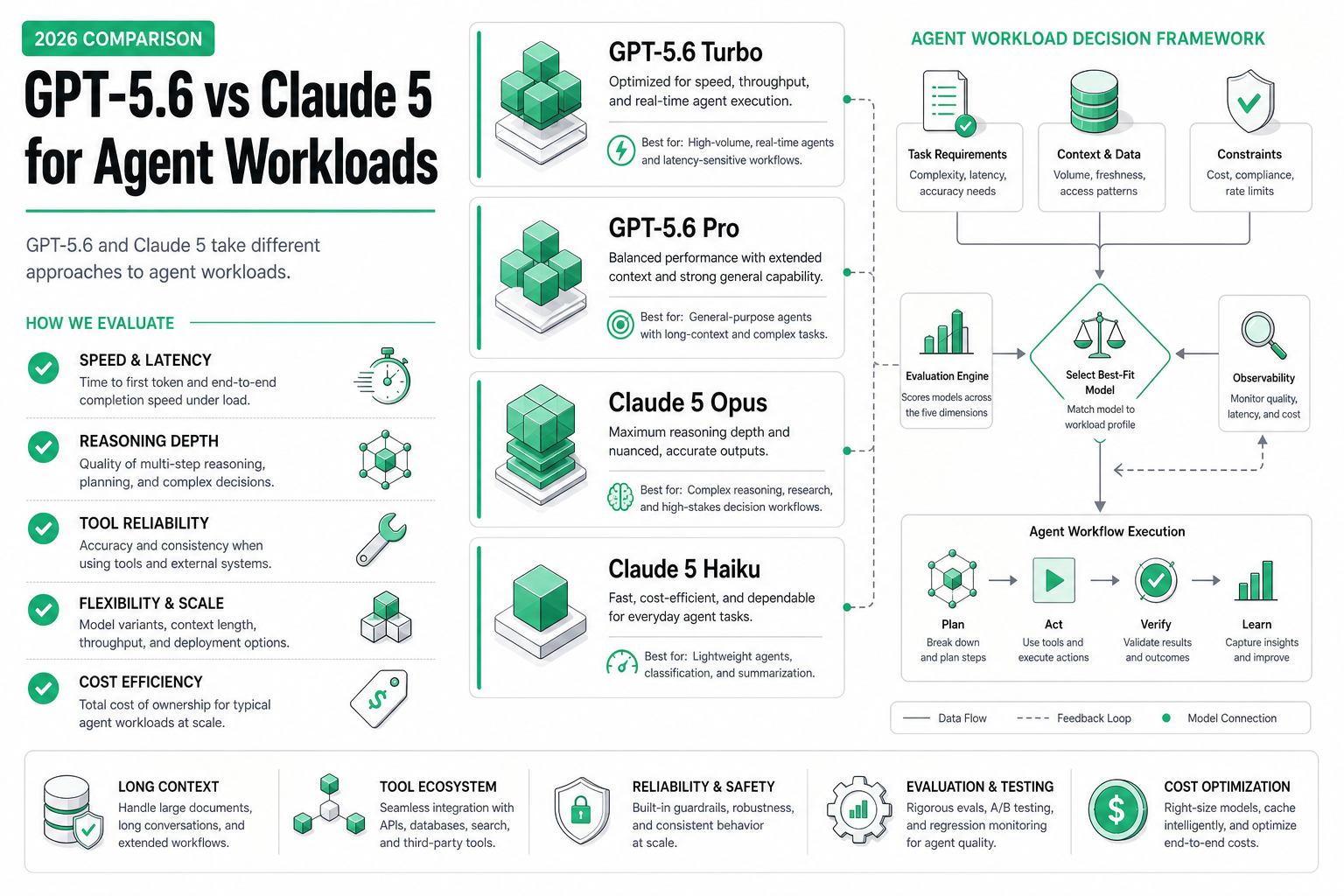
TL;DR — GPT-5.6 wins on speed, vision capabilities, and variant flexibility (six models for different tasks). Claude 5 wins on reasoning depth, tool-calling reliability, and consistent 1M context performance. For agent workloads: use GPT-5.6 Terra/Sol for speed-sensitive multi-step pipelines, Claude Sonnet 5/Opus 5 for reliability-critical and reasoning-heavy tasks.
The “which is better for agents” question has no single answer in 2026. Both families have evolved into specialized toolkits rather than single models. OpenAI gives you six variants optimized for different workload types. Anthropic gives you three tiers with deeper specialization per tier.
This comparison cuts by scenario. Not “which model is generally better” but “for this specific agent pattern, which family should handle it.”
Architecture Differences That Matter for Agents
| Aspect | GPT-5.6 Family | Claude 5 Family |
|---|---|---|
| Variant count | 6 (Luna/Sol/Terra × base/Pro) | 3 (Haiku/Sonnet/Opus) |
| Max context | 1.05M (Sol) | 1M (Sonnet & Opus) |
| Fastest variant | Terra (~100ms TTFT) | Haiku (~120ms TTFT) |
| Deepest reasoner | Sol Pro | Opus 5 (slight edge) |
| Tool calling accuracy | 93% (Sol) | 97% (Opus), 93% (Sonnet) |
| Vision capability | Strong across all variants | Good but not primary strength |
| Structured output reliability | 91% schema compliance | 95% schema compliance |
| Caching support | Standard | 5min + 1hr prompt caching tiers |
GPT-5.6 Advantages for Agents
Speed Across the Board
GPT-5.6 Terra delivers sub-200ms time-to-first-token on most prompts. Even Sol, the reasoning variant, responds faster than Claude Opus 5 for equivalent complexity:
| Task Type | GPT-5.6 (best variant) | Claude 5 (best tier) |
|---|---|---|
| Simple classification | Terra: 95ms | Haiku: 120ms |
| Code generation | Sol: 1.8s | Sonnet 5: 2.2s |
| Deep analysis | Sol Pro: 3.5s | Opus 5: 4.8s |
| Long-context (500K) | Sol: 9s | Opus 5: 22s, Sonnet 5: 11s |
For agent architectures with strict latency budgets (user-facing chatbots, real-time decision systems), GPT-5.6’s speed advantage compounds across multi-turn interactions.
Vision Integration
GPT-5.6 processes images natively across all variants with strong accuracy. Agents that need to interpret screenshots, analyze charts, read documents with mixed text/images, or process visual data work better with GPT-5.6. Claude 5 handles vision but it’s not the primary training emphasis.
For agent use cases like:
- UI testing agents that verify screenshot correctness
- Data extraction from charts and infographics
- Document processing with embedded images
- Visual code review (architecture diagrams)
GPT-5.6 produces more accurate and detailed visual analysis.
Six Variants = Precision Routing
With six models, you can match precisely:
- Terra for routing/classification decisions (~$0.80/M input)
- Terra Pro for structured extraction at speed (~$1.50/M input)
- Luna for user-facing response generation (~$2.50/M input)
- Sol for analytical work (~$4/M input)
- Sol Pro for the hardest reasoning tasks (~$8/M input)
Claude offers three tiers, which means the jump from Haiku to Sonnet is larger. GPT-5.6’s finer granularity lets you optimize cost more precisely per agent step.
Claude 5 Advantages for Agents
Reasoning Depth
On problems requiring 15+ logical steps, Claude Opus 5 outperforms GPT-5.6 Sol Pro by 4-8 percentage points. This gap widens on:
- Multi-constraint satisfaction (keeping 10+ rules simultaneously)
- Novel problem solving (not pattern matching from training data)
- Cross-document reasoning (synthesizing insights across sources)
For agents doing complex analysis — legal reasoning, architectural code review, financial modeling — this accuracy difference translates directly into fewer errors that require human correction.
Tool Calling Stability
This is Claude 5’s killer advantage for agents. Tool calling accuracy:
| Complexity | GPT-5.6 Sol | Claude Sonnet 5 | Claude Opus 5 |
|---|---|---|---|
| Simple (1-2 params) | 96% | 97% | 99% |
| Medium (3-5 params) | 92% | 94% | 97% |
| Complex (6+ params, nested) | 85% | 89% | 95% |
| Multi-tool sequential | 83% | 88% | 94% |
The difference at “complex” and “multi-tool” levels is where production agents live. A 10-step agent loop with 85% per-step accuracy gives 80% end-to-end success (0.85^10 = 0.20 failure rate). At 94% per-step, end-to-end success jumps to 54% (0.94^10).
Every percentage point of tool-calling accuracy saves exponential retry cost in multi-step workflows.
Prompt Caching Economics
Anthropic’s two-tier caching system (5-minute at 0.1× read cost, 1-hour at 0.1× read cost with higher write premium) dramatically changes agent economics. For agents that make repeated calls with shared context (system prompts, loaded documents, conversation history), caching cuts effective per-call cost by 70-90%.
GPT-5.6 has standard caching but without the transparent tiered pricing that lets you architect specifically around cache behavior.
Consistent Long-Context Behavior
Both Opus 5 and Sonnet 5 handle 1M tokens with consistent quality. GPT-5.6’s 1.05M context (Sol only) is slightly larger but some users report quality degradation past 800K tokens on certain tasks. Claude’s behavior at 900K+ tokens is more predictable — what works at 500K generally works at 900K with proportional latency increase.
Scenario-Based Recommendations
Coding Agent (Multi-File Edits)
Winner: Claude Sonnet 5
Coding agents make sequential tool calls (read file → analyze → edit → verify). Tool-calling reliability is paramount. Sonnet 5’s 94% accuracy on sequential multi-tool calls beats Sol’s 83%. The speed difference (Sonnet 5 slightly slower) is irrelevant because the time saved from not retrying failed tool calls far exceeds the per-call latency gap.
Customer-Facing Chatbot
Winner: GPT-5.6 Luna
Conversational agents need fast responses, natural language, and consistent personality. Luna’s speed (sub-200ms TTFT) and conversational optimization make it feel more responsive. Tool calls in chatbots are typically simple (1-2 params), where both families perform well.
Research Agent (Multi-Document Synthesis)
Winner: Claude Opus 5
Processing 20+ documents to produce a synthesis requires: loading everything into context, reasoning across sources, and producing structured output. Opus 5’s reasoning depth and tool-calling stability at this complexity level are unmatched. Sol Pro comes close but Opus 5 catches cross-document insights that Sol Pro misses.
Monitoring/Alerting Agent
Winner: GPT-5.6 Terra
Agents that continuously process metrics, classify anomalies, and trigger alerts need: sub-200ms decisions, simple reasoning, and high throughput. Terra handles thousands of classification calls per minute at negligible cost. Haiku is comparable but slightly slower.
Autonomous Multi-Step Agent
Winner: Claude Sonnet 5 (with Opus 5 escalation)
Autonomous agents running 20-50 step workflows need consistent tool calling across many sequential steps. Claude’s higher per-step reliability compounds into dramatically higher end-to-end success rates. Use Sonnet 5 as the default, escalate to Opus 5 when the agent detects it’s stuck or confidence is low.
Cost Comparison for Common Agent Patterns
| Agent Pattern | GPT-5.6 (optimal variant) | Claude 5 (optimal tier) | Cost Winner |
|---|---|---|---|
| 1000 simple classifications | Terra: $1.60 | Haiku: $2.00 | GPT-5.6 |
| 100 code reviews (100K ctx) | Sol: $56 | Sonnet 5: $48 | Claude 5 (with caching) |
| 50 deep analyses | Sol Pro: $52 | Opus 5: $97 | GPT-5.6 |
| 500 chatbot sessions | Luna: $18 | Sonnet 5: $22 | GPT-5.6 |
| 20 autonomous agent runs | Sol: $34 + retries | Sonnet 5: $26 (fewer retries) | Claude 5 |
The cost winner depends on whether you count retry costs. Claude’s higher tool-calling accuracy means fewer retries, which can flip the economics on multi-step tasks even when per-call pricing is higher.
For a detailed breakdown of GPT-5.6’s variant system, see GPT-5.6 Luna, Sol, Terra explained. For Claude’s agent strengths, see Claude Sonnet 5 for agents and coding.
FAQ
For a new agent project, which should I start with?
Claude Sonnet 5 for reliability-critical agents (tool calling, multi-step workflows). GPT-5.6 Sol for speed-critical agents (user-facing, real-time). If your agent does both, use Claude for the workflow backbone and GPT-5.6 Terra for the latency-sensitive user interaction layer.
Can I mix both families in one agent?
Yes, and many production systems do. Use GPT-5.6 Terra for fast routing decisions, Claude Sonnet 5 for reliable tool execution, and Claude Opus 5 for complex reasoning steps. SandBase’s unified API makes switching between providers within a single workflow trivial.
Which handles rate limiting better at scale?
Both providers have robust rate limiting, but approaches differ. OpenAI provides higher default rate limits. Anthropic’s per-model rate limits are lower but their caching system reduces the number of full API calls needed. At enterprise scale (>1M calls/day), both require custom agreements.
Is GPT-5.6’s vision advantage meaningful for most agents?
Only if your agent processes visual content. If it’s pure text/code, vision capability is irrelevant. But for agents that interact with web pages, process PDFs with diagrams, or analyze screenshots, GPT-5.6’s stronger vision genuinely reduces error rates.
Which ecosystem has better observability tooling?
Both integrate with standard observability platforms (Langfuse, Helicone, etc.). Anthropic’s usage API provides more granular token-level breakdowns (cache hits, cache writes, thinking tokens). OpenAI provides slightly better real-time streaming diagnostics. Neither has a decisive advantage.