Best 1M-Context Models for Agents (2026)
Ranking the top 1M-context models for agent workloads in 2026: Opus 5, Sonnet 5, Kimi K3, GPT-5.6 Sol. Scored on reasoning, speed, cost, and ecosystem.
TL;DR — Four models offer 1M+ token context in 2026: Claude Opus 5, Claude Sonnet 5, Kimi K3, and GPT-5.6 Sol. No single model wins all dimensions. Opus 5 leads on reasoning, K3 wins speed and cost, Sol offers the largest window (1.05M), and Sonnet 5 is the best overall balance. Pick by your primary constraint.
The million-token context window went from research curiosity to production requirement in 2026. Entire codebases, legal document collections, research corpora — they fit in a single prompt now. But “supports 1M tokens” doesn’t mean all models handle it equally well.
This is a ranked comparison of the four serious contenders, scored across the four dimensions that matter most for agent workloads: reasoning quality, speed, cost efficiency, and ecosystem maturity.
The Contenders
| Model | Context | Provider | Positioning |
|---|---|---|---|
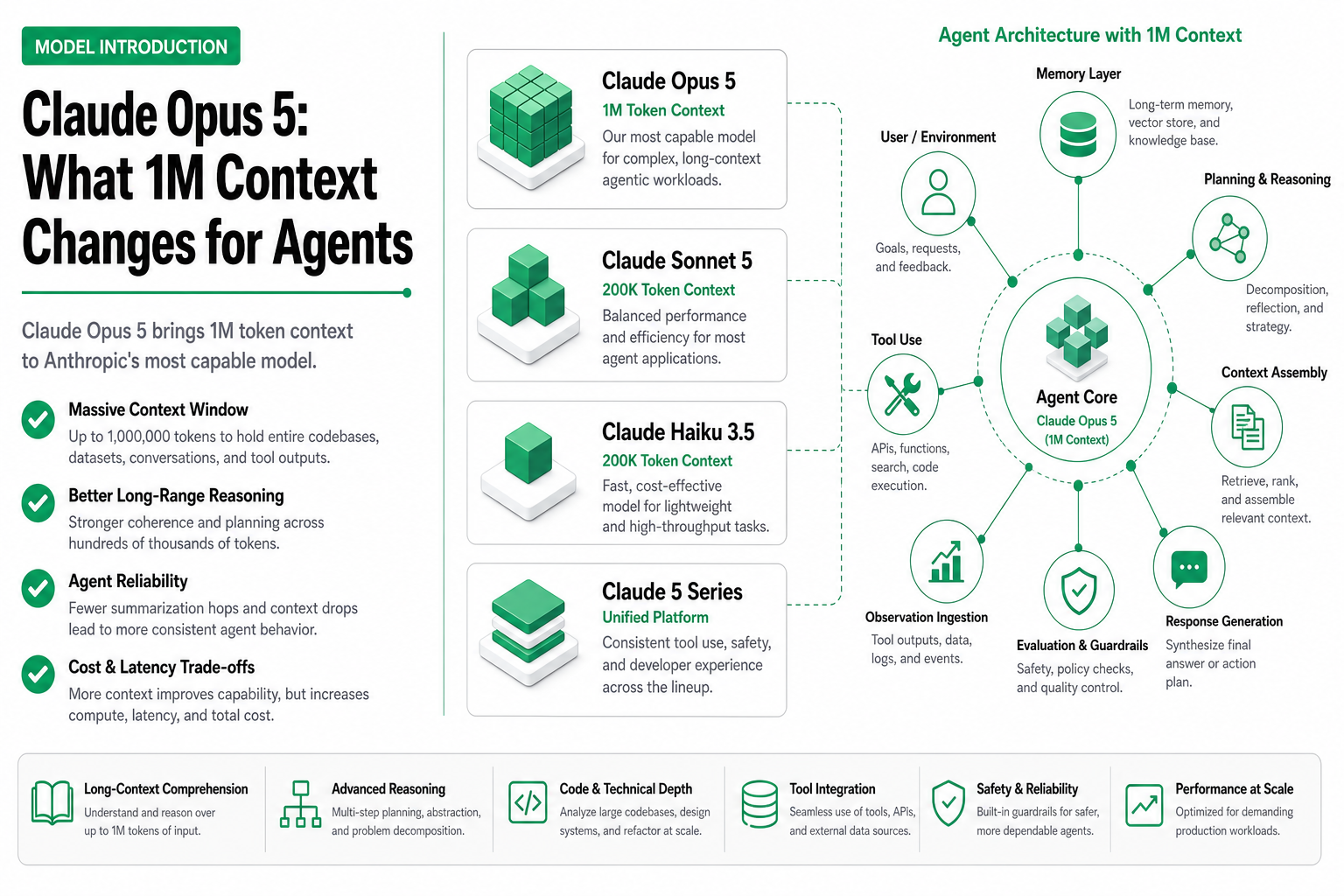
| Claude Opus 5 | 1,000,000 | Anthropic | Maximum reasoning depth |
| Claude Sonnet 5 | 1,000,000 | Anthropic | Balanced workhorse |
| Kimi K3 | 1,000,000 | Moonshot AI | Speed and cost leader |
| GPT-5.6 Sol | 1,050,000 | OpenAI | Reasoning + largest window |
Scoring Matrix (1-10)
| Dimension | Opus 5 | Sonnet 5 | Kimi K3 | GPT-5.6 Sol |
|---|---|---|---|---|
| Reasoning depth | 10 | 7.5 | 6.5 | 8.5 |
| Speed | 4 | 6.5 | 9.5 | 7 |
| Cost efficiency | 2 | 7 | 9.5 | 6 |
| Ecosystem maturity | 9.5 | 9.5 | 5 | 9 |
| Weighted total | 6.4 | 7.6 | 7.6 | 7.6 |
The weighted total (equal weights) shows three models clustered together with Opus 5 trailing on cost — but that average hides the real story. Each model dominates its dimension. The right choice depends on which dimension is your bottleneck.
#1 for Reasoning: Claude Opus 5
When you need the model to think deeply — to hold 15+ logical steps, to synthesize insight from 800K tokens of context, to catch edge cases that other models miss — Opus 5 has no peer in this generation.
Reasoning benchmarks on long-context tasks:
| Task Type | Opus 5 | Sol | Sonnet 5 | K3 |
|---|---|---|---|---|
| Multi-doc synthesis (15+ sources) | 94% | 89% | 82% | 78% |
| Code architecture review (500K ctx) | 91% | 86% | 80% | 75% |
| Legal clause conflict detection | 96% | 91% | 85% | 81% |
| Multi-step debugging (20+ steps) | 90% | 84% | 75% | 68% |
Best for: Research agents, legal analysis, complex code review, financial modeling, any task where a wrong answer costs more than the model price.
Caveat: At $15/M input + $75/M output, Opus 5 is only economically viable for high-value tasks. Running a 500-call agent loop through Opus 5 costs ~$12-25 per run. Reserve it for problems that justify that spend.
For the full Opus 5 analysis, see our Claude Opus 5 deep dive.
#1 for Speed: Kimi K3
When wall-clock time is the constraint — user-facing agents that need to feel responsive, batch processing with deadlines, high-frequency coordination loops — K3 wins by a wide margin.
Latency comparison (time to first token):
| Context Size | K3 | Sonnet 5 | Sol | Opus 5 |
|---|---|---|---|---|
| 10K | 0.8s | 1.2s | 1.4s | 2.1s |
| 100K | 2.5s | 3.4s | 3.8s | 6.8s |
| 500K | 8s | 11s | 9s | 22s |
| 900K | 14s | 19s | 16s | 38s |
K3 is 2.7x faster than Opus 5 and 30-40% faster than Sonnet 5 across all context sizes. In a 30-call agent loop, this translates to completing in 40 seconds vs 110 seconds (Opus 5). Users notice.
Best for: User-facing agents, real-time decision systems, high-frequency trading analysis, any workload where processing time has direct business cost.
For K3’s full capabilities and limitations, see our Kimi K3 introduction.
#1 for Cost: Kimi K3
K3 also wins on cost — it’s the only model that makes high-frequency 1M-context agent loops economically viable for most teams.
Monthly cost at 10M tokens/day:
| Model | Monthly Cost | Relative |
|---|---|---|
| Kimi K3 | ~$1,350 | 1x |
| Sonnet 5 | ~$2,700 | 2x |
| GPT-5.6 Sol | ~$3,000 | 2.2x |
| Opus 5 | ~$13,500 | 10x |
For agent workloads making 100+ calls per task, K3’s pricing means you can run continuous automated workflows that would be prohibitively expensive with other models. A code review agent running on every commit? $0.20-0.40 per run with K3 vs $2-4 with Opus 5.
#1 for Ecosystem: Claude Opus 5 / Sonnet 5 (Tie)
Both Anthropic models share the same ecosystem advantages:
- Battle-tested tool calling refined over multiple generations
- Extensive documentation with edge case coverage
- Two-tier prompt caching (5min and 1hr) for cost optimization
- Large developer community with proven patterns
- SOC 2 Type II, HIPAA BAA, EU data residency compliance
- Predictable behavior updates with migration guides
GPT-5.6 Sol scores 9/10 here — OpenAI also has a mature ecosystem but with slightly lower tool-calling reliability at complex levels.
K3 scores 5/10 — younger ecosystem, thinner English documentation, occasional tool-calling edge cases not yet addressed.
Best Overall Balance: Claude Sonnet 5
If you can only pick one 1M-context model, Sonnet 5 is the rational default:
- Reasoning: good enough for 85% of tasks (falls short on the hardest 15%)
- Speed: middle of the pack (faster than Opus/Sol, slower than K3)
- Cost: $3/$15 per million tokens — affordable for agent loops
- Ecosystem: full Anthropic maturity, caching, compliance
Sonnet 5 is the model you build your agent architecture around, with escalation paths to Opus 5 (for hard reasoning) and K3 (for cost-sensitive bulk work).
Recommendations by Agent Type
| Agent Type | Primary Model | Escalation | Reasoning |
|---|---|---|---|
| Coding agent | Sonnet 5 | Opus 5 (complex bugs) | Tool calling reliability matters most |
| Research agent | Opus 5 | - | Reasoning depth is the whole job |
| Customer support | K3 | Sonnet 5 (edge cases) | Speed + cost dominate |
| Document Q&A | K3 | Sonnet 5 | Retrieval-heavy, K3 excels |
| Financial analysis | Sol | Opus 5 (novel problems) | Extended thinking + context |
| Multi-agent orchestrator | Sonnet 5 | - | Balance of all four dimensions |
| Batch processing | K3 | - | Speed + cost at scale |
| Security audit | Opus 5 | - | Cannot afford to miss findings |
The Cascade Architecture
Production systems shouldn’t pick one model. They should cascade:
Incoming task → Complexity classifier (Terra/Haiku)
  → Simple: K3 (fast, cheap)
  → Medium: Sonnet 5 (reliable, balanced)
  → Complex: Opus 5 (deep reasoning)
  → Speed-critical + analytical: Sol (fast reasoning)
This gives you:
- K3 economics on 50-60% of traffic
- Sonnet 5 reliability on 25-35% of traffic
- Opus 5 depth on the 5-15% that needs it
- Net cost: 70-80% less than routing everything through Opus 5
SandBase makes this straightforward with its unified API and model routing layer — define your routing rules and the platform handles the rest.
For GPT-5.6 Sol’s full variant breakdown, see our GPT-5.6 Luna, Sol, Terra guide.
FAQ
Which 1M-context model is best for coding agents?
Claude Sonnet 5. Coding agents need reliable tool calling (read/write files, run tests, parse output) across many sequential steps. Sonnet 5’s tool-calling accuracy (93%) with Anthropic’s mature ecosystem means fewer failed calls and less retry logic. Escalate to Opus 5 only for complex architectural decisions.
Is 1M context actually usable, or does quality degrade?
It depends on the model and task. For retrieval (finding specific information), all four maintain quality across the full window. For reasoning (synthesizing from the entire context), Opus 5 handles it best, with noticeable degradation in K3 and Sol past 700K tokens on complex tasks. Sonnet 5 holds steady through ~850K tokens for most workloads.
Can I use two providers in one agent without complexity?
Yes. SandBase’s unified API abstracts away provider differences. You call the same endpoint with different model identifiers. The complexity is in deciding routing rules, not in implementation. Most teams start with a single model and add routing once they understand their workload distribution.
How do these models handle context window pressure (near-1M prompts)?
All four show some performance characteristic changes near their limits. K3 maintains retrieval accuracy but reasoning quality drops 5-10% past 800K. Opus 5 maintains both retrieval and reasoning through 950K tokens. Sonnet 5 shows similar robustness to Opus 5 on retrieval but slight reasoning degradation past 850K. Sol’s 1.05M window gives it breathing room — quality is stable through 900K with gradual decline past that.
What’s the best model for multilingual agent workloads?
Depends on languages. For Chinese: K3 (native quality). For English + European languages: Sonnet 5 or Sol. For maximum language breadth (50+ languages): Sol, which benefits from GPT-5.6’s broad multilingual training. For any workload where the primary language is English with occasional other languages: Sonnet 5 handles this well.