Claude Tag: Anthropic Puts an AI Teammate in Your Slack
Claude Tag lets teams @mention Claude in Slack channels to delegate real work. Multiplayer, persistent memory, proactive, async. Available for Team and Enterprise.
TL;DR: Anthropic launched Claude Tag on June 23, 2026 — a native Slack integration that turns Claude into a persistent, multiplayer AI teammate. You @mention it in channels, it remembers context, follows up proactively, and works asynchronously. Runs Opus 4.8. Available on Team and Enterprise plans. Replaces the old “Claude in Slack” app. 65% of Anthropic’s own product code is now written by their internal Claude Tag.
What Is Claude Tag?
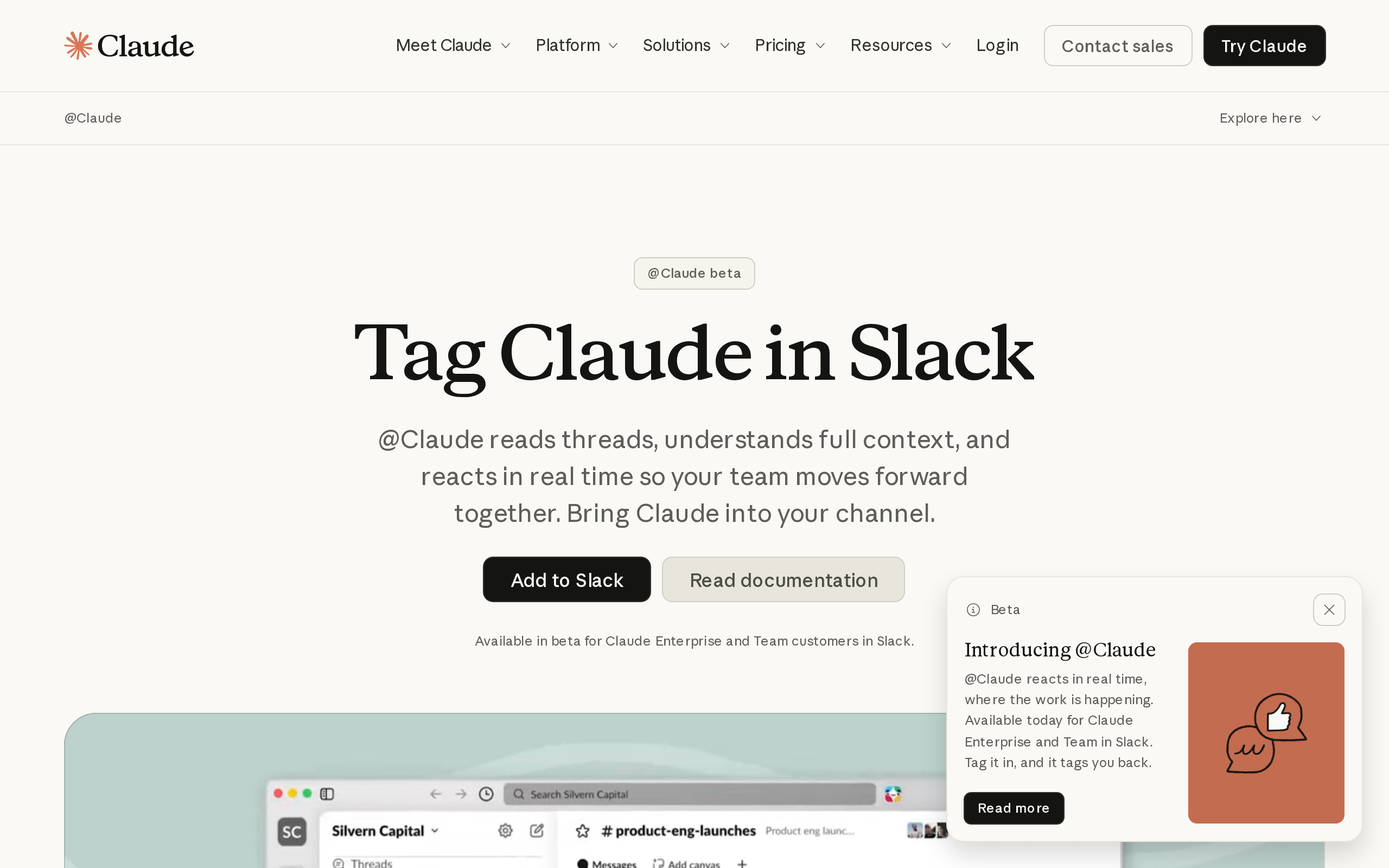
Claude Tag is Anthropic’s new Slack-native AI agent that operates as a first-class channel member. Unlike the old “Claude in Slack” app — which was essentially a DM chatbot — Claude Tag lives in your channels, participates in conversations, remembers everything it’s witnessed, and can be assigned tasks that it completes asynchronously while your team moves on to other work.
Announced on June 23, 2026, it’s available in beta for Slack workspaces on Anthropic’s Team and Enterprise plans.
The product page is live at claude.com/product/tag.
Core Capabilities
Multiplayer by Design
Each channel gets one Claude identity. When anyone @mentions Claude, the entire channel sees the response. There’s no private side-channel — it’s a shared teammate. This makes Claude Tag fundamentally different from individual-user AI assistants: the whole team benefits from every interaction.
Persistent Memory
Claude Tag remembers the context from every channel it’s in. It reads messages, learns team conventions, and builds up institutional knowledge over time. Memory is channel-scoped — what Claude learns in #engineering stays in #engineering — and all stored memories are admin-reviewable.
Proactive (Ambient Mode)
When “ambient” mode is enabled, Claude doesn’t just wait to be tagged. It:
- Flags potentially relevant information when it spots something useful
- Follows up on stale threads that seem unresolved
- Surfaces connections between conversations happening in different threads
Ambient mode is opt-in per channel and can be disabled at any time.
Async Execution
Set a task, and Claude works while you do other things. You can:
- Assign research tasks that take minutes to complete
- Schedule future tasks (e.g., “remind us to revisit this decision next Friday”)
- Queue multiple tasks without waiting for each to finish
DMs for Private Work
Beyond channel interactions, every user gets a private DM with Claude that includes personal tools — calendar integration, personal notes, private brainstorming. DM usage is billed to the individual; channel usage is billed to the organization.
Under the Hood
| Attribute | Details |
|---|---|
| Model | Opus 4.8 |
| Launch date | June 23, 2026 |
| Availability | Slack — Team and Enterprise plans (beta) |
| Billing | Consumption-based: org pays for channel tags, individual pays for DMs |
| Memory scope | Channel-scoped, admin-reviewable |
| Data retention | Slack convos separate from Claude chat history; auto-deleted within 30 days if workspace disconnected |
| Access levels | Organization-wide, workspace, private channel |
| Admin controls | Channel-scoped identities, spend limits (org + per-channel), audit logs |
The Dogfooding Number
Anthropic reports that 65% of their product team’s code is now created by their internal Claude Tag instance. That’s not a marketing claim about potential — it’s self-reported production usage inside the company building the tool.
Admin Controls and Security
Claude Tag ships with enterprise-grade controls from day one:
- Channel-scoped identities: Each channel’s Claude has its own context boundary. Cross-channel information doesn’t leak.
- Spend limits: Set at both organization level and per-channel granularity.
- Audit logs: Full visibility into what Claude was asked, what it produced, and what it accessed.
- Three access levels: Organization-wide (available everywhere), workspace-scoped (specific Slack workspace), or private channel (invite-only).
- Data separation: Slack conversations are stored separately from Claude’s general chat history. If you disconnect the workspace, data is auto-deleted within 30 days.
Migration from “Claude in Slack”
Claude Tag replaces the old “Claude in Slack” app entirely. Existing users have a 30-day migration window. The old app will stop working after that period. The migration is straightforward — install Claude Tag, and it inherits your existing workspace configuration.
Comparison: Claude Tag vs Claude Code vs Claude Cowork vs ChatGPT in Slack
| Feature | Claude Tag | Claude Code | Claude Cowork | ChatGPT in Slack |
|---|---|---|---|---|
| Primary surface | Slack channels | Terminal / IDE | Shared canvas | Slack channels |
| Model | Opus 4.8 | Opus 4 / Sonnet | Opus 4 | GPT-4o |
| Multiplayer | ✅ Native (one per channel) | ❌ Single-user | ✅ Shared canvas | ⚠️ Basic (no persistent identity) |
| Persistent memory | ✅ Channel-scoped | ⚠️ Project-scoped files | ✅ Session-scoped | ❌ Stateless |
| Proactive behavior | ✅ Ambient mode | ❌ On-demand only | ⚠️ Suggestions | ❌ On-demand only |
| Async tasks | ✅ Full async + scheduling | ✅ Background tasks | ⚠️ Limited | ❌ Synchronous only |
| Code execution | ❌ Not primary use case | ✅ Core feature | ✅ Sandboxed | ❌ No |
| Billing | Consumption (org + individual) | Subscription + usage | Subscription | Subscription |
| Enterprise controls | ✅ Full (spend limits, audit) | ✅ Full | ✅ Full | ⚠️ Limited |
| Best for | Team coordination, delegation | Software development | Document collaboration | Quick Q&A |
How It Compares to Building Your Own Slack Bot with the API
Many teams have already built custom Slack bots using the Anthropic Messages API (or even open-source frameworks — see our best open-source AI agent frameworks roundup). Here’s the honest trade-off:
| Aspect | Claude Tag (Managed) | Custom Slack Bot (API) |
|---|---|---|
| Setup time | Minutes (install from Slack App Directory) | Days to weeks |
| Memory management | Built-in, channel-scoped, auto-managed | You build and maintain the vector store |
| Proactive behavior | Toggle ambient mode on/off | You write the event listeners and logic |
| Billing granularity | Per-channel spend limits, org dashboard | You track token usage yourself |
| Customization | Limited to Anthropic’s feature set | Unlimited — any model, any logic |
| Model choice | Opus 4.8 only | Any model from any provider |
| Data control | Anthropic stores conversations (30-day retention post-disconnect) | Full control — your infra, your data |
| Multi-agent orchestration | Single Claude per channel | Arbitrary agent topologies |
| Cost at scale | Consumption-based (can get expensive with ambient mode) | Token costs only + your infra |
| Maintenance | Zero — Anthropic handles updates | Ongoing — you own the code |
When Claude Tag wins: You want a capable AI teammate fast, your team lives in Slack, and you don’t need custom logic beyond what Claude can do out of the box. The persistent memory and proactive follow-ups are genuinely hard to replicate.
When a custom bot wins: You need multi-model routing, custom tool integrations beyond what Claude Tag supports, full data sovereignty, or you’re building agent workflows that require orchestration across multiple services. If you’re in this camp, DeepSeek Harness is worth evaluating as your orchestration layer.
Pricing
Claude Tag uses consumption-based billing:
| Usage Type | Who Pays | Notes |
|---|---|---|
| Channel @mentions | Organization | Counts against org spend limit |
| Ambient mode activity | Organization | Higher token usage — monitor closely |
| Scheduled tasks | Organization | Billed when task executes |
| DM conversations | Individual user | Personal subscription or credits |
| Per-channel spend cap | Configurable | Prevents runaway costs per channel |
| Org-level spend cap | Configurable | Hard ceiling across all channels |
No per-seat licensing — you pay for what Claude actually does. This is a meaningful distinction from ChatGPT’s enterprise pricing, which is per-seat regardless of actual AI usage.
For teams evaluating cost, the key variable is ambient mode. A busy #general channel with ambient enabled will consume significantly more tokens than a quiet #project-x channel where Claude is only @mentioned directly. Start with ambient off, measure baseline costs, then enable selectively.
FAQ
Does Claude Tag work with Slack Free or Pro plans?
No. Claude Tag requires Anthropic’s Team or Enterprise plan. Your Slack workspace can be on any Slack plan, but you need the Anthropic subscription for the AI functionality.
Can I use Claude Tag in private channels?
Yes. Admins can configure three access levels: organization-wide (all channels), workspace-scoped, or specific private channels. Claude only sees messages in channels it’s been explicitly added to.
What happens to my data if I disconnect Claude Tag?
Slack conversations stored by Claude Tag are automatically deleted within 30 days of disconnection. This data is kept separate from Claude’s general chat history and is never used for model training.
Does Claude Tag replace Claude Code for developers?
No. They serve different purposes. Claude Tag is for team coordination, delegation, and async work inside Slack. Claude Code is for hands-on software development in your terminal and IDE. Many teams will use both — Claude Code for writing code, Claude Tag for everything else.
Can multiple people interact with Claude in the same thread?
Yes — that’s the core “multiplayer” design. Everyone in the channel sees Claude’s responses, can add context, and can redirect the conversation. Claude maintains thread context and understands multiple participants.
Bottom Line
Claude Tag is Anthropic’s bet that AI agents belong inside the tools teams already use, not in separate apps. The persistent memory, ambient awareness, and async execution make it genuinely different from a chatbot bolted onto Slack. The 65% internal dogfooding stat suggests Anthropic is confident enough to bet their own productivity on it.
The trade-off is vendor lock-in — you get Opus 4.8 and Anthropic’s feature roadmap, nothing else. If that works for your team, Claude Tag is the fastest path to an AI teammate that actually sticks around and remembers what happened yesterday.
What’s Next for Claude Tag?
Anthropic hasn’t published a public roadmap, but based on the beta constraints and enterprise demand patterns, expect:
- More model options: Currently locked to Opus 4.8, but demand for lighter/cheaper models in high-volume channels is inevitable.
- Tool integrations: First-party connections to Jira, Linear, GitHub, Notion — reducing the need for custom Slack bots that bridge these services.
- Cross-channel awareness: Today, memory is strictly channel-scoped. Future versions may offer opt-in cross-channel context with appropriate admin controls.
- Usage analytics dashboard: Teams will want to see which channels use Claude most, what types of tasks are delegated, and where ambient mode adds the most value.
For teams already exploring AI-assisted workflows, Claude Tag fills a specific gap: the persistent, team-aware assistant that lives where work actually happens. Whether it’s worth the vendor lock-in depends entirely on how much of your team’s coordination already runs through Slack — and for most software teams in 2026, that answer is “almost all of it.”