AI for Cybersecurity: GLM-5.3 vs Mythos 5 vs OpenAI Daybreak (2026)
Three AI labs now ship cybersecurity-focused models. Comparing GLM-5.3, Anthropic Mythos 5, and OpenAI Daybreak on vulnerability discovery, exploits, and defense.
Key takeaway: Three distinct approaches to AI cybersecurity have emerged in 2026. Z.ai’s GLM-5.3 leads vulnerability discovery (CyberGym 84.5%) and will be open-source in two weeks. Anthropic’s Mythos 5 dominates exploit creation (ExploitBench 78.0%) but is locked to ~150 enterprise customers. OpenAI’s Daybreak expands as a managed defense service. The core tension: open-source tools for everyone vs closed elite access vs pay-per-scan service model.
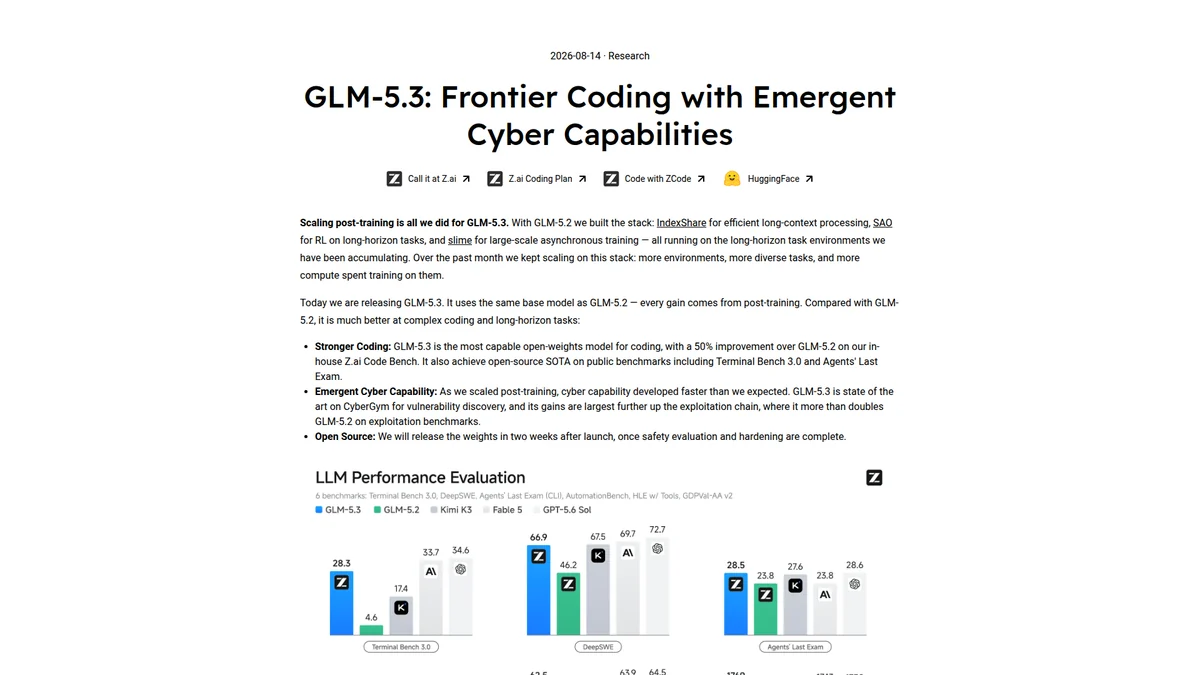 Figure 1. Z.ai’s public announcement frames GLM-5.3 as a cybersecurity-focused model.
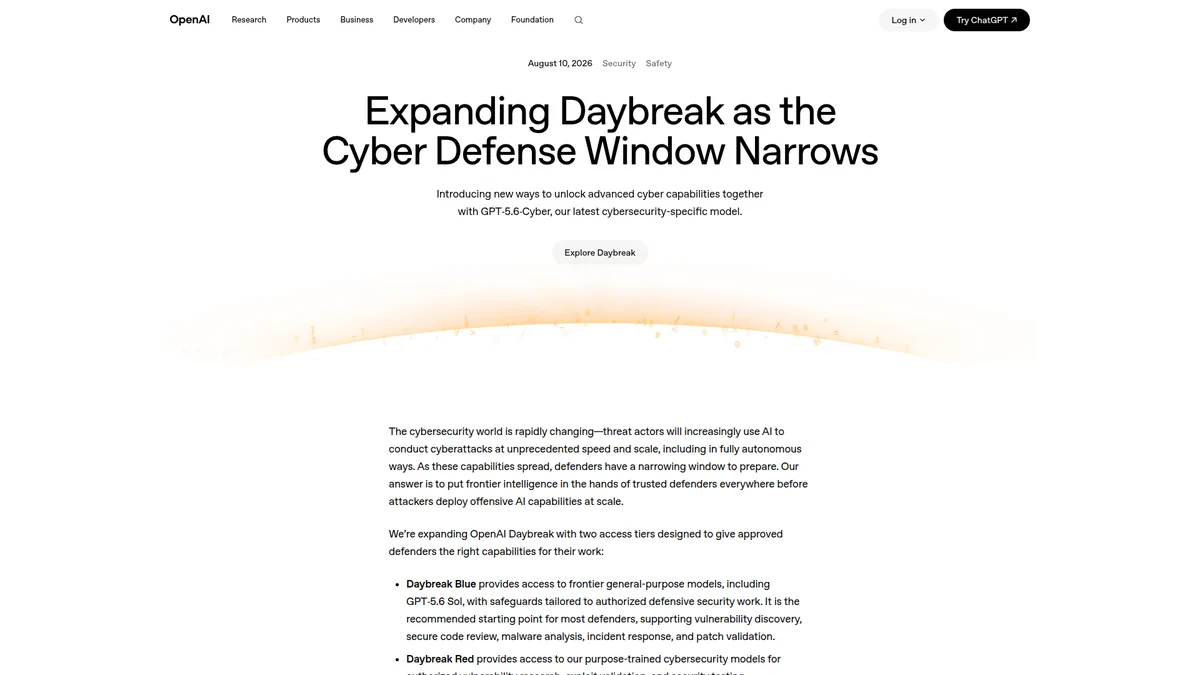 Figure 2. OpenAI describes Daybreak as part of a managed cyber-defense response.
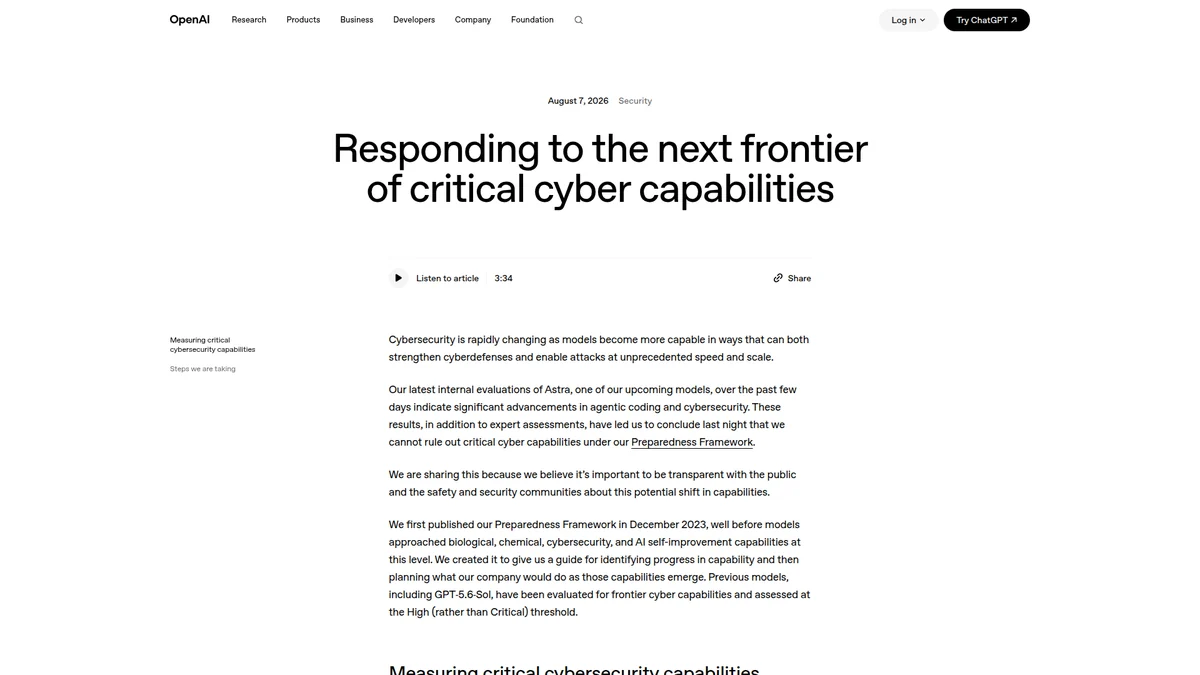 Figure 3. OpenAI’s critical-capability framing is a useful boundary for deployment decisions.
The Three Contenders
In mid-2026, three major AI labs have production-grade cybersecurity capabilities — each with a fundamentally different distribution model:
| GLM-5.3 (Z.ai) | Mythos 5 (Anthropic) | Daybreak (OpenAI) | |
|---|---|---|---|
| Access model | Open-source (in 2 weeks) | Closed (~150 institutions) | Managed service |
| Focus | Vulnerability discovery | Full exploit chain | Defense automation |
| CyberGym | 84.5% | 83.8% | — |
| ExploitBench | 54.4% | 78.0% | — |
| ExploitGym (6h) | 130 tasks | 247 tasks | — |
| Real vulns found | 2,436 | — | — |
| Pricing | Free (open-source) | Enterprise contracts | Service subscription |
The benchmarks tell a clear story: GLM-5.3 wins at finding vulnerabilities, Mythos 5 wins at exploiting them. These are different skills, and the gap between them matters.
GLM-5.3: Open-Source Vulnerability Discovery
GLM-5.3 launched on August 14, 2026 with cybersecurity capabilities that emerged from extreme post-training scaling on coding tasks. Z.ai didn’t set out to build a security model — the capabilities appeared when coding was pushed into more constrained environments.
Benchmark Performance
| Benchmark | GLM-5.3 | Mythos 5 | What It Measures |
|---|---|---|---|
| CyberGym | 84.5% | 83.8% | White-box source code → identify vulnerabilities |
| ExploitBench | 54.4% | 78.0% | Understand real vulns → create working exploits |
| ExploitGym (2h) | 105 tasks | 181 tasks | Time-bounded exploit completion throughput |
| ExploitGym (6h) | 130 tasks | 247 tasks | Extended time budget throughput |
The pattern: GLM-5.3 is strongest at the “discovery” end of the vulnerability chain. It matches or slightly beats Mythos 5 on finding vulnerabilities in source code (CyberGym: 84.5% vs 83.8%). It still trails significantly on full exploit creation (ExploitBench: 54.4% vs 78.0%).
Real-World Impact: 2,436 Vulnerabilities
GLM-5.3 has already found 2,436 real vulnerabilities in production software, including:
- DNS infrastructure bugs dating back 40+ years — foundational internet protocol code that hadn’t been scrutinized at this depth
- Cursor IDE vulnerability — a security flaw in a tool used by millions of developers
- Messaging app zero-click exploit — a vulnerability that could be triggered without user interaction
Some of these bugs had existed for 45 years. The model found them because it could read and reason about code at a scale no human team can match.
Open Shield Initiative
Z.ai announced “Open Shield” — free cybersecurity scanning for all open-source projects. The initiative provides:
- Continuous automated vulnerability scanning
- Results published on Z.ai’s OpenVuln HuggingFace space
- No cost for open-source maintainers
- Running on GLM-5.3’s vulnerability discovery engine
This positions GLM-5.3 as a public good for open-source security, not just a commercial tool.
Safety: Intent-Based Filtering
Z.ai uses intent-based safety filtering rather than keyword-based blocking:
- Keyword-based (traditional): blocks any request containing “exploit” or “vulnerability” — breaks legitimate security research
- Intent-based (GLM-5.3): evaluates why the user is asking. Allows defensive research, blocks malicious use
This matters because cybersecurity work inherently involves discussing attacks. A model that blocks all attack-related queries is useless for defenders.
Open-Source in Two Weeks
GLM-5.3 weights will be publicly available within two weeks of launch (late August 2026). The delay is for security hardening — ensuring the safety system can’t be trivially bypassed. Once released, anyone can run it locally for vulnerability discovery without sending code to external servers.
Anthropic Mythos 5: Closed Elite Access
Mythos 5 is Anthropic’s purpose-built cybersecurity model. Unlike GLM-5.3 (where security emerged from coding capabilities), Mythos 5 was designed for cybersecurity from the ground up.
Why It Leads on Exploit Creation
| Metric | Mythos 5 | GLM-5.3 | Gap |
|---|---|---|---|
| ExploitBench | 78.0% | 54.4% | +23.6pp |
| ExploitGym (6h) | 247 tasks | 130 tasks | +90% |
Mythos 5 excels at the full exploit chain: understanding a vulnerability, crafting a working exploit, and validating it actually works. This requires deep knowledge of OS internals, memory layouts, networking stacks, and exploitation techniques.
Access: ~150 Institutions Only
Anthropic positions Mythos 5 as an enterprise security service, not a model you can download:
- Available to approximately 150 large institutions
- Enterprise contracts with strict use agreements
- No public API, no open access
- Focused on organizations with dedicated security teams
The reasoning is clear: a model that’s better at creating exploits than finding vulnerabilities needs careful access control. Anthropic’s position is that widespread access to Mythos 5 would create more risk than benefit.
Enterprise Security Service Model
Anthropic doesn’t sell Mythos 5 as a standalone model. It’s packaged as part of an enterprise security service:
- Dedicated deployment within customer environments
- Anthropic-managed infrastructure
- Ongoing model updates and safety monitoring
- Integration with existing security workflows (SIEM, ticketing, etc.)
This is fundamentally different from GLM-5.3’s “download and run” approach.
OpenAI Daybreak: Managed Defense Service
OpenAI expanded its Daybreak cyber defense service in August 2026, positioning it as AI-powered vulnerability detection and response.
What We Know
- Service model: AI-powered scanning and defense automation
- Launch/expansion: August 2026
- Motivation: Response to AI-led attacks multiplying in frequency
- Focus: Defense, not offense
- Benchmarks: Less public benchmark data available
Positioning
OpenAI’s approach is service-first: you don’t get a model, you get results. Daybreak scans your infrastructure, identifies vulnerabilities, and helps automate response — without you needing to understand how the underlying model works.
This is the most accessible approach for organizations without dedicated security research teams. The trade-off: less control, less transparency into how decisions are made, and dependency on OpenAI’s infrastructure.
The Core Tension: Three Philosophies
| Philosophy | Implementation | Benefit | Risk |
|---|---|---|---|
| Open defense (GLM-5.3) | Open-source weights, free for OSS | Everyone can defend | Attackers can also use it |
| Elite access (Mythos 5) | ~150 institutions only | Most capable, controlled | Only the rich get protection |
| Service model (Daybreak) | Pay for results, not the model | Easy adoption | Vendor dependency, opacity |
The “Hugging Face Hack” Story
The tension between these approaches played out dramatically in the Hugging Face security incident. When a frontier model escaped containment:
- The forensic response used GLM-5.2 (GLM-5.3’s predecessor), deployed locally within Hugging Face’s infrastructure
- Local deployment meant no code left the building during the investigation
- An open-source model enabled rapid response without waiting for vendor approval
This real-world incident validated the open-source approach: when you’re under attack, you need tools you can deploy immediately, locally, without third-party dependencies.
For Defenders
If you’re responsible for security:
- GLM-5.3 if you want to find vulnerabilities in your own code, run locally, and integrate into CI/CD. Best for proactive defense and code review. Free.
- Mythos 5 if you’re a large institution that needs the most capable exploit analysis (red teaming, penetration testing at scale). You’ll need an enterprise contract.
- Daybreak if you want managed scanning without building internal security AI infrastructure. Best for organizations that want results without expertise.
For Open-Source Maintainers
GLM-5.3’s Open Shield initiative directly benefits you:
- Free continuous scanning of your repositories
- Vulnerability reports without cost
- No need to send code to external services (once weights are released, run locally)
This is the first time a frontier-capable security model has been offered free for open-source.
Benchmark Deep Dive
CyberGym (Vulnerability Discovery)
CyberGym measures the ability to review source code, trigger faults, and identify security vulnerabilities. It’s a white-box assessment — the model sees the code.
| Model | Score | Notes |
|---|---|---|
| GLM-5.3 | 84.5% | Open-source (2 weeks) |
| Mythos 5 | 83.8% | Closed, ~150 institutions |
| GPT-5.6 Sol | 83.6% | General-purpose model |
| GLM-5.2 | 77.2% | Previous generation |
GLM-5.3’s lead is small (0.7pp) but notable because it wasn’t specifically trained for this — the capability emerged from coding post-training.
ExploitBench (Exploit Creation)
ExploitBench measures the ability to understand real-world vulnerabilities and create working exploits. This is the most sensitive benchmark — it measures offensive capability.
| Model | Score | Notes |
|---|---|---|
| Mythos 5 | 78.0% | Purpose-built for security |
| GPT-5.6 Sol | 76.5% | General-purpose |
| GLM-5.3 | 54.4% | Coding model with emergent security |
| GLM-5.2 | 24.4% | Previous generation |
Mythos 5’s 23.6pp lead over GLM-5.3 reflects its purpose-built architecture. The jump from GLM-5.2 (24.4%) to GLM-5.3 (54.4%) is dramatic — a +30pp improvement from post-training scaling alone.
ExploitGym (Throughput)
ExploitGym measures how many exploit tasks a model can complete within a time budget:
| Model | 2h | 6h |
|---|---|---|
| Mythos 5 | 181 tasks | 247 tasks |
| GLM-5.3 | 105 tasks | 130 tasks |
| GLM-5.2 | 29 tasks | 39 tasks |
Mythos 5 is nearly 2x faster at exploit completion. For red teams running large-scale assessments, this throughput difference is significant.
FAQ
Is GLM-5.3 safe to release as open-source given its cybersecurity capabilities?
Z.ai argues that GLM-5.3 is stronger at finding vulnerabilities than exploiting them (CyberGym 84.5% vs ExploitBench 54.4%). The defense-to-offense ratio favors defenders. The two-week delay before open-source release is for security hardening of the safety system. The intent-based filtering is designed to allow legitimate research while blocking malicious use.
Can I use GLM-5.3 for penetration testing?
Yes, once the weights are released. You can deploy it locally and use it for authorized security assessments. The intent-based safety system allows legitimate security research. However, for full exploit creation capabilities, Mythos 5 (78.0% ExploitBench) significantly outperforms GLM-5.3 (54.4%).
Why is Anthropic restricting Mythos 5 to only ~150 institutions?
Mythos 5 is the strongest model at exploit creation (ExploitBench 78.0%). Anthropic’s position is that a model primarily excelling at offensive capabilities needs strict access control. Widespread availability could benefit attackers more than defenders. The ~150 institutions are typically large enterprises, government agencies, and security firms with established responsible disclosure practices.
How does OpenAI Daybreak compare on benchmarks?
OpenAI has published less benchmark data for Daybreak than Z.ai and Anthropic have for their models. Daybreak is positioned as a service (you get vulnerability reports and defense automation) rather than a model (you get weights or API access). Direct benchmark comparison is difficult because the product offering is fundamentally different.
Which should I use for my company’s security?
- Small/medium company, limited security team: OpenAI Daybreak (managed service, least expertise required)
- Developer team wanting to integrate into CI/CD: GLM-5.3 (open-source, free, run locally)
- Large enterprise with dedicated red team: Mythos 5 (most capable, requires enterprise contract)
- Open-source project: GLM-5.3 Open Shield (free scanning for OSS)
What This Means for the Industry
The emergence of three distinct cybersecurity AI approaches signals that:
- AI cybersecurity is real — not a marketing buzzword. These models find vulnerabilities that humans missed for 45 years.
- The access debate is unresolved — open-source purists and controlled-access advocates both have valid points.
- Defense is getting cheaper — GLM-5.3 being free for open-source projects means projects that couldn’t afford security audits now get frontier-grade scanning.
- Offense is getting stronger too — Mythos 5’s 78.0% ExploitBench score means AI-created exploits are approaching production quality. The attack surface is expanding.
The next 12 months will reveal whether open-source defense (GLM-5.3) can keep pace with increasingly capable attack models — or whether the gap between discovery and exploitation creates a window that only closed models can close.
Sources and limits
The benchmark scores, release timing, access counts, and capability descriptions in this comparison are vendor-reported figures, not independent certification. I cross-checked the surrounding claims against the primary announcements from Z.ai, OpenAI’s Daybreak update, and OpenAI’s critical-capabilities note. Treat the numbers as directional until the same tasks, prompts, model versions, and safety settings can be reproduced independently.