DeepSeek Harness vs Claude Managed Agents (2026)
DeepSeek Harness vs Claude Managed Agents compared. Open-source composable plugins vs managed hosted infrastructure. Architecture, trade-offs, and when to pick each.
TL;DR: Two completely opposite philosophies for running AI agents. DeepSeek Harness gives you composable plugins and total control — you build it, you run it, you own it. Claude Managed Agents gives you managed infrastructure and zero ops — Anthropic builds it, runs it, and bills you by the token+runtime. DSH is model-agnostic and MIT-licensed; CMA locks you to Claude. Choose based on whether you want to own your infrastructure or rent someone else’s.
The Core Trade-Off in One Sentence
DeepSeek Harness: You assemble the agent from plugins. You run it. You’re responsible for everything.
Claude Managed Agents: You define what the agent should do. Anthropic runs it. You pay for convenience.
This is the build-vs-buy decision applied to agent infrastructure. Both are legitimate choices depending on your constraints — but they lead to very different operational realities.
Quick Comparison
| DeepSeek Harness | Claude Managed Agents | |
|---|---|---|
| Provider | DeepSeek AI (open-source) | Anthropic (hosted service) |
| License | MIT | Proprietary (API access) |
| Architecture | Plugin-based (Cordis meta-framework) | Decoupled brain/hands/session |
| Hosting | Self-hosted only | Anthropic-managed (or self-hosted sandbox) |
| Model support | Any model (plugin) | Claude only |
| Maturity | Developer preview (v0.1) | Beta (April 2026) |
| Session persistence | Plugin (you choose how) | Built-in append-only event log |
| Sandbox | Plugin (you choose what) | Managed cloud container (or self-hosted) |
| Scheduling | Plugin | Built-in scheduled deployments (cron) |
| Multi-agent | Plugin (compose multiple instances) | Built-in multiagent orchestration |
| Memory/Learning | Plugin (not built-in) | Dreaming (research preview) |
| Credential management | Your responsibility | Vaults (built-in) |
| Tools | Plugin (all tools are plugins) | Built-in bash, file ops, web search, MCP |
| Observability | Append-only trajectory log | Server-side event stream + webhooks |
| Cost model | Your compute costs | Tokens + runtime rate |
| Ops burden | High (you manage everything) | Near-zero (Anthropic manages) |
| Extensibility | Unlimited (hot-reload plugins) | Configure, don’t extend |
Architecture: Two Decoupling Stories
Both DSH and CMA arrived at the same insight — decouple the components — but from opposite directions.
DeepSeek Harness: Decouple Everything Into Plugins
DSH decouples by making every component a replaceable plugin. The framework is literally empty. Cordis loads plugins, manages their lifecycle, and handles dependencies. That’s it.
┌──────────────────────────────────────┐
│  Cordis (plugin loader + lifecycle)  │
├──────────────────────────────────────┤
│  [Model]  [Tools]  [Session]  [UI]  │
│  [Sandbox] [Storage] [Loop] [Sched] │
│  ← all interchangeable plugins →    │
└──────────────────────────────────────┘
You swap any piece without touching the core. Want a different model? Swap the model plugin. Different session store? Swap the session plugin. Different agent loop pattern? Swap the loop plugin. The harness itself never changes.
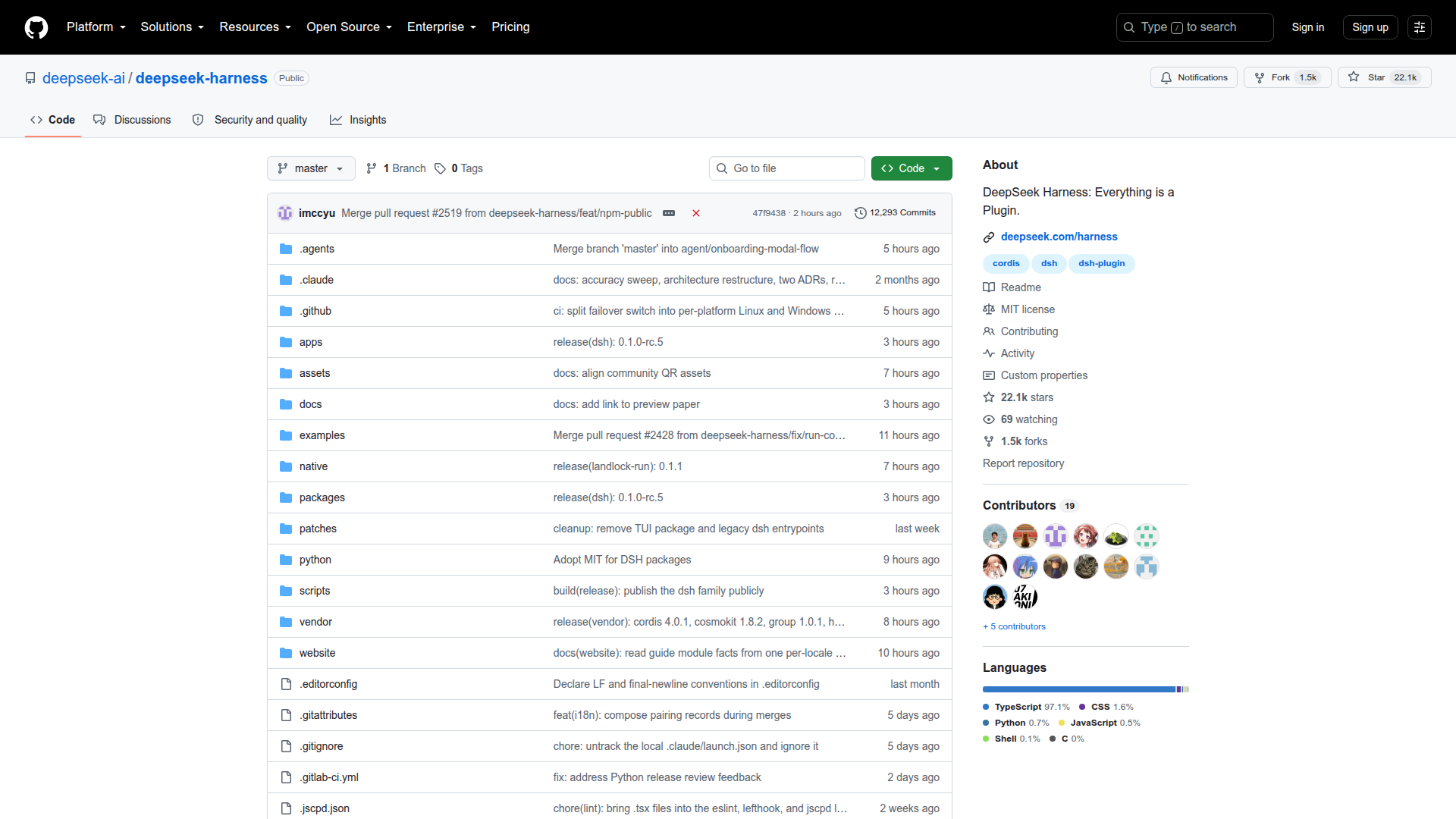 DeepSeek Harness — open-source, MIT licensed, plugin-everything architecture.
Claude Managed Agents: Decouple Brain, Hands, Session
CMA decouples by separating three concerns behind stable interfaces:
┌─────────────────────────────────────────┐
│  Brain (stateless harness, calls model) │
├─────────────────────────────────────────┤
│  Session (append-only event log)        │
├─────────────────────────────────────────┤
│  Hands (cattle containers, tools)       │
└─────────────────────────────────────────┘
The brain doesn’t live in the container. It calls the container the way it calls any tool: execute(name, input) → string. If a container dies, a new one spins up. The session lives outside both, so neither brain nor hands failures lose state.
Anthropic’s engineering blog reports that this decoupling dropped p50 TTFT by 60% and p95 by over 90% — because inference can start before the container is ready.
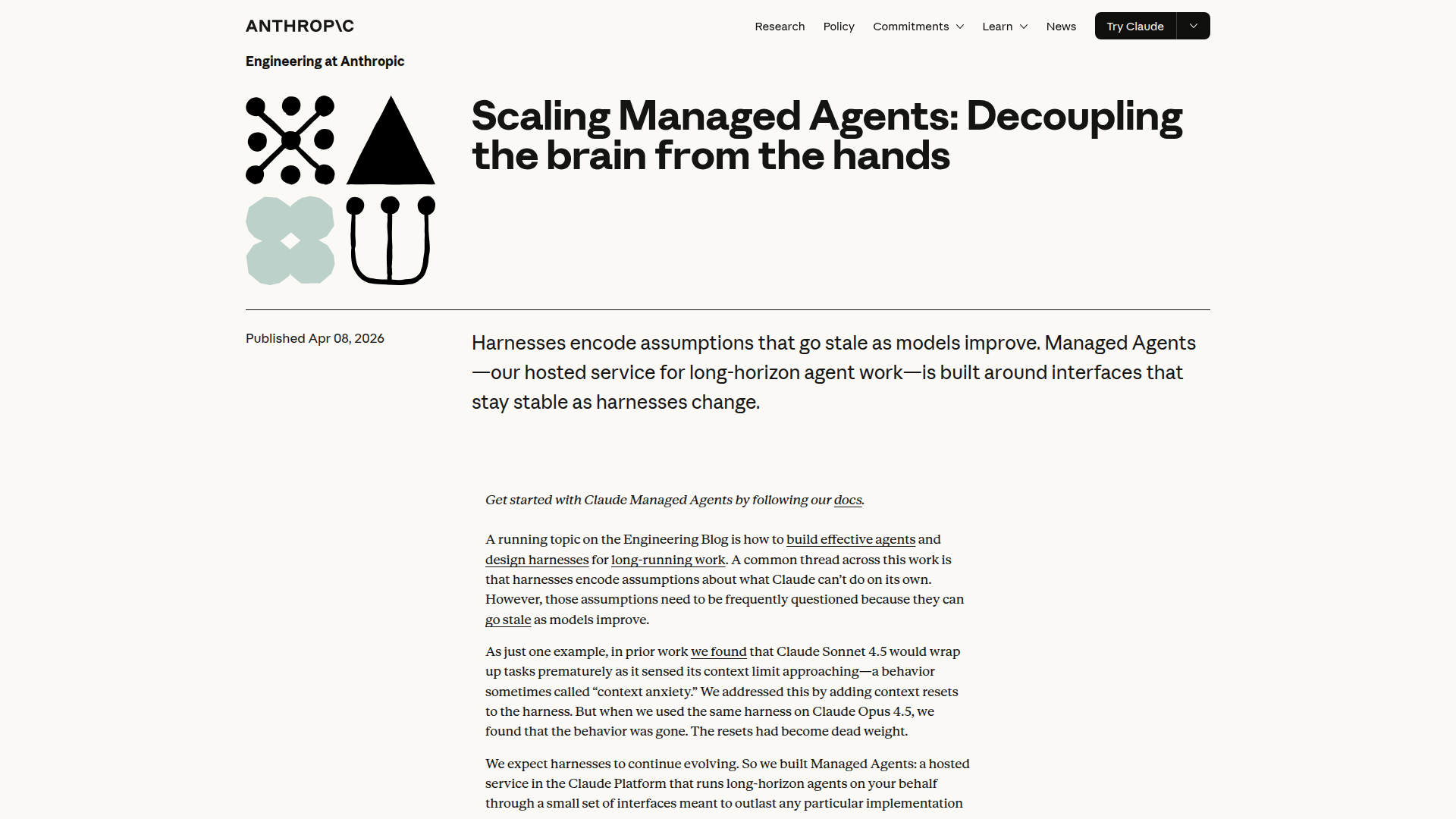 Anthropic’s engineering blog — “Decoupling the brain from the hands” explains CMA’s architecture.
The Philosophical Difference
DSH says: “We can’t predict what you’ll need, so we’ll let you plug in anything.”
CMA says: “We can’t predict what harness Claude will need in the future, so we’ll build interfaces general enough to accommodate any harness.”
Both are designing for “programs as yet unthought of.” DSH gives that flexibility to the developer. CMA keeps it internal — Anthropic evolves the harness behind stable APIs, and you benefit without rebuilding.
Model Lock-In: The Elephant
This is the biggest practical difference and it’s not subtle:
- DSH: Use any model. DeepSeek, Claude, GPT, Gemini, open-weight models, local inference — all via model plugins. You can switch models without changing anything else.
- CMA: Claude only. Period. The harness is tuned for Claude’s specific capabilities, the optimizations (prompt caching, compaction) are Claude-specific, and the pricing is Claude-specific.
If you’re already all-in on Claude, CMA’s lock-in isn’t a problem — it’s an optimization. If you need model flexibility (cost optimization, specialized models for sub-tasks, regulatory requirements), CMA is structurally unable to help.
Session Persistence: Same Principle, Different Ownership
Both use append-only event logs. Both record everything the model sees.
| Aspect | DeepSeek Harness | Claude Managed Agents |
|---|---|---|
| Storage location | Your infrastructure (plugin decides) | Anthropic’s servers |
| Format | Trajectory view (system prompt, CoT, tools, results) | Server-sent events (SSE) stream |
| Data retention | You control | Anthropic’s policy (can delete via API) |
| HIPAA/ZDR eligible | Depends on your setup | Not currently eligible |
| Replay/Fork | Built-in | Via getEvents() interface |
For regulated industries (healthcare, finance), CMA’s current ineligibility for Zero Data Retention or HIPAA BAA coverage may be a dealbreaker. DSH gives you full control — but you’re also fully responsible for compliance.
Ops Burden: The Hidden Cost
This is where the real trade-off lives:
CMA’s hidden benefit: You don’t build sandbox orchestration, credential vaults, session storage, container lifecycle management, multi-agent routing, or scheduled execution. Anthropic handles all of that. For a team that wants to ship an agent product, not become infrastructure engineers, this is massive.
DSH’s hidden cost: “Everything is a plugin” means everything must be configured, hosted, monitored, and maintained by you. Session storage needs a database. Sandboxes need container orchestration. Credentials need a vault. Scheduling needs a scheduler. You either build these plugins or wait for the community to build them.
| Ops Task | DeepSeek Harness | Claude Managed Agents |
|---|---|---|
| Sandbox provisioning | You (Docker, E2B, etc.) | Anthropic |
| Credential management | You | Vaults (built-in) |
| Session storage | You (Redis, Postgres, etc.) | Anthropic |
| Container lifecycle | You | Cattle (auto-replaced) |
| Scaling | You | Anthropic |
| Monitoring | You (Trajectory view helps) | Webhooks + event stream |
| Cost optimization | Full control | Limited (Anthropic pricing) |
Pricing: Apples to Oranges
CMA: Tokens (Claude pricing) + runtime rate. You pay per-token and per-minute of sandbox runtime. No infrastructure costs to you.
DSH: Your inference costs (whatever model, wherever you run it) + your infrastructure costs (servers, containers, storage, network). Lower unit costs are possible but you eat the ops burden.
For small-scale or prototype work, CMA is likely cheaper when you factor in engineering time. At scale with predictable workloads, DSH can be dramatically cheaper if you’ve already solved the infrastructure problem.
When to Choose DeepSeek Harness
- You need model flexibility (multi-model routing, cost optimization across providers)
- You want to own your data and infrastructure completely
- You’re building a custom agent product where the harness is your competitive advantage
- You have the engineering team to maintain plugin infrastructure
- You’re in a regulated industry that requires on-premises data handling
- You want to contribute to an open-source ecosystem
When to Choose Claude Managed Agents
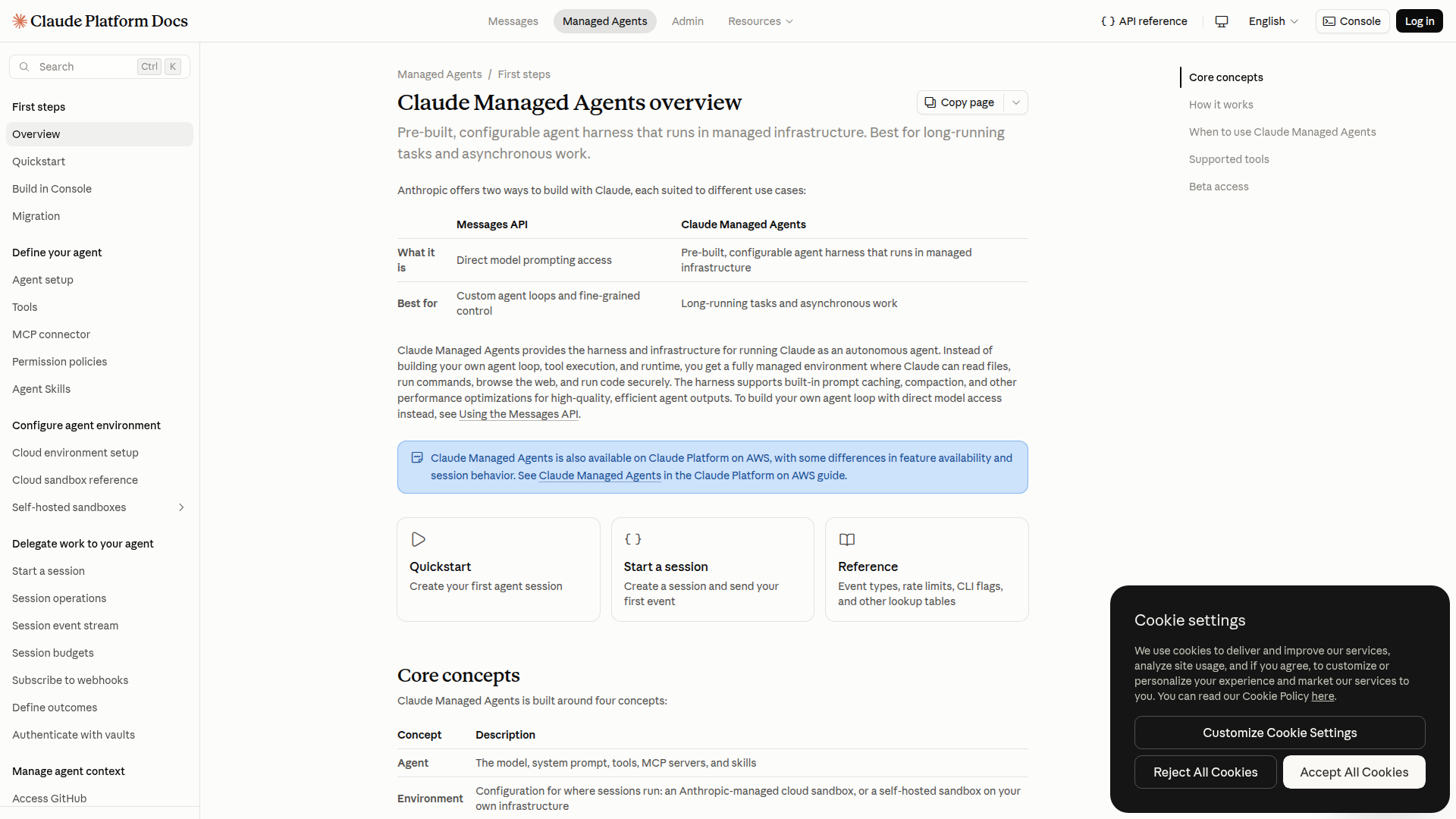 Claude Platform docs — agent setup, environments, sessions, tools, and scheduled deployments.
- You’re building on Claude and don’t need other models
- You want to ship fast without becoming infrastructure engineers
- Scheduled deployments (cron agents) are a core requirement
- You need Anthropic’s credential vaults and security model
- Multi-agent orchestration is needed out of the box
- Your team is small and ops burden matters more than flexibility
Can You Use Both?
Not directly — they’re architecturally incompatible. But conceptually:
- If you’re a CMA user who wants more flexibility: wait for DSH’s ecosystem to mature, then evaluate whether a self-hosted plugin stack meets your needs better than CMA’s managed approach.
- If you’re a DSH user who wants less ops: you could build a DSH model plugin that calls Claude via the Messages API (not CMA). You get Claude’s intelligence without CMA’s managed infrastructure.
- The hybrid path: use CMA for production workloads where ops simplicity matters, and DSH for internal tooling, benchmarks, or experimental agents where flexibility matters.
For more on open-source agent framework options, see our DeepSeek Harness vs OpenClaw vs Hermes Agent comparison and the DeepSeek Harness deep-dive.
FAQ
Is DeepSeek Harness a Claude Managed Agents competitor?
Not directly. DSH is an open-source toolkit for building any agent. CMA is a managed service for running Claude agents. They compete only if your decision is “build my own harness vs use Anthropic’s.” If you need non-Claude models, there’s no competition — CMA can’t serve you.
Which has better session transparency?
Both are excellent here. DSH’s Trajectory view shows everything the model sees (system prompts, CoT, tool calls). CMA’s append-only event log does the same. The difference is where the data lives — your servers vs Anthropic’s.
What about Anthropic’s “Dreaming” feature?
Dreaming is CMA’s background memory consolidation — agents review past sessions and curate their own memory store. It’s in research preview (request access required). DSH has no built-in equivalent, but you could build a similar plugin. For how other frameworks handle learning, see how Hermes’ self-improving loop works.
Will DSH eventually offer a hosted version?
Unknown. The current release is self-hosted only with no cloud offering announced. DeepSeek hasn’t indicated plans for a managed service.
Which is more mature?
CMA is more mature as a product (beta since April 2026, with scheduled deployments, vaults, multiagent orchestration). DSH is less mature overall (v0.1 developer preview, August 2026) but its underlying Cordis framework has years of development behind it (12,293 commits in the repo).