Gemini 3.7 Flash: 50% Cheaper, Coding-First (Aug 2026)
Gemini 3.7 Flash launches at $0.75/$3.75 per million tokens, half the cost of 3.6 Flash. 1M context, multimodal, tunable thinking, strong tool use for agents.
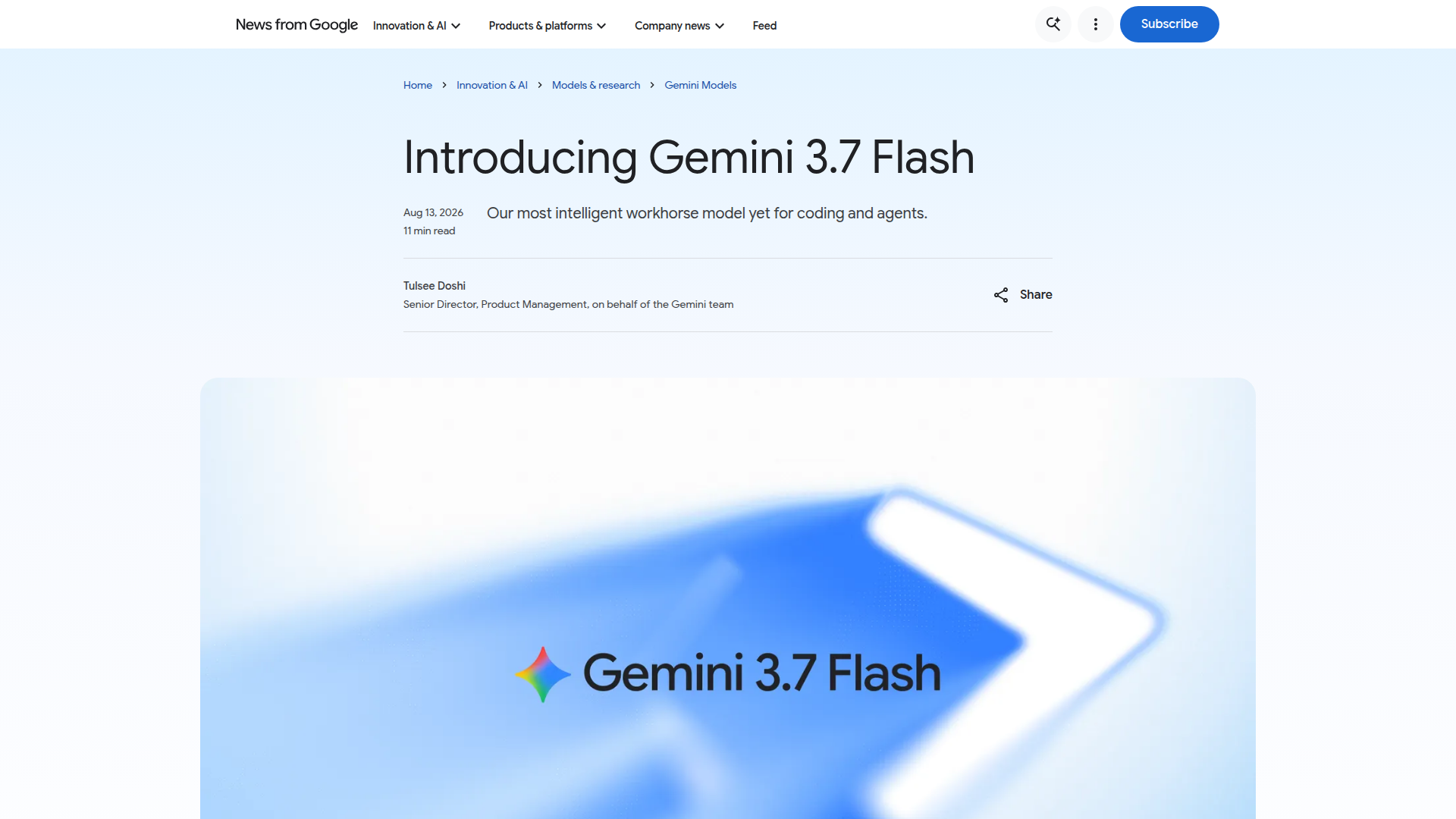
Google shipped Gemini 3.7 Flash on August 13 — just 23 days after 3.6 Flash, which was widely seen as a flop. The pricing tells you everything about Google’s mood: $0.75 per million input tokens and $3.75 output, exactly half of what 3.6 Flash cost. This is Google DeepMind sprinting to stay relevant in an agent market where DeepSeek V4 Flash charges $0.14/$0.28 and developers have started routing around Gemini entirely.
I’ve been testing it for two days. The improvements over 3.6 are real — particularly in software engineering tasks and tool-use reliability. But “real improvements” and “worth switching from DeepSeek V4 Flash” are two different conversations.
TL;DR
- Gemini 3.7 Flash: $0.75 input / $3.75 output per 1M tokens (introductory through Dec 31, 2026). Full price from Jan 2027: $1.50/$7.50.
- 50% cheaper than 3.6 Flash at launch — Google’s response to losing ground.
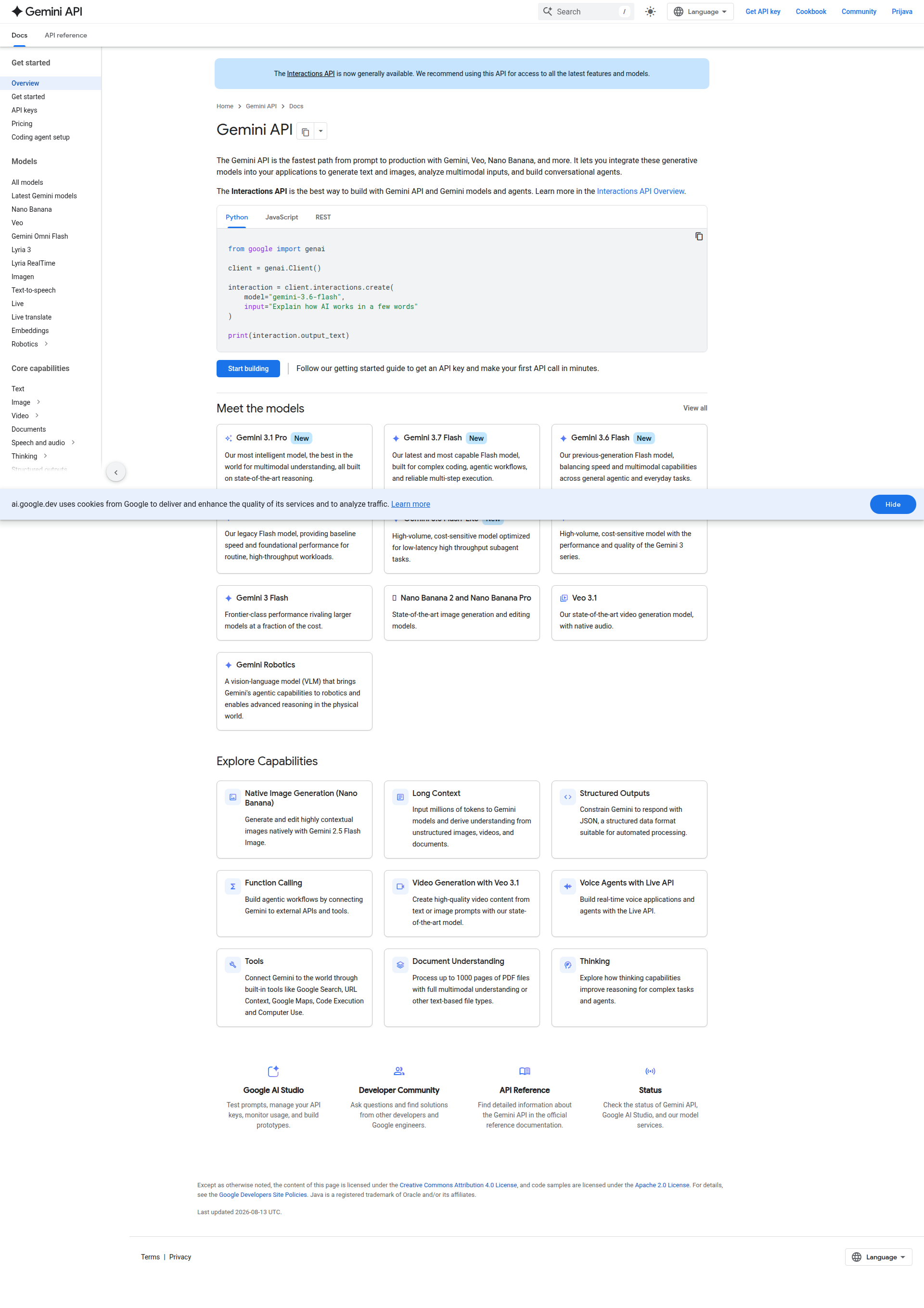
- 1M token context window, multimodal (text, image, video, audio, PDF), tunable thinking levels.
- Strong tool use and agentic capabilities. Improvements in software engineering, knowledge work, web dev.
- Available via Gemini API, AI Studio, and Antigravity.
- Still 5x more expensive than DeepSeek V4 Flash on input, 13x on output.
Why 23 Days Between Releases
Let’s be honest about the context. Gemini 3.6 Flash launched July 21 and immediately drew unfavorable comparisons to DeepSeek V4 Flash, which beat it on most agent benchmarks at a fraction of the price. Community reception was lukewarm. Developers who’d already integrated DeepSeek V4 Flash at $0.14/$0.28 saw no reason to pay 10x for comparable or weaker performance.
Google’s response was fast: ship 3.7 Flash with halved prices and meaningful quality improvements, especially in the coding and tool-use categories that matter most for agents. Twenty-three days between major releases is unusual for Google — it tells you how much pressure they’re feeling.
Model Specifications
| Spec | Value |
|---|---|
| Release Date | August 13, 2026 |
| Introductory Input Price | $0.75 / 1M tokens |
| Introductory Output Price | $3.75 / 1M tokens |
| Full Price (Jan 2027+) | $1.50 input / $7.50 output per 1M tokens |
| Context Window | 1,000,000 tokens |
| Modalities | Text, Image, Video, Audio, PDF |
| Thinking | Tunable levels (off, low, medium, high) |
| Tool Use | Native function calling, parallel tools |
| Availability | Gemini API, AI Studio, Antigravity |
| License | Proprietary (API access only) |
The tunable thinking is worth noting. You can dial it from off (fastest, cheapest) to high (slower, more deliberate) per request. For simple tool-use routing, turn it off. For multi-step planning or complex code generation, crank it up. This gives you cost control within a single model deployment.
Pricing Comparison: The Market in August 2026
Here’s where Gemini 3.7 Flash sits relative to what agents actually use:
| Model | Input ($/1M tokens) | Output ($/1M tokens) | Context | Notes |
|---|---|---|---|---|
| Gemini 3.7 Flash | $0.75 | $3.75 | 1M | Introductory pricing through Dec 2026 |
| Gemini 3.6 Flash | $1.50 | $7.50 | 1M | Now effectively deprecated |
| DeepSeek V4 Flash | $0.14 | $0.28 | 1M | MIT open-source, self-hostable |
| Claude Sonnet 4 | $3.00 | $15.00 | 200K | Strongest tool-use |
| GPT-5.5 | $2.50 | $10.00 | 256K | OpenAI’s mid-tier |
| Gemini 3.7 Flash (full price, Jan 2027) | $1.50 | $7.50 | 1M | Same as 3.6 Flash was |
The uncomfortable truth for Google: even at half price, Gemini 3.7 Flash is 5.4x more expensive on input and 13.4x on output compared to DeepSeek V4 Flash. The introductory pricing is Google buying time — once it resets to $1.50/$7.50 in January, it’s just 3.6 Flash pricing all over again.
Where 3.7 Flash does win on value: against Claude Sonnet 4 and GPT-5.5. It’s 4x cheaper than Sonnet 4 on input and 4x on output. For teams that need more capability than DeepSeek V4 Flash but can’t justify Sonnet 4 pricing, 3.7 Flash occupies a legitimate middle ground.
What’s Actually Better for Agents
Google’s announcement emphasizes three improvement areas: software engineering, knowledge work, and web development. Here’s what that looks like in practice:
Tool Use and Function Calling
3.7 Flash handles complex multi-tool schemas more reliably than 3.6. It’s less likely to hallucinate tool parameters or call tools in the wrong order during multi-step plans. For agent frameworks that rely on structured tool-calling, this is the improvement that matters most.
Coding Tasks
The model writes more complete code on first pass, handles larger file contexts better, and produces fewer partial implementations that need follow-up turns. This directly reduces the number of iterations in a coding agent loop, which reduces cost and latency.
Tunable Thinking for Cost Optimization
The thinking levels let you match compute to task complexity. Example pattern for agents:
from openai import OpenAI

client = OpenAI(
    base_url="https://generativelanguage.googleapis.com/v1beta/openai/",
    api_key="YOUR_GEMINI_API_KEY"
)

# Simple routing decision — thinking off for speed
route_resp = client.chat.completions.create(
    model="gemini-3.7-flash",
    messages=[{"role": "user", "content": "Which tool handles file uploads?"}],
    extra_body={"thinking": {"level": "off"}}
)

# Complex code generation — thinking high for quality
code_resp = client.chat.completions.create(
    model="gemini-3.7-flash",
    messages=[{"role": "user", "content": "Refactor this module to use dependency injection..."}],
    extra_body={"thinking": {"level": "high"}}
)
This pattern lets you use one model across your agent while paying more compute only where quality demands it.
1M Context: Where It Matters
The 1M token context window is shared with DeepSeek V4 Flash, which means it’s no longer a differentiator — it’s table stakes for agent-class models. But multimodal input (images, video, audio, PDFs) within that context window is where Gemini still has an edge. If your agent needs to process screenshots, read PDFs, or analyze video frames as part of its workflow, 3.7 Flash handles this natively without pre-processing steps.
For coding agents working with large repositories, the same advice applies as with DeepSeek V4’s 1M context: the window is headroom, not an invitation to stuff everything in every turn.
Who Should Use Gemini 3.7 Flash
I see three clear use cases:
-
Multimodal agent workflows. If your agent processes images, PDFs, or video alongside text, 3.7 Flash’s native multimodal support with 1M context is the cleanest option.
-
Teams locked into Google Cloud. If you’re already on Vertex AI or need to stay in the Google ecosystem for compliance, 3.7 Flash is the best agent model available there.
-
Middle-tier pricing tolerance. If DeepSeek V4 Flash doesn’t meet your quality bar but Sonnet 4 is too expensive, 3.7 Flash fills the gap.
Who probably shouldn’t switch: anyone already happy with DeepSeek V4 Flash’s quality-to-cost ratio, or anyone who needs the strongest possible tool-use reliability (that’s still Claude Sonnet 4).
The Bigger Picture: Google’s Pricing Strategy
The introductory pricing through December 2026 is explicitly a land-grab. Google is betting that once developers build on 3.7 Flash at $0.75/$3.75, switching costs will keep them when prices double in January. It’s the same playbook cloud providers use for compute discounts.
The question is whether developers will build pricing assumptions around the introductory rate or plan for the $1.50/$7.50 reality. If you’re designing an agent system today, model your costs at the full price. Treat the discount as bonus margin, not baseline economics.
FAQ
Is the introductory pricing permanent?
No. Google has explicitly stated $0.75/$3.75 per million tokens runs through December 31, 2026. Starting January 1, 2027, the price doubles to $1.50/$7.50. Plan accordingly.
How does Gemini 3.7 Flash compare to DeepSeek V4 Flash for coding agents?
DeepSeek V4 Flash is significantly cheaper ($0.14/$0.28 vs $0.75/$3.75) and has strong coding benchmarks (82.7 Terminal-Bench). Gemini 3.7 Flash offers better multimodal support and tunable thinking. If your agent is text-only coding, DeepSeek wins on cost. If you need vision or PDF processing mid-workflow, Gemini has the edge.
Can I use Gemini 3.7 Flash through SandBase?
Yes. SandBase routes to Gemini 3.7 Flash via the standard OpenAI-compatible endpoint. Use google/gemini-3.7-flash as the model identifier.
What does “tunable thinking” mean in practice?
Each API request can specify a thinking level: off, low, medium, or high. Higher levels produce better quality on complex tasks but cost more tokens and take longer. For agent routing decisions, use “off.” For code generation or multi-step planning, use “high.”
Should I switch from Claude Sonnet 4 to Gemini 3.7 Flash?
Only if cost is the primary driver. Claude Sonnet 4 still has the strongest tool-use reliability and code quality among frontier models. Gemini 3.7 Flash is 4x cheaper but won’t match Sonnet 4’s precision on complex agent workflows. Test both on your specific tasks before committing.
Bottom Line
Gemini 3.7 Flash is Google’s acknowledgment that the agent model market has moved faster than they expected. The halved pricing and 23-day turnaround from 3.6 Flash tell the competitive story. The model itself is genuinely good — better tool use, better coding, tunable thinking — but it lands in a market where DeepSeek V4 Flash offers 80% of the quality at 15% of the cost.
If you need multimodal capabilities in your agent loop, or you’re committed to the Google ecosystem, 3.7 Flash is the right pick. For everyone else, the value proposition depends heavily on whether the quality gap justifies the 5-13x price premium over DeepSeek. At introductory pricing, it’s worth testing. At full price in January, the math gets harder.