Claude Opus 5 Pricing (2026): API Cost, 1M Context & Limits
Claude Opus 5 pricing and review for 2026: 1M context, $5/M input, $25/M output, API limits, adaptive thinking, effort controls, and Opus vs Sonnet trade-offs.
Claude Opus 5 is not the $15/$75 model described in the original version of this article. Anthropic launched it on July 24, 2026 at $5 per million input tokens and $25 per million output tokens. It has a 1M-token context window, supports up to 128K output tokens on the synchronous Messages API, and adds adaptive thinking plus configurable effort.
Those corrections change the buying decision. Opus 5 is still a premium model, but it is no longer sensible to describe it as a five-times-more-expensive specialist that should almost never be used. Anthropic itself positions it for complex agentic coding and enterprise work; Sonnet 5 remains the faster, cheaper choice when that ceiling is unnecessary.
TL;DR
- Choose Opus 5 for difficult coding, long-running agents, and professional work where verification and judgment justify the premium.
- Choose Sonnet 5 when speed and cost matter more: its listed price is $2/M input and $10/M output.
- A 1M context limit is capacity, not permission to send an unfiltered repository or document archive.
- Set
effortexplicitly and evaluate quality, tokens, latency, and task completion on your own workload.- The Claude API model ID is
claude-opus-5; SandBase documentsanthropic/claude-opus-5on its Anthropic-compatible Messages endpoint.
Claude Opus 5 specifications
| Spec | Current value |
|---|---|
| Release date | July 24, 2026 |
| Claude API ID | claude-opus-5 |
| Input price | $5 per million tokens |
| Output price | $25 per million tokens |
| Context window | 1M tokens |
| Maximum synchronous output | 128K tokens |
| Input / output modalities | Text and image input; text output |
| Thinking control | Adaptive thinking and configurable effort |
| Comparative latency | Moderate in Anthropic’s current model table |
| Fast mode | About 2.5× default speed at 2× base price, according to Anthropic |
Pricing, availability, and platform-specific features can change. This table was checked against Anthropic’s Opus 5 announcement and current models overview on August 23, 2026.
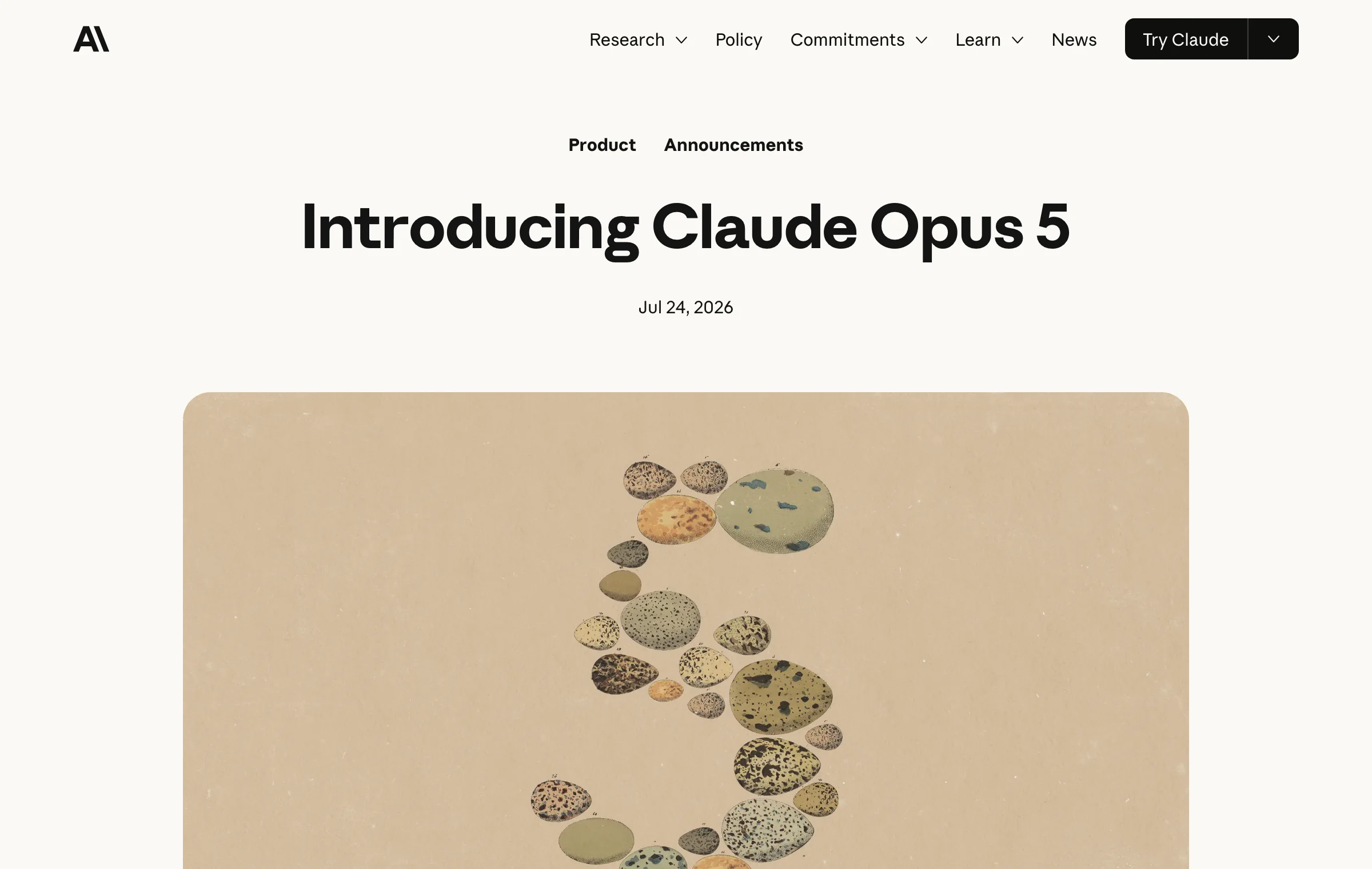 Anthropic’s official launch page, captured August 23, 2026. The launch date is July 24, 2026.
What actually changed from Opus 4.8
Anthropic describes Opus 5 as a performance improvement at the same base token price as Opus 4.8. The release focuses on software engineering, agentic work, knowledge work, scientific tasks, and stronger self-verification. It also introduces a more explicit cost-versus-capability control through effort settings.
The useful architectural change is not simply “more intelligence.” It is the combination of:
- adaptive thinking, which lets the model vary reasoning behavior;
- effort settings, which let an application trade tokens and time for capability;
- 1M context, which raises the ceiling for large working sets;
- 128K output, which supports larger artifacts than the 4K–8K limit claimed in the old article;
- Fast mode, when lower latency matters enough to pay the higher rate.
These are controls to test, not guarantees. Anthropic’s published benchmarks and customer reports are evidence about its release evaluation; they do not prove that Opus 5 will outperform another model on your repository, policy corpus, or Agent harness.
Opus 5 vs Sonnet 5
Anthropic’s current table gives both models 1M context and 128K maximum synchronous output. The distinction is capability, price, and speed—not the context window alone.
| Decision factor | Claude Opus 5 | Claude Sonnet 5 |
|---|---|---|
| Positioning | Complex agentic coding and enterprise work | Speed/intelligence balance |
| Input / output price | $5 / $25 per MTok | $2 / $10 per MTok |
| Comparative latency | Moderate | Fast |
| Context / max output | 1M / 128K | 1M / 128K |
| Best starting point | Hard, valuable tasks with meaningful judgment | High-volume coding, tools, and general production work |
At list price, Opus 5 is 2.5× Sonnet 5 for both input and output—not 5×. That ratio is still material. A routing decision should therefore use task value and measured completion quality, not a vague “hard prompt” label.
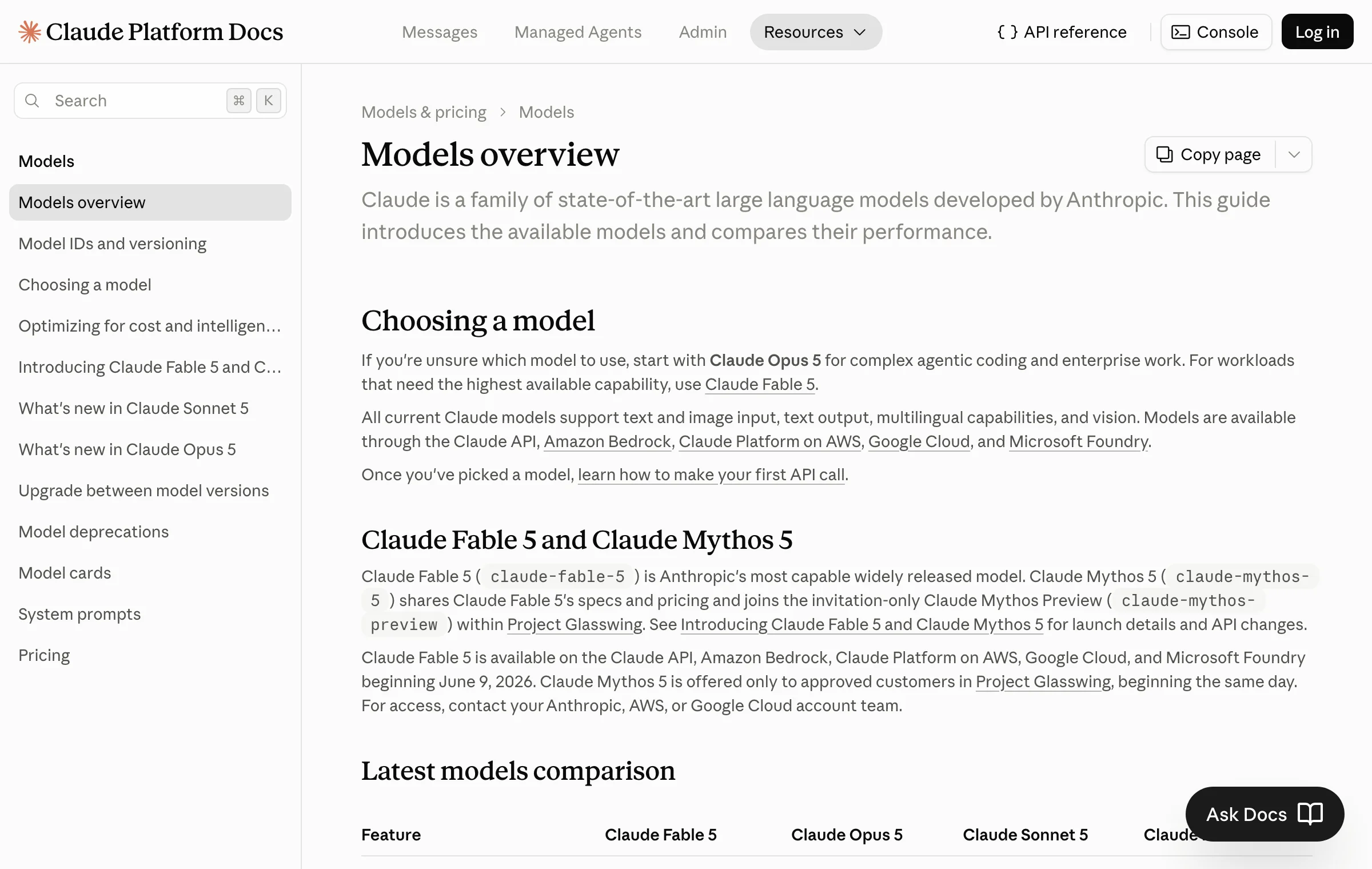 Claude Platform models overview, captured August 23, 2026. The live table is the source of truth for model IDs, pricing, context, output limits, and comparative latency.
When Opus 5 is a sensible default
“Always route to a cheaper model first” is not universally economical. A failed software change or incomplete professional workflow can cost more than the token difference. Start with Opus 5 when all three conditions hold:
- The task is valuable enough to pay for better completion odds. Examples include a difficult code migration, root-cause analysis, or a multi-step work product that will be reviewed by an expert.
- The model must sustain a long chain of work. It needs to plan, use tools, inspect results, revise, and verify—not merely answer one question.
- Your evaluation shows an advantage. The same harness, tools, prompts, and acceptance tests should demonstrate a meaningful improvement over Sonnet 5 or another candidate.
This is different from claiming that Opus 5 will ingest a whole codebase and understand every dependency “in one pass.” Context capacity does not guarantee recall, relevance selection, or correct cross-file reasoning. Repository maps, retrieval, staged verification, and tests still matter.
When Sonnet 5 or another model fits better
Choose the lower-cost route when the task is frequent, latency-sensitive, mechanically verifiable, or already meets its acceptance threshold on a cheaper model. Common examples include:
- classification and routing;
- schema-bound extraction;
- small, localized code edits with good tests;
- short summaries;
- high-volume tool calls;
- interactive experiences where response time dominates.
Do not assume that every planning call belongs on Opus and every execution call belongs on Sonnet. Planning can be easy; execution can contain the hard judgment. Route based on measured failure modes.
What 1M context does—and does not—solve
A 1M window reduces forced chunking for large repositories, document sets, traces, and conversation state. It does not remove four production constraints:
- irrelevant input still consumes money and attention;
- long prompts can make failures harder to diagnose;
- access control must be applied before data enters a prompt;
- output must still be checked against the source material and task acceptance criteria.
For long-context work, record which files or passages were supplied, preserve citations or evidence pointers, and test retrieval quality at different prompt lengths. The right target is the smallest complete working set, not the largest possible request.
Cost examples with current list prices
The arithmetic is straightforward, but these examples are not estimates of task quality or total project cost.
| Request | Input cost | Output cost | Total |
|---|---|---|---|
| 100K input + 5K output | $0.50 | $0.125 | $0.625 |
| 500K input + 10K output | $2.50 | $0.25 | $2.75 |
| 1M input + 20K output | $5.00 | $0.50 | $5.50 |
Prompt caching can reduce eligible repeated input costs by up to 90%, and Batch processing can reduce eligible costs by 50%, according to Anthropic. Eligibility, write/read rates, cache lifetime, and Batch latency matter; consult current pricing documentation before modeling production spend.
Calling Claude Opus 5 through SandBase
SandBase currently documents Claude Opus 5 at POST /v1/messages with model ID anthropic/claude-opus-5. Use the schema and examples on the live model page rather than assuming the OpenAI Chat Completions shape exposes every Anthropic-native feature.
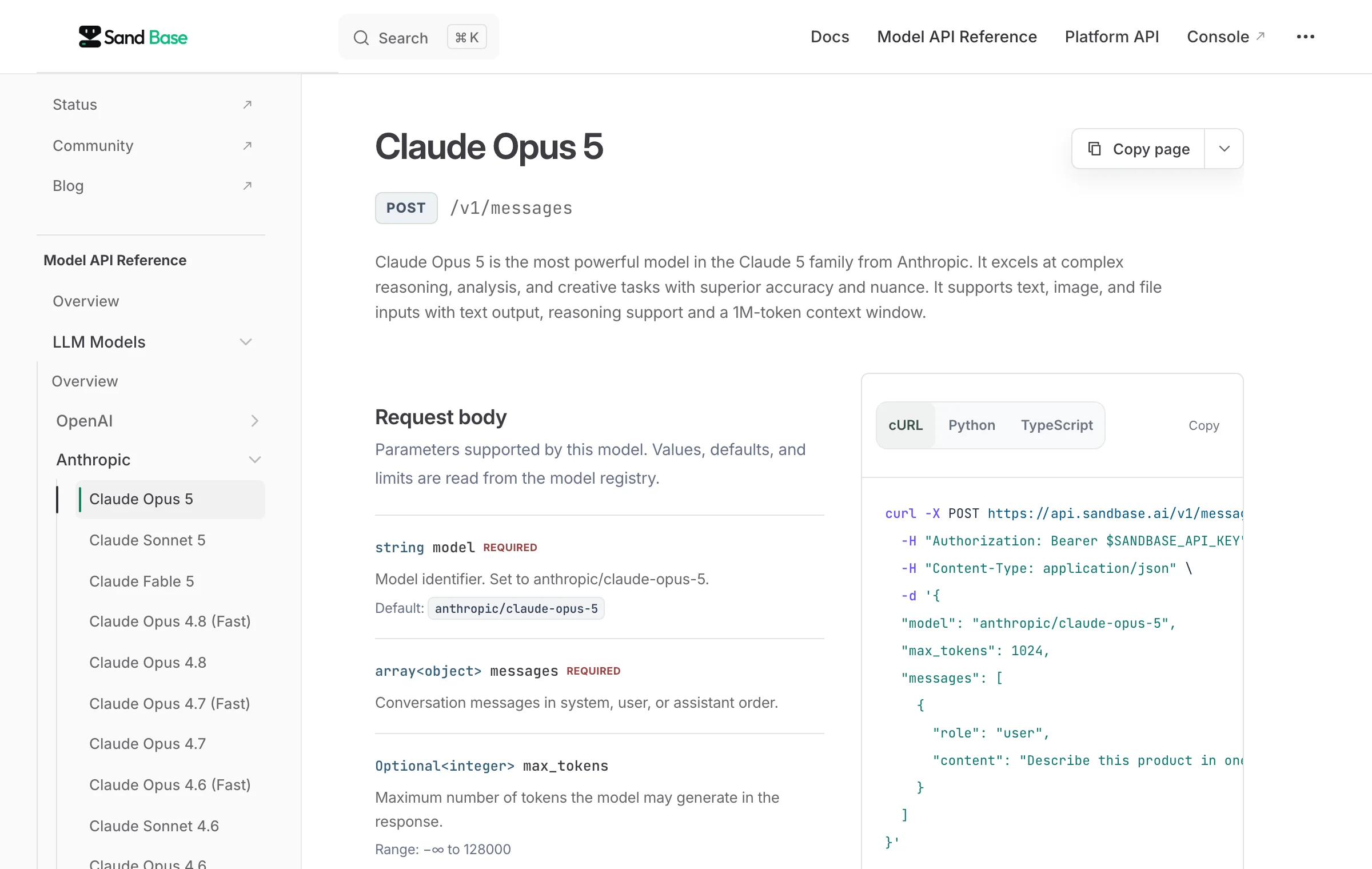 SandBase model reference, captured August 23, 2026. It shows the current endpoint, model identifier, request fields, and 128K output limit.
curl -X POST https://api.sandbase.ai/v1/messages \
  -H "Authorization: Bearer $SANDBASE_API_KEY" \
  -H "Content-Type: application/json" \
  -d '{
    "model": "anthropic/claude-opus-5",
    "max_tokens": 2048,
    "messages": [
      {"role": "user", "content": "Review this migration plan and identify the highest-risk assumption."}
    ]
  }'
Verify current availability and fields in the SandBase Claude Opus 5 reference. SandBase provides an integration surface; Anthropic remains the model provider.
A production evaluation plan
Before changing a default route:
- Select 30–100 real tasks with expert-reviewed acceptance criteria.
- Hold the harness, tools, context, retries, and stopping conditions constant.
- Test at least Sonnet 5 and Opus 5 with explicit effort settings.
- Measure task completion, reviewer corrections, tool failures, tokens, latency, and total cost.
- Separate model failures from retrieval, tool, permission, and harness failures.
- Route only the task classes where Opus 5’s measured gain exceeds its cost and latency premium.
- Repeat after model, prompt, tool, or harness changes.
This produces a defensible routing policy. A generic percentage threshold or an invented “hardest 20%” rule does not.
FAQ
How much does Claude Opus 5 cost?
Anthropic lists $5 per million input tokens and $25 per million output tokens at publication time. Fast mode is listed at twice the base price, and US-only inference at 1.1×. Check the current pricing page before purchase.
Does Claude Opus 5 have a 1M context window?
Yes. Anthropic’s current models table lists 1M context and 128K maximum synchronous output. The Batch API can support a different maximum under a documented beta header.
Is Opus 5 Anthropic’s most capable model?
No. Anthropic’s current overview describes Claude Fable 5 as its most capable widely released model. Opus 5 is positioned for complex agentic coding and enterprise work at a lower price.
Should every Agent use Opus 5?
No. Use workload-specific evaluations. Sonnet 5 is faster and costs 40% of Opus 5’s input and output rates; simpler or latency-sensitive tasks may not benefit from the premium.