Best AI Image Generation APIs in 2026
Ranked evaluation of the best AI image generation APIs in 2026 — Seedream 5.0, Qwen-Image-3, Nano Banana, DALL-E 3, and Midjourney. Rated by quality, speed, cost, editing, and agent integration.
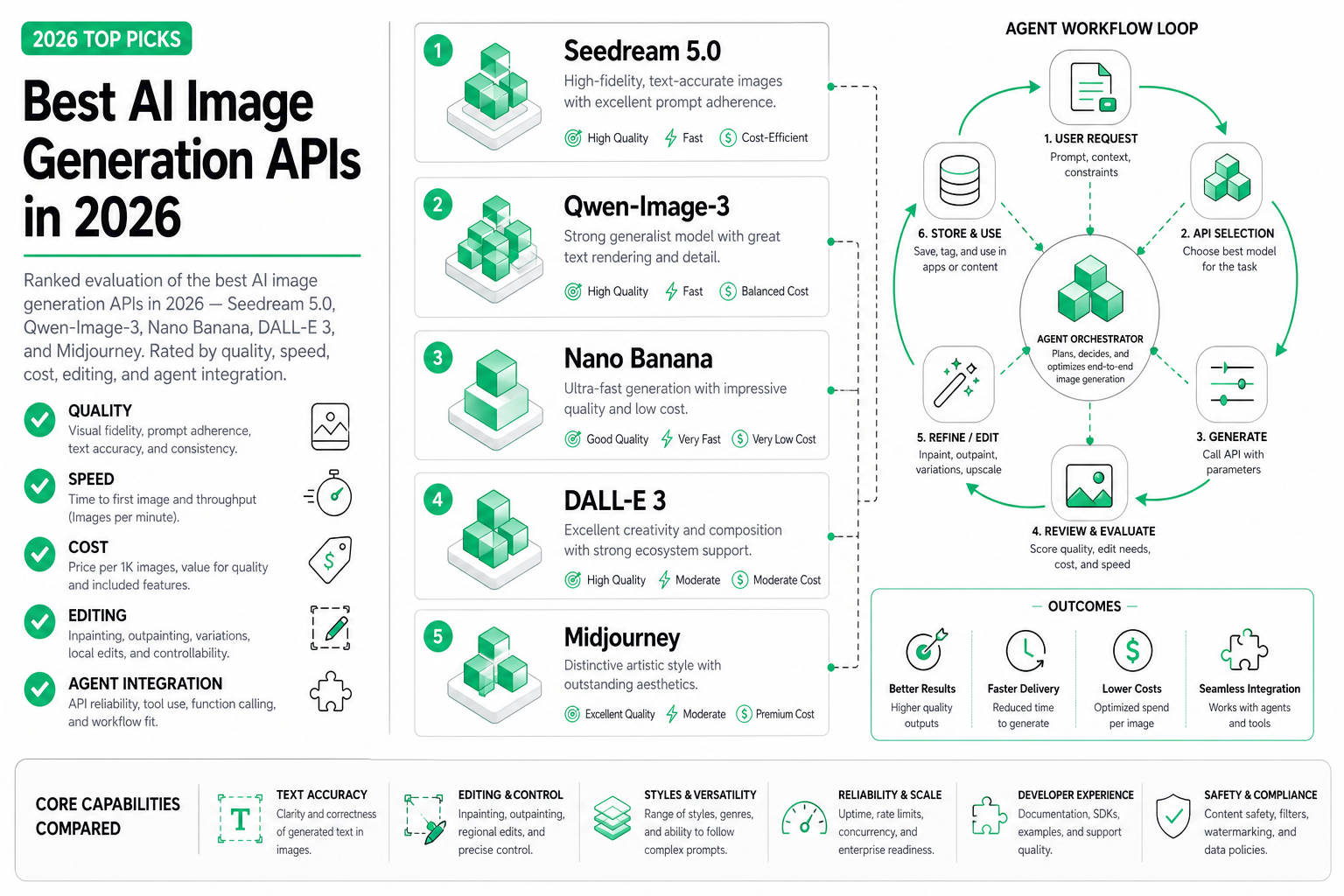
TL;DR — The best image generation APIs in 2026 depend on your priorities. For agent-integrated workflows: Seedream 5.0 Pro (quality), Qwen-Image-3 (editing + multilingual), Nano Banana (speed + cost). For standalone quality: DALL-E 3 and Midjourney remain strong but lack the ecosystem integration that agent platforms provide.
The 2026 image generation landscape
Image generation has matured from a novelty into production infrastructure. Agents generate thousands of images daily for e-commerce, marketing, content creation, and product design. The API you choose determines your quality floor, cost ceiling, and operational flexibility.
This guide evaluates the top image generation APIs available in 2026, with special attention to agent platform integration — because raw quality means nothing if your agent can’t call the API reliably at scale.
For a detailed head-to-head of the three SandBase models, see our Seedream vs Qwen-Image-3 vs Nano Banana comparison. For video generation APIs, see our best video generation APIs guide.
Ranking methodology
We evaluate each API across five dimensions:
- Quality (40% weight) — photorealism, detail, composition, prompt adherence
- Speed (20% weight) — generation latency, throughput capacity
- Cost (20% weight) — per-image pricing, volume discounts
- Edit capability (10% weight) — built-in editing, edit quality
- Agent integration (10% weight) — API reliability, unified access, monitoring, error handling
The rankings
#1: Seedream 5.0 Pro — Best overall quality
| Dimension | Score | Notes |
|---|---|---|
| Quality | 9.5/10 | Industry-leading photorealism |
| Speed | 6.0/10 | 8–12s per image (slow for volume) |
| Cost | 6.5/10 | ~$0.04/image (mid-range) |
| Edit capability | 8.0/10 | Full edit support |
| Agent integration | 9.5/10 | Native SandBase, OpenAI-compatible |
| Weighted score | 8.2/10 |
Best for: Final marketing assets, print materials, brand imagery, hero images where quality is paramount.
Model ID: bytedance/seedream/5.0/pro
Seedream Pro consistently produces the sharpest, most photorealistic images in our testing. The 8–12 second latency is acceptable for single-image generation but becomes a bottleneck for batch operations. The Fast variant (bytedance/seedream/5.0/pro/fast) addresses this — same API, 2–4s latency, 90–95% quality.
#2: Qwen-Image-3 — Best generation + editing combo
| Dimension | Score | Notes |
|---|---|---|
| Quality | 8.5/10 | Strong across styles |
| Speed | 7.0/10 | 5–9s generation, 4–7s edit |
| Cost | 7.0/10 | ~$0.03/image |
| Edit capability | 9.0/10 | Best-in-class unified editing |
| Agent integration | 9.5/10 | Native SandBase, OpenAI-compatible |
| Weighted score | 8.2/10 |
Best for: Edit-heavy workflows, multilingual teams, CJK content, product variant generation.
Model ID: alibaba/qwen-image-3
Qwen-Image-3 ties with Seedream Pro on weighted score but for different reasons. Its unified generation + editing architecture means you don’t need a separate editing service. Multilingual prompt support is genuinely superior — not just “it works in Chinese” but “it understands Chinese cultural context in prompts.”
#3: Nano Banana 2 Lite — Best speed/cost ratio
| Dimension | Score | Notes |
|---|---|---|
| Quality | 7.7/10 | Good, not great |
| Speed | 9.5/10 | 1–3s per image |
| Cost | 9.5/10 | ~$0.01/image |
| Edit capability | 7.0/10 | Basic editing supported |
| Agent integration | 9.5/10 | Native SandBase, OpenAI-compatible |
| Weighted score | 8.1/10 |
Best for: Agent pipelines at scale, rapid prototyping, A/B testing, budget-constrained projects.
Model ID: google/nano-banana-2-lite
Google’s Nano Banana 2 Lite delivers the best economics for volume operations. At $0.01 per image and 1–3 second latency, it’s 4× cheaper and 4× faster than Seedream Pro. Quality is lower, but sufficient for social media, thumbnails, and exploration phases.
#4: DALL-E 3 (OpenAI) — Best prompt understanding
| Dimension | Score | Notes |
|---|---|---|
| Quality | 9.0/10 | Excellent, especially for creative |
| Speed | 6.5/10 | 5–10s typical |
| Cost | 5.5/10 | $0.04–0.08/image depending on size |
| Edit capability | 6.0/10 | Limited native editing |
| Agent integration | 7.0/10 | Direct API, no unified platform |
| Weighted score | 7.5/10 |
Best for: Creative content, complex conceptual imagery, when prompt interpretation is critical.
DALL-E 3 remains excellent at understanding nuanced prompts and producing creative, unexpected compositions. However, it’s not available through unified agent platforms like SandBase, meaning you manage a separate API key, billing system, rate limiting, and error handling. For agent pipelines that already use SandBase for other services, this adds operational overhead.
#5: Midjourney API — Best artistic quality
| Dimension | Score | Notes |
|---|---|---|
| Quality | 9.5/10 | Unmatched artistic aesthetic |
| Speed | 5.5/10 | 10–30s typical |
| Cost | 5.0/10 | Subscription-based, ~$0.05+ effective |
| Edit capability | 7.0/10 | Variations, upscale, remix |
| Agent integration | 5.0/10 | No standard REST API, Discord-based |
| Weighted score | 7.3/10 |
Best for: Artistic/aesthetic content, when human curation is part of the workflow.
Midjourney produces arguably the most aesthetically pleasing images in the market. The catch: its API access is limited and not designed for agent automation. Discord-based interaction, subscription pricing, and lack of standard REST endpoints make it challenging to integrate into automated pipelines.
#6: Nano Banana Lite — Maximum throughput
| Dimension | Score | Notes |
|---|---|---|
| Quality | 7.2/10 | Baseline acceptable |
| Speed | 9.5/10 | 1–3s per image |
| Cost | 10.0/10 | ~$0.008/image (cheapest) |
| Edit capability | 6.5/10 | Basic editing |
| Agent integration | 9.5/10 | Native SandBase |
| Weighted score | 7.9/10 |
Best for: Exploration phases, thumbnail generation, when you need 1000+ images at minimum cost.
Model ID: google/nano-banana-lite
#7: Seedream 5.0 Pro/Fast — Best quality at speed
| Dimension | Score | Notes |
|---|---|---|
| Quality | 8.2/10 | 90-95% of Pro |
| Speed | 9.0/10 | 2–4s per image |
| Cost | 8.5/10 | ~$0.015/image |
| Edit capability | 7.5/10 | Full edit, reduced quality |
| Agent integration | 9.5/10 | Native SandBase |
| Weighted score | 8.3/10 |
Best for: High-quality volume generation, social media, iteration workflows.
Model ID: bytedance/seedream/5.0/pro/fast
Comparison table
| API | Quality | Speed | Cost/img | Edit | Agent-ready | Best for |
|---|---|---|---|---|---|---|
| Seedream Pro | 9.5 | 8–12s | $0.04 | ✓ | ✓ | Final assets |
| Seedream Fast | 8.2 | 2–4s | $0.015 | ✓ | ✓ | Quality + speed |
| Qwen-Image-3 | 8.5 | 5–9s | $0.03 | ✓✓ | ✓ | Edit workflows |
| NB 2 Lite | 7.7 | 1–3s | $0.01 | ○ | ✓ | Scale pipelines |
| NB Lite | 7.2 | 1–3s | $0.008 | ○ | ✓ | Minimum cost |
| DALL-E 3 | 9.0 | 5–10s | $0.04-0.08 | △ | △ | Creative prompts |
| Midjourney | 9.5 | 10–30s | ~$0.05 | ○ | ✗ | Art direction |
✓✓ = excellent, ✓ = good, ○ = basic, △ = limited, ✗ = poor/none
Agent platform integration: why it matters
For production agents, API quality is table stakes. What matters equally:
- Unified billing — One invoice, one dashboard, one spend control point
- Consistent error handling — Same retry logic, same timeout patterns across models
- Model switching — Change one string (model ID) to switch between providers
- Rate limit management — Platform-level throttling, no per-provider configuration
- Usage analytics — Track cost per workflow, per agent, per model from one place
SandBase provides all five for Seedream, Qwen-Image-3, and Nano Banana. DALL-E and Midjourney require separate integrations, adding operational complexity that scales linearly with the number of models you use.
Code comparison: unified vs fragmented
# Unified (SandBase) — switch models by changing one string
from openai import OpenAI
client = OpenAI(base_url="https://api.sandbase.ai/v1", api_key="one-key")

# These all use the same client, same error handling, same billing
img1 = client.images.generate(model="bytedance/seedream/5.0/pro", prompt=p, n=1)
img2 = client.images.generate(model="alibaba/qwen-image-3", prompt=p, n=1)
img3 = client.images.generate(model="google/nano-banana-2-lite", prompt=p, n=1)
# Fragmented — separate clients, keys, error patterns
from openai import OpenAI
import requests
# OpenAI for DALL-E
openai_client = OpenAI(api_key="openai-key")
dalle_img = openai_client.images.generate(model="dall-e-3", prompt=p, n=1)
# Midjourney — completely different paradigm
mj_response = requests.post("https://api.midjourney.com/...",
headers={"Authorization": "Bearer mj-key"},
json={"prompt": p}) # Different API contract entirelyDecision framework
For agent builders
| Priority | Recommended | Why |
|---|---|---|
| Maximum automation | SandBase models (any) | Unified API, reliable, scalable |
| Best quality per dollar | Seedream Fast | 8.2 quality at $0.015 |
| Highest absolute quality | Seedream Pro | 9.5 quality |
| Edit-heavy workflows | Qwen-Image-3 | 9.0 edit quality |
| Thousands of images/day | Nano Banana 2 Lite | $0.01, 1–3s latency |
| Creative/artistic | DALL-E 3 + manual curation | Best prompt creativity |
For teams evaluating APIs
Ask yourself:
- How many images per day/month? → High volume favors Nano Banana or Seedream Fast
- Are edits part of the workflow? → Yes favors Qwen-Image-3
- Is this for final customer-facing output? → Yes favors Seedream Pro
- Do I already use an agent platform? → Yes favors SandBase-native models
- Budget per 1,000 images? → Under $15 requires Fast or Nano Banana
Related Reading
- Unified AI API for LLM, Image & Video (2026)
- Best AI Image Editing APIs for Agents (2026)
- Seedream vs Qwen-Image-3 vs Nano Banana (2026)
- Seedream 5.0 Pro: ByteDance’s Image Generator
- Qwen-Image-3: Generation + Edit in One Model
- Batch Image Generation Pipeline for Agents
- Seedream Fast vs Pro: Quality-Cost Tradeoff
Conclusion
The “best” image generation API depends entirely on your constraints. For agent-scale operations where you need reliability, unified billing, and the ability to mix models strategically, the SandBase ecosystem (Seedream + Qwen-Image-3 + Nano Banana) provides the most complete solution. For standalone creative projects where a human curates every output, DALL-E 3 and Midjourney remain excellent choices.
The market is heading toward multi-model strategies where different APIs serve different stages of the same pipeline. Platforms that make model-switching trivial will capture the most value.