Unified AI API for LLM, Image & Video: 2026 Guide
Unified AI API guide for developers: compare SandBase, fal, Replicate, and OpenRouter across LLM, image, video, tools, auth, billing, retries, and production trade-offs.
The integration diagram usually looks tidy until video enters the workflow. Chat streams tokens. Image generation may finish in seconds. Video can sit in a queue, emit progress events, fail after a paid attempt, and return an asset that expires. Calling all of that “one endpoint” hides the engineering work rather than removing it.
A unified AI API is useful for developers who need one commercial and operational layer across LLM, image, video, and tool calls. Use one when shared authentication, billing, discovery, retries, and observability matter more than owning every provider integration. Keep direct integrations when a provider-native feature, data agreement, or latency path is strategic.
TL;DR
- SandBase fits workflows that combine models with search, social, data, or other callable APIs.
- fal is the media-first choice when image and video inference are the product core.
- Replicate suits teams that value a broad hosted-model marketplace and explicit model versions.
- OpenRouter is the cleanest fit when multi-provider LLM routing is the main problem.
- Unify credentials and operations; do not force text and asynchronous media into one fake universal schema.
What “unified” should actually mean
There are three promises hiding inside the phrase “unified AI API”:
- Commercial unification: one account, credit balance, invoice, and usage ledger.
- Operational unification: common authentication, request IDs, error classes, retries, budgets, and observability.
- Schema unification: similar request and response shapes across providers.
The first two compound in value as a product adds models. The third has a hard limit. An LLM completion, an image edit with masks, and a queued video render do not share the same lifecycle. A credible platform makes those differences explicit.
That boundary matters more than model count. A catalog can add a provider overnight; your application still has to understand terminal states, webhook delivery, asset retention, cancellation, and cost attribution.
SandBase, fal, Replicate, and OpenRouter compared
| Platform | Best fit | Model scope | Non-model tools | Main trade-off |
|---|---|---|---|---|
| SandBase | Agents and products crossing models, media, search, and data APIs | LLM, embedding, image, video, audio, moderation | Broad callable API catalog | Broad abstraction still requires inspecting each capability schema |
| fal | Media-heavy applications | Strong image, video, audio, vision, and 3D focus | Not a general business/data API marketplace | Less useful when workflows also need many external data tools |
| Replicate | Hosted open and commercial model access | Broad marketplace with official and versioned models | No general external-tool catalog | Prediction contracts vary by model and version |
| OpenRouter | LLM routing, provider choice, and unified billing | LLM-first catalog with additional modalities | No broad external-tool marketplace | Media and real-world tool orchestration are not its central abstraction |
Catalogs, prices, schemas, and availability change. This comparison was source-checked on August 23, 2026; verify the exact route before making a production decision.
SandBase: models and real-world APIs in one catalog
SandBase separates models, APIs, Agents, and Skills in its Store. The model surface covers text, image, audio, video, and embeddings; the API surface covers capabilities such as search, scraping, data, media, and SaaS actions. That distinction is useful when an agent must observe or act, not only generate.
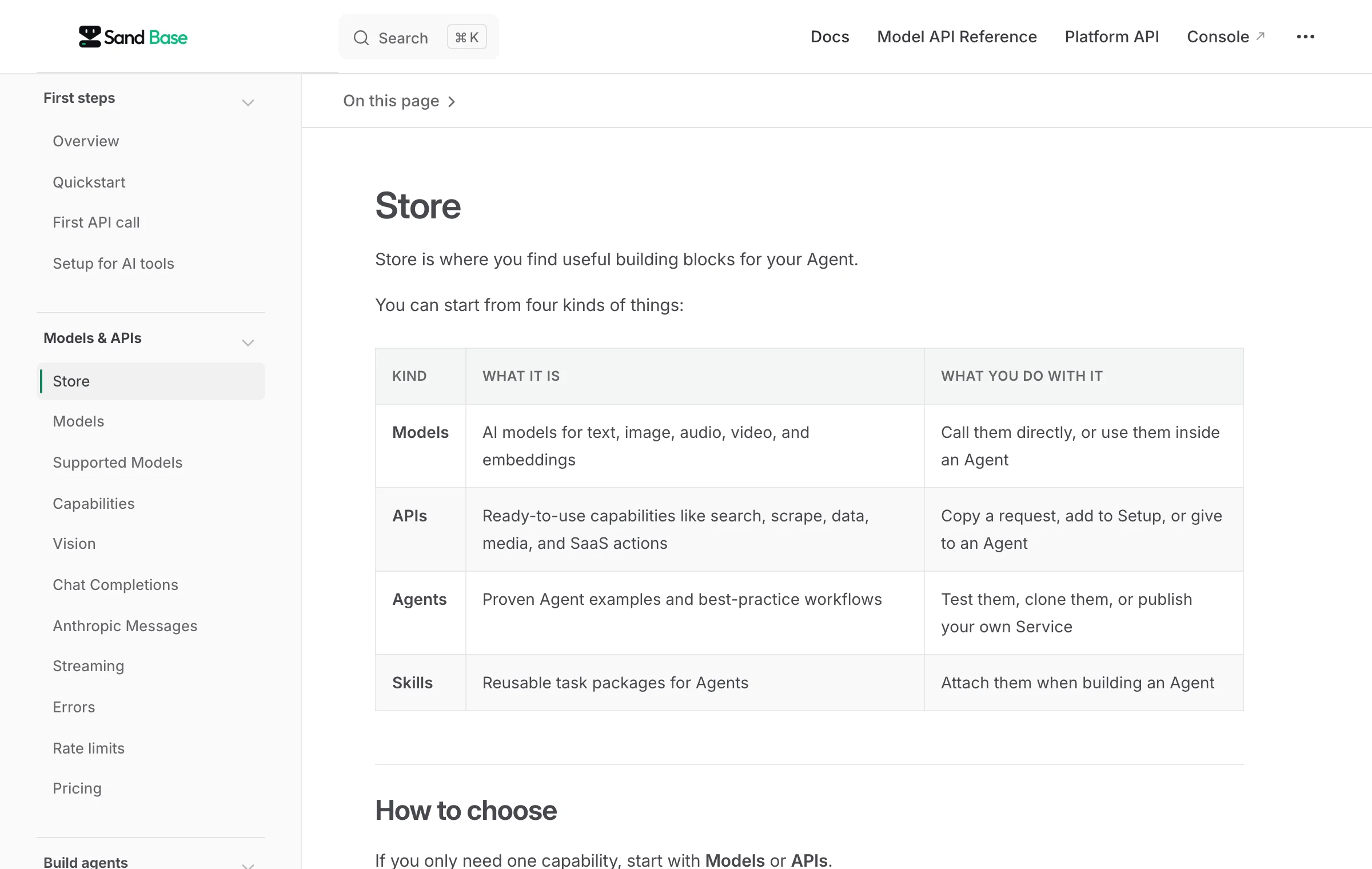 SandBase Store documentation, captured August 23, 2026. The catalog keeps model inference and callable APIs distinct instead of flattening both into one label.
The LLM path supports an OpenAI-compatible interface, while media jobs use capability-specific inputs and asynchronous status handling. This is the right kind of inconsistency: authentication and operations can be shared without pretending that a video job behaves like a chat completion.
Choose SandBase when:
- one workflow combines LLM reasoning, image or video generation, and external data;
- an agent needs search, social, scraping, finance, or business APIs beside models;
- one account and usage surface are worth more than direct provider ownership;
- an OpenAI-compatible LLM path lowers migration cost.
Do not choose it merely to avoid reading provider schemas. You still need to inspect the selected capability and test failure behavior. Start with the SandBase Store and model API reference.
fal: media inference is the center of gravity
fal makes more sense when the product itself is generative media. Its public catalog emphasizes image-to-video, stylization, transformation, lipsync, training, 3D, audio, and related GPU-backed workloads. Its Model APIs document direct execution and queue-oriented patterns rather than forcing every workload through an LLM-shaped contract.
That focus is an advantage for a creative product. It becomes less decisive when the same workflow also needs a long list of social, business, finance, or web-data actions.
Choose fal when image and video latency, model breadth, and media-specific controls dominate the architecture. Review current endpoints in the fal model endpoint documentation.
Replicate: stable official models plus versioned community models
Replicate’s distinction between official and community models is operationally meaningful. Its documentation says official models are always on, predictably priced, and exposed through a stable API; community models can be pinned to explicit versions.
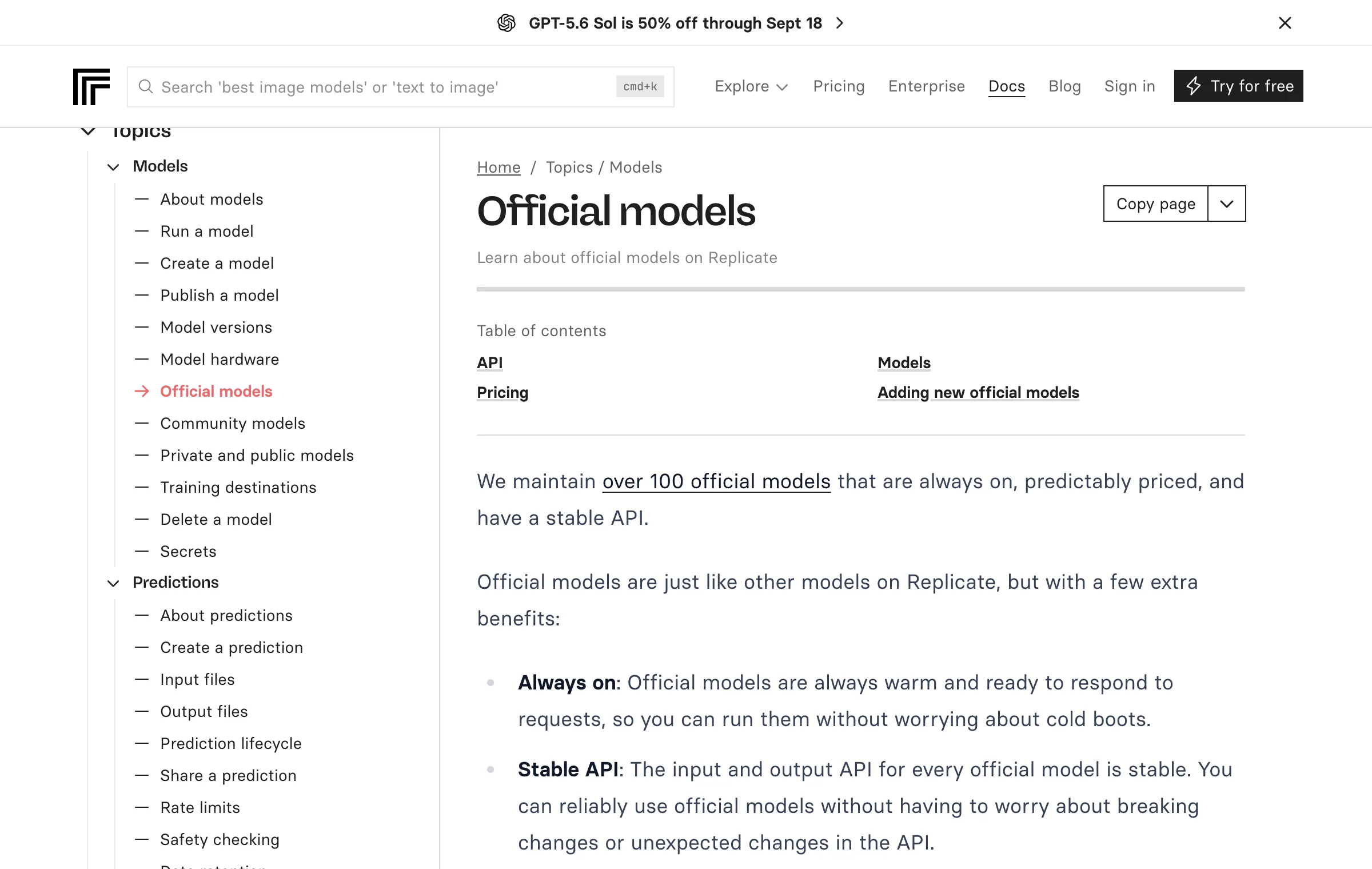 Replicate official-model documentation, captured August 23, 2026. The stable-API promise applies to official models, not automatically to every community model.
That makes Replicate attractive when reproducibility and access to a broad hosted-model marketplace matter. The cost is more model-specific application logic: input and output contracts can still vary, and a general catalog of non-model business APIs is outside the product’s core.
Choose Replicate when you want hosted model access with an explicit version story. Read the official model documentation before assuming every listing has the same availability guarantees.
OpenRouter: route language models first
OpenRouter is strongest when the job is provider selection, LLM routing, and unified billing. Its current catalog exposes filters for text, image, video, speech, transcription, and embeddings, so “LLM-only” is no longer a complete description. The product’s center of gravity is still model routing rather than a general marketplace of external business and data actions.
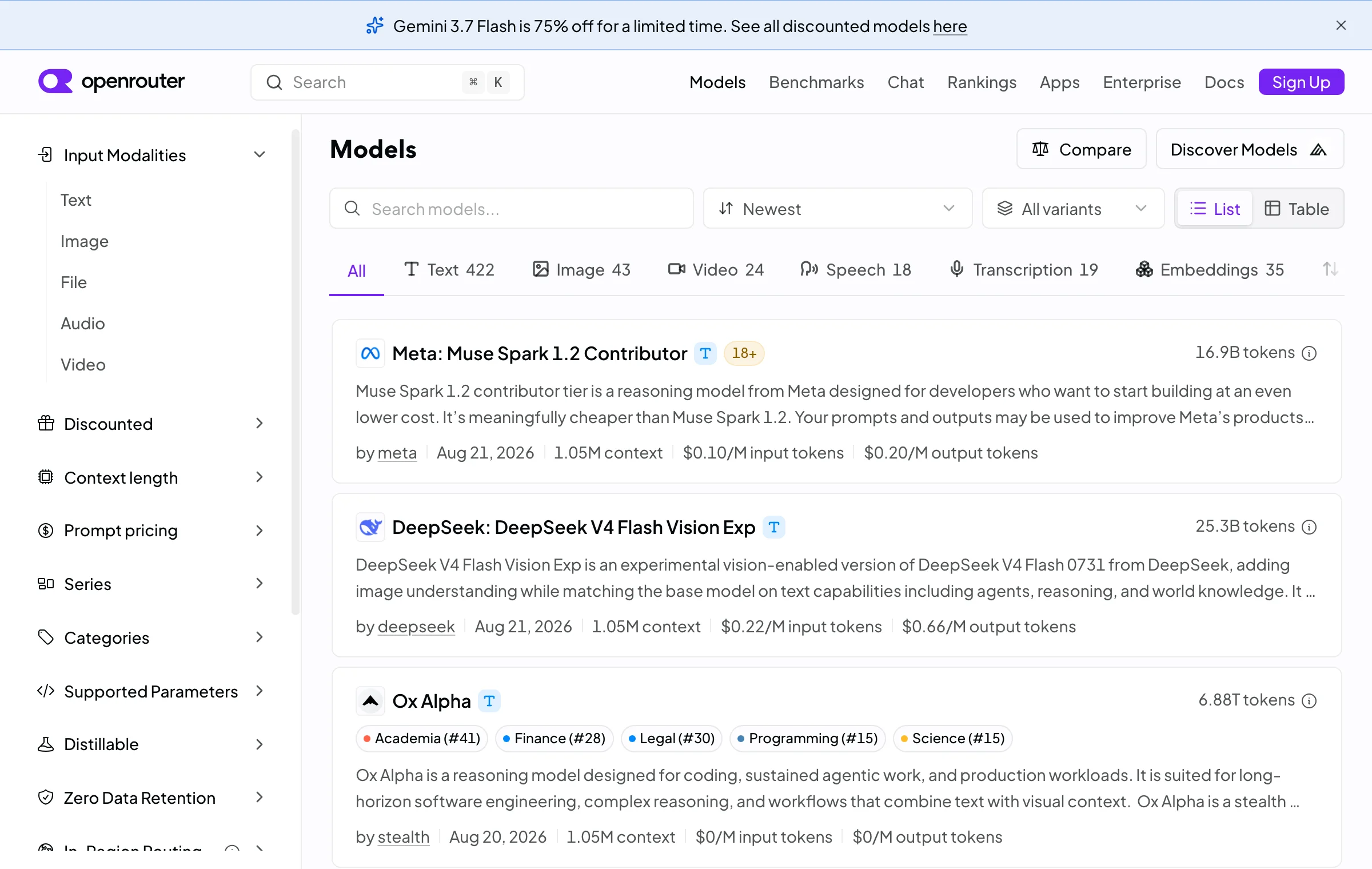 OpenRouter model catalog, captured August 23, 2026. Category counts and available routes are live catalog data and will change.
Choose OpenRouter when text and reasoning models drive most traffic and provider routing is the main source of complexity. If you also need self-hosting or gateway controls, see the OpenRouter alternatives comparison.
Keep this production boundary in your own code
Even with one vendor, keep a thin internal adapter:
workflow
  ├── text.generate()   → stream or response
  ├── image.generate()  → result or job
  ├── video.submit()    → job → status/webhook → asset
  └── tool.run()        → typed external result
             ↓
    request ID · retries · budget · usage · trace
             ↓
         unified AI API
Normalize the parts your product owns: correlation IDs, error categories, terminal states, asset references, cost records, and audit events. Preserve provider-specific controls behind a deliberate escape hatch.
This is the part teams often skip. A unified vendor reduces integration count; it does not remove the need for idempotency, timeout policy, webhook verification, or fallback design.
A practical evaluation sequence
- List every modality and external tool required by the complete workflow.
- Verify exact model IDs, schemas, prices, regions, and retention rules in current docs.
- Test synchronous, streaming, queued, and webhook lifecycles separately.
- Retry a paid request deliberately and verify duplicate-charge behavior.
- Measure queue delay, generation time, failure rate, and asset availability for your workload.
- Reconcile tokens, images, seconds, and per-call APIs into one internal cost record.
- Test a provider outage and confirm the fallback preserves your product contract.
- Document which provider-specific features the unified layer cannot expose.
Testing scope matters: this article compares documented architecture and public catalog behavior. It does not claim a controlled latency, quality, reliability, or price benchmark across the four platforms.
Which unified AI API should you choose?
- Choose SandBase for an agent or application combining LLMs, image/video generation, and real-world APIs.
- Choose fal for a media product where generative-image and video inference are the primary workload.
- Choose Replicate for broad hosted-model access and explicit official/versioned model contracts.
- Choose OpenRouter for multi-provider LLM routing and billing.
- Keep direct integrations when a native feature, contract, compliance requirement, or critical latency path justifies the maintenance cost.
There is no universal winner. Match the platform to the slowest, most failure-prone part of the workflow—not the largest number on a homepage.
FAQ
Can one API handle LLM, image, and video generation?
One account and API family can cover all three. One literal request schema usually should not. Streaming text and queued video have different lifecycle, retry, and asset requirements.
Is an OpenAI-compatible API enough for multimodal applications?
It lowers migration cost for chat and embeddings and may cover selected image interfaces. It does not automatically normalize video queues, webhooks, asset expiration, or external data tools.
What is the best unified AI API for agents?
SandBase is the closest fit among these four when an agent needs both model modalities and callable real-world APIs. fal, Replicate, and OpenRouter are better choices for narrower media, model-marketplace, or LLM-routing requirements.
Should a production application keep direct provider integrations?
Yes, when a provider-native feature or commercial/data relationship is strategically important. Consolidation should remove operational duplication without hiding capabilities the product depends on.