Seedream vs Qwen-Image-3 vs Nano Banana (2026)
Head-to-head comparison of Seedream 5.0 Pro, Qwen-Image-3, and Nano Banana on SandBase — quality, speed, cost, editing, and prompt following across real use cases.
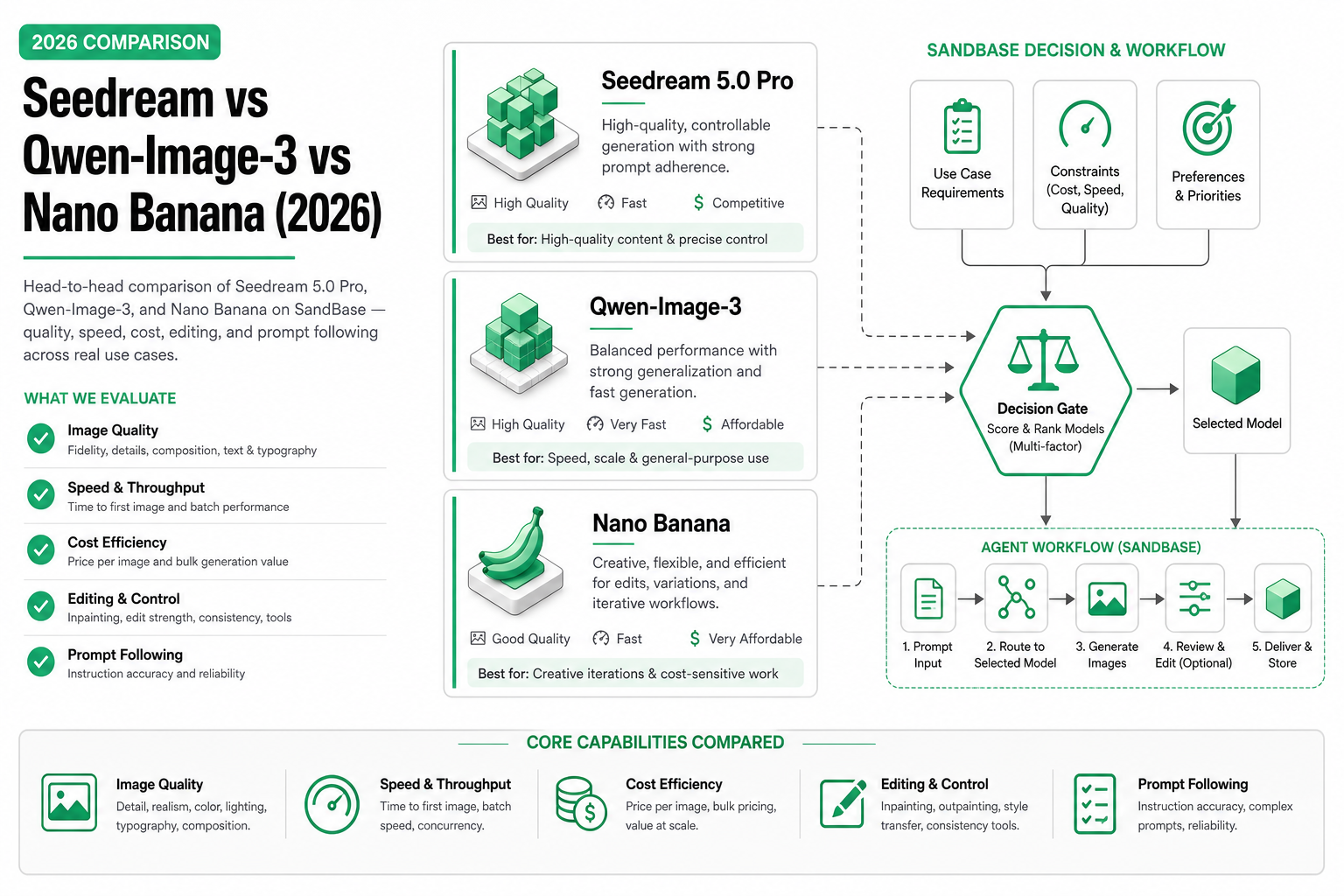
TL;DR — Three image generation families are available on SandBase: Seedream 5.0 Pro/Fast (ByteDance), Qwen-Image-3 (Alibaba), and Nano Banana Lite/2-Lite (Google). Each excels in different dimensions. Seedream Pro wins on raw quality, Qwen-Image-3 dominates editing workflows, and Nano Banana delivers the best speed-to-cost ratio. This guide helps you pick the right model for each task.
The three contenders
SandBase offers five image model variants across three families. Here’s the landscape:
| Model | Vendor | Model ID | Primary strength |
|---|---|---|---|
| Seedream 5.0 Pro | ByteDance | bytedance/seedream/5.0/pro | Maximum quality |
| Seedream 5.0 Pro/Fast | ByteDance | bytedance/seedream/5.0/pro/fast | Speed with high quality |
| Qwen-Image-3 | Alibaba | alibaba/qwen-image-3 | Unified generation + editing |
| Nano Banana Lite | google/nano-banana-lite | Fast, cost-effective | |
| Nano Banana 2 Lite | google/nano-banana-2-lite | Next-gen speed, improved quality |
For detailed breakdowns of individual models, see our Seedream 5.0 Pro deep dive and Qwen-Image-3 guide.
Head-to-head comparison
Generation quality
We evaluated each model across five common generation categories using consistent prompts:
| Category | Seedream Pro | Seedream Fast | Qwen-Image-3 | Nano Banana Lite | Nano Banana 2 Lite |
|---|---|---|---|---|---|
| Photorealism | 9.5 | 8.2 | 8.5 | 7.5 | 8.0 |
| Artistic/illustration | 9.0 | 8.0 | 8.5 | 8.0 | 8.5 |
| Product photography | 9.5 | 8.5 | 8.5 | 7.0 | 7.5 |
| Text rendering | 8.0 | 7.0 | 8.5 | 6.5 | 7.0 |
| Complex scenes (3+ subjects) | 9.0 | 7.5 | 8.5 | 7.0 | 7.5 |
| Average | 9.0 | 7.8 | 8.5 | 7.2 | 7.7 |
Winner: Seedream Pro for raw image quality. Qwen-Image-3 is a close second with more consistent results across categories.
Speed
Latency matters differently depending on your use case. For agent pipelines processing hundreds of images, every second compounds.
| Model | Generation latency | Edit latency | Images/minute (sequential) |
|---|---|---|---|
| Seedream Pro | 8–12s | 6–10s | 5–7 |
| Seedream Fast | 2–4s | 2–3s | 15–30 |
| Qwen-Image-3 | 5–9s | 4–7s | 7–12 |
| Nano Banana Lite | 1–3s | 1–2s | 20–60 |
| Nano Banana 2 Lite | 1–3s | 1–2s | 20–60 |
Winner: Nano Banana variants for raw speed. Seedream Fast is the fastest among the high-quality models.
Cost efficiency
Estimated per-image cost at different volumes:
| Model | Per image | 100 images | 1,000 images | Cost rating |
|---|---|---|---|---|
| Seedream Pro | ~$0.04 | $4.00 | $40.00 | $$$ |
| Seedream Fast | ~$0.015 | $1.50 | $15.00 | $$ |
| Qwen-Image-3 | ~$0.03 | $3.00 | $30.00 | $$ |
| Nano Banana Lite | ~$0.008 | $0.80 | $8.00 | $ |
| Nano Banana 2 Lite | ~$0.01 | $1.00 | $10.00 | $ |
Winner: Nano Banana Lite for cost. At 1,000 images, the difference between Nano Banana ($8) and Seedream Pro ($40) is 5×.
Editing capabilities
All five variants support prompt-based editing, but quality varies significantly:
| Edit type | Seedream Pro | Seedream Fast | Qwen-Image-3 | Nano Banana Lite | Nano Banana 2 Lite |
|---|---|---|---|---|---|
| Background replacement | 8.5 | 7.5 | 9.0 | 7.0 | 7.5 |
| Element swap | 7.5 | 6.5 | 8.5 | 6.5 | 7.0 |
| Style transfer | 8.0 | 7.0 | 8.0 | 7.5 | 8.0 |
| Inpainting | 8.0 | 7.0 | 8.5 | 6.5 | 7.0 |
| Text modification | 7.0 | 6.0 | 7.5 | 5.5 | 6.0 |
| Average edit quality | 7.8 | 6.8 | 8.3 | 6.6 | 7.1 |
Winner: Qwen-Image-3 for editing. Its unified architecture gives it a clear edge in all edit categories.
Prompt following
How accurately each model interprets complex prompts:
| Prompt complexity | Seedream Pro | Seedream Fast | Qwen-Image-3 | Nano Banana Lite | Nano Banana 2 Lite |
|---|---|---|---|---|---|
| Simple (1 subject) | 9.5 | 9.0 | 9.5 | 9.0 | 9.0 |
| Medium (2-3 subjects + style) | 9.0 | 8.0 | 9.0 | 7.5 | 8.0 |
| Complex (4+ elements + layout) | 8.5 | 7.0 | 8.5 | 6.5 | 7.0 |
| CJK text in image | 7.5 | 6.5 | 9.0 | 5.0 | 5.5 |
| Multilingual prompt | 8.0 | 7.5 | 9.5 | 7.0 | 7.0 |
Winner: Qwen-Image-3 for prompt following, especially multilingual and CJK scenarios.
Decision table: when to use each model
| Scenario | Best choice | Why |
|---|---|---|
| Final marketing hero image | Seedream Pro | Highest photorealistic quality |
| Social media content (volume) | Seedream Fast | Good quality at 3× speed vs Pro |
| E-commerce product variants | Qwen-Image-3 | Best editing + multilingual |
| Rapid prototyping / mood boards | Nano Banana 2 Lite | Fastest + cheapest |
| Agent pipeline (500+ images) | Nano Banana Lite | Lowest cost at scale |
| Chinese/Japanese text in image | Qwen-Image-3 | Strongest CJK rendering |
| Background replacement | Qwen-Image-3 | 9.0 edit quality |
| A/B testing visuals | Seedream Fast | Fast enough for 20+ variants |
| Print-quality output | Seedream Pro | Maximum detail + sharpness |
| Budget-constrained project | Nano Banana Lite | $8 per 1,000 images |
Workflow: combining models strategically
The smartest approach isn’t choosing one model — it’s using different models at different pipeline stages:
from openai import OpenAI

client = OpenAI(
    base_url="https://api.sandbase.ai/v1",
    api_key="your-sandbase-api-key"
)

class ImagePipeline:
    """Multi-model image pipeline optimized for quality and cost."""

    # Model selection by pipeline stage
    MODELS = {
        "explore": "google/nano-banana-2-lite",      # Fast, cheap exploration
        "iterate": "bytedance/seedream/5.0/pro/fast", # Quality iteration
        "final": "bytedance/seedream/5.0/pro",        # Maximum quality output
        "edit": "alibaba/qwen-image-3",               # Best editing
    }

    def explore(self, prompts: list[str], n_per_prompt: int = 2):
        """Phase 1: Generate many cheap candidates to find direction."""
        results = []
        for prompt in prompts:
            response = client.images.generate(
                model=self.MODELS["explore"],
                prompt=prompt,
                n=n_per_prompt,
                size="1024x1024"
            )
            results.extend([(prompt, img.url) for img in response.data])
        return results  # Review these to pick best directions

    def iterate(self, selected_prompts: list[str], n_per_prompt: int = 4):
        """Phase 2: Generate higher-quality variants of winning concepts."""
        results = []
        for prompt in selected_prompts:
            response = client.images.generate(
                model=self.MODELS["iterate"],
                prompt=prompt,
                n=n_per_prompt,
                size="1024x1024"
            )
            results.extend([(prompt, img.url) for img in response.data])
        return results

    def finalize(self, final_prompt: str):
        """Phase 3: Generate the final high-quality output."""
        response = client.images.generate(
            model=self.MODELS["final"],
            prompt=final_prompt,
            n=1,
            size="1024x1024"
        )
        return response.data[0].url

    def edit(self, image_data: str, instruction: str):
        """Phase 4: Apply edits using the best editing model."""
        response = client.post("/v1/run", body={
            "model": self.MODELS["edit"],
            "operation": "edit",
            "input": {"image": image_data, "prompt": instruction}
        })
        return response.json()["output"]["image"]
Cost comparison: single model vs multi-model pipeline
For a campaign producing 10 final images from 200 exploration candidates:
| Approach | Cost | Time | Final quality |
|---|---|---|---|
| All Seedream Pro | $8.00 (200 images) | ~33 min | 9.5/10 |
| All Nano Banana | $1.60 (200 images) | ~5 min | 7.5/10 |
| Multi-model pipeline | $3.20 | ~12 min | 9.5/10 |
The multi-model pipeline: 150 explorations with Nano Banana ($1.20) → 40 iterations with Seedream Fast ($0.60) → 10 finals with Seedream Pro ($0.40) → edits with Qwen-Image-3 ($1.00). Same final quality as all-Pro, 60% cheaper, 64% faster.
Nano Banana: the speed specialist
Google’s Nano Banana models deserve specific attention. They’re not trying to compete on absolute quality — they’re optimized for:
- Agent-scale generation — when you need 500+ images and can’t wait hours
- Iteration speed — test prompt variations in under 2 seconds each
- Cost-sensitive pipelines — when image quality needs to be “good enough” not “perfect”
- Real-time applications — chatbots that generate images on-the-fly during conversation
Nano Banana Lite vs 2 Lite
| Aspect | Nano Banana Lite | Nano Banana 2 Lite |
|---|---|---|
| Generation | First-gen, optimized for speed | Next-gen, better quality at same speed |
| Quality gap vs Pro | ~25% below Seedream Pro | ~20% below Seedream Pro |
| Edit capability | Basic edits | Improved edit consistency |
| Best for | Maximum throughput | Balanced speed + quality |
| Recommended for new projects | — | ✓ |
For new projects, default to Nano Banana 2 Lite. It’s marginally more expensive but meaningfully better in output quality. Use Nano Banana Lite only when you’re optimizing for the absolute lowest cost per image.
Feature matrix
| Feature | Seedream Pro | Seedream Fast | Qwen-Image-3 | NB Lite | NB 2 Lite |
|---|---|---|---|---|---|
| Text-to-image | ✓ | ✓ | ✓ | ✓ | ✓ |
| Image editing | ✓ | ✓ | ✓ | ✓ | ✓ |
| Batch generation | 4/req | 4/req | 4/req | 4/req | 4/req |
| 2048×2048 | ✓ | ✓ | ✓ | ✓ | ✓ |
| Multiple aspect ratios | ✓ | ✓ | ✓ | ✓ | ✓ |
| CJK text rendering | ○ | ○ | ✓ | ✗ | ✗ |
| Multilingual prompts | ○ | ○ | ✓ | ○ | ○ |
| OpenAI-compatible API | ✓ | ✓ | ✓ | ✓ | ✓ |
✓ = strong, ○ = adequate, ✗ = weak
Making your decision
Choose Seedream Pro if: Quality is non-negotiable. You’re producing final assets for campaigns, print, or high-visibility placements. Budget is secondary to output quality.
Choose Seedream Fast if: You need Seedream-level quality direction but with faster iteration. Social media, A/B testing, concept exploration where “very good” beats “perfect but slow.”
Choose Qwen-Image-3 if: Editing is central to your workflow. You work in multiple languages. You need CJK text in images. You want one model for both generation and editing.
Choose Nano Banana 2 Lite if: Volume and speed matter most. Agent pipelines processing hundreds of images. Budget-constrained. Quality needs to be good, not great.
Choose Nano Banana Lite if: Absolute minimum cost per image. Maximum throughput for screening/exploration phases where quality is secondary.
Related Reading
- Seedream 5.0 Pro: ByteDance’s Image Generator
- Qwen-Image-3: Generation + Edit in One Model
- Seedream Fast vs Pro: Quality-Cost Tradeoff
- Best AI Image Generation APIs in 2026
- Best AI Image Editing APIs for Agents (2026)
- Batch Image Generation Pipeline for Agents
Conclusion
There’s no single “best” image model — there’s the best model for your specific use case, and often the best approach uses multiple models together. SandBase’s unified API makes model-switching trivial: same API key, same SDK, same error handling. Change one string (the model ID) and you’ve switched between ByteDance, Alibaba, and Google’s image generation in your pipeline.
The competitive landscape keeps improving quality while driving down costs. The real winner is the developer who uses each model’s strengths strategically rather than defaulting to one for everything.